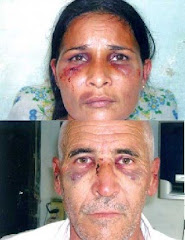
Rep. Mario Diaz-Balart, Obama administration demand release of Cuban
prisoner
Vladimir Morera Bacallao hospitalized after 81-day hunger strike
State Department, GOP Miami lawmaker express concern over dissident
Dispute over political prisoner is hiccup in recent improved U.S.-Cuban ties
BY JAMES ROSEN
McClatchy Washington Bureau
WASHINGTON
In a rare alliance of often-conflicting viewpoints on U.S.-Cuban
relations, Rep. Mario Diaz-Balart joined the State Department on Tuesday
in calling for the immediate release of a Cuban political prisoner who
is in intensive care following an 81-day hunger strike.
Vladimir Morera Bacallao was one of 53 dissidents released from prison
in January under an accord the previous month between President Barack
Obama and Cuban leader Raúl Castro. But he was detained again in April
after displaying a sign suggesting that the national elections were a sham.
"The United States is deeply concerned about the deteriorating physical
condition of Vladimir Morera Bacallao, who has been on a hunger strike
since October to protest his imprisonment for peacefully expressing
political dissent," said Mark Toner, a State Department spokesman.
Toner, noting that Morera Bacallao has been hospitalized, reportedly in
very serious condition, added: "The United States urgently calls on the
Cuban government to release" the dissident.
The dispute was the most recent episode in a historic shift in relations
between Havana and Washington over the last year.
In a deal brokered by Pope Francis, the United States and Cuba in July
opened embassies in the two longtime adversaries' capitals, three months
after Obama and Castro became the first U.S. and Cuban leaders to meet
in more than a half century.
As part of the movement toward normalized relations, the Obama
administration has lightened restrictions on U.S. citizens' travel to
Cuba, although they must do so under a license from the U.S. Treasury
Department.
THE UNITED STATES URGENTLY CALLS ON THE CUBAN GOVERNMENT TO RELEASE MR.
MORERA BACALLAO.
State Department spokesman Mark Toner
Despite the administration's appeal for Morera Bacallao's release,
Diaz-Balart criticized both Obama and Castro for the dissident's
treatment by the Cuban government.
"Morera Bacallao has risked everything for the basic right to have a
voice in his government," the Miami Republican said. "His unjustifiable
imprisonment and mistreatment are further indictments of the brutal
malevolence of the Castro regime, and the utter failure of Obama's
appeasement of Cuba's dictators."
As part of a broader normalization of relations under a Dec. 17, 2014,
agreement, the Cuban government released the last of 53 political
prisoners last Jan. 11 from a list compiled by the United States.
"We know there are going to be human rights concerns we still have when
it comes to Cuba, but we are very pleased that they followed through on
this commitment," Marie Harf, a State Department spokeswoman, said in
January after all 53 had been freed.
During municipal elections in April, Morera Bacallao erected a sign that
read: "I vote for my freedom and not in an election where I cannot
choose my president."
Two opposition members, Hildebrando Chaviano and Yuniel Lopez, were the
first dissidents in decades to run in any election. Both lost their bids
for local government seats.
Despite the changes, the U.S. economic embargo of Cuba remains in
effect. The U.S. Chamber of Commerce, saying the embargo costs the
American economy $1.2 billion a year, backs Obama's initiative to lift it.
All eight U.S.-Cuban members of Congress, among them four from Florida,
oppose normalized relations between the countries while Castro, the
brother of longtime leader Fidel Castro, remains in power.
Sens. Marco Rubio of Florida and Ted Cruz of Texas, both seeking the
Republican presidential nomination, are among the most ardent opponents
of improved ties.
In addition to Rubio and Diaz-Balart, Republican Reps. Ileana
Ros-Lehtinen of Miami and Carlos Curbelo of Kendall oppose normalized
relations.
A Miami Herald poll published a year ago showed a distinct split in
viewpoints between Cuban-Americans born in the United States and those
who emigrated from Cuba.
A total of 64 percent of those born in the United States supported
Obama's initiative to normalize relations, compared with just 38 percent
of those born in Cuba.
Source: Rep. Mario Diaz-Balart, Obama administration demand release of
Cuban prisoner | Miami Herald -
http://www.miamiherald.com/news/nation-world/world/americas/cuba/article52148245.html
Wednesday, December 30, 2015

Tuesday, December 29, 2015
Central American Agreement Will Transfer Cuban Migrants By Air In January
Central American Agreement Will Transfer Cuban Migrants By Air In
January / 14ymedio, Reinaldo Escobar
Posted on December 28, 2015
14ymedio, (With information from EFE), Mexico, 28 December 2015 — A
total of 250 Cuban migrants stranded in Costa Rica will benefit from a
pilot project agreed to this Monday in Guatemala, among the member
countries of the Cental American Integration System (SICA) along with
Mexico, according to the office of the Mexican Secretary of Foreign
Affairs, who spoke with this newspaper. The test will take place at the
beginning of January, the Foreign Ministry said, and if all goes well
Cuban migrants will continue to be evacuated via this route.
After hours of meeting, the Guatemalan Foreign Ministry made a brief
public statement, without offering more details, declaring, "It was
agreed to undertake a pilot project of humanitarian transfers in the
first week of January, and a working group has been formed that will be
responsible for the necessary coordination for the first transfer."
Minutes later, the Costa Rican Foreign Ministry added that the Cuban
migrants will leave by air from Costa Rica to El Salvador, from where
they will be taken by bus to Mexico.
Once in Mexico, the Cubans will be granted an exit permit already
allowed under that country's immigration laws. This exit permit,
according the Mexican National Institute of Migration, is valid for 20
days and is granted to citizens declared "stateless." In the case of
Cubans, this happens when the Cuban Consulate is advised by the Mexican
authorities of the entry of a citizen with a Cuban passport, and the
consulate remains silent or denies that the citizen is Cuban.
According to the Mexican Foreign Ministry, there are no plans to
accompany the Cubans arriving from Costa Rica to the US border.
Costa Rica has granted nearly 8,000 special transit visas to Cubans
since 14 November, but last week announced that it no longer has the
capacity to continue receiving the islanders, and so has ceased to issue
these documents in most cases.
The crisis was generated on 15 November when Nicaragua closed its border
to Cuban migrants, citing security risks to its sovereignty and
stranding thousands of Cubans who are now in Costa Rica and Panama
waiting to continue their journey through Central America.
Representatives of Guatemala, Belize, El Salvador, Honduras, Costa Rica,
Panama and Mexico, as well as the International Organization for
Migration (IOM), met Monday on the outskirts of the Guatemalan capital
to discuss this immigration crisis, which finally found a solution more
than a month after the Cubans began to be stranded in Costa Rica, which
led Costa Rica to leave the political discussions of the Central
American Integration System (SICA).
Costa Rican Foreign Minister Manuel Gonzalez described the results of
Monday's meeting as "positive" and said in the official statement
released in San José that he could not fully detail the technical and
logistical aspects of the transfer, out of respect for the discretion
requested by some countries.
"We hope that these agreements can materialize in the short term.
Unfortunately, this season of the year makes it impossible to move
faster," he said.
On 18 December Costa Rica suspended its participation in the political
affairs of SICA due to the lack of solidarity among countries in the
region to allow the passage of Cubans and solve the humanitarian crisis.
"It is satisfactory and a reason to thank those countries who showed
their good will," said the Costa Rican Foreign Minister Monday, after
the agreement reached in Guatemala, but he did not specify if the
government had decided to fully restore relations with SICA.
But this decision, celebrated by Costa Rica and all the participating
nations, should not be interpreted as "a precedent" in the region, but
an action to address "a temporary situation," said the Guatemalan
Foreign Ministry, which also said that it would convene the Regional
Conference on Migration (CRM) to address this issue in its entirety.
The participating countries also reaffirmed their commitment to combat
human trafficking networks, and said they would apply "without delay"
the law which severely penalizes this illegal activity, and that
"unfortunately obliges countries in the region to return to their
country of origin all persons entering their territory in an
unauthorized manner."
"This will be addressed to prevent irregular migration and to firmly
combat the crime of human trafficking, and primarily to protect the
integrity of migrants and ensure respect for their fundamental rights,"
said Guatemala, a country through which migrants transit and that every
year suffers migration firsthand.
Source: Central American Agreement Will Transfer Cuban Migrants By Air
In January / 14ymedio, Reinaldo Escobar | Translating Cuba -
http://translatingcuba.com/central-american-agreement-escobar/
January / 14ymedio, Reinaldo Escobar
Posted on December 28, 2015
14ymedio, (With information from EFE), Mexico, 28 December 2015 — A
total of 250 Cuban migrants stranded in Costa Rica will benefit from a
pilot project agreed to this Monday in Guatemala, among the member
countries of the Cental American Integration System (SICA) along with
Mexico, according to the office of the Mexican Secretary of Foreign
Affairs, who spoke with this newspaper. The test will take place at the
beginning of January, the Foreign Ministry said, and if all goes well
Cuban migrants will continue to be evacuated via this route.
After hours of meeting, the Guatemalan Foreign Ministry made a brief
public statement, without offering more details, declaring, "It was
agreed to undertake a pilot project of humanitarian transfers in the
first week of January, and a working group has been formed that will be
responsible for the necessary coordination for the first transfer."
Minutes later, the Costa Rican Foreign Ministry added that the Cuban
migrants will leave by air from Costa Rica to El Salvador, from where
they will be taken by bus to Mexico.
Once in Mexico, the Cubans will be granted an exit permit already
allowed under that country's immigration laws. This exit permit,
according the Mexican National Institute of Migration, is valid for 20
days and is granted to citizens declared "stateless." In the case of
Cubans, this happens when the Cuban Consulate is advised by the Mexican
authorities of the entry of a citizen with a Cuban passport, and the
consulate remains silent or denies that the citizen is Cuban.
According to the Mexican Foreign Ministry, there are no plans to
accompany the Cubans arriving from Costa Rica to the US border.
Costa Rica has granted nearly 8,000 special transit visas to Cubans
since 14 November, but last week announced that it no longer has the
capacity to continue receiving the islanders, and so has ceased to issue
these documents in most cases.
The crisis was generated on 15 November when Nicaragua closed its border
to Cuban migrants, citing security risks to its sovereignty and
stranding thousands of Cubans who are now in Costa Rica and Panama
waiting to continue their journey through Central America.
Representatives of Guatemala, Belize, El Salvador, Honduras, Costa Rica,
Panama and Mexico, as well as the International Organization for
Migration (IOM), met Monday on the outskirts of the Guatemalan capital
to discuss this immigration crisis, which finally found a solution more
than a month after the Cubans began to be stranded in Costa Rica, which
led Costa Rica to leave the political discussions of the Central
American Integration System (SICA).
Costa Rican Foreign Minister Manuel Gonzalez described the results of
Monday's meeting as "positive" and said in the official statement
released in San José that he could not fully detail the technical and
logistical aspects of the transfer, out of respect for the discretion
requested by some countries.
"We hope that these agreements can materialize in the short term.
Unfortunately, this season of the year makes it impossible to move
faster," he said.
On 18 December Costa Rica suspended its participation in the political
affairs of SICA due to the lack of solidarity among countries in the
region to allow the passage of Cubans and solve the humanitarian crisis.
"It is satisfactory and a reason to thank those countries who showed
their good will," said the Costa Rican Foreign Minister Monday, after
the agreement reached in Guatemala, but he did not specify if the
government had decided to fully restore relations with SICA.
But this decision, celebrated by Costa Rica and all the participating
nations, should not be interpreted as "a precedent" in the region, but
an action to address "a temporary situation," said the Guatemalan
Foreign Ministry, which also said that it would convene the Regional
Conference on Migration (CRM) to address this issue in its entirety.
The participating countries also reaffirmed their commitment to combat
human trafficking networks, and said they would apply "without delay"
the law which severely penalizes this illegal activity, and that
"unfortunately obliges countries in the region to return to their
country of origin all persons entering their territory in an
unauthorized manner."
"This will be addressed to prevent irregular migration and to firmly
combat the crime of human trafficking, and primarily to protect the
integrity of migrants and ensure respect for their fundamental rights,"
said Guatemala, a country through which migrants transit and that every
year suffers migration firsthand.
Source: Central American Agreement Will Transfer Cuban Migrants By Air
In January / 14ymedio, Reinaldo Escobar | Translating Cuba -
http://translatingcuba.com/central-american-agreement-escobar/
Hard Times for Cuban Sugar Cane Harvest
Hard Times for Cuban Sugar Cane Harvest / 14ymedio, Orlando Palma
Posted on December 28, 2015
14ymedio, Orlando Palma, 28 December 2015 – Guarapo, sugarcane juice,
may be harder to get in 2016, thanks to the climate, obsolete technology
and missed payments to producers, all of which are affecting the current
sugar harvest, according to information presented to the National
Assembly on Sunday by the directors of the AzCuba Group.
Delayed payments from the last harvest to private, leasee and
cooperative producers total more than 95 million pesos and are
of particular concern in the provinces of Holguin, Mayabeque, Matanzas,
Camagüey and Granma.
According to AzCuba president Orlando Celso Garcia, the drought in July
and August and the excessive rain in the months of November and December
also will negatively affect the sugar harvest.
The delay in starting by a group of centers in the so-called "little
harvest" is another negative factor, and is due to the immaturity of the
cane and infrastructure problems in the sugar mills.
According to AzCuba's official figures, the technological and input
needs of the sector required 173 million pesos in imports, but only 98
million pesos worth was approved.
Data from the last harvest were handled very discreetly in the official
press, and no figure was given for the number of tons produced. A
summary of the report prepared by AzCuba and published in the newspaper
Granma limited itself to saying that although "the plan fell 4% short of
what was expected," production "grew 18% over the previous harvest."
Cuban sugar production reached 8.5 million metric tons in 1970 and fell
to 1.1 million metric tons in the 2009-2010 harvest, a figure that had
already been reached on the island in the early years of the twentieth
century.
Source: Hard Times for Cuban Sugar Cane Harvest / 14ymedio, Orlando
Palma | Translating Cuba -
http://translatingcuba.com/hard-times-for-cuban-sugar-cane-harvest-14ymedio-orlando-palma/
Posted on December 28, 2015
14ymedio, Orlando Palma, 28 December 2015 – Guarapo, sugarcane juice,
may be harder to get in 2016, thanks to the climate, obsolete technology
and missed payments to producers, all of which are affecting the current
sugar harvest, according to information presented to the National
Assembly on Sunday by the directors of the AzCuba Group.
Delayed payments from the last harvest to private, leasee and
cooperative producers total more than 95 million pesos and are
of particular concern in the provinces of Holguin, Mayabeque, Matanzas,
Camagüey and Granma.
According to AzCuba president Orlando Celso Garcia, the drought in July
and August and the excessive rain in the months of November and December
also will negatively affect the sugar harvest.
The delay in starting by a group of centers in the so-called "little
harvest" is another negative factor, and is due to the immaturity of the
cane and infrastructure problems in the sugar mills.
According to AzCuba's official figures, the technological and input
needs of the sector required 173 million pesos in imports, but only 98
million pesos worth was approved.
Data from the last harvest were handled very discreetly in the official
press, and no figure was given for the number of tons produced. A
summary of the report prepared by AzCuba and published in the newspaper
Granma limited itself to saying that although "the plan fell 4% short of
what was expected," production "grew 18% over the previous harvest."
Cuban sugar production reached 8.5 million metric tons in 1970 and fell
to 1.1 million metric tons in the 2009-2010 harvest, a figure that had
already been reached on the island in the early years of the twentieth
century.
Source: Hard Times for Cuban Sugar Cane Harvest / 14ymedio, Orlando
Palma | Translating Cuba -
http://translatingcuba.com/hard-times-for-cuban-sugar-cane-harvest-14ymedio-orlando-palma/
Cuban Activist On The Brink Of Death After A Prolonged Hunger Strike
Cuban Activist On The Brink Of Death After A Prolonged Hunger Strike /
14ymedio, Reinaldo Escobar
Posted on December 27, 2015
14ymedio, Reinaldo Escobar, Havana, 26 December 2015 – A blacksmith by
profession, he never imagined that after so many years of fabricating
bars for his neighbors' homes, he would end up locked behind prison
bars. The activist Vladimir Morera Bacallao will mark 80 days on a
hunger strike this Monday, 28 December, the Day of the Holy
Innocents. That is, if the authorities don't release him or he doesn't
starve to death first.
Right now, Morera Bacallao languishes in intermediate care at the
Arnaldo Milian provincial hospital in the city of Santa Clara. He was
taken there less than a week ago, after his family and colleagues in the
Cuban Reflection Movement (MCR) carried out a campaign demanding that
the prison authorities pay attention to his case.
MCR leader Librado Linares told 14ymedio that morera Bacallao now weighs
less than 95 pounds, and within the next few hours his health could
deteriorate "to the point of no return." Saturday afternoon, Linares, a
former prisoner of the 2003 Black Spring, said "he is so weak now that
he doesn't recognize anyone."
Linares says that he is "knocking on the doors of the Bishop [of Santa
Clara] and some of the province's fraternal organizations," to prevent
the hunger striker's death and to achieve his immediate release. The
dissident is calling on the national and international community to do
everything possible, "to not let him die."
Morera Bacallo, was sentenced to four years in prison in case 404 of
2015, accused of the crime of "injuries." The basis of this accusation,
according to his family members who attended the trial, was a blow to
the head received by Ivis Herrera, second secretary of the Communist
Party in the municipality of Manicaragua, in the province of Villa Clara.
Several witnesses confirmed that the injury occurred when the official
fell to the ground while sliding on melted asphalt that had been thrown
down in front of and around Morera Bacallao's house. The dumping of the
material was part of the aggressions of the area's "rapid response
brigades" against the dissident, instigated by Ivis Herrera himself.
The events, classified as "public disorder," happened on 19 April of
this year, on the eve of the elections for the People's Power. The
opponent decided to put a sign on the door of his house where he
proclaimed, "I vote for my freedom and not in some elections where I
cannot elect my president." The text unleashed the fury of the town's
government rulers.
Most of the working-age people in Manicaragua work in military factories
or are active members of the armed forces. Thus, the residents of the
area respond with a special intolerance and violence against any public
display of differences with the government.
Rapid response brigades assaulted Morera Bacallao's house in April,
breaking windows, beating the inhabitants without distinction to sex or
age, and throwing bricks. The operation included the spreading of melted
asphalt, along with insults and abuse. In the early morning hours, when
it seemed that everything was over, the uniformed Special Brigade of the
Ministry of the Interior arrived and arrested the activist.
From the moment he fell into prison, the dissident declared himself on
a hunger strike and only abandoned it in June, 40 days later, when he
was hospitalized and they promised they would review his case. As the
authorities did not fulfill their promise, on 9 October he resumed
his hunger strike in the Guamajal prison hospital on the outskirts of
Santa Clara. There he lost more than 88 pounds, according to Arsenio
Lopez Roa, an inmate who provided the information.
Last Monday, the medical team informed the family that the striker had
"vomited blood at least eight times, during the transfer from prison to
the hospital." The same source predicted that "at any moment he could
experience digestive bleeding."
In November 2013, Morera Bacallao was sentenced to eight years in prison
for reasons very similar to today's, after suffering an act of
repudiation. He was released after one year, on 14 December 2014, after
consecutive hunger strikes. Two months later, his name appeared on the
list of the 53 prisoners released after talks between Barack Obama and
Raul Castro; a list that was not initially made public at the time of
their release.
Source: Cuban Activist On The Brink Of Death After A Prolonged Hunger
Strike / 14ymedio, Reinaldo Escobar | Translating Cuba -
http://translatingcuba.com/cuban-activist-on-the-brink-of-death-after-a-prolonged-hunger-strike-14ymedio-reinaldo-escobar/
14ymedio, Reinaldo Escobar
Posted on December 27, 2015
14ymedio, Reinaldo Escobar, Havana, 26 December 2015 – A blacksmith by
profession, he never imagined that after so many years of fabricating
bars for his neighbors' homes, he would end up locked behind prison
bars. The activist Vladimir Morera Bacallao will mark 80 days on a
hunger strike this Monday, 28 December, the Day of the Holy
Innocents. That is, if the authorities don't release him or he doesn't
starve to death first.
Right now, Morera Bacallao languishes in intermediate care at the
Arnaldo Milian provincial hospital in the city of Santa Clara. He was
taken there less than a week ago, after his family and colleagues in the
Cuban Reflection Movement (MCR) carried out a campaign demanding that
the prison authorities pay attention to his case.
MCR leader Librado Linares told 14ymedio that morera Bacallao now weighs
less than 95 pounds, and within the next few hours his health could
deteriorate "to the point of no return." Saturday afternoon, Linares, a
former prisoner of the 2003 Black Spring, said "he is so weak now that
he doesn't recognize anyone."
Linares says that he is "knocking on the doors of the Bishop [of Santa
Clara] and some of the province's fraternal organizations," to prevent
the hunger striker's death and to achieve his immediate release. The
dissident is calling on the national and international community to do
everything possible, "to not let him die."
Morera Bacallo, was sentenced to four years in prison in case 404 of
2015, accused of the crime of "injuries." The basis of this accusation,
according to his family members who attended the trial, was a blow to
the head received by Ivis Herrera, second secretary of the Communist
Party in the municipality of Manicaragua, in the province of Villa Clara.
Several witnesses confirmed that the injury occurred when the official
fell to the ground while sliding on melted asphalt that had been thrown
down in front of and around Morera Bacallao's house. The dumping of the
material was part of the aggressions of the area's "rapid response
brigades" against the dissident, instigated by Ivis Herrera himself.
The events, classified as "public disorder," happened on 19 April of
this year, on the eve of the elections for the People's Power. The
opponent decided to put a sign on the door of his house where he
proclaimed, "I vote for my freedom and not in some elections where I
cannot elect my president." The text unleashed the fury of the town's
government rulers.
Most of the working-age people in Manicaragua work in military factories
or are active members of the armed forces. Thus, the residents of the
area respond with a special intolerance and violence against any public
display of differences with the government.
Rapid response brigades assaulted Morera Bacallao's house in April,
breaking windows, beating the inhabitants without distinction to sex or
age, and throwing bricks. The operation included the spreading of melted
asphalt, along with insults and abuse. In the early morning hours, when
it seemed that everything was over, the uniformed Special Brigade of the
Ministry of the Interior arrived and arrested the activist.
From the moment he fell into prison, the dissident declared himself on
a hunger strike and only abandoned it in June, 40 days later, when he
was hospitalized and they promised they would review his case. As the
authorities did not fulfill their promise, on 9 October he resumed
his hunger strike in the Guamajal prison hospital on the outskirts of
Santa Clara. There he lost more than 88 pounds, according to Arsenio
Lopez Roa, an inmate who provided the information.
Last Monday, the medical team informed the family that the striker had
"vomited blood at least eight times, during the transfer from prison to
the hospital." The same source predicted that "at any moment he could
experience digestive bleeding."
In November 2013, Morera Bacallao was sentenced to eight years in prison
for reasons very similar to today's, after suffering an act of
repudiation. He was released after one year, on 14 December 2014, after
consecutive hunger strikes. Two months later, his name appeared on the
list of the 53 prisoners released after talks between Barack Obama and
Raul Castro; a list that was not initially made public at the time of
their release.
Source: Cuban Activist On The Brink Of Death After A Prolonged Hunger
Strike / 14ymedio, Reinaldo Escobar | Translating Cuba -
http://translatingcuba.com/cuban-activist-on-the-brink-of-death-after-a-prolonged-hunger-strike-14ymedio-reinaldo-escobar/
Harsh conditions drive Cuban flight
Harsh conditions drive Cuban flight
By Harriet Alexander in New York
9:47 AM Tuesday Dec 29, 2015
More tourism hasn't changed Cubans' lives, those fleeing say. Photo / AP
Yenis Rojas should be a symbol of Cuba's future. A doctor, she has
worked all her life for the state, and is full of drive, energy and
ambition.
And yet she has fled, as part of the largest outflow in 35 years.
"I had to get out," she said from Costa Rica, close to the border with
Nicaragua, where she is camped out. "I couldn't stand it any more."
She is one of an estimated 6000 migrants stranded in Central America,
hoping to make it north.
It is a problem that has been brewing for many weeks. Last week
Nicaragua proposed that Washington organise an airlift to take the
migrants directly to the United States.
Since 1966 Cubans have been able, unlike any other Latin Americans, to
show up at a US port of entry, declare their nationality, and enter the
country. But with the new, slowly blossoming friendship between the US
and Cuba, they fear that policy may end.
"Now we all want to leave Cuba more than ever," Rojas said.
The 36-year-old is one of an estimated 45,000 Cubans to have left the
island this year - the largest number since the 1980 Mariel boatlift,
which took 125,000 people across the Florida Straits.
Many now are using a new route - flying in to Ecuador, which has lifted
visa restrictions, and then travelling through Central America and Mexico.
But the US-Cuba agreement was supposed to bring better days. Embassies
have opened, business has surged, and direct flights and postal services
have resumed. Internet access has widened and the number of US visitors
has risen by 50 per cent, year on year.
But when asked whether this has helped financially, Rojas said: " ...
our lives have not changed. ... it's getting worse."
Human rights campaigners claim that 1500 people were arbitrarily
detained in December.
Jordan, 38, arrived in Miami via Ecuador a month ago. "I made US$12 a
month as an electrician in Cuba. Here I can make US$1000. For tourists
Cuba is beautiful. But for us living there, it's so hard."
Rojas dreams of following in his footsteps. "You asked me what has
changed in the past year for us. Well we've all gone completely crazy to
leave."
- Daily Telegraph UK
Source: Harsh conditions drive Cuban flight - World - NZ Herald News -
http://www.nzherald.co.nz/world/news/article.cfm?c_id=2&objectid=11567091&ref=rss
By Harriet Alexander in New York
9:47 AM Tuesday Dec 29, 2015
More tourism hasn't changed Cubans' lives, those fleeing say. Photo / AP
Yenis Rojas should be a symbol of Cuba's future. A doctor, she has
worked all her life for the state, and is full of drive, energy and
ambition.
And yet she has fled, as part of the largest outflow in 35 years.
"I had to get out," she said from Costa Rica, close to the border with
Nicaragua, where she is camped out. "I couldn't stand it any more."
She is one of an estimated 6000 migrants stranded in Central America,
hoping to make it north.
It is a problem that has been brewing for many weeks. Last week
Nicaragua proposed that Washington organise an airlift to take the
migrants directly to the United States.
Since 1966 Cubans have been able, unlike any other Latin Americans, to
show up at a US port of entry, declare their nationality, and enter the
country. But with the new, slowly blossoming friendship between the US
and Cuba, they fear that policy may end.
"Now we all want to leave Cuba more than ever," Rojas said.
The 36-year-old is one of an estimated 45,000 Cubans to have left the
island this year - the largest number since the 1980 Mariel boatlift,
which took 125,000 people across the Florida Straits.
Many now are using a new route - flying in to Ecuador, which has lifted
visa restrictions, and then travelling through Central America and Mexico.
But the US-Cuba agreement was supposed to bring better days. Embassies
have opened, business has surged, and direct flights and postal services
have resumed. Internet access has widened and the number of US visitors
has risen by 50 per cent, year on year.
But when asked whether this has helped financially, Rojas said: " ...
our lives have not changed. ... it's getting worse."
Human rights campaigners claim that 1500 people were arbitrarily
detained in December.
Jordan, 38, arrived in Miami via Ecuador a month ago. "I made US$12 a
month as an electrician in Cuba. Here I can make US$1000. For tourists
Cuba is beautiful. But for us living there, it's so hard."
Rojas dreams of following in his footsteps. "You asked me what has
changed in the past year for us. Well we've all gone completely crazy to
leave."
- Daily Telegraph UK
Source: Harsh conditions drive Cuban flight - World - NZ Herald News -
http://www.nzherald.co.nz/world/news/article.cfm?c_id=2&objectid=11567091&ref=rss
Japan to forgive ¥120 billion in claims against Cuba
Japan to forgive ¥120 billion in claims against Cuba
JIJI
DEC 28, 2015
Japan has decided to give up ¥120 billion in claims for damages against
Cuba that arose from the Caribbean country's overdue debt, according to
informed sources.
The government is looking at resuming yen loans to Cuba, following the
restoration of its diplomatic ties with the United States after a break
of 54 years.
Earlier this month, the Paris Club of major creditor countries agreed to
forgive $11 billion of Cuba's $16 billion in debt to 14 countries,
including Japan, Canada, Britain, Spain and Italy.
Japan's decision will reduce Cuba's debt to Tokyo to ¥60 billion in loan
principal and interest. Japan will now request Cuba to repay the amount
over 18 years, the sources said.
Cuba's debt repayments to Japan are expected to begin in fiscal 2016,
which starts in April. While monitoring the progress, the government
will decide when to restart soft loans to the resource-rich nation,
whose economy is forecast to grow.
Cuba defaulted on its debts in 1986. Damages from the delayed
repayments, for which Nippon Export and Investment Insurance holds
claims, ballooned to ¥120 billion over the three decades.
Source: Japan to forgive ¥120 billion in claims against Cuba | The Japan
Times -
http://www.japantimes.co.jp/news/2015/12/28/business/japan-forgive-%C2%A5120-billion-claims-cuba/#.VoJGwRUrLjZ
JIJI
DEC 28, 2015
Japan has decided to give up ¥120 billion in claims for damages against
Cuba that arose from the Caribbean country's overdue debt, according to
informed sources.
The government is looking at resuming yen loans to Cuba, following the
restoration of its diplomatic ties with the United States after a break
of 54 years.
Earlier this month, the Paris Club of major creditor countries agreed to
forgive $11 billion of Cuba's $16 billion in debt to 14 countries,
including Japan, Canada, Britain, Spain and Italy.
Japan's decision will reduce Cuba's debt to Tokyo to ¥60 billion in loan
principal and interest. Japan will now request Cuba to repay the amount
over 18 years, the sources said.
Cuba's debt repayments to Japan are expected to begin in fiscal 2016,
which starts in April. While monitoring the progress, the government
will decide when to restart soft loans to the resource-rich nation,
whose economy is forecast to grow.
Cuba defaulted on its debts in 1986. Damages from the delayed
repayments, for which Nippon Export and Investment Insurance holds
claims, ballooned to ¥120 billion over the three decades.
Source: Japan to forgive ¥120 billion in claims against Cuba | The Japan
Times -
http://www.japantimes.co.jp/news/2015/12/28/business/japan-forgive-%C2%A5120-billion-claims-cuba/#.VoJGwRUrLjZ
Thirteen killed, 34 injured in truck collision in Cuba
Thirteen killed, 34 injured in truck collision in Cuba
There have been more than 10,000 reported traffic accidents in Cuba in
the past year which have resulted in the death of 615 people killed.
IndiaToday.in
New Delhi, December 29, 2015 | Posted by Parthshri Arora | UPDATED 11:51 IST
Thirteen people died and another 34 were injured in eastern Cuba due to
a collision between two trucks according to local media reports.
The collision happened in Santiago de Cuba province, Agencia Cubana de
Noticias reported.
Of the 34 injured, five were in very serious condition, the report added.
Authorities are investigating the cause for the crash.
The Cuban government decided that it was cheaper to turn trucks into
people movers than to import costly buses, due to Cuba's long running
economic crises.
In a country of 11 million, there have been more than 10,000 reported
traffic accidents in Cuba in the past year which have resulted in the
death of 615 people killed.
Source: Thirteen killed, 34 injured in truck collision in Cuba : World,
News - India Today -
http://indiatoday.intoday.in/story/thirteen-killed-34-injured-in-truck-collision-in-cuba/1/557812.html
There have been more than 10,000 reported traffic accidents in Cuba in
the past year which have resulted in the death of 615 people killed.
IndiaToday.in
New Delhi, December 29, 2015 | Posted by Parthshri Arora | UPDATED 11:51 IST
Thirteen people died and another 34 were injured in eastern Cuba due to
a collision between two trucks according to local media reports.
The collision happened in Santiago de Cuba province, Agencia Cubana de
Noticias reported.
Of the 34 injured, five were in very serious condition, the report added.
Authorities are investigating the cause for the crash.
The Cuban government decided that it was cheaper to turn trucks into
people movers than to import costly buses, due to Cuba's long running
economic crises.
In a country of 11 million, there have been more than 10,000 reported
traffic accidents in Cuba in the past year which have resulted in the
death of 615 people killed.
Source: Thirteen killed, 34 injured in truck collision in Cuba : World,
News - India Today -
http://indiatoday.intoday.in/story/thirteen-killed-34-injured-in-truck-collision-in-cuba/1/557812.html
Stranded Cuban migrants to be allowed passage to the US
Stranded Cuban migrants to be allowed passage to the US
From the section Latin America & Caribbean
Central American nations have reached an agreement to allow several
thousand Cuban migrants stranded in Costa Rica for over a month to
continue their journey towards the United States.
The migrants will be airlifted to El Salvador and put on buses, which
will take them to the US.
American legislation gives Cuban migrants preferential treatment.
If they arrive at the US border by land they are allowed to enter the
country and apply for residency.
Those who are intercepted at sea are sent back, under the special
immigration policy known as "wet foot, dry foot".
'Policy must change'
Many Cuban migrants fear that the thaw in relations between Washington
and Havana may put an end to the preferential treatment given to them.
"We have agreed to make the first humanitarian transfer in January,"
said foreign ministers from the Sica regional group and Mexico.
They met in Guatemala City to try to find a solution to the crisis.
Cuba did not attend the meeting, but said it expected "a quick and
adequate solution" from the nations involved.
"I strongly believe that the politicization of US migration policy
toward Cuba must change," said Cuban Foreign Minister Bruno Rodriguez.
The number of Cubans trying to make their way to the US through Latin
America by land has risen sharply since December 2014, when the two
countries announced they had agreed to begin restoring relations.
'Show generosity'
The current crisis began in November when Nicaragua, a close ally of
Cuba, denied access to thousands of migrants arriving from Costa Rica.
The Cuban government says an estimated 7,000 migrants have been living
on the Costa Rican side of the border since 14 November.
Many of the migrants flew from Cuba to Ecuador, which did not require
Cubans to have visas. Ecuador has since changed its visa policy for Cubans.
From Ecuador, the Cuban migrants travelled north through Colombia,
Panama and Costa Rica until they were stopped by Nicaragua.
The move has caused tension between Costa Rica and Nicaragua.
Costa Rica had called for the creation of a "humanitarian corridor" to
allow the migrants to continue their long journey to the US border,
about 2,400 km (1,500 miles) away.
On Sunday, Pope Francis urged Central American nations to show
generosity in dealing with the crisis.
"I invite the countries of the region to renew with generosity all
necessary efforts in order to find a rapid solution to this humanitarian
drama," the Pope told tens of thousands of people at the Vatican's St
Peter's Square.
The Pope said many of the Cubans passing through Central America were
victims of human trafficking.
Source: Stranded Cuban migrants to be allowed passage to the US - BBC
News - http://www.bbc.com/news/world-latin-america-35191828
From the section Latin America & Caribbean
Central American nations have reached an agreement to allow several
thousand Cuban migrants stranded in Costa Rica for over a month to
continue their journey towards the United States.
The migrants will be airlifted to El Salvador and put on buses, which
will take them to the US.
American legislation gives Cuban migrants preferential treatment.
If they arrive at the US border by land they are allowed to enter the
country and apply for residency.
Those who are intercepted at sea are sent back, under the special
immigration policy known as "wet foot, dry foot".
'Policy must change'
Many Cuban migrants fear that the thaw in relations between Washington
and Havana may put an end to the preferential treatment given to them.
"We have agreed to make the first humanitarian transfer in January,"
said foreign ministers from the Sica regional group and Mexico.
They met in Guatemala City to try to find a solution to the crisis.
Cuba did not attend the meeting, but said it expected "a quick and
adequate solution" from the nations involved.
"I strongly believe that the politicization of US migration policy
toward Cuba must change," said Cuban Foreign Minister Bruno Rodriguez.
The number of Cubans trying to make their way to the US through Latin
America by land has risen sharply since December 2014, when the two
countries announced they had agreed to begin restoring relations.
'Show generosity'
The current crisis began in November when Nicaragua, a close ally of
Cuba, denied access to thousands of migrants arriving from Costa Rica.
The Cuban government says an estimated 7,000 migrants have been living
on the Costa Rican side of the border since 14 November.
Many of the migrants flew from Cuba to Ecuador, which did not require
Cubans to have visas. Ecuador has since changed its visa policy for Cubans.
From Ecuador, the Cuban migrants travelled north through Colombia,
Panama and Costa Rica until they were stopped by Nicaragua.
The move has caused tension between Costa Rica and Nicaragua.
Costa Rica had called for the creation of a "humanitarian corridor" to
allow the migrants to continue their long journey to the US border,
about 2,400 km (1,500 miles) away.
On Sunday, Pope Francis urged Central American nations to show
generosity in dealing with the crisis.
"I invite the countries of the region to renew with generosity all
necessary efforts in order to find a rapid solution to this humanitarian
drama," the Pope told tens of thousands of people at the Vatican's St
Peter's Square.
The Pope said many of the Cubans passing through Central America were
victims of human trafficking.
Source: Stranded Cuban migrants to be allowed passage to the US - BBC
News - http://www.bbc.com/news/world-latin-america-35191828
Amid Cuba Opening, Havana Quinceanera Biz Booms
Amid Cuba Opening, Havana Quinceanera Biz Booms
By CHRISTINE ARMARIO, ASSOCIATED PRESS HAVANA — Dec 29, 2015, 12:02 AM
Up a winding flight of stairs at a beachside Havana home, Camila Lopez
Rivas lies on the tile floor, smiling mischievously into a video camera
circling overhead.
Tossed around her are layers of a blue and aqua taffeta dress, the first
of nine outfits the 14-year-old will pose in, from colonial ball gowns
to a neon green bikini.
Camila lives in Miami, the daughter of a truck driver who left Cuba when
she was a baby. She doesn't remember the island, but wanted to return
for the photographs and videos that Latin American girls typically take
for their 15th birthdays.
"I left very young," Camila said between a halt in the taping. "But I'm
from here."
Such voyages back to Cuba are becoming increasingly common for girls who
find that marking the milestone on the island is both appealing and
economical. Cuban reforms permitting small-scale, private businesses and
the re-establishment of U.S.-Cuban diplomatic relations have encouraged
new photo and event planning businesses for events such as girls' 15th
birthdays.
The complicated networks connecting Cubans in Miami and Havana feed the
growth: Camila learned about Marbella Studio, the business she hired,
from another girl in Florida who had her photos taken there.
Marbella Studios in Guanabo, a 30-minute drive from Havana, is located
in an Art Deco-style home and employs 12 photographers, stylists and
videographers. There are more than 500 outfits to choose from in three
dressing rooms and a calendar full of appointments with clients. Owner
Sarah Medina Vigor said about 60 percent of the 500 or so girls her
studio photographs each year travel here from other countries, with July
and December being the peak months.
Celebrations known as "quinceaneras," marking a girl's 15th birthday and
recognizing her transition to womanhood, date back centuries in Latin
America. Some vestiges of the older celebrations remain, with Latin
American girls performing traditional waltzes. But in Cuba, photographs
are the main focus.
Signs for new photo businesses that document 15th birthdays line the
doorways of decrepit Havana buildings and advertisements abound on
websites such as Revolico.com, an underground Cuban Craigslist. Many
studios are run by former state sector professionals who purchased
cameras with the help of U.S. relatives and have found taking pictures
far more profitable than the average monthly government salary of $20.
Alberto Gonzalez, owner of Aladino photo studio, said he saw an equal
number of clients from Cuba and abroad over the summer. "This year, more
came than any other," he said of the visitors.
But the daughters of workers in Cuba's emerging private sector are also
helping fuel business. With the economic reforms, many families on the
island now have extra cash to spend for quniceanera celebrations.
They include 14-year-old Dachely Silva, who sat at Aladino one afternoon
before a gold-rimmed mirror as a makeup artist layered mascara onto her
eyelashes. Her mother, Mayelin Alfonso, recalled posing in just one
dress for her own 15th birthday.
Now, her husband has a business driving tourists around in a restored
classic American car. Without the business, "we would not be able to
afford this," Alfonso said.
Quinceanera packages at most studios start around $150 and include
professional hair and makeup artists, scenic Havana backdrops and
multiple wardrobe changes — a bargain compared to similar services in
the U.S. that typically start at about $1,000.
In the past, quinceanera photos typically featured girls in poufy
dresses and crowns. But at many Havana studios, there are now punk-rock
style sneakers and miniskirts among the rows of high heels and gowns.
The girls also pose in bikinis, feathered boas and little else for
photos that would raise eyebrows back in some parts of the U.S.
Some girls hold their quinceanera parties in Cuba as well. On one fall
evening, dozens of teens stood outside a new party hall in a restored
colonial building where a woman who lives in the U.S. was throwing her
sister a 15th birthday party.
A guest, 14-year-old Maria Fernandez of Havana, said it was "very
emotional" to see friends come back to the island for their 15th
birthday celebrations. "They have friends and an entire life here," she
said.
Daniela Santos Torres, 14, left Cuba when she was 3, returning in
December for her quinceanera photos and party. She now lives in
Glendale, Arizona, where her father runs a home remodeling business. She
said returning to Cuba for her celebration was "a dream," allowing her
to include her extended family and friends on the island.
While many Cuban Americans who left the island shortly after the 1959
revolution remain reluctant to visit, those who left for primarily
economic reasons over the past decade rarely hesitate to return.
"Recent Cuban immigrants tend to support more engagement of all kinds
with Cuba, including restoring diplomatic ties, lifting the embargo,
allowing travel by all U.S. citizens, and investing in the fledgling
private sector of the island's economy," said Jorge Duany, director of
Florida International University's Cuba Research Institute.
Camila finished her eight-hour photo and video shoot with a session at
the beach. In February, she'll return for her party at the Melia Cohiba
Hotel near Havana's Malecon seaside promenade.
"Cuba is in style," said her father, Eliecer Lopez Rufin. "Everyone
wants to come do their party here."
———
Follow Christine Armario on Twitter: https://www.twitter.com/cearmario
Other recent stories by Christine Armario:
http://bigstory.ap.org/content/christine-armario
Source: Amid Cuba Opening, Havana Quinceanera Biz Booms - ABC News -
http://abcnews.go.com/International/wireStory/amid-cuba-opening-havana-quinceanera-biz-booms-35986006
By CHRISTINE ARMARIO, ASSOCIATED PRESS HAVANA — Dec 29, 2015, 12:02 AM
Up a winding flight of stairs at a beachside Havana home, Camila Lopez
Rivas lies on the tile floor, smiling mischievously into a video camera
circling overhead.
Tossed around her are layers of a blue and aqua taffeta dress, the first
of nine outfits the 14-year-old will pose in, from colonial ball gowns
to a neon green bikini.
Camila lives in Miami, the daughter of a truck driver who left Cuba when
she was a baby. She doesn't remember the island, but wanted to return
for the photographs and videos that Latin American girls typically take
for their 15th birthdays.
"I left very young," Camila said between a halt in the taping. "But I'm
from here."
Such voyages back to Cuba are becoming increasingly common for girls who
find that marking the milestone on the island is both appealing and
economical. Cuban reforms permitting small-scale, private businesses and
the re-establishment of U.S.-Cuban diplomatic relations have encouraged
new photo and event planning businesses for events such as girls' 15th
birthdays.
The complicated networks connecting Cubans in Miami and Havana feed the
growth: Camila learned about Marbella Studio, the business she hired,
from another girl in Florida who had her photos taken there.
Marbella Studios in Guanabo, a 30-minute drive from Havana, is located
in an Art Deco-style home and employs 12 photographers, stylists and
videographers. There are more than 500 outfits to choose from in three
dressing rooms and a calendar full of appointments with clients. Owner
Sarah Medina Vigor said about 60 percent of the 500 or so girls her
studio photographs each year travel here from other countries, with July
and December being the peak months.
Celebrations known as "quinceaneras," marking a girl's 15th birthday and
recognizing her transition to womanhood, date back centuries in Latin
America. Some vestiges of the older celebrations remain, with Latin
American girls performing traditional waltzes. But in Cuba, photographs
are the main focus.
Signs for new photo businesses that document 15th birthdays line the
doorways of decrepit Havana buildings and advertisements abound on
websites such as Revolico.com, an underground Cuban Craigslist. Many
studios are run by former state sector professionals who purchased
cameras with the help of U.S. relatives and have found taking pictures
far more profitable than the average monthly government salary of $20.
Alberto Gonzalez, owner of Aladino photo studio, said he saw an equal
number of clients from Cuba and abroad over the summer. "This year, more
came than any other," he said of the visitors.
But the daughters of workers in Cuba's emerging private sector are also
helping fuel business. With the economic reforms, many families on the
island now have extra cash to spend for quniceanera celebrations.
They include 14-year-old Dachely Silva, who sat at Aladino one afternoon
before a gold-rimmed mirror as a makeup artist layered mascara onto her
eyelashes. Her mother, Mayelin Alfonso, recalled posing in just one
dress for her own 15th birthday.
Now, her husband has a business driving tourists around in a restored
classic American car. Without the business, "we would not be able to
afford this," Alfonso said.
Quinceanera packages at most studios start around $150 and include
professional hair and makeup artists, scenic Havana backdrops and
multiple wardrobe changes — a bargain compared to similar services in
the U.S. that typically start at about $1,000.
In the past, quinceanera photos typically featured girls in poufy
dresses and crowns. But at many Havana studios, there are now punk-rock
style sneakers and miniskirts among the rows of high heels and gowns.
The girls also pose in bikinis, feathered boas and little else for
photos that would raise eyebrows back in some parts of the U.S.
Some girls hold their quinceanera parties in Cuba as well. On one fall
evening, dozens of teens stood outside a new party hall in a restored
colonial building where a woman who lives in the U.S. was throwing her
sister a 15th birthday party.
A guest, 14-year-old Maria Fernandez of Havana, said it was "very
emotional" to see friends come back to the island for their 15th
birthday celebrations. "They have friends and an entire life here," she
said.
Daniela Santos Torres, 14, left Cuba when she was 3, returning in
December for her quinceanera photos and party. She now lives in
Glendale, Arizona, where her father runs a home remodeling business. She
said returning to Cuba for her celebration was "a dream," allowing her
to include her extended family and friends on the island.
While many Cuban Americans who left the island shortly after the 1959
revolution remain reluctant to visit, those who left for primarily
economic reasons over the past decade rarely hesitate to return.
"Recent Cuban immigrants tend to support more engagement of all kinds
with Cuba, including restoring diplomatic ties, lifting the embargo,
allowing travel by all U.S. citizens, and investing in the fledgling
private sector of the island's economy," said Jorge Duany, director of
Florida International University's Cuba Research Institute.
Camila finished her eight-hour photo and video shoot with a session at
the beach. In February, she'll return for her party at the Melia Cohiba
Hotel near Havana's Malecon seaside promenade.
"Cuba is in style," said her father, Eliecer Lopez Rufin. "Everyone
wants to come do their party here."
———
Follow Christine Armario on Twitter: https://www.twitter.com/cearmario
Other recent stories by Christine Armario:
http://bigstory.ap.org/content/christine-armario
Source: Amid Cuba Opening, Havana Quinceanera Biz Booms - ABC News -
http://abcnews.go.com/International/wireStory/amid-cuba-opening-havana-quinceanera-biz-booms-35986006
Central American nations announce deal on Cuban migrants
Central American nations announce deal on Cuban migrants
BY JAVIER CORDOBA
Associated Press
SAN JOSE, COSTA RICA
Central American nations have reached a deal to let the first of
thousands of stranded Cuban migrants continue their journey north toward
the United States next month, officials said Monday.
The humanitarian transfer will airlift an unspecified number of Cubans
the first week of January from Costa Rica to El Salvador, from where
they will continue by bus toward Mexico, Costa Rica's Foreign Ministry
said in a statement.
The Guatemalan government, which hosted a diplomatic meeting earlier in
the day to consider the issue, described it as a "pilot" program and
said a work group has been tasked with coordinating logistics.
The two governments did not immediately release further details, citing
some nations' desire for discretion on what has become a diplomatic
flashpoint between Costa Rica and neighboring Nicaragua.
The number of Cubans stranded in Costa Rica has reached at least 8,000
since Nicaragua closed its border to them weeks ago. The islanders say
they are trying to reach the United States, where favorable migratory
policies toward Cubans mean nearly all are allowed to stay and apply for
residency.
On Sunday, Pope Francis called for their plight to be resolved.
Costa Rican Foreign Minister Manuel Gonzalez said the measure will be
available only to Cubans who are already in Costa Rica. Ministry
spokeswoman Melissa Duran told The Associated Press it will be up to the
migrants to pay the costs of their travel, but did not give more specifics.
On Dec. 18, Costa Rica stopped issuing transit visas for Cuban migrants
and announced that any who arrived after that without a visa would be
deported.
Cuba has seen a spike in outward migration in the year since it and
Washington announced they would re-establish diplomatic ties after more
than five decades of open hostility. Many Cuban migrants say they chose
now to emigrate out of fear that detente could bring about an end to the
U.S. policies that benefit them — although U.S. officials say no change
is in the works.
Cuba and its close ally Nicaragua argue that the U.S. policies toward
Cubans encourage them to attempt dangerous migratory routes and cause a
brain drain on the island.
Source: Central American nations announce deal on Cuban migrants | Miami
Herald -
http://www.miamiherald.com/news/nation-world/world/americas/article51965650.html
BY JAVIER CORDOBA
Associated Press
SAN JOSE, COSTA RICA
Central American nations have reached a deal to let the first of
thousands of stranded Cuban migrants continue their journey north toward
the United States next month, officials said Monday.
The humanitarian transfer will airlift an unspecified number of Cubans
the first week of January from Costa Rica to El Salvador, from where
they will continue by bus toward Mexico, Costa Rica's Foreign Ministry
said in a statement.
The Guatemalan government, which hosted a diplomatic meeting earlier in
the day to consider the issue, described it as a "pilot" program and
said a work group has been tasked with coordinating logistics.
The two governments did not immediately release further details, citing
some nations' desire for discretion on what has become a diplomatic
flashpoint between Costa Rica and neighboring Nicaragua.
The number of Cubans stranded in Costa Rica has reached at least 8,000
since Nicaragua closed its border to them weeks ago. The islanders say
they are trying to reach the United States, where favorable migratory
policies toward Cubans mean nearly all are allowed to stay and apply for
residency.
On Sunday, Pope Francis called for their plight to be resolved.
Costa Rican Foreign Minister Manuel Gonzalez said the measure will be
available only to Cubans who are already in Costa Rica. Ministry
spokeswoman Melissa Duran told The Associated Press it will be up to the
migrants to pay the costs of their travel, but did not give more specifics.
On Dec. 18, Costa Rica stopped issuing transit visas for Cuban migrants
and announced that any who arrived after that without a visa would be
deported.
Cuba has seen a spike in outward migration in the year since it and
Washington announced they would re-establish diplomatic ties after more
than five decades of open hostility. Many Cuban migrants say they chose
now to emigrate out of fear that detente could bring about an end to the
U.S. policies that benefit them — although U.S. officials say no change
is in the works.
Cuba and its close ally Nicaragua argue that the U.S. policies toward
Cubans encourage them to attempt dangerous migratory routes and cause a
brain drain on the island.
Source: Central American nations announce deal on Cuban migrants | Miami
Herald -
http://www.miamiherald.com/news/nation-world/world/americas/article51965650.html
Monday, December 28, 2015
Vladimir Morera, the political prisoner on a hunger strike, is admitted to intensive care
Vladimir Morera, the political prisoner on a hunger strike, is admitted
to intensive care
DDC | La Habana | 24 Dic 2015 - 4:05 pm.
Political prisoner Vladimir Morera Bacallao was admitted, in serious
condition, to the Hospital Arnaldo Milian de Santa Clara on Monday
night, confirmed his wife, Maribel Herrera, for DIARIO DE CUBA. Morera,
who is in intensive care, has been on a hunger strike for 74 days, and
his family fears for his life.
During his transfer from prison to the hospital he apparently coughed up
blood eight times, the medical team informed his family, and it is
believed that "at any moment he could develop gastrointentestinal bleeding."
"He is very weak and feeble, weighs about 45 kilos (99 pounds), but has
not abandoned his hunger strike. He eats nothing, drinks little water,
and refuses to bet set up with an IV," explained Herrera.
The protestor seems also seems to be experiencing vision problems.
Morera was imprisoned during the last election organized by the regime.
The activist was tried and convicted of protesting and condemning the
Government for holding elections that are a farce.
On Tuesday the Assembly of the Cuban Resistance and other opposition
groups called for his release.
Source: Vladimir Morera, the political prisoner on a hunger strike, is
admitted to intensive care | Diario de Cuba -
http://www.diariodecuba.com/derechos-humanos/1450969554_19048.html
to intensive care
DDC | La Habana | 24 Dic 2015 - 4:05 pm.
Political prisoner Vladimir Morera Bacallao was admitted, in serious
condition, to the Hospital Arnaldo Milian de Santa Clara on Monday
night, confirmed his wife, Maribel Herrera, for DIARIO DE CUBA. Morera,
who is in intensive care, has been on a hunger strike for 74 days, and
his family fears for his life.
During his transfer from prison to the hospital he apparently coughed up
blood eight times, the medical team informed his family, and it is
believed that "at any moment he could develop gastrointentestinal bleeding."
"He is very weak and feeble, weighs about 45 kilos (99 pounds), but has
not abandoned his hunger strike. He eats nothing, drinks little water,
and refuses to bet set up with an IV," explained Herrera.
The protestor seems also seems to be experiencing vision problems.
Morera was imprisoned during the last election organized by the regime.
The activist was tried and convicted of protesting and condemning the
Government for holding elections that are a farce.
On Tuesday the Assembly of the Cuban Resistance and other opposition
groups called for his release.
Source: Vladimir Morera, the political prisoner on a hunger strike, is
admitted to intensive care | Diario de Cuba -
http://www.diariodecuba.com/derechos-humanos/1450969554_19048.html
EL PAQUETE SEMANAL - HOW OFFLINE PIRACY FLOURISHES IN CUBA
EL PAQUETE SEMANAL: HOW OFFLINE PIRACY FLOURISHES IN CUBA
BY ERNESTO ON DECEMBER 26, 2015 C: 38
OPINION
For more than a decade many Cubans have been pirating the latest
entertainment without a proper connection to the Internet. Instead, they
have built their own person-to-person distribution network to share a
weekly package of pirated material: El Paquete Semanal.
For hundreds of millions of people piracy is mostly an online phenomenon.
However, in countries where an open and accessible Internet is rare, the
public turns to other forms of peer-to-peer communication.
Ernesto Oroza, artist, designer and author based in South Florida,
explains in detail how Cubans have shared the latest entertainment
through innovative distribution channels for more than a decade.
The article below appears in The Pirate Book, a collection of articles
and guest contributions covering unique cultural and historical facts
and perspectives on online and offline piracy.
The Pirate Book was edited by Nicolas Maigret & Maria Roszkowska and can
be downloaded for free. Hard-copies are also available on request.
EL PAQUETE SEMANAL
by Ernesto Oroza
Origins And Present Time
It all started maybe 10 or 15 years ago. I remember that my nephew was
the first one in the family doing it. He had a little USB hard drive,
and one day he got a large quantity of films from a neighbor – things
such as National Geographic nature documentaries, music, action films,
and video clips.
Computers were rare in Cuba at the time. You could find maybe one
computer on each block. Some people who had computers started collecting
and selling kits of digital contents; it became a way to earn money. You
could buy one terabyte of contents, connect the hard drive directly to a
television, and watch it without any computer. You just needed to bring
your own hard drive to the seller and transfer the files at his place.
You could even customize the package by asking for a part of it only (to
save money) or for more specific contents (only kung fu movies, TV
shows, games, music, etc.).
Today, El Paquete could include series, films, soap operas (people love
Korean soap operas right now), documentaries, music, video clips,
reality shows, graphic humor, comics and cartoons, software, apps,
antivirus software, language courses, magazines in PDF format,
advertising, and an offline version of Revolico, among other materials.
The contents for each issue of El Paquete are usually collected from
online sources. Some foreigners and people connected to foreign
companies, embassies, or consulates have satellite antennas in their
houses, and some people have illegal satellite antennas too.
Maybe the creators of El Paquete are people working for the government
in official institutions with large digital bandwidth that allows
downloading long videos and music compilations. The fact is that
somebody is recording the materials, transferring them onto hard drives,
and preparing a new compilation every week (El Paquete Semanal, "The
Weekly Package").
There's also extensive clandestine traffic of digital devices between
Cuba and Miami. This includes USB flash drives and hard drives, but some
cultural content for El Paquete is also transported this way.
The cost of a full El Paquete is about 1 CUC (24-25 Cuban pesos), so in
terms of local income, it's expensive given that the average monthly
salary is between 15 and 20 CUC a month. But in Cuba quite often
multiple generations live in the same house: grandparents, parents, and
children. So the expense of a single copy of El Paquete is often shared
among the extended family.
For those who distribute the package, the cost, if acquired directly
from the matrix, varies according to the day on which it was bought
between 10.00 CUC and 3.00 CUC, Sunday being the most expensive. These
dealers cross the city by bike and have dozens of clients who spend 10
CUC weekly.
Now there is new street vendor license available named "Disk Seller and
Buyer," so many people are selling partial contents of El Paquete using
DVDs and CDs, especially series, video clips, and international soap operas.
Anti-Paquete
El Paquete became a big problem in Cuba because the government is
particularly afraid of this mode of content distribution. According to
the authorities, not only is it out of control and promotes
contamination by American culture, its artistic/intellectual level is
also quite low, as it's full of American blockbusters and Mexican soap
operas.
The government claims that Cubans instead need educational material for
young people, something that is good for the new generation, not films
with sex or violence. Nevertheless, I remember that for many years every
Saturday at 9 p.m. you could watch two or three pirated American movies
on national television, blockbusters like Die Hard for example. People
loved it, and it was common to say in a conversation that something was
like "Saturday's film," meaning that it had sex and violence.
But when the phenomena of El Paquete started, the real preoccupation of
the government wasn't the artistic quality Ad from a collector & seller
of pirated movies and other materials in Cuba. This ad was distributed
in El Paquete 8-8-2015. of its content, but politics; they didn't want
it to be used for spreading information against the government.
This USB package was spontaneous, unpredictable, and impossible to
control. Of course it quickly became illegal; if you were caught selling
it, you could go to prison or the government could confiscate your
computer. But some other methods to stop El Paquete were also tested.
One example was the creation of a direct rival: the authorities made
their own Paquete named Maletín or Mochila, which means a "bag" or
"backpack" in English. Inside, instead of US blockbusters, you could
find classical movies and music and educational materials. Actually,
people found it very boring and nobody liked it, so this anti-Paquete
system was a total failure.
And of course it was just as pirated as the clandestine one: the
government did not pay for its contents either; it was all "stolen."
Another attempt involved the creation of anti-Paquete propaganda: I
remember a very dramatic report on the TV news about computer virus
attacks all over the world that showed USB and El Paquete iconography
and claimed that hackers could use these viruses to steal your
information or destroy your computer.
Another faction of the government, mostly intellectuals, are proposing
to contaminate El Paquete with cultural contents, I guess Godard,
Glauber Rocha, and Bergman, but for many this will be an extension of
the indoctrination that Cubans have endured for more than 50 years
through information, education, and cultural systems.
Anyway, before the government proposed it, some cultural producers such
as reggaeton singers, filmmakers, designers and editors, among others,
began using El Paquete for the distribution of their works and
activities. There are even some original materials created specifically
for this distribution channel.
There are many local bands which created video clips especially for El
Paquete: national television does not promote them and YouTube is
banned, so they use El Paquete for distribution and promotion (e.g., La
Diosa "El Paquete with a strong message: "If you're not inside the
Paquete, you don't
exist!").
Web in a Box
Revolico is the Cuban version of Craigslist, a website where people can
directly publish small ads to sell or exchange different kinds of goods
and services: cars, jobs, clothes, animals, electronics, etc. The
problem is that people need to have access to the Internet to use it,
and in Cuba it's mostly
impossible.
People in Cuba love and need Revolico because it's the only way to
exchange materials, information, and goods. So Revolico went inside El
Paquete as a list of small ads. In a recent interview I conducted with
the creators of Revolico, Hiram (a co-founder) explained that they are
now working on a new offline version of this platform that will be ready
soon to take advantage of the El Paquete distribution system.
SNet
Today, in Cuba more and more people have computers and other electronic
devices such as tablets and smartphones, but home Internet and Wi-Fi
access remains forbidden unless you have special permission from the
Ministry of Communications (recently the government opened 35 points
with public Wi-Fi around the country with a cost of 2 CUC per hour, and
service is limited). As a consequence, there is a new phenomenon called
SNet (Street Net), a sort of clandestine network
At the beginning young people started to use telephone cables to connect
computers in the neighborhood in order to play games in a network.
Later, they found a way to connect the computers using Wi-Fi. Today,
this network consists of about 10,000 computers. The police also access
the system to monitor the flux of information.
The government warns that if you share counter-revolutionary material or
other forbidden content, it will break the whole SNet system. Despite
this, SNet has become one of the main avenues for playing collective
games and information distribution.
Besides SNet, there is also a governmental Internet, a very slow and
monitored intranet. Every e-mail that is written in Cuba is tracked by
the political police. There are many systems to monitor key words. Some
government employees or institutions. An advertising for "El Maletín",
governmental anti-paquete have a faster and more direct Internet
connection, with access to Yahoo, Hotmail, etc., but it's still
impossible to access other big international platforms such as YouTube
and Google Maps.
Recently, I collaborated with some SNet administrators to test the
possibilities of the net. We designed a small program and inserted it to
produce a collective poem based in the exquisite corpse method. We got a
poem of 3,000 words in just a week, meaning that many users of SNet were
involved.
—
Note: Articles and interviews have appeared after the publication of the
The Pirate Book, pointing to Elio Hector Lopez (aka The Transporter) as
one of the main managers of El Paquete Semanal.
Source: El Paquete Semanal: How Offline Piracy Flourishes in Cuba -
TorrentFreak -
https://torrentfreak.com/el-paquete-semanal-how-offline-piracy-flourishes-in-cuba-151226/
BY ERNESTO ON DECEMBER 26, 2015 C: 38
OPINION
For more than a decade many Cubans have been pirating the latest
entertainment without a proper connection to the Internet. Instead, they
have built their own person-to-person distribution network to share a
weekly package of pirated material: El Paquete Semanal.
For hundreds of millions of people piracy is mostly an online phenomenon.
However, in countries where an open and accessible Internet is rare, the
public turns to other forms of peer-to-peer communication.
Ernesto Oroza, artist, designer and author based in South Florida,
explains in detail how Cubans have shared the latest entertainment
through innovative distribution channels for more than a decade.
The article below appears in The Pirate Book, a collection of articles
and guest contributions covering unique cultural and historical facts
and perspectives on online and offline piracy.
The Pirate Book was edited by Nicolas Maigret & Maria Roszkowska and can
be downloaded for free. Hard-copies are also available on request.
EL PAQUETE SEMANAL
by Ernesto Oroza
Origins And Present Time
It all started maybe 10 or 15 years ago. I remember that my nephew was
the first one in the family doing it. He had a little USB hard drive,
and one day he got a large quantity of films from a neighbor – things
such as National Geographic nature documentaries, music, action films,
and video clips.
Computers were rare in Cuba at the time. You could find maybe one
computer on each block. Some people who had computers started collecting
and selling kits of digital contents; it became a way to earn money. You
could buy one terabyte of contents, connect the hard drive directly to a
television, and watch it without any computer. You just needed to bring
your own hard drive to the seller and transfer the files at his place.
You could even customize the package by asking for a part of it only (to
save money) or for more specific contents (only kung fu movies, TV
shows, games, music, etc.).
Today, El Paquete could include series, films, soap operas (people love
Korean soap operas right now), documentaries, music, video clips,
reality shows, graphic humor, comics and cartoons, software, apps,
antivirus software, language courses, magazines in PDF format,
advertising, and an offline version of Revolico, among other materials.
The contents for each issue of El Paquete are usually collected from
online sources. Some foreigners and people connected to foreign
companies, embassies, or consulates have satellite antennas in their
houses, and some people have illegal satellite antennas too.
Maybe the creators of El Paquete are people working for the government
in official institutions with large digital bandwidth that allows
downloading long videos and music compilations. The fact is that
somebody is recording the materials, transferring them onto hard drives,
and preparing a new compilation every week (El Paquete Semanal, "The
Weekly Package").
There's also extensive clandestine traffic of digital devices between
Cuba and Miami. This includes USB flash drives and hard drives, but some
cultural content for El Paquete is also transported this way.
The cost of a full El Paquete is about 1 CUC (24-25 Cuban pesos), so in
terms of local income, it's expensive given that the average monthly
salary is between 15 and 20 CUC a month. But in Cuba quite often
multiple generations live in the same house: grandparents, parents, and
children. So the expense of a single copy of El Paquete is often shared
among the extended family.
For those who distribute the package, the cost, if acquired directly
from the matrix, varies according to the day on which it was bought
between 10.00 CUC and 3.00 CUC, Sunday being the most expensive. These
dealers cross the city by bike and have dozens of clients who spend 10
CUC weekly.
Now there is new street vendor license available named "Disk Seller and
Buyer," so many people are selling partial contents of El Paquete using
DVDs and CDs, especially series, video clips, and international soap operas.
Anti-Paquete
El Paquete became a big problem in Cuba because the government is
particularly afraid of this mode of content distribution. According to
the authorities, not only is it out of control and promotes
contamination by American culture, its artistic/intellectual level is
also quite low, as it's full of American blockbusters and Mexican soap
operas.
The government claims that Cubans instead need educational material for
young people, something that is good for the new generation, not films
with sex or violence. Nevertheless, I remember that for many years every
Saturday at 9 p.m. you could watch two or three pirated American movies
on national television, blockbusters like Die Hard for example. People
loved it, and it was common to say in a conversation that something was
like "Saturday's film," meaning that it had sex and violence.
But when the phenomena of El Paquete started, the real preoccupation of
the government wasn't the artistic quality Ad from a collector & seller
of pirated movies and other materials in Cuba. This ad was distributed
in El Paquete 8-8-2015. of its content, but politics; they didn't want
it to be used for spreading information against the government.
This USB package was spontaneous, unpredictable, and impossible to
control. Of course it quickly became illegal; if you were caught selling
it, you could go to prison or the government could confiscate your
computer. But some other methods to stop El Paquete were also tested.
One example was the creation of a direct rival: the authorities made
their own Paquete named Maletín or Mochila, which means a "bag" or
"backpack" in English. Inside, instead of US blockbusters, you could
find classical movies and music and educational materials. Actually,
people found it very boring and nobody liked it, so this anti-Paquete
system was a total failure.
And of course it was just as pirated as the clandestine one: the
government did not pay for its contents either; it was all "stolen."
Another attempt involved the creation of anti-Paquete propaganda: I
remember a very dramatic report on the TV news about computer virus
attacks all over the world that showed USB and El Paquete iconography
and claimed that hackers could use these viruses to steal your
information or destroy your computer.
Another faction of the government, mostly intellectuals, are proposing
to contaminate El Paquete with cultural contents, I guess Godard,
Glauber Rocha, and Bergman, but for many this will be an extension of
the indoctrination that Cubans have endured for more than 50 years
through information, education, and cultural systems.
Anyway, before the government proposed it, some cultural producers such
as reggaeton singers, filmmakers, designers and editors, among others,
began using El Paquete for the distribution of their works and
activities. There are even some original materials created specifically
for this distribution channel.
There are many local bands which created video clips especially for El
Paquete: national television does not promote them and YouTube is
banned, so they use El Paquete for distribution and promotion (e.g., La
Diosa "El Paquete with a strong message: "If you're not inside the
Paquete, you don't
exist!").
Web in a Box
Revolico is the Cuban version of Craigslist, a website where people can
directly publish small ads to sell or exchange different kinds of goods
and services: cars, jobs, clothes, animals, electronics, etc. The
problem is that people need to have access to the Internet to use it,
and in Cuba it's mostly
impossible.
People in Cuba love and need Revolico because it's the only way to
exchange materials, information, and goods. So Revolico went inside El
Paquete as a list of small ads. In a recent interview I conducted with
the creators of Revolico, Hiram (a co-founder) explained that they are
now working on a new offline version of this platform that will be ready
soon to take advantage of the El Paquete distribution system.
SNet
Today, in Cuba more and more people have computers and other electronic
devices such as tablets and smartphones, but home Internet and Wi-Fi
access remains forbidden unless you have special permission from the
Ministry of Communications (recently the government opened 35 points
with public Wi-Fi around the country with a cost of 2 CUC per hour, and
service is limited). As a consequence, there is a new phenomenon called
SNet (Street Net), a sort of clandestine network
At the beginning young people started to use telephone cables to connect
computers in the neighborhood in order to play games in a network.
Later, they found a way to connect the computers using Wi-Fi. Today,
this network consists of about 10,000 computers. The police also access
the system to monitor the flux of information.
The government warns that if you share counter-revolutionary material or
other forbidden content, it will break the whole SNet system. Despite
this, SNet has become one of the main avenues for playing collective
games and information distribution.
Besides SNet, there is also a governmental Internet, a very slow and
monitored intranet. Every e-mail that is written in Cuba is tracked by
the political police. There are many systems to monitor key words. Some
government employees or institutions. An advertising for "El Maletín",
governmental anti-paquete have a faster and more direct Internet
connection, with access to Yahoo, Hotmail, etc., but it's still
impossible to access other big international platforms such as YouTube
and Google Maps.
Recently, I collaborated with some SNet administrators to test the
possibilities of the net. We designed a small program and inserted it to
produce a collective poem based in the exquisite corpse method. We got a
poem of 3,000 words in just a week, meaning that many users of SNet were
involved.
—
Note: Articles and interviews have appeared after the publication of the
The Pirate Book, pointing to Elio Hector Lopez (aka The Transporter) as
one of the main managers of El Paquete Semanal.
Source: El Paquete Semanal: How Offline Piracy Flourishes in Cuba -
TorrentFreak -
https://torrentfreak.com/el-paquete-semanal-how-offline-piracy-flourishes-in-cuba-151226/
Real Madrid to Hold Youth Soccer Camp in Cuba
Real Madrid to Hold Youth Soccer Camp in Cuba
Published 27 December 2015
Spanish soccer club Real Madrid is preparing to organize a sports camp
in Cuba.
One hundred children are set to participate in a Real Madrid soccer camp
in Cuba, officials announced Saturday.
"We want to bring five Spanish coaches, while the Cubans hope to have
five coaches and ten teachers to work with approximately 100 children,"
said Joaquin Sangues, director of the Real Madrid Foundation, according
to Cuban newspaper Granma.
Sangues said the camp is part of a broader plan to promote soccer in Cuba.
"We're all interested in seeing this kind of work in Cuba in the
future," Sangues said.
RELATED: teleSUR's Top 10 Sports Stories of 2015
The exact date of the camp has yet to be confirmed, though organizers
say it will likely take place over the course of a week. Former Real
Madrid players may also participate.
Soccer has long been sidelined in Cuba for baseball, though Cuban sports
officials say the sport is quickly becoming more popular.
In 2012, Cuba won the Caribbean Cup, after placing second in 2005, 1999
and 1996.
Source: Real Madrid to Hold Youth Soccer Camp in Cuba | News | teleSUR
English -
http://www.telesurtv.net/english/news/Real-Madrid-to-Hold-Youth-Soccer-Camp-in-Cuba-20151227-0002.html
Published 27 December 2015
Spanish soccer club Real Madrid is preparing to organize a sports camp
in Cuba.
One hundred children are set to participate in a Real Madrid soccer camp
in Cuba, officials announced Saturday.
"We want to bring five Spanish coaches, while the Cubans hope to have
five coaches and ten teachers to work with approximately 100 children,"
said Joaquin Sangues, director of the Real Madrid Foundation, according
to Cuban newspaper Granma.
Sangues said the camp is part of a broader plan to promote soccer in Cuba.
"We're all interested in seeing this kind of work in Cuba in the
future," Sangues said.
RELATED: teleSUR's Top 10 Sports Stories of 2015
The exact date of the camp has yet to be confirmed, though organizers
say it will likely take place over the course of a week. Former Real
Madrid players may also participate.
Soccer has long been sidelined in Cuba for baseball, though Cuban sports
officials say the sport is quickly becoming more popular.
In 2012, Cuba won the Caribbean Cup, after placing second in 2005, 1999
and 1996.
Source: Real Madrid to Hold Youth Soccer Camp in Cuba | News | teleSUR
English -
http://www.telesurtv.net/english/news/Real-Madrid-to-Hold-Youth-Soccer-Camp-in-Cuba-20151227-0002.html
Cuba’s Mariel Mega-Port Advances but at a Snail’s Pace
Cuba's Mariel Mega-Port Advances but at a Snail's Pace
December 27, 2015
Fernando Ravsberg
HAVANA TIMES — "We have approved eight businesses and we have four files
on record and others which are in the final stages of review, therefore,
the coming months should produce a group of new operations," says Ana
Teresa Igarza, the Director of the Office of the Mariel Special
Development Zone.
Igarza adds: "We have approved two Mexican investors: one aimed at the
food industry in meat processing (Richmeat of Cuba SA), the other
belongs to the chemical industry, a paint factory to produce sealants
and additives (Devox Caribbean).
"There are two Cuban companies (Mariel Container Terminal SA and Mariel
Logistics Services SA); and a Spanish firm, (Profood Service SA) also in
the food industry, which is dedicated to the production of juices,
concentrates, alcoholic and non-alcoholic beverages.
"We also approved two Belgian projects, one focused on logistics
activity (BDC LOG SA) and the other in the electronic industry, to
produce industrial temperature sensors, electric boards and automatic
programming (BDC TEC SA )."
The Director of the Office of the Mariel Special Development Zone
presents as an achievement that eight companies have been approved since
it was created in 2013 and where today only three of them are
operational. Undoubtedly the idea of moving forward but without haste
has been taken very seriously.
Source: Cuba's Mariel Mega-Port Advances but at a Snail's Pace - Havana
Times.org - http://www.havanatimes.org/?p=115745
December 27, 2015
Fernando Ravsberg
HAVANA TIMES — "We have approved eight businesses and we have four files
on record and others which are in the final stages of review, therefore,
the coming months should produce a group of new operations," says Ana
Teresa Igarza, the Director of the Office of the Mariel Special
Development Zone.
Igarza adds: "We have approved two Mexican investors: one aimed at the
food industry in meat processing (Richmeat of Cuba SA), the other
belongs to the chemical industry, a paint factory to produce sealants
and additives (Devox Caribbean).
"There are two Cuban companies (Mariel Container Terminal SA and Mariel
Logistics Services SA); and a Spanish firm, (Profood Service SA) also in
the food industry, which is dedicated to the production of juices,
concentrates, alcoholic and non-alcoholic beverages.
"We also approved two Belgian projects, one focused on logistics
activity (BDC LOG SA) and the other in the electronic industry, to
produce industrial temperature sensors, electric boards and automatic
programming (BDC TEC SA )."
The Director of the Office of the Mariel Special Development Zone
presents as an achievement that eight companies have been approved since
it was created in 2013 and where today only three of them are
operational. Undoubtedly the idea of moving forward but without haste
has been taken very seriously.
Source: Cuba's Mariel Mega-Port Advances but at a Snail's Pace - Havana
Times.org - http://www.havanatimes.org/?p=115745
US Airlines Are Quietly Prepping For Cuba
US Airlines Are Quietly Prepping For Cuba
AIRLINES & AIRPORTS | RICH THOMASELLI | DECEMBER 27, 2015
U.S. airlines are quietly working behind the scenes to prepare for
commercial travel to Cuba once the half century-long travel embargo to
the island nation is lifted.
A big hurdle was cleared last week, when the U.S State Department
announced it had reached an agreement with Cuba to resume commercial air
travel between the two countries.
"This arrangement will continue to allow charter operations and
establish scheduled air service, which will facilitate an increase in
authorized travel, enhance traveler choices and promote people-to-people
links between the two countries," the State Dept. said.
The next major hurdle is for Congress to lift the embargo that still
technically bars travel to Cuba for standard tourism. But the major
airlines believe that's just a formality waiting to happen in an
election year, and have been prepping for such an announcement.
American Airlines has already said it will formally apply to the
government for a service contract that authorizes commercial flights to
Cuba, and some observers believe the carrier's recent moves of expanding
flights to other Caribbean destinations is a precursor to starting
flights to Cuba.
American is adding flights from Dallas to Grand Cayman and Punta Cana,
in the Dominican Republic; Los Angeles to Montego Bay, Jamaica; and
Charlotte to Curacao and Puerto Plata, also in the Dominican Republic.
Charlotte will be a key new hub for American. It was a hub for US
Airways but after the merger of the two airlines, and after US Airways
ceased flying under that name in October, Charlotte is now American's
second-biggest hub — with 90 percent market share — behind its home base
in Dallas.
JetBlue has also announced new non-stop daily flight service between
Fort Lauderdale-Hollywood International Airport (FLL) and Rafael
Hernandez Airport (BQN) in Aguadilla, Puerto Rico beginning May 5,
2016. Fort Lauderdale is one of JetBlue's two busiest hubs. The carrier
currently operates nearly 145 daily flights from FLL to the Caribbean
and Latin America.
The moves are important for both American and JetBlue. As they both look
to pick U.S. cities that will launch flights to Cuba, its Caribbean and
Latin American destinations could also serve as jumping off points.
It will be interesting to see if low-budget carrier Spirit — also based
in Florida — joins American, Delta, United, JetBlue and Southwest, who
have already expressed considerable interest in flying to Cuba.
"We're interested in flying to Cuba when the time is right, and it's
right for Spirit's business model," spokesman Paul Berry told USA Today.
"Like with any destination we choose to fly, we will want to be able to
offer the lowest fares to and from Cuba and still be profitable. It's
still too early to know what the costs of flying to Cuba will be, and
what infrastructure will be in place. When we see the finalized
agreement, we will be better able to determine how — and when — we want
to fit Cuba into our plans."
Source: US Airlines Are Quietly Prepping For Cuba | TravelPulse -
http://www.travelpulse.com/news/airlines/us-airlines-are-quietly-prepping-for-cuba.html
AIRLINES & AIRPORTS | RICH THOMASELLI | DECEMBER 27, 2015
U.S. airlines are quietly working behind the scenes to prepare for
commercial travel to Cuba once the half century-long travel embargo to
the island nation is lifted.
A big hurdle was cleared last week, when the U.S State Department
announced it had reached an agreement with Cuba to resume commercial air
travel between the two countries.
"This arrangement will continue to allow charter operations and
establish scheduled air service, which will facilitate an increase in
authorized travel, enhance traveler choices and promote people-to-people
links between the two countries," the State Dept. said.
The next major hurdle is for Congress to lift the embargo that still
technically bars travel to Cuba for standard tourism. But the major
airlines believe that's just a formality waiting to happen in an
election year, and have been prepping for such an announcement.
American Airlines has already said it will formally apply to the
government for a service contract that authorizes commercial flights to
Cuba, and some observers believe the carrier's recent moves of expanding
flights to other Caribbean destinations is a precursor to starting
flights to Cuba.
American is adding flights from Dallas to Grand Cayman and Punta Cana,
in the Dominican Republic; Los Angeles to Montego Bay, Jamaica; and
Charlotte to Curacao and Puerto Plata, also in the Dominican Republic.
Charlotte will be a key new hub for American. It was a hub for US
Airways but after the merger of the two airlines, and after US Airways
ceased flying under that name in October, Charlotte is now American's
second-biggest hub — with 90 percent market share — behind its home base
in Dallas.
JetBlue has also announced new non-stop daily flight service between
Fort Lauderdale-Hollywood International Airport (FLL) and Rafael
Hernandez Airport (BQN) in Aguadilla, Puerto Rico beginning May 5,
2016. Fort Lauderdale is one of JetBlue's two busiest hubs. The carrier
currently operates nearly 145 daily flights from FLL to the Caribbean
and Latin America.
The moves are important for both American and JetBlue. As they both look
to pick U.S. cities that will launch flights to Cuba, its Caribbean and
Latin American destinations could also serve as jumping off points.
It will be interesting to see if low-budget carrier Spirit — also based
in Florida — joins American, Delta, United, JetBlue and Southwest, who
have already expressed considerable interest in flying to Cuba.
"We're interested in flying to Cuba when the time is right, and it's
right for Spirit's business model," spokesman Paul Berry told USA Today.
"Like with any destination we choose to fly, we will want to be able to
offer the lowest fares to and from Cuba and still be profitable. It's
still too early to know what the costs of flying to Cuba will be, and
what infrastructure will be in place. When we see the finalized
agreement, we will be better able to determine how — and when — we want
to fit Cuba into our plans."
Source: US Airlines Are Quietly Prepping For Cuba | TravelPulse -
http://www.travelpulse.com/news/airlines/us-airlines-are-quietly-prepping-for-cuba.html
Direct China-Cuba air service begins
Direct China-Cuba air service begins
Published December 27, 2015 EFE
The first direct flight between China and Cuba took off on Sunday from
the international airport in Beijing for Havana, with state-owned
carrier Air China aiming to promote Chinese tourism in Latin America and
the Caribbean.
The route is the first direct one linking China, the world's
second-largest economy, and the Caribbean, as well as the first route
between the Asian nation and Latin America operated by an Asian airline.
The existing flights from China to Mexico and Brazil are operated by
foreign carriers.
The Boeing 777 departed at 1:45 p.m. Beijing time (0545 GMT) and is
scheduled to arrive at 8:15 Havana time (0115 GMT on Monday).
The route requires 19.5 hours of flying time, with a stopover for
refueling scheduled in Montreal.
Officials expect the route to boost not just tourism between China and
Cuba, but travel from the Asian nation to all of Latin America, a region
that is rarely visited by the growing number of Chinese tourists.
China became the world's top source of tourists in 2014, but Chinese
tourists tend to mainly visit Europe and Southeast Asia.
People in China are familiar with Cuba and the countries have had
friendly political and cultural relations for decades.
Cuba and China have a "long-running friendship" and the flight will draw
more "tourists and Chinese businessmen" to the island, Cuban Ambassador
to China Alberto Jesus Fernando Silva said during a ceremony organized
by Cuban diplomats and Air China at the Beijing airport before the
plane's departure.
Tourist arrivals from China rose 27 percent in Cuba in the past year,
the ambassador said.
The direct flight will help "promote links with Cuba and the Caribbean,"
Air China executive Fan Cheng said.
Cuba was the first country in Latin America to establish diplomatic
relations with the People's Republic of China, Fan said. EFE
Source: Direct China-Cuba air service begins | Fox News Latino -
http://latino.foxnews.com/latino/news/2015/12/27/direct-china-cuba-air-service-begins/
Published December 27, 2015 EFE
The first direct flight between China and Cuba took off on Sunday from
the international airport in Beijing for Havana, with state-owned
carrier Air China aiming to promote Chinese tourism in Latin America and
the Caribbean.
The route is the first direct one linking China, the world's
second-largest economy, and the Caribbean, as well as the first route
between the Asian nation and Latin America operated by an Asian airline.
The existing flights from China to Mexico and Brazil are operated by
foreign carriers.
The Boeing 777 departed at 1:45 p.m. Beijing time (0545 GMT) and is
scheduled to arrive at 8:15 Havana time (0115 GMT on Monday).
The route requires 19.5 hours of flying time, with a stopover for
refueling scheduled in Montreal.
Officials expect the route to boost not just tourism between China and
Cuba, but travel from the Asian nation to all of Latin America, a region
that is rarely visited by the growing number of Chinese tourists.
China became the world's top source of tourists in 2014, but Chinese
tourists tend to mainly visit Europe and Southeast Asia.
People in China are familiar with Cuba and the countries have had
friendly political and cultural relations for decades.
Cuba and China have a "long-running friendship" and the flight will draw
more "tourists and Chinese businessmen" to the island, Cuban Ambassador
to China Alberto Jesus Fernando Silva said during a ceremony organized
by Cuban diplomats and Air China at the Beijing airport before the
plane's departure.
Tourist arrivals from China rose 27 percent in Cuba in the past year,
the ambassador said.
The direct flight will help "promote links with Cuba and the Caribbean,"
Air China executive Fan Cheng said.
Cuba was the first country in Latin America to establish diplomatic
relations with the People's Republic of China, Fan said. EFE
Source: Direct China-Cuba air service begins | Fox News Latino -
http://latino.foxnews.com/latino/news/2015/12/27/direct-china-cuba-air-service-begins/
Tampa, Cuba once shared network for smuggling illegal aliens into the U.S.
Tampa, Cuba once shared network for smuggling illegal aliens into the U.S.
By Paul Guzzo | Tribune Staff Published: December 27, 2015
Coming from around the globe — Europe, Asia and the Middle East — they
snuck into Tampa in the early 20th century disguised as fishermen or
pleasure boat passengers and crew. Other times, they hid below deck of a
cargo ship among the tobacco or other freight.
Once they stepped foot onto the docks in Tampa, they disappeared into
the United States, some living as noble citizens while others engaged in
underworld or espionage activities.
Still, no matter how, why or from where they secretly came to Tampa,
most had at least one similarity: They were smuggled from Cuba.
As Tampa leaders seek to restore the city's ties with Cuba under the
current climate of normalization, they have regularly trumpeted the
century-old positive links between the two: The island nation's
immigrants founded Ybor City; Tampa residents supported Cuba's war of
independence against Spain; and, of course, the local cigar industry
thrived using Cuban tobacco.
But Tampa and Cuba share a nefarious bond as well — a network for
smuggling illegal aliens into the U.S.
This was a time in American history in which the immigration debate
echoed that of today, but with Communists and the Red Scare replacing
Syrians and Muslims in the discussions. Laws were passed meant to calm
the fears, but outlaws located less than 300 nautical miles away
circumvented these federal regulations and earned a fortune in the process.
In the 1920s, according to government archives, as many as 200
immigrants per week were hidden on boats sailing from Cuba to Florida,
with the port of choice being Tampa's because of its proximity to the
island nation, frequency of cargo shipments — primarily tobacco —
arriving from Cuba, and powerful organized crime syndicate looking to
profit from the business.
"Tampa and Cuba were a natural fit for this," said Katherine Hirschfeld,
associate professor of anthropology at the University of Oklahoma and
the author of "Gangster-States: Organized Crime, Kleptocracy and
Political Collapse."
"When the cigar factories moved to Tampa, a lot of regular supply
shipments headed there; the Ybor City community had residents fluent in
Spanish and Italian, which cut back on language barriers; and due to
Tampa's underworld, an infrastructure was already built."
Hirschfeld provided the Tribune with archives of U.S. immigration
reports from the 1920s that detail a human smuggling network between
corrupt Cuban government officials and Tampa gangsters who had
controlled the liquor bootlegging industry since Prohibition began in 1920.
"Rum, narcotics and the corn syrup and molasses needed to make liquor
came from or through Cuba to either New Orleans or Tampa because those
were the two southern port cities with the strongest organized crime
syndicates," said St. Petersburg resident Scott Deitche, a mafia
historian and author of "Cocktail Noir," which explores the role alcohol
played in the rise of the Italian-led underworld. "The gangsters then
simply had to add humans to these boats already carrying illicit goods
to Tampa to earn more money."
According to a Sept. 16, 1927, New York Times article on this alien
smuggling, the Japanese, Chinese and "Hindus" were charged an average of
$750 to be taken to Florida from Cuba, and Greeks and Italians had to
pay $300 per head.
The average revenue of each boat, states the immigration archives, was
$3,000 to $5,000.
At the root of this smuggling ring were federal policies that set caps
on the number of immigrants legally allowed to settle in the U.S.
The Immigration Act of 1921 limited new immigrants from each country to
3 percent of the total population of that nationality living in the U.S.
as of 1890. The Immigration Act of 1924 lowered that cap to 2 percent.
These were passed due to a fear that new immigrants would flood the
workforce and prevent U.S. natives from finding work. Or that they were
coming to America to undermine the government in order to inspire an
uprising akin to the Bolshevik Revolution of 1917 that brought Communism
to Russia.
Those seeking illegal entry into the U.S., said author Hirschfeld,
likely had "very different histories and motivations, ranging from noble
to nefarious."
Some, she said, may have been seeking better and more peaceful lives in
the U.S.
It was in 1925, for instance, that Italy's Benito Mussolini — who was
legally elected prime minister in 1922 — declared a dictatorship.
And in Greece during the early 20th century, due to tensions with
neighboring Bulgaria, the threat of war loomed.
Both Italy and Greece had cultural connections in Tampa, states the
immigration archives. The Italians had individuals in Ybor City working
as smugglers, and the Greeks were in Tarpon Springs.
Others could have been drawn to the possibilities of earn a living in
illegal ventures in the United States' expanding underworld, which
thrived off speakeasies, prostitution, drug trafficking and gambling,
all of which were prevalent in Tampa.
Still others truly may have been seeking to bring a Communist revolution
to the U.S.
There was a short period of time in the 1920s during which Havana served
as the headquarters of the Caribbean Bureau of Communist International,
an underground group organized out of Moscow by the father of Russia's
communist movement Vladimir Lenin, said Hirschfeld, to "accelerate the
process of world revolution.
"Their job was to coordinate activities and supply revolutionary
movements with arms and training."
The Ybor City Labor Temple became the official headquarters of the
Communist Party in Florida starting in 1930, suggesting, Hirschfeld
said, that "at least some of the illegal immigrants were foreign
radicals who traveled between Havana and Tampa in the 1920s to organize
a formal party apparatus in the southern U.S."
No matter where an immigrant's journey began, Cuba was an ideal site to
launch its last leg; not only was it close to the U.S., but it had
government leaders in the early 20th century who embraced smuggling.
Cuba in that era was often on the edge of an insurrection, Hirschfeld
said. Revolutionary groups sought to finance their causes through the
smuggling of weapons, drugs, alcohol and people. So the Cuban government
decided the best defense against this type of fundraising was to
monopolize the illegal industries themselves.
"Smugglers range from men close to the Cuban secretary of state to
members of the Cuban Congress; from officials and men of wealth and
position to the lowest water-front scum," the immigration archives report.
An immigration report from April 1925 states that incoming Cuban
president Gerardo Machado personally protected certain smugglers.
Machado's term began the following month.
The smugglers either owned a fleet of or obtained sea vessels —
freighters, fishing boats, speed boats or yachts — and would then find
ways to hide the immigrants, including furnishing fake employment
records or U.S. citizenship papers so they could masquerade as crew on
any type of boat or passengers returning on a pleasure cruise.
The Cuban smuggling hub, according to the archives, was the fishing
village of Jaimanitas and the point man there was Rene Berndes.
According to immigration archives, Berndes served in the Austrian army
during World War I and was blacklisted by the U.S. government, although
the archives do not explain why. He purchased his Cuban citizenship
through a hefty bribe to government officials and his brother was
Austrian consul in Havana. From Cuba he operated a legal venture that
helped with his illegal one — he exported tobacco.
His main Tampa connections, said the archives, were Salvatore "Red"
Italiano, Ralph Reina and Mario Perla.
"Italiano was one of the early dominant mob figures in Tampa," said
mafia historian Deitche. "Mario Perla was known for fire insurance
scams. Reina was into gambling and did run a gambling ship off the coast
of Havana for a while."
Still, there are men listed in the immigration archives about whom even
Deitche — who has been chronicling Tampa mafia history for 15 years —
knew nothing, such as "Tarpon Springs smugglers" Denten Larenhunt, Frank
Parker, Jim Shivers and Gus Carlos and "Tampa smugglers" Jose Creide,
Celestino Gonzalez and Harrison Smith.
These unknowns, said author Hirschfeld, represent the frustration of
researching a clandestine operation almost a century after it ended. The
extent of the operation and all those involved from both sides of the
law — in Cuba and Tampa — may never be known.
"Even after you find a trove of underworld gossip and intelligence on
some individuals you end up with more questions," Hirschfeld said.
"These questions may never be answered because of time and
circumstances. But we can be certain that Tampa and Cuba formed a
smuggling network that brought a lot of immigrants to the U.S."
Source: Tampa, Cuba once shared network for smuggling illegal aliens
into the U.S. | TBO.com and The Tampa Tribune -
http://www.tbo.com/news/cuba/tampa-cuba-once-shared-network-for-smuggling-illegal-aliens-into-the-us-20151227/
By Paul Guzzo | Tribune Staff Published: December 27, 2015
Coming from around the globe — Europe, Asia and the Middle East — they
snuck into Tampa in the early 20th century disguised as fishermen or
pleasure boat passengers and crew. Other times, they hid below deck of a
cargo ship among the tobacco or other freight.
Once they stepped foot onto the docks in Tampa, they disappeared into
the United States, some living as noble citizens while others engaged in
underworld or espionage activities.
Still, no matter how, why or from where they secretly came to Tampa,
most had at least one similarity: They were smuggled from Cuba.
As Tampa leaders seek to restore the city's ties with Cuba under the
current climate of normalization, they have regularly trumpeted the
century-old positive links between the two: The island nation's
immigrants founded Ybor City; Tampa residents supported Cuba's war of
independence against Spain; and, of course, the local cigar industry
thrived using Cuban tobacco.
But Tampa and Cuba share a nefarious bond as well — a network for
smuggling illegal aliens into the U.S.
This was a time in American history in which the immigration debate
echoed that of today, but with Communists and the Red Scare replacing
Syrians and Muslims in the discussions. Laws were passed meant to calm
the fears, but outlaws located less than 300 nautical miles away
circumvented these federal regulations and earned a fortune in the process.
In the 1920s, according to government archives, as many as 200
immigrants per week were hidden on boats sailing from Cuba to Florida,
with the port of choice being Tampa's because of its proximity to the
island nation, frequency of cargo shipments — primarily tobacco —
arriving from Cuba, and powerful organized crime syndicate looking to
profit from the business.
"Tampa and Cuba were a natural fit for this," said Katherine Hirschfeld,
associate professor of anthropology at the University of Oklahoma and
the author of "Gangster-States: Organized Crime, Kleptocracy and
Political Collapse."
"When the cigar factories moved to Tampa, a lot of regular supply
shipments headed there; the Ybor City community had residents fluent in
Spanish and Italian, which cut back on language barriers; and due to
Tampa's underworld, an infrastructure was already built."
Hirschfeld provided the Tribune with archives of U.S. immigration
reports from the 1920s that detail a human smuggling network between
corrupt Cuban government officials and Tampa gangsters who had
controlled the liquor bootlegging industry since Prohibition began in 1920.
"Rum, narcotics and the corn syrup and molasses needed to make liquor
came from or through Cuba to either New Orleans or Tampa because those
were the two southern port cities with the strongest organized crime
syndicates," said St. Petersburg resident Scott Deitche, a mafia
historian and author of "Cocktail Noir," which explores the role alcohol
played in the rise of the Italian-led underworld. "The gangsters then
simply had to add humans to these boats already carrying illicit goods
to Tampa to earn more money."
According to a Sept. 16, 1927, New York Times article on this alien
smuggling, the Japanese, Chinese and "Hindus" were charged an average of
$750 to be taken to Florida from Cuba, and Greeks and Italians had to
pay $300 per head.
The average revenue of each boat, states the immigration archives, was
$3,000 to $5,000.
At the root of this smuggling ring were federal policies that set caps
on the number of immigrants legally allowed to settle in the U.S.
The Immigration Act of 1921 limited new immigrants from each country to
3 percent of the total population of that nationality living in the U.S.
as of 1890. The Immigration Act of 1924 lowered that cap to 2 percent.
These were passed due to a fear that new immigrants would flood the
workforce and prevent U.S. natives from finding work. Or that they were
coming to America to undermine the government in order to inspire an
uprising akin to the Bolshevik Revolution of 1917 that brought Communism
to Russia.
Those seeking illegal entry into the U.S., said author Hirschfeld,
likely had "very different histories and motivations, ranging from noble
to nefarious."
Some, she said, may have been seeking better and more peaceful lives in
the U.S.
It was in 1925, for instance, that Italy's Benito Mussolini — who was
legally elected prime minister in 1922 — declared a dictatorship.
And in Greece during the early 20th century, due to tensions with
neighboring Bulgaria, the threat of war loomed.
Both Italy and Greece had cultural connections in Tampa, states the
immigration archives. The Italians had individuals in Ybor City working
as smugglers, and the Greeks were in Tarpon Springs.
Others could have been drawn to the possibilities of earn a living in
illegal ventures in the United States' expanding underworld, which
thrived off speakeasies, prostitution, drug trafficking and gambling,
all of which were prevalent in Tampa.
Still others truly may have been seeking to bring a Communist revolution
to the U.S.
There was a short period of time in the 1920s during which Havana served
as the headquarters of the Caribbean Bureau of Communist International,
an underground group organized out of Moscow by the father of Russia's
communist movement Vladimir Lenin, said Hirschfeld, to "accelerate the
process of world revolution.
"Their job was to coordinate activities and supply revolutionary
movements with arms and training."
The Ybor City Labor Temple became the official headquarters of the
Communist Party in Florida starting in 1930, suggesting, Hirschfeld
said, that "at least some of the illegal immigrants were foreign
radicals who traveled between Havana and Tampa in the 1920s to organize
a formal party apparatus in the southern U.S."
No matter where an immigrant's journey began, Cuba was an ideal site to
launch its last leg; not only was it close to the U.S., but it had
government leaders in the early 20th century who embraced smuggling.
Cuba in that era was often on the edge of an insurrection, Hirschfeld
said. Revolutionary groups sought to finance their causes through the
smuggling of weapons, drugs, alcohol and people. So the Cuban government
decided the best defense against this type of fundraising was to
monopolize the illegal industries themselves.
"Smugglers range from men close to the Cuban secretary of state to
members of the Cuban Congress; from officials and men of wealth and
position to the lowest water-front scum," the immigration archives report.
An immigration report from April 1925 states that incoming Cuban
president Gerardo Machado personally protected certain smugglers.
Machado's term began the following month.
The smugglers either owned a fleet of or obtained sea vessels —
freighters, fishing boats, speed boats or yachts — and would then find
ways to hide the immigrants, including furnishing fake employment
records or U.S. citizenship papers so they could masquerade as crew on
any type of boat or passengers returning on a pleasure cruise.
The Cuban smuggling hub, according to the archives, was the fishing
village of Jaimanitas and the point man there was Rene Berndes.
According to immigration archives, Berndes served in the Austrian army
during World War I and was blacklisted by the U.S. government, although
the archives do not explain why. He purchased his Cuban citizenship
through a hefty bribe to government officials and his brother was
Austrian consul in Havana. From Cuba he operated a legal venture that
helped with his illegal one — he exported tobacco.
His main Tampa connections, said the archives, were Salvatore "Red"
Italiano, Ralph Reina and Mario Perla.
"Italiano was one of the early dominant mob figures in Tampa," said
mafia historian Deitche. "Mario Perla was known for fire insurance
scams. Reina was into gambling and did run a gambling ship off the coast
of Havana for a while."
Still, there are men listed in the immigration archives about whom even
Deitche — who has been chronicling Tampa mafia history for 15 years —
knew nothing, such as "Tarpon Springs smugglers" Denten Larenhunt, Frank
Parker, Jim Shivers and Gus Carlos and "Tampa smugglers" Jose Creide,
Celestino Gonzalez and Harrison Smith.
These unknowns, said author Hirschfeld, represent the frustration of
researching a clandestine operation almost a century after it ended. The
extent of the operation and all those involved from both sides of the
law — in Cuba and Tampa — may never be known.
"Even after you find a trove of underworld gossip and intelligence on
some individuals you end up with more questions," Hirschfeld said.
"These questions may never be answered because of time and
circumstances. But we can be certain that Tampa and Cuba formed a
smuggling network that brought a lot of immigrants to the U.S."
Source: Tampa, Cuba once shared network for smuggling illegal aliens
into the U.S. | TBO.com and The Tampa Tribune -
http://www.tbo.com/news/cuba/tampa-cuba-once-shared-network-for-smuggling-illegal-aliens-into-the-us-20151227/
Cuban migrants - Pope Francis urges quick solution
Cuban migrants: Pope Francis urges quick solution
27 December 2015
From the section Latin America & Caribbean
Pope Francis has called for Central American countries to show
generosity in dealing with the rising numbers of Cuban migrants stranded
in the region.
Several thousand Cubans are stranded at the border between Costa Rica
and Nicaragua, hoping to reach the United States by land.
Nicaragua has refused to allow the migrants to pass through its territory.
The Pope said many of the Cubans passing through Central America were
victims of human trafficking.
"I invite the countries of the region to renew with generosity all
necessary efforts in order to find a rapid solution to this humanitarian
drama," the Pope told tens of thousands of people at the Vatican's St
Peter's Square.
The Cubans migrants have been stuck near the Penas Blancas border
crossing since November
Pope Francis will visit Mexico in February. Migration will be one of the
main topics of his visit.
He is due to celebrate mass in Ciudad Juarez, close to the border with
Texas.
'Wet foot, dry foot"
Many Cuban migrants fear that the thaw in relations between Washington
and Havana may put an end to the preferential treatment given to them.
The number of Cubans trying to make their way to the US through Latin
America by land has risen sharply since December 2014, when the two
countries announced they had agreed to begin restoring relations.
The United States has a special immigration policy for Cuban citizens,
known as "wet foot, dry foot".
It allows Cubans who reach the US by land to apply for residency while
those who are intercepted at sea are turned back.
The policy has led to a rise in Cubans trying to make their way to the
US through Latin America by land.
Nicaragua, a close ally of Cuba, closed its border to the migrants in
November, accusing Costa Rica of dumping the migrants on its doorstep.
'Humanitarian corridor'
Many of the migrants flew from Cuba to Ecuador, which did not require
Cubans to have visas. Ecuador has since changed its visa policy for Cubans.
From Ecuador, the Cuban migrants travelled north through Colombia,
Panama and Costa Rica until they were stopped by Nicaragua.
The move has caused tension between Costa Rica and Nicaragua.
Some 3,000 Cuban migrants are believed to be stranded on the Costa Rican
side of the border.
Costa Rica demanded that a "humanitarian corridor" be created to allow
the migrants to continue their long journey to the US border, about
2,400 km (1,500 miles) away.
It also tried to persuade Belize and Guatemala to allow the migrants to
go through their territory.
Last week, Nicaragua proposed that the migrants be airlifted to the US.
Cuba's communist government has accused the US of encouraging illegal
migration by sticking to a dated Cold War policy.
Source: Cuban migrants: Pope Francis urges quick solution - BBC News -
http://www.bbc.com/news/world-latin-america-35187411
27 December 2015
From the section Latin America & Caribbean
Pope Francis has called for Central American countries to show
generosity in dealing with the rising numbers of Cuban migrants stranded
in the region.
Several thousand Cubans are stranded at the border between Costa Rica
and Nicaragua, hoping to reach the United States by land.
Nicaragua has refused to allow the migrants to pass through its territory.
The Pope said many of the Cubans passing through Central America were
victims of human trafficking.
"I invite the countries of the region to renew with generosity all
necessary efforts in order to find a rapid solution to this humanitarian
drama," the Pope told tens of thousands of people at the Vatican's St
Peter's Square.
The Cubans migrants have been stuck near the Penas Blancas border
crossing since November
Pope Francis will visit Mexico in February. Migration will be one of the
main topics of his visit.
He is due to celebrate mass in Ciudad Juarez, close to the border with
Texas.
'Wet foot, dry foot"
Many Cuban migrants fear that the thaw in relations between Washington
and Havana may put an end to the preferential treatment given to them.
The number of Cubans trying to make their way to the US through Latin
America by land has risen sharply since December 2014, when the two
countries announced they had agreed to begin restoring relations.
The United States has a special immigration policy for Cuban citizens,
known as "wet foot, dry foot".
It allows Cubans who reach the US by land to apply for residency while
those who are intercepted at sea are turned back.
The policy has led to a rise in Cubans trying to make their way to the
US through Latin America by land.
Nicaragua, a close ally of Cuba, closed its border to the migrants in
November, accusing Costa Rica of dumping the migrants on its doorstep.
'Humanitarian corridor'
Many of the migrants flew from Cuba to Ecuador, which did not require
Cubans to have visas. Ecuador has since changed its visa policy for Cubans.
From Ecuador, the Cuban migrants travelled north through Colombia,
Panama and Costa Rica until they were stopped by Nicaragua.
The move has caused tension between Costa Rica and Nicaragua.
Some 3,000 Cuban migrants are believed to be stranded on the Costa Rican
side of the border.
Costa Rica demanded that a "humanitarian corridor" be created to allow
the migrants to continue their long journey to the US border, about
2,400 km (1,500 miles) away.
It also tried to persuade Belize and Guatemala to allow the migrants to
go through their territory.
Last week, Nicaragua proposed that the migrants be airlifted to the US.
Cuba's communist government has accused the US of encouraging illegal
migration by sticking to a dated Cold War policy.
Source: Cuban migrants: Pope Francis urges quick solution - BBC News -
http://www.bbc.com/news/world-latin-america-35187411
U.S. Businesses Look To Cuba, But See Limited Opportunities So Far
U.S. Businesses Look To Cuba, But See Limited Opportunities So Far
Updated December 27, 201511:13 AM ET
MICHELE KELEMEN
When the U.S. and Cuba re-opened their embassies this year, American
businesses started to look for opportunities on the island. They are
quickly learning though that it will be a tough slog.
John Kavulich, president of the U.S.-Cuba Trade and Economic Council,
took a deep dive into the numbers and found that if you "make two
columns and you have what the U.S. has gained and what Cuba has gained,
Cuba has gained far more during the last year than has the U.S."
U.S. agricultural sales have been dropping steadily, falling by 37
percent, while U.S. travel to Cuba skyrocketed and U.S. dollar outflows
were up 150 percent.
Even in the area of telecommunications, a priority for the Obama
administration, U.S. companies have little to show but a couple of
roaming agreements on the island.
That might benefit U.S. visitors, but it is a far cry from what
secretary of State John Kerry told a prominent Cuban blogger in Havana
in August.
"We want every person in Cuba to be able to be connected," Kerry said,
adding, "Our companies are very anxious to become involved in Cuba in
helping to create that connectivity."
The Obama administration must be disappointed by the results, says
Kavulich, of the U.S.-Cuba trade council in New York. Still, he predicts
President Obama will continue to ease restrictions on Cuba so that it
will be harder for the next U.S. president to change course.
"Unfortunately, because of that, and because the Cuban government knows
he wants to go to Cuba and they know he wants to create this landscape
that can't be changed. Cubans, being good negotiators, they are
basically sitting back and waiting for more," Kavulich said in an
interview with NPR.
He would still like Obama to visit Havana to serve as the "gardener in
chief," helping commercial ties take root so that American companies
will become stakeholders in this new approach to Cuba.
Human Rights Issues
Ana Quintana, of the conservative Washington think tank, the Heritage
Foundation, disagrees.
If the purpose of this new policy is to empower the Cuban people, she
argues, there should be no commercial exchanges with the Cuban military
or intelligence services.
"That's not at all what is been done. The new areas that have been
opened for commercial exchanges have been directly through the Cuban
government," she said.
If Obama wants to visit Cuba in 2016, Quintana says he should meet first
with some of the dissidents, whose rights have been eroded even as
diplomatic ties were restored.
She doesn't see the U.S. making human rights priority, though Kerry says
that's what he's doing. On his one-day stop in Havana, Kerry told
reporters traveling with him that the U.S. and Cuba won't have normal
ties unless Cuba is "moving with respect to issues of conscience."
Obama, meanwhile, told Yahoo News he would go to Cuba if there's
progress in the area of human rights.
Source: U.S. Businesses Look To Cuba, But See Limited Opportunities So
Far : Parallels : NPR -
http://www.npr.org/sections/parallels/2015/12/27/460947127/u-s-businesses-look-to-cuba-but-see-limited-opportunities-so-far
Updated December 27, 201511:13 AM ET
MICHELE KELEMEN
When the U.S. and Cuba re-opened their embassies this year, American
businesses started to look for opportunities on the island. They are
quickly learning though that it will be a tough slog.
John Kavulich, president of the U.S.-Cuba Trade and Economic Council,
took a deep dive into the numbers and found that if you "make two
columns and you have what the U.S. has gained and what Cuba has gained,
Cuba has gained far more during the last year than has the U.S."
U.S. agricultural sales have been dropping steadily, falling by 37
percent, while U.S. travel to Cuba skyrocketed and U.S. dollar outflows
were up 150 percent.
Even in the area of telecommunications, a priority for the Obama
administration, U.S. companies have little to show but a couple of
roaming agreements on the island.
That might benefit U.S. visitors, but it is a far cry from what
secretary of State John Kerry told a prominent Cuban blogger in Havana
in August.
"We want every person in Cuba to be able to be connected," Kerry said,
adding, "Our companies are very anxious to become involved in Cuba in
helping to create that connectivity."
The Obama administration must be disappointed by the results, says
Kavulich, of the U.S.-Cuba trade council in New York. Still, he predicts
President Obama will continue to ease restrictions on Cuba so that it
will be harder for the next U.S. president to change course.
"Unfortunately, because of that, and because the Cuban government knows
he wants to go to Cuba and they know he wants to create this landscape
that can't be changed. Cubans, being good negotiators, they are
basically sitting back and waiting for more," Kavulich said in an
interview with NPR.
He would still like Obama to visit Havana to serve as the "gardener in
chief," helping commercial ties take root so that American companies
will become stakeholders in this new approach to Cuba.
Human Rights Issues
Ana Quintana, of the conservative Washington think tank, the Heritage
Foundation, disagrees.
If the purpose of this new policy is to empower the Cuban people, she
argues, there should be no commercial exchanges with the Cuban military
or intelligence services.
"That's not at all what is been done. The new areas that have been
opened for commercial exchanges have been directly through the Cuban
government," she said.
If Obama wants to visit Cuba in 2016, Quintana says he should meet first
with some of the dissidents, whose rights have been eroded even as
diplomatic ties were restored.
She doesn't see the U.S. making human rights priority, though Kerry says
that's what he's doing. On his one-day stop in Havana, Kerry told
reporters traveling with him that the U.S. and Cuba won't have normal
ties unless Cuba is "moving with respect to issues of conscience."
Obama, meanwhile, told Yahoo News he would go to Cuba if there's
progress in the area of human rights.
Source: U.S. Businesses Look To Cuba, But See Limited Opportunities So
Far : Parallels : NPR -
http://www.npr.org/sections/parallels/2015/12/27/460947127/u-s-businesses-look-to-cuba-but-see-limited-opportunities-so-far
Sunday, December 27, 2015
Everything Changes, So That Nothing Changes in the Cuban Armed Forces
Everything Changes, So That Nothing Changes in the Cuban Armed Forces /
Juan Juan Almeida
Posted on December 25, 2015
Juan Juan Almeida, 14 December 2015 — For the Cuban government, December
is a month of notable events and anniversaries. And, although it
tramples on the right of people to support Human Rights Day, it is worth
repeating; it allows people to celebrate the anniversary of the landing
of the yacht Granma, the Revolutionary Armed Forces' birthday, the
jubilee of the Battle of Ideas, the anniversary of the Battle of Alegria
de Pio, and praising the fact that, since 1977, following a historic
manoeuvre of calculated ambiguity, it also permits the celebration of
Christmas Eve and Christmas.
Strange, cruel, and unusual, because partying is what is important and
because, as my grandmother, who didn't need to study to gain wisdom,
said, "All believers think that their religion is better than their
neighbour's one."
Nevertheless, right now, when the phantasmagorical menace of an
imperialist invasion has ceased to exist, when the fable which describes
the subversive presence of the enemy in the north has lost all its
efficacy, when it looks like Raúl's reforms are going to last, and when
we shouldn't say that Cuba is a dictatorship, but an "authority" which,
without doubt, continues to commit ignominious excesses in pursuit of
the interests of the state, the Cuban idealogues should abandon the
"poetry of '59", and work hard at developing an institutional make-up
which crystallises, I am not saying makes transparent, Cuba's vision to
the world.
What I am talking about is, obviously, a psycho-political veneer. For
example, the Union of Military Troops could change its name in order to
change the facade, and in this way the new recruits to Military Service
will emerge a little more agreeable than when they went in.
"To change everything so that nothing changes"; well-known paradox of
the novel The Ocelot, by the Italian writer Giuseppe Tomasi di
Lampedusa, is the sophistry of the Cuban government. What was once
called the Rebel Army, and then the Ministry of Defence, and later
MINFAR; can now be called PATRIGAL, which is a bit closer to the
present-day business reality, which is a mix of "patrimony" and
"national", and which is led by a General.
The uniform and soldiers' ranks, which still belong to the dead
structure of the non-existent Warsaw Pact, could also be redesigned. Get
rid of the uncomfortable, ghastly and rather undignified and hot
olive-green uniform, and turn to a more symbolic, indigenous and airy
one, like the ones used by the Mambisas in the struggle for liberty. The
difficult bit will be in equalising the distinguished, cultured and
recognised Camagueyan strategist, Major General Ignacio Agramonte y
Loynaz with Brigadier General Lázaro Pichs Sobrino, Director of the
Ministry of FAR, without adjectives to set them apart, and to know that
the only war he has seen is Fast and Furious (Part II), on the small screen.
I am not suggesting the Adidas sweat-suit should be the national
uniform, because that has become the preferred get-up of the ex-leader,
and that would be a complication. Quite apart from the recent corruption
scandal, of volcanic proportions, which involved a representative of the
famous German company and unscrupulous directors of the Cuban sports
industry.
Lastly, and only from eagerness to attract sympathy, as an additional
measure, they could transform the military barracks into motels, just as
they did one day with lodgings number 222, in order to convert it into
the garrison which now includes Mr. President's house.
To end now, as the Chinese proverb says about China, "BIG SOULS HAVE
FREE WILL"
Translated by GH
Source: Everything Changes, So That Nothing Changes in the Cuban Armed
Forces / Juan Juan Almeida | Translating Cuba -
http://translatingcuba.com/everything-changes-so-that-nothing-changes-in-the-cuban-armed-forces-juan-juan-almeida/
Juan Juan Almeida
Posted on December 25, 2015
Juan Juan Almeida, 14 December 2015 — For the Cuban government, December
is a month of notable events and anniversaries. And, although it
tramples on the right of people to support Human Rights Day, it is worth
repeating; it allows people to celebrate the anniversary of the landing
of the yacht Granma, the Revolutionary Armed Forces' birthday, the
jubilee of the Battle of Ideas, the anniversary of the Battle of Alegria
de Pio, and praising the fact that, since 1977, following a historic
manoeuvre of calculated ambiguity, it also permits the celebration of
Christmas Eve and Christmas.
Strange, cruel, and unusual, because partying is what is important and
because, as my grandmother, who didn't need to study to gain wisdom,
said, "All believers think that their religion is better than their
neighbour's one."
Nevertheless, right now, when the phantasmagorical menace of an
imperialist invasion has ceased to exist, when the fable which describes
the subversive presence of the enemy in the north has lost all its
efficacy, when it looks like Raúl's reforms are going to last, and when
we shouldn't say that Cuba is a dictatorship, but an "authority" which,
without doubt, continues to commit ignominious excesses in pursuit of
the interests of the state, the Cuban idealogues should abandon the
"poetry of '59", and work hard at developing an institutional make-up
which crystallises, I am not saying makes transparent, Cuba's vision to
the world.
What I am talking about is, obviously, a psycho-political veneer. For
example, the Union of Military Troops could change its name in order to
change the facade, and in this way the new recruits to Military Service
will emerge a little more agreeable than when they went in.
"To change everything so that nothing changes"; well-known paradox of
the novel The Ocelot, by the Italian writer Giuseppe Tomasi di
Lampedusa, is the sophistry of the Cuban government. What was once
called the Rebel Army, and then the Ministry of Defence, and later
MINFAR; can now be called PATRIGAL, which is a bit closer to the
present-day business reality, which is a mix of "patrimony" and
"national", and which is led by a General.
The uniform and soldiers' ranks, which still belong to the dead
structure of the non-existent Warsaw Pact, could also be redesigned. Get
rid of the uncomfortable, ghastly and rather undignified and hot
olive-green uniform, and turn to a more symbolic, indigenous and airy
one, like the ones used by the Mambisas in the struggle for liberty. The
difficult bit will be in equalising the distinguished, cultured and
recognised Camagueyan strategist, Major General Ignacio Agramonte y
Loynaz with Brigadier General Lázaro Pichs Sobrino, Director of the
Ministry of FAR, without adjectives to set them apart, and to know that
the only war he has seen is Fast and Furious (Part II), on the small screen.
I am not suggesting the Adidas sweat-suit should be the national
uniform, because that has become the preferred get-up of the ex-leader,
and that would be a complication. Quite apart from the recent corruption
scandal, of volcanic proportions, which involved a representative of the
famous German company and unscrupulous directors of the Cuban sports
industry.
Lastly, and only from eagerness to attract sympathy, as an additional
measure, they could transform the military barracks into motels, just as
they did one day with lodgings number 222, in order to convert it into
the garrison which now includes Mr. President's house.
To end now, as the Chinese proverb says about China, "BIG SOULS HAVE
FREE WILL"
Translated by GH
Source: Everything Changes, So That Nothing Changes in the Cuban Armed
Forces / Juan Juan Almeida | Translating Cuba -
http://translatingcuba.com/everything-changes-so-that-nothing-changes-in-the-cuban-armed-forces-juan-juan-almeida/
Polarized Cuban Miami
Polarized Cuban Miami / Cubanet, Luis Cino Alvarez
Posted on December 26, 2015
Cubant, Luis Cina Alvarez, Havana, 25 December 2015 — A year since 17D*,
Cuban Miami grows ever more polarized. And it's not only between those
who favor dialogue with the Cuban regime and those who are staunchly
opposed to the Castro regime –although at the end of the road,
everything has to do, in one way or another, with that dichotomy.
There are those who love Obama (the few) and those who detest him, who
deny his part in lifting the US out of the recession, who categorically
assert that Obamacare is crap, who accuse the president of being
pro-Muslim and a leftist, of being too soft in foreign policy
(especially regarding the Castro regime), of endangering the country's
security in the face of jihadism, of exacerbating racial tensions, etc.
There are those who declare that they will vote for the Democrats — that
is, for Hillary Clinton, but never for Bernie Sanders — and who say they
are Republicans for life, who fervently prefer Marco Rubio (a sign
posted in Coral Gables proclaims that Florida is his) –or Ted Cruz — but
if neither of these wins the Republican nomination, they are willing to
vote for Donald Trump, all his outrageousness and clownish behavior
notwithstanding.
There are the early arrivals, not only the ones who got there in the
'60s, but also via the Mariel Boatlift in 1980, and those who arrived
after the Rafter Crisis of 1994; those in Hialeah and the Southwest, and
those in Coral Gables, Kendall or Coconut Grove; those who buy groceries
at Publix or Sedano's; those who speak English and those who don't make
even a minimal effort to garble it; those who favor lifting of the
embargo and those who advocate for its continuance; those who defend or
oppose the Cuban Adjustment Act; those who support and sympathize with
the dissidents and those who don't trust them and want nothing to do
with them; those who oppose sending of remittances to Cuba and those who
are not willing to let their families live in misery; those who protest
the appearances by Cuban artists in Miami, even Los Van Van, and those
who groove to reggaeton and guachineo as though they were still back
home in Mantilla or San Miguel del Padrón.
During my stay in Miami, I listened to many discussions for and against
the US government rescuing the thousands of Cubans stuck at the border
between Costa Rica and Nicaragua. Many are sensitized to the hardships
that their compatriots are facing, while others say that among those who
seek to reach American soil, besides there surely being G-2
infiltrators, the majority are lumpen, lowlifes, people who never lifted
a finger against the regime and, meek as they were, turned into lions
when it came time to claim their rights — both those that were due and
not due to them — the moment they set foot on foreign ground.
In Miami some Cubans take pride in being exiles, while others say — as
the Castro regime likes for them to say — that they are economic and not
political migrants, as from any other country in the region. Very few of
them will be honest enough to admit that they "don't want to get
mixed-up in politics" so that the activation of their passport won't be
denied and they'll be able to travel to Cuba to visit their relatives.
For there are those who can go for a year without seeing their loved
ones, and those who say that "as long as that system remains unchanged,
they will not even be roped-in to returning."
What all of these Cubans have in common, whether they acknowledge it or
not, is that they are pining away for their country and all that is
familiar to them–the good, the not so great, and even the bad. And it is
precisely this nostalgia that unites them while at the same time divides
them. And what can be done about this, so passionate are we Cubans.
luicino2012@gmail.com
*Translator's note: Just as Americans say "9-11" instead of September
11, 2001, Cubans say "17D" instead of 17 December 2014, the day Barack
Obama and Raul Castro jointly announced the restoration of relations
between the United States and Cuba.
Translated by Alicia Barraqué Ellison
Source: Polarized Cuban Miami / Cubanet, Luis Cino Alvarez | Translating
Cuba -
http://translatingcuba.com/polarized-cuban-miami-cubanet-luis-cino-alvarez/
Posted on December 26, 2015
Cubant, Luis Cina Alvarez, Havana, 25 December 2015 — A year since 17D*,
Cuban Miami grows ever more polarized. And it's not only between those
who favor dialogue with the Cuban regime and those who are staunchly
opposed to the Castro regime –although at the end of the road,
everything has to do, in one way or another, with that dichotomy.
There are those who love Obama (the few) and those who detest him, who
deny his part in lifting the US out of the recession, who categorically
assert that Obamacare is crap, who accuse the president of being
pro-Muslim and a leftist, of being too soft in foreign policy
(especially regarding the Castro regime), of endangering the country's
security in the face of jihadism, of exacerbating racial tensions, etc.
There are those who declare that they will vote for the Democrats — that
is, for Hillary Clinton, but never for Bernie Sanders — and who say they
are Republicans for life, who fervently prefer Marco Rubio (a sign
posted in Coral Gables proclaims that Florida is his) –or Ted Cruz — but
if neither of these wins the Republican nomination, they are willing to
vote for Donald Trump, all his outrageousness and clownish behavior
notwithstanding.
There are the early arrivals, not only the ones who got there in the
'60s, but also via the Mariel Boatlift in 1980, and those who arrived
after the Rafter Crisis of 1994; those in Hialeah and the Southwest, and
those in Coral Gables, Kendall or Coconut Grove; those who buy groceries
at Publix or Sedano's; those who speak English and those who don't make
even a minimal effort to garble it; those who favor lifting of the
embargo and those who advocate for its continuance; those who defend or
oppose the Cuban Adjustment Act; those who support and sympathize with
the dissidents and those who don't trust them and want nothing to do
with them; those who oppose sending of remittances to Cuba and those who
are not willing to let their families live in misery; those who protest
the appearances by Cuban artists in Miami, even Los Van Van, and those
who groove to reggaeton and guachineo as though they were still back
home in Mantilla or San Miguel del Padrón.
During my stay in Miami, I listened to many discussions for and against
the US government rescuing the thousands of Cubans stuck at the border
between Costa Rica and Nicaragua. Many are sensitized to the hardships
that their compatriots are facing, while others say that among those who
seek to reach American soil, besides there surely being G-2
infiltrators, the majority are lumpen, lowlifes, people who never lifted
a finger against the regime and, meek as they were, turned into lions
when it came time to claim their rights — both those that were due and
not due to them — the moment they set foot on foreign ground.
In Miami some Cubans take pride in being exiles, while others say — as
the Castro regime likes for them to say — that they are economic and not
political migrants, as from any other country in the region. Very few of
them will be honest enough to admit that they "don't want to get
mixed-up in politics" so that the activation of their passport won't be
denied and they'll be able to travel to Cuba to visit their relatives.
For there are those who can go for a year without seeing their loved
ones, and those who say that "as long as that system remains unchanged,
they will not even be roped-in to returning."
What all of these Cubans have in common, whether they acknowledge it or
not, is that they are pining away for their country and all that is
familiar to them–the good, the not so great, and even the bad. And it is
precisely this nostalgia that unites them while at the same time divides
them. And what can be done about this, so passionate are we Cubans.
luicino2012@gmail.com
*Translator's note: Just as Americans say "9-11" instead of September
11, 2001, Cubans say "17D" instead of 17 December 2014, the day Barack
Obama and Raul Castro jointly announced the restoration of relations
between the United States and Cuba.
Translated by Alicia Barraqué Ellison
Source: Polarized Cuban Miami / Cubanet, Luis Cino Alvarez | Translating
Cuba -
http://translatingcuba.com/polarized-cuban-miami-cubanet-luis-cino-alvarez/
Saturday, December 26, 2015
Coast Guard Repatriates Cuban Migrants Found Near Key West
Coast Guard Repatriates Cuban Migrants Found Near Key West
December 26, 2015 4:41 PM
MIAMI (CBSMiami) — The U.S. Coast Guard repatriated 27 migrants back to
Cuba Saturday.
On December 18, the Coast Guard Cutter Resolute discovered a rustic
vessel about 45 nautical miles southwest of Key West with 12 Cuban
migrants aboard.
A few hours later, another boat was found carrying 15 Cuban migrants
about 10 nautical miles behind the first boat.
The migrants in both boats were treated and safely transported back to
their country.
Since the beginning of October, the Coast Guard 7th District estimates
that 1,334 Cubans have attempted to illegally migrate via the sea. This
represents the total amount of at-sea interdictions, landings and
disruptions in the Florida Straits, the Caribbean and Atlantic.
Officials believe the numbers are up as Cubans have begun to worry that
the U.S. will soon end their wet-foot-dry-foot policy allowing those who
make it here to stay.
Source: Coast Guard Repatriates Cuban Migrants Found Near Key West « CBS
Miami -
http://miami.cbslocal.com/2015/12/26/coast-guard-repatriates-cuban-migrants-found-near-key-west/
December 26, 2015 4:41 PM
MIAMI (CBSMiami) — The U.S. Coast Guard repatriated 27 migrants back to
Cuba Saturday.
On December 18, the Coast Guard Cutter Resolute discovered a rustic
vessel about 45 nautical miles southwest of Key West with 12 Cuban
migrants aboard.
A few hours later, another boat was found carrying 15 Cuban migrants
about 10 nautical miles behind the first boat.
The migrants in both boats were treated and safely transported back to
their country.
Since the beginning of October, the Coast Guard 7th District estimates
that 1,334 Cubans have attempted to illegally migrate via the sea. This
represents the total amount of at-sea interdictions, landings and
disruptions in the Florida Straits, the Caribbean and Atlantic.
Officials believe the numbers are up as Cubans have begun to worry that
the U.S. will soon end their wet-foot-dry-foot policy allowing those who
make it here to stay.
Source: Coast Guard Repatriates Cuban Migrants Found Near Key West « CBS
Miami -
http://miami.cbslocal.com/2015/12/26/coast-guard-repatriates-cuban-migrants-found-near-key-west/
Inefficiency, Not Drought, Is the Cause of Cuba’s Water Shortages
Inefficiency, Not Drought, Is the Cause of Cuba's Water Shortages
December 25, 2015
By Pilar Montes
HAVANA TIMES — Reinaldo and Estela rent out accommodations in Old
Havana. Conversing with them about their businesses, they told Havana
Times that their main problem isn't the lack of customers but water
shortages.
Reinaldo and Estela asked to remain anonymous, fearing reprisals from
municipal authorities. Their homes are on San Ignacia and Luz streets,
respectively.
"It's not that this municipality isn't being supplied with water, the
problem is that we don't get enough. If you add the fact that part of
this water seeps away through leaks in the pipes or inside the
buildings, then you see why water shortages become an almost daily
struggle for us," Reinaldo explained.
"It bothers me that the press and radio and television news programs
often blame the tenants, when finding the materials to fix leaks is very
difficult and, when these are available, they are sold at prices beyond
the reach of the population," Estela said.
At the Council of Ministers meeting held last weekend, the chairwoman of
the National Water Resources Institute, Ines Maria Chapman, acknowledged
that the inefficiency of the water distribution system causes yearly
losses of 3.4 billion cubic meters every year (more than 50 percent of
the water supplied), a figure that has now allegedly been reduced to 15
percent, according to official reports.
When asked how these water problems in buildings and homes might be
solved, those interviewed concurred that "the most immediate solution
would be to find a driver of a water cistern truck."
Reinaldo explained that "the tanker-trucks head directly to public
buildings and State entities, but any distribution to private residences
has to be pre-included on their roadmap, because they are barred from
dealing directly with tenants and people who rent rooms, without
previous authorization from their superiors."
"They may deny it, but those responsible for monitoring the services
offered by these drivers most likely benefit from the unregistered
incomes they make," he added.
"In fact," he continued, "dealing directly with those in need of this
service is the most profitable operation for them, as they charge
anywhere between 10 and 15 Cuban Convertible Pesos (11.50 to 17.00 US
dollars) "under the table," depending on the size of the truck. What's
more, even though one or two tenants may be the ones who pay for the
water, everyone benefits from this and no one complains or reports on
the tanker-truck driver."
With respect to complaints by tenants with leaks in their apartments,
these two persons who rent out accommodations said that "these stem from
the high prices of connecting tubes, faucets of different sizes, master
taps, valves and toilet fittings, which low-income people can't afford."
"At the other end," those interviewed pointed out, "we have hoarders who
buy the water to resell it at three or four times the market price, the
same thing that happens with building materials."
A recently-published study on water distribution in Old Havana titled
"Water Networks in the Old Town" points out that "nearly all of the
drinking water consumed by residents of the old town is supplied through
aqueduct networks." Efforts aimed at modernizing and expanding the
capacities of this system are bogged down by leaks in connecting pipes
and in residences.
Source: Inefficiency, Not Drought, Is the Cause of Cuba's Water
Shortages - Havana Times.org - http://www.havanatimes.org/?p=115720
December 25, 2015
By Pilar Montes
HAVANA TIMES — Reinaldo and Estela rent out accommodations in Old
Havana. Conversing with them about their businesses, they told Havana
Times that their main problem isn't the lack of customers but water
shortages.
Reinaldo and Estela asked to remain anonymous, fearing reprisals from
municipal authorities. Their homes are on San Ignacia and Luz streets,
respectively.
"It's not that this municipality isn't being supplied with water, the
problem is that we don't get enough. If you add the fact that part of
this water seeps away through leaks in the pipes or inside the
buildings, then you see why water shortages become an almost daily
struggle for us," Reinaldo explained.
"It bothers me that the press and radio and television news programs
often blame the tenants, when finding the materials to fix leaks is very
difficult and, when these are available, they are sold at prices beyond
the reach of the population," Estela said.
At the Council of Ministers meeting held last weekend, the chairwoman of
the National Water Resources Institute, Ines Maria Chapman, acknowledged
that the inefficiency of the water distribution system causes yearly
losses of 3.4 billion cubic meters every year (more than 50 percent of
the water supplied), a figure that has now allegedly been reduced to 15
percent, according to official reports.
When asked how these water problems in buildings and homes might be
solved, those interviewed concurred that "the most immediate solution
would be to find a driver of a water cistern truck."
Reinaldo explained that "the tanker-trucks head directly to public
buildings and State entities, but any distribution to private residences
has to be pre-included on their roadmap, because they are barred from
dealing directly with tenants and people who rent rooms, without
previous authorization from their superiors."
"They may deny it, but those responsible for monitoring the services
offered by these drivers most likely benefit from the unregistered
incomes they make," he added.
"In fact," he continued, "dealing directly with those in need of this
service is the most profitable operation for them, as they charge
anywhere between 10 and 15 Cuban Convertible Pesos (11.50 to 17.00 US
dollars) "under the table," depending on the size of the truck. What's
more, even though one or two tenants may be the ones who pay for the
water, everyone benefits from this and no one complains or reports on
the tanker-truck driver."
With respect to complaints by tenants with leaks in their apartments,
these two persons who rent out accommodations said that "these stem from
the high prices of connecting tubes, faucets of different sizes, master
taps, valves and toilet fittings, which low-income people can't afford."
"At the other end," those interviewed pointed out, "we have hoarders who
buy the water to resell it at three or four times the market price, the
same thing that happens with building materials."
A recently-published study on water distribution in Old Havana titled
"Water Networks in the Old Town" points out that "nearly all of the
drinking water consumed by residents of the old town is supplied through
aqueduct networks." Efforts aimed at modernizing and expanding the
capacities of this system are bogged down by leaks in connecting pipes
and in residences.
Source: Inefficiency, Not Drought, Is the Cause of Cuba's Water
Shortages - Havana Times.org - http://www.havanatimes.org/?p=115720
Will American tourists change Cuba for better or worse
Will American tourists change Cuba for better or worse
December 26, 2015 5:40 PM MST
In Cuba, everybody's equal—politically, economically and socially
speaking. Unlike the U.S., Cuba prides itself on being an egalitarian
society. Since Fidel Castro's Revolucion in 1958, Cuba has embraced a
socialist ideology in which the government owns virtually everything and
the Cuban people own equally nothing. Let's not forget, Cuba is still a
Communist dictatorship run by the aging Castro brothers.
Fidel Castro overthrew the former Cuban dictator, Fulgencio Batista,
known for pandering to the rich and oppressing the poor. While in office
Batista openly "enjoyed a wealthy lifestyle from money generated by the
influx of tourism and American corporations to the island, while the
country's poor became even more impoverished."
"Batista allowed Cuba to become a playground for America's rich. Just
fifty miles from Florida, rich Americans would fly out to Havana to
gamble and to enjoy the good life. — C.N. Trueman"
With travel restrictions to Cuba eased up somewhat, the question now is,
"Will the influx of American tourists with money to spend change Cuba?"
Recommended before travelling to Cuba— educate yourself about Cuba's
history. Cuba is not like other Latin American countries in the
hemisphere. Cuba has been barred from participating in the global
economy for the past 50 years. This has taken a huge socio-economic toil
on the country that is visible almost everywhere you look.
During a recent visit to Cuba, I saw Cubans living in substandard
housing, much of which was dilapidated. Although obvious poverty exists
among the Cuban people, they probably don't see themselves as poor
compared to each other. As part of the Cuban government's socialist care
package, Cubans receive free education, free medical care and monthly
food rations. For the most part, Cubans seem resigned, if not content,
with their lives and the way things are under Castro.
As more American tourists descend on the island in the coming months,
Cubans will realize more how the rest of the world lives. Incomes are
likely to increase for some Cubans because of the increase in tourists.
And although this may seem like a good thing, it does have a downside.
There's the potential for economic disparity among Cubans as a result of
some Cubans benefiting more than others from the tourist trade.
For instance, Cubans who work the streets besieging tourists for money
for posing for pictures, providing directions, performing music or
dancing, selling their wares will likely earn less money than Cubans who
work in hospitality fields or transportation where they receive generous
tips from tourists. As Cuban tourism breaks records, one thing is
already quite noticeable—
"Racial mixes in many settings, such as professional schools or in the
tourism business, the light skinned Cubans hold the preponderance of
jobs that pay in hard currency."
These are the jobs that pay better and provide upward mobility to a
better future.
Cuba has a diverse population who seem to get along well from what I
could observe. Being African-American, I was naturally curious about
whether racism exists in Cuban society. The official answer I received
from my light-skinned Cuban guide was "We don't have racism like in
America." In Cuba, about 65 percent of the people self identify as
"white" while the remaining 35 percent is divided between Afro-Cuban
(10), Mulatto (24) and Asian (1). But the reality is there are no pure
blooded Cubans.
"Doctor and geneticist Beatriz Matcheco recently conducted a study among
Cubans of all colors and absolutely all of them had both European and
African genes.— AfroCubaWeb"
As a society in general, Cubans do not subscribe to misguided notions of
the racial or social superiority of any one group. This kind of thinking
left with the wealthy white Cubans who fled to Miami after Castro took
over. Now all Cubans are pretty much in the same socio-economic boat. It
wouldn't surprise me one bit, however, if racism were to trickle back
into Cuba as tourists from America and other countries model such
behavior in interactions with the locals and other tourists. During my
visit, it was hard not to notice how some Caucasian tourists treated
lighter skinned vs darker skinned Cubans.
My other questions concerned unemployment and illegal drugs in Cuba. My
guide said that any Cuban who wants a job could have a job. It may not
pay well but it's a job. Apparently, since there is no private
enterprise in Cuba, everybody works for the government in some way.
There's a government office that puts people to work. With Cuba's
crumbling buildings and potholed streets there's plenty of work to do
for anyone who wants it.
"Some blame the decrepitude on the U.S. economic embargo that has
blocked travel and the flow of goods to the island for nearly 45 years
in an effort -- through nine U.S. administrations -- to starve Cuba into
abandoning what Washington sees as a ruinous adherence to
communism.—Carol J. Williams"
As for a drug problem in Cuba, according to my Cuban guide, it's limited
to marijuana, no hard drugs. That could change as drug traffickers from
outside Cuba get wind of a potential new market. Hopefully, Cuba can do
what the United States has failed to do all these years— after thousands
of deaths and incarcerations—maintain its drug free society.
Cuba needs a complete overhaul of its entire infrastructure, including
roads, bridges, buildings, etc. Large stretches of Cuba have fallen into
disrepair from years of not having the capital investment, equipment or
materials to make needed repairs. Finding any new construction underway
in Cuba is like finding a drop of rain in a desert. Renovations to some
existing properties, like hotels and restaurants, are being done for
solely for the tourist trade.
"Cuba is falling apart -- literally."
When they see conditions in Cuba, the first thing American tourists say
is that American business needs to come to Cuba, put their marque on
everything and bring the country back into the 21st century. Wishful
thinking. The current Cuban government has turned the tables on America
by putting up its own blockade against an invasion of American
capitalism. Cuba desperately needs the investment, but any foreign
companies willing to play will be required to accept Cuba's terms and
conditions, which means the Cuban government will own, in part or whole,
whatever you build. And to that I say—
"Viva la revolucion"
Note: Recently, the government eased restrictions on ownership. Cubans
can purchase homes, and operate small businesses.
Source: Will American tourists change Cuba for better or worse |
Examiner.com -
http://www.examiner.com/article/will-american-tourists-change-cuba-for-better-or-worse
December 26, 2015 5:40 PM MST
In Cuba, everybody's equal—politically, economically and socially
speaking. Unlike the U.S., Cuba prides itself on being an egalitarian
society. Since Fidel Castro's Revolucion in 1958, Cuba has embraced a
socialist ideology in which the government owns virtually everything and
the Cuban people own equally nothing. Let's not forget, Cuba is still a
Communist dictatorship run by the aging Castro brothers.
Fidel Castro overthrew the former Cuban dictator, Fulgencio Batista,
known for pandering to the rich and oppressing the poor. While in office
Batista openly "enjoyed a wealthy lifestyle from money generated by the
influx of tourism and American corporations to the island, while the
country's poor became even more impoverished."
"Batista allowed Cuba to become a playground for America's rich. Just
fifty miles from Florida, rich Americans would fly out to Havana to
gamble and to enjoy the good life. — C.N. Trueman"
With travel restrictions to Cuba eased up somewhat, the question now is,
"Will the influx of American tourists with money to spend change Cuba?"
Recommended before travelling to Cuba— educate yourself about Cuba's
history. Cuba is not like other Latin American countries in the
hemisphere. Cuba has been barred from participating in the global
economy for the past 50 years. This has taken a huge socio-economic toil
on the country that is visible almost everywhere you look.
During a recent visit to Cuba, I saw Cubans living in substandard
housing, much of which was dilapidated. Although obvious poverty exists
among the Cuban people, they probably don't see themselves as poor
compared to each other. As part of the Cuban government's socialist care
package, Cubans receive free education, free medical care and monthly
food rations. For the most part, Cubans seem resigned, if not content,
with their lives and the way things are under Castro.
As more American tourists descend on the island in the coming months,
Cubans will realize more how the rest of the world lives. Incomes are
likely to increase for some Cubans because of the increase in tourists.
And although this may seem like a good thing, it does have a downside.
There's the potential for economic disparity among Cubans as a result of
some Cubans benefiting more than others from the tourist trade.
For instance, Cubans who work the streets besieging tourists for money
for posing for pictures, providing directions, performing music or
dancing, selling their wares will likely earn less money than Cubans who
work in hospitality fields or transportation where they receive generous
tips from tourists. As Cuban tourism breaks records, one thing is
already quite noticeable—
"Racial mixes in many settings, such as professional schools or in the
tourism business, the light skinned Cubans hold the preponderance of
jobs that pay in hard currency."
These are the jobs that pay better and provide upward mobility to a
better future.
Cuba has a diverse population who seem to get along well from what I
could observe. Being African-American, I was naturally curious about
whether racism exists in Cuban society. The official answer I received
from my light-skinned Cuban guide was "We don't have racism like in
America." In Cuba, about 65 percent of the people self identify as
"white" while the remaining 35 percent is divided between Afro-Cuban
(10), Mulatto (24) and Asian (1). But the reality is there are no pure
blooded Cubans.
"Doctor and geneticist Beatriz Matcheco recently conducted a study among
Cubans of all colors and absolutely all of them had both European and
African genes.— AfroCubaWeb"
As a society in general, Cubans do not subscribe to misguided notions of
the racial or social superiority of any one group. This kind of thinking
left with the wealthy white Cubans who fled to Miami after Castro took
over. Now all Cubans are pretty much in the same socio-economic boat. It
wouldn't surprise me one bit, however, if racism were to trickle back
into Cuba as tourists from America and other countries model such
behavior in interactions with the locals and other tourists. During my
visit, it was hard not to notice how some Caucasian tourists treated
lighter skinned vs darker skinned Cubans.
My other questions concerned unemployment and illegal drugs in Cuba. My
guide said that any Cuban who wants a job could have a job. It may not
pay well but it's a job. Apparently, since there is no private
enterprise in Cuba, everybody works for the government in some way.
There's a government office that puts people to work. With Cuba's
crumbling buildings and potholed streets there's plenty of work to do
for anyone who wants it.
"Some blame the decrepitude on the U.S. economic embargo that has
blocked travel and the flow of goods to the island for nearly 45 years
in an effort -- through nine U.S. administrations -- to starve Cuba into
abandoning what Washington sees as a ruinous adherence to
communism.—Carol J. Williams"
As for a drug problem in Cuba, according to my Cuban guide, it's limited
to marijuana, no hard drugs. That could change as drug traffickers from
outside Cuba get wind of a potential new market. Hopefully, Cuba can do
what the United States has failed to do all these years— after thousands
of deaths and incarcerations—maintain its drug free society.
Cuba needs a complete overhaul of its entire infrastructure, including
roads, bridges, buildings, etc. Large stretches of Cuba have fallen into
disrepair from years of not having the capital investment, equipment or
materials to make needed repairs. Finding any new construction underway
in Cuba is like finding a drop of rain in a desert. Renovations to some
existing properties, like hotels and restaurants, are being done for
solely for the tourist trade.
"Cuba is falling apart -- literally."
When they see conditions in Cuba, the first thing American tourists say
is that American business needs to come to Cuba, put their marque on
everything and bring the country back into the 21st century. Wishful
thinking. The current Cuban government has turned the tables on America
by putting up its own blockade against an invasion of American
capitalism. Cuba desperately needs the investment, but any foreign
companies willing to play will be required to accept Cuba's terms and
conditions, which means the Cuban government will own, in part or whole,
whatever you build. And to that I say—
"Viva la revolucion"
Note: Recently, the government eased restrictions on ownership. Cubans
can purchase homes, and operate small businesses.
Source: Will American tourists change Cuba for better or worse |
Examiner.com -
http://www.examiner.com/article/will-american-tourists-change-cuba-for-better-or-worse
A bad year for freedom in Cuba
A bad year for freedom in Cuba
Saturday - Dec. 26, 2015
By Charles Lane
Much has changed in Cuba since President Obama and the island's
dictator, Raúl Castro, announced their rapprochement a year ago.
Hundreds of millions of dollars have flowed into Cuban government
coffers because of more U.S. tourism and remittances. Havana has
negotiated a generous U.S.-tolerated debt restructuring with Western
creditors. You can't walk down the street in Havana, it seems, without
bumping into a would-be American investor.
And, of course, the stars and stripes wave over a reopened U.S. Embassy
in Havana.
But when it comes to the elementary freedoms that the Castro regime has
denied its people since 1959, results are scant.
"This year has been a bad year for us," democratic activist Antonio G.
Rodiles told Washington Post editors this month. Rodiles cited a "huge
increase in arbitrary arrests," as well as his savage beating by regime
thugs in July.
"Raúl Castro has been legitimized and recognized by the majority of the
governments of the planet and played a leading part in a Summit of the
Americas amid flashing cameras and meetings with Barack Obama,"
independent blogger Yoani Sánchez wrote. "Inside the country, he has not
wanted to give even the slightest recognition to his critics, against
whom he has continued arrests, mob actions and painful character
assassination."
As for freer telecommunications, there are a few new open-air WiFi
hotspots, but they are exorbitantly priced and officially monitored,
Sánchez noted. Meanwhile, Washington trumpets a deal to restore
snail-mail service between the United States and Cuba on a date to be
announced.
This is what happens when a magical-thinking president runs up against a
communist octogenarian who inherited Cuba from his brother, Fidel, and
aspires to pass it to his son, who is the intelligence chief, and
son-in-law, the tourism industry boss.
"Our central premise," Obama explained to Yahoo News, "has always been
for a small country 90 miles off the shores of Miami — that if they are
suddenly exposed to the world and America and opened up to our
information and our culture and our visitors and our businesses,
invariably they are going to change."
If Obama can figure that out, so can Castro. The dictator has every
incentive to limit U.S.-Cuban interactions to those he can contain and
control, which is what he has done so far. (By the way, Havana is 229
miles from Miami.) When Yahoo News asked Obama to list "concessions"
Castro had made, the president couldn't name one.
Obama wants Congress to lift the rest of the embargo, in part to
eliminate one of Castro's last propaganda excuses. Anticipating that,
Castro has declared that, even if the embargo ends, "normalization" as
he defines it would hinge on more U.S. concessions, including a handover
of the naval base at Guatanamo Bay.
U.S. engagement probably won't "work" in Cuba any more than isolation
did, and Cuba is not analogous to China, to which it's often compared.
There was no real alternative to trade and engagement with a
geopolitical giant such as China, human rights notwithstanding. Tiny,
impoverished But Cuba offers no strategic compensation for legitimizing
its dictatorship through business as usual — not even the agreement to
protect whitetip sharks and other marine life Washington and Havana so
excitedly unveiled.
"Our original theory on this was not that we were going to see immediate
changes or loosening of the control of the Castro regime, but rather
that, over time, you'd lay the predicates for substantial
transformation," Obama told Yahoo News.
He has all the time in the world to try his theory — before leaving
office a year from now.
Cubans are tired of waiting.
Charles Lane is a Washington Post columnist.
Source: A bad year for freedom in Cuba | TribLIVE -
http://triblive.com/opinion/featuredcommentary/9647880-74/castro-cuba-obama#axzz3vVL8h7xW
Saturday - Dec. 26, 2015
By Charles Lane
Much has changed in Cuba since President Obama and the island's
dictator, Raúl Castro, announced their rapprochement a year ago.
Hundreds of millions of dollars have flowed into Cuban government
coffers because of more U.S. tourism and remittances. Havana has
negotiated a generous U.S.-tolerated debt restructuring with Western
creditors. You can't walk down the street in Havana, it seems, without
bumping into a would-be American investor.
And, of course, the stars and stripes wave over a reopened U.S. Embassy
in Havana.
But when it comes to the elementary freedoms that the Castro regime has
denied its people since 1959, results are scant.
"This year has been a bad year for us," democratic activist Antonio G.
Rodiles told Washington Post editors this month. Rodiles cited a "huge
increase in arbitrary arrests," as well as his savage beating by regime
thugs in July.
"Raúl Castro has been legitimized and recognized by the majority of the
governments of the planet and played a leading part in a Summit of the
Americas amid flashing cameras and meetings with Barack Obama,"
independent blogger Yoani Sánchez wrote. "Inside the country, he has not
wanted to give even the slightest recognition to his critics, against
whom he has continued arrests, mob actions and painful character
assassination."
As for freer telecommunications, there are a few new open-air WiFi
hotspots, but they are exorbitantly priced and officially monitored,
Sánchez noted. Meanwhile, Washington trumpets a deal to restore
snail-mail service between the United States and Cuba on a date to be
announced.
This is what happens when a magical-thinking president runs up against a
communist octogenarian who inherited Cuba from his brother, Fidel, and
aspires to pass it to his son, who is the intelligence chief, and
son-in-law, the tourism industry boss.
"Our central premise," Obama explained to Yahoo News, "has always been
for a small country 90 miles off the shores of Miami — that if they are
suddenly exposed to the world and America and opened up to our
information and our culture and our visitors and our businesses,
invariably they are going to change."
If Obama can figure that out, so can Castro. The dictator has every
incentive to limit U.S.-Cuban interactions to those he can contain and
control, which is what he has done so far. (By the way, Havana is 229
miles from Miami.) When Yahoo News asked Obama to list "concessions"
Castro had made, the president couldn't name one.
Obama wants Congress to lift the rest of the embargo, in part to
eliminate one of Castro's last propaganda excuses. Anticipating that,
Castro has declared that, even if the embargo ends, "normalization" as
he defines it would hinge on more U.S. concessions, including a handover
of the naval base at Guatanamo Bay.
U.S. engagement probably won't "work" in Cuba any more than isolation
did, and Cuba is not analogous to China, to which it's often compared.
There was no real alternative to trade and engagement with a
geopolitical giant such as China, human rights notwithstanding. Tiny,
impoverished But Cuba offers no strategic compensation for legitimizing
its dictatorship through business as usual — not even the agreement to
protect whitetip sharks and other marine life Washington and Havana so
excitedly unveiled.
"Our original theory on this was not that we were going to see immediate
changes or loosening of the control of the Castro regime, but rather
that, over time, you'd lay the predicates for substantial
transformation," Obama told Yahoo News.
He has all the time in the world to try his theory — before leaving
office a year from now.
Cubans are tired of waiting.
Charles Lane is a Washington Post columnist.
Source: A bad year for freedom in Cuba | TribLIVE -
http://triblive.com/opinion/featuredcommentary/9647880-74/castro-cuba-obama#axzz3vVL8h7xW
Subscribe to:
Posts (Atom)