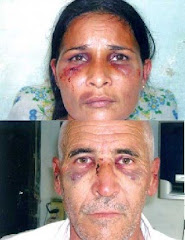
State Security Summons Estado de Sats Members to "Warn" Them About "For
Another Cuba" Graffiti
Posted on June 24, 2014
Several members of Estado de Sats were summoned by State Security to a
Havana police station this Saturday, to "warn" them about the Grafiti
Colectivo Por otra Cuba, organized by the independent project for this
Sunday, to support the campaign demanding that the Government ratify the
United Nations covenants that it signed in 2008.
"They wanted (…) to threaten us, as always, and to say that they would
not allow any type of action," the visual artist Lía Villares told
Diario de Cuba.
"I told them it was an international action, a global movement in
support of the campaign, and that they couldn't prevent what was
happening in different parts of the world," she added.
Two years since the start of the campaign, Estado de Sats has proposed
"simultaneous and collective graffiti," within and outside Cuba, of the
For Another Cuba logo, created by the graphic artist and caricaturist
Gustavo Rodríguez (Garrincha).
Also "to document the actions and post photos and videos on social
networks, to make this 'collective graffiti' a media success in support
of the message For Another Cuba."
In addition to Villares, also summoned were the photographer Claudio
Fuentes, the writer and independent journalist Camilo Ernesto Olivera,
and the activist Dixán Romero, who did not appear because of
irregularities in the summonses.
"I went out wearing a shirt with the campaign logo and they were so
upset, evidently so disturbed, that they talked to the logo, not to me,"
related Villares, who was "warned" by two officials.
"I asked them why they don't combat corruption, delinquency, why a
person like myself sitting there at three o'clock on a Saturday
afternoon (…) why they were doing this work while the country was
falling apart. But that didn't interest them, they wanted to deliver
their threatening and intimidating message," she added.
The Campaign for Another Cuba demands that Havana ratify the United
Nations covenants on civil, political, economic, social and cultural rights.
Diario de Cuba, 8 June 2014
Source: State Security Summons Estado de Sats Members to "Warn" Them
About "For Another Cuba" Graffiti | Translating Cuba -
http://translatingcuba.com/state-security-summons-estado-de-sats-members-to-warn-them-about-for-another-cuba-graffiti/
Wednesday, June 25, 2014

Cuban Mission in Venezuela in Danger
Cuban Mission in Venezuela in Danger / Juan Juan Almeida
Posted on June 24, 2014
They add up to thousands, the Cubans, health professionals, who have
been sent to Venezuela since the first Cuban Medical Mission landed in
Caracas December 16, 1999.
Our technicians, doctors, nurses; they continue and will continue
fulfilling the Hippocratic Oath in the South American country and the
sacred duty of offering medical attention to all who need it.
The enthusiasm of the first collaborations has eroded, today all the
personnel of the Cuban medical cooperation seem to be transitioning to a
bad moment, full of insecurity and uncertainty, because among many other
situations, they confront the discontent of a wide sector of the population.
So shows a classified report dated last Friday, June 13, signed by Dr.
Victor Gauter, chief of all the missions, and sent with urgency to the
Cuban Public Health Ministry.
The document in question asserts that in the Carabobo state alone,
located in the north central coast of Venezuela, in a central region of
the country, in the first week of June, that is to say, from Sunday the
first until Saturday the seventh, the following points were given which
I quote verbatim because of their importance:
- Nine Cuban cooperators were threatened by Venezuelan nationals. Among
the main causes of these threats are the relationship of a couple of
married nationals and political issues.
- Two collaborators deserted, one stomatologist and one a rehabilitation
technician from Valencia township.
- Five volunteer workers were attacked in different townships of the State.
- Two popular medical offices were stoned, one in the Valencia township
and the other in the Naguanagua location.
- In the Bolivar and Marti CDI, located in the Guacara township, they
hung posters that said, "Cubans out."
- At the "La Libertad" stomatology clinic, ASIC Bolivar, also in the
Guacara township, they opened a hole in the wall and they stole all the
instruments and halogen light from the display case.
- Eight collaborators were urgently hospitalized on presenting symptoms
of dengue fever.
It is a lot for only one state, and too much for a week. But before such
concrete events, with clear traces of a serious conflict that looms, the
directors from Havana responded with their habitual irresponsibility
and, without abandoning the repeated formula of false humanism, they
sent an official who travels states with the mission of recruiting
personnel in order to form groups of Cuban computer experts linked to
social networks who will flood Twitter uploading photos of achievements
and "red Sundays."
Come on, as if real problems could be controlled with visual solutions.
We should not forget that the damages caused to people, with the sole
objective of politicizing, have not only consequences but also guilty
parties.
Translated by mlk.
18 June 2014
Source: Cuban Mission in Venezuela in Danger / Juan Juan Almeida |
Translating Cuba -
http://translatingcuba.com/cuban-mission-in-venezuela-in-danger-juan-juan-almeida/
Posted on June 24, 2014
They add up to thousands, the Cubans, health professionals, who have
been sent to Venezuela since the first Cuban Medical Mission landed in
Caracas December 16, 1999.
Our technicians, doctors, nurses; they continue and will continue
fulfilling the Hippocratic Oath in the South American country and the
sacred duty of offering medical attention to all who need it.
The enthusiasm of the first collaborations has eroded, today all the
personnel of the Cuban medical cooperation seem to be transitioning to a
bad moment, full of insecurity and uncertainty, because among many other
situations, they confront the discontent of a wide sector of the population.
So shows a classified report dated last Friday, June 13, signed by Dr.
Victor Gauter, chief of all the missions, and sent with urgency to the
Cuban Public Health Ministry.
The document in question asserts that in the Carabobo state alone,
located in the north central coast of Venezuela, in a central region of
the country, in the first week of June, that is to say, from Sunday the
first until Saturday the seventh, the following points were given which
I quote verbatim because of their importance:
- Nine Cuban cooperators were threatened by Venezuelan nationals. Among
the main causes of these threats are the relationship of a couple of
married nationals and political issues.
- Two collaborators deserted, one stomatologist and one a rehabilitation
technician from Valencia township.
- Five volunteer workers were attacked in different townships of the State.
- Two popular medical offices were stoned, one in the Valencia township
and the other in the Naguanagua location.
- In the Bolivar and Marti CDI, located in the Guacara township, they
hung posters that said, "Cubans out."
- At the "La Libertad" stomatology clinic, ASIC Bolivar, also in the
Guacara township, they opened a hole in the wall and they stole all the
instruments and halogen light from the display case.
- Eight collaborators were urgently hospitalized on presenting symptoms
of dengue fever.
It is a lot for only one state, and too much for a week. But before such
concrete events, with clear traces of a serious conflict that looms, the
directors from Havana responded with their habitual irresponsibility
and, without abandoning the repeated formula of false humanism, they
sent an official who travels states with the mission of recruiting
personnel in order to form groups of Cuban computer experts linked to
social networks who will flood Twitter uploading photos of achievements
and "red Sundays."
Come on, as if real problems could be controlled with visual solutions.
We should not forget that the damages caused to people, with the sole
objective of politicizing, have not only consequences but also guilty
parties.
Translated by mlk.
18 June 2014
Source: Cuban Mission in Venezuela in Danger / Juan Juan Almeida |
Translating Cuba -
http://translatingcuba.com/cuban-mission-in-venezuela-in-danger-juan-juan-almeida/
Lift the embargo – but liberate Cuba first
Lift the embargo – but liberate Cuba first
By Jeff Jacoby | GLOBE COLUMNIST JUNE 25, 2014
AT A June 12 appearance in New York before the Council on Foreign
Relations, Hillary Clinton made the familiar argument for ending the US
trade embargo against Cuba, the same one critics of the policy have been
making for years.
"The embargo is Castro's best friend," the former secretary of state
said; it provides the Havana regime with "an excuse for everything."
Scrapping sanctions would "change the psychology of this issue" and
improve US relations with the rest of the hemisphere. So "we should
advocate for normalizing relations and see what [Cuba's rulers] do."
A few hours earlier, Cuba's rulers had been doing one of the things they
do best: persecuting peaceful dissidents. More than 40 pro-democracy
activists were rounded up on June 11, and several were allegedly beaten
by security agents. One of Cuba's most respected dissidents, Jorge Luís
García Pérez, widely known as Antúnez, said he was battered and choked
into unconsciousness in a police station in Santa Clara, according to
the Miami Herald. State security officials warned Antúnez to stop
collecting signatures on a petition condemning international efforts to
reduce US sanctions against Cuba.
In Cuba, as in the United States, it requires no bravery to publicly
oppose the embargo. Cubans who publicly support it, on the other hand,
risk being prosecuted for committing a crime punishable by up to 15
years imprisonment. Clinton's critique of the US embargo drew attention
because she is a potential candidate for president. But what really
merits the headlines is the courage shown by the hundreds of ordinary
Cuban citizens openly urging the free world not to do more business with
the dictatorship that for so long has kept Cuba on its knees.
Conventional wisdom holds that the US embargo has persisted only because
Cuban-Americans in Florida, a key voting bloc, strongly defend it.
Florida International University generated some media notice last week
with a new poll showing that by a narrow majority, Cubans living in
metropolitan Miami — the capital of the Cuban American community —
actually oppose the embargo. Critics quickly flagged some glaring
problems with the poll, such as the 90 percent of respondents who
claimed to be registered voters, while only 62 percent said they were US
citizens. And the reported results filtered out the "unsures," which on
the embargo question amounted to 12 percent of respondents. Including
those numbers in the overall tally would show 45 percent against the
embargo — a plurality, not a majority.
Yet the focus on polling data is a distraction. The US economic embargo
is not the cause of Cuba's misery. The Castro tyranny is. Unilaterally
repealing the embargo would not weaken that tyranny by flooding the
island with American tourists, consumer goods, and democratic notions,
as sanctions opponents romantically imagine. Nearly 3 million tourists
already visit Cuba annually, hundreds of thousands of Americans among
them. In recent years, more tourists have traveled to Cuba from the
United States than from any other country except Canada.
The trade embargo is far from hermetic. Since 2000, US exporters have
sold close to $5 billion in food, agricultural, and medical goods to
Cuba — for several years, in fact, the United States was Cuba's
fifth-largest trade partner. Meanwhile, Cuba has had the rest of the
world to do business with, unfettered by embargoes or Florida politics.
If tourism and trade were going to undermine Cuba's communist regime, it
would surely have toppled long ago. But engagement with totalitarians
doesn't turn them into free and democratic neighbors. Rather, it
empowers them to crack down on their subjects with even greater
impunity. According to Elizardo Sanchez, a well-known human rights
activist in Havana, detentions of dissidents have spiked, reaching more
than 3,800 in just the first four months of 2014, far above the previous
high of 2,795 two years ago.
The embargo, or what remains of it, is not chiseled in granite. It is,
however, codified in US law. The Helms-Burton Act, signed by Hillary
Clinton's husband in 1996, allows the embargo to be lifted once the
Cuban government legalizes political opposition, frees its political
prisoners, and schedules democratic elections. Cuban dissidents insist
on that point at the risk of going to prison. Shouldn't American
politicians, with nothing at risk but their credibility, insist on it as
well?
Jeff Jacoby can be reached at jacoby@globe.com. Follow him on Twitter
@jeff_jacoby.
Source: Lift the embargo – but liberate Cuba first - Opinion - The
Boston Globe -
http://www.bostonglobe.com/opinion/2014/06/24/lift-embargo-but-liberate-cuba-first/7Msp22F4gTVhBajSG8lSaK/story.html
By Jeff Jacoby | GLOBE COLUMNIST JUNE 25, 2014
AT A June 12 appearance in New York before the Council on Foreign
Relations, Hillary Clinton made the familiar argument for ending the US
trade embargo against Cuba, the same one critics of the policy have been
making for years.
"The embargo is Castro's best friend," the former secretary of state
said; it provides the Havana regime with "an excuse for everything."
Scrapping sanctions would "change the psychology of this issue" and
improve US relations with the rest of the hemisphere. So "we should
advocate for normalizing relations and see what [Cuba's rulers] do."
A few hours earlier, Cuba's rulers had been doing one of the things they
do best: persecuting peaceful dissidents. More than 40 pro-democracy
activists were rounded up on June 11, and several were allegedly beaten
by security agents. One of Cuba's most respected dissidents, Jorge Luís
García Pérez, widely known as Antúnez, said he was battered and choked
into unconsciousness in a police station in Santa Clara, according to
the Miami Herald. State security officials warned Antúnez to stop
collecting signatures on a petition condemning international efforts to
reduce US sanctions against Cuba.
In Cuba, as in the United States, it requires no bravery to publicly
oppose the embargo. Cubans who publicly support it, on the other hand,
risk being prosecuted for committing a crime punishable by up to 15
years imprisonment. Clinton's critique of the US embargo drew attention
because she is a potential candidate for president. But what really
merits the headlines is the courage shown by the hundreds of ordinary
Cuban citizens openly urging the free world not to do more business with
the dictatorship that for so long has kept Cuba on its knees.
Conventional wisdom holds that the US embargo has persisted only because
Cuban-Americans in Florida, a key voting bloc, strongly defend it.
Florida International University generated some media notice last week
with a new poll showing that by a narrow majority, Cubans living in
metropolitan Miami — the capital of the Cuban American community —
actually oppose the embargo. Critics quickly flagged some glaring
problems with the poll, such as the 90 percent of respondents who
claimed to be registered voters, while only 62 percent said they were US
citizens. And the reported results filtered out the "unsures," which on
the embargo question amounted to 12 percent of respondents. Including
those numbers in the overall tally would show 45 percent against the
embargo — a plurality, not a majority.
Yet the focus on polling data is a distraction. The US economic embargo
is not the cause of Cuba's misery. The Castro tyranny is. Unilaterally
repealing the embargo would not weaken that tyranny by flooding the
island with American tourists, consumer goods, and democratic notions,
as sanctions opponents romantically imagine. Nearly 3 million tourists
already visit Cuba annually, hundreds of thousands of Americans among
them. In recent years, more tourists have traveled to Cuba from the
United States than from any other country except Canada.
The trade embargo is far from hermetic. Since 2000, US exporters have
sold close to $5 billion in food, agricultural, and medical goods to
Cuba — for several years, in fact, the United States was Cuba's
fifth-largest trade partner. Meanwhile, Cuba has had the rest of the
world to do business with, unfettered by embargoes or Florida politics.
If tourism and trade were going to undermine Cuba's communist regime, it
would surely have toppled long ago. But engagement with totalitarians
doesn't turn them into free and democratic neighbors. Rather, it
empowers them to crack down on their subjects with even greater
impunity. According to Elizardo Sanchez, a well-known human rights
activist in Havana, detentions of dissidents have spiked, reaching more
than 3,800 in just the first four months of 2014, far above the previous
high of 2,795 two years ago.
The embargo, or what remains of it, is not chiseled in granite. It is,
however, codified in US law. The Helms-Burton Act, signed by Hillary
Clinton's husband in 1996, allows the embargo to be lifted once the
Cuban government legalizes political opposition, frees its political
prisoners, and schedules democratic elections. Cuban dissidents insist
on that point at the risk of going to prison. Shouldn't American
politicians, with nothing at risk but their credibility, insist on it as
well?
Jeff Jacoby can be reached at jacoby@globe.com. Follow him on Twitter
@jeff_jacoby.
Source: Lift the embargo – but liberate Cuba first - Opinion - The
Boston Globe -
http://www.bostonglobe.com/opinion/2014/06/24/lift-embargo-but-liberate-cuba-first/7Msp22F4gTVhBajSG8lSaK/story.html
Cuban Singer Silvio Rodriguez’ “Discoveries”
Cuban Singer Silvio Rodriguez' "Discoveries"
June 24, 2014
Haroldo Dilla Alonso
HAVANA TIMES — A few days ago, singer-songwriter Silvio Rodriguez
angered that very small part of Cuba's population with access to the
Internet. This happened when, following a concert held at a small town
in Cuba's eastern end, the musician was interviewed by the official
government web-site Cubadebate.
During the interview, Rodriguez showed a certain degree of
disillusionment with the outcome of what both the interviewer and
interviewee agreed to call "communism." More importantly, he made a
chilling confession: "I've realized," he said, "that people are screwed,
really screwed…" He added: "a whole lot more screwed than I thought,"
before mentioning another empirical discovery: "my life is far more
comfortable than that of the immense majority of Cubans."
What's striking about these statements is that Silvio Rodriguez has
always lived in Cuba, and that he has resided on the island for the past
twenty years. In the course of these two decades, Cuba's population has
become alarmingly impoverished, individual consumption has dwindled and
been transformed into a daily struggle and social services have
degenerated to truly regrettable levels. And only now does he discover,
to his surprise, that "people are screwed."
I must point out that, ten years ago, Silvio Rodriguez himself publicly
supported the Cuban government's repression of those who were "screwed"
and called for a system that offered them brighter prospects, including
the execution, without due process, of three young black men who had
hijacked a ferry in order to emigrate to the United States.
Silvio Rodriguez' statements are an illustration of the perversities
that emerge from a system that has not completed its transition to
capitalism and of the frivolous disappointment of an elite that imagined
it would transform the world and ended up discovering it had merely
staged a burlesque show for a public that had been gagged.
These disparaging public declarations have become common among the
post-revolutionary elite, interested in publicizing an account of things
in which it appears as the baby we should keep and the rest as the dirty
bath water we ought to throw out.
A few years ago, when the Cuban president announced the implementation
of his economic "reforms," no few miserable public officials spoke of
the devastated Cuban population as a society of vulgar children who
simply opened their mouths and waited for the State to spoon-feed them.
Only a few weeks ago, we learned of another sudden outburst, that of
Alfredo Guevara, a learned official and patron of the arts who, in his
last days, complained of a people he considered unworthy of the
government's efforts.
What makes Silvio Rodriguez different from Alfredo Guevara – perhaps
because he does not suspect that the world he knew is dying (a common
type of blindness among intellectuals) – is that he believes we should
continue to move forward: "it's likely a great part of the population
will have to endure many hardships, hard work, problems and shortages,
on top of the many hardships, hard work, problems and shortages we've
had for many years." That is to say, Silvio Rodriguez is calling on
Cubans to make new sacrifices.
Silvio Rodriguez has in fact always been calling on others to make
sacrifices. He did it when he was starting out as an artist and he was
yet another common Cuban committed to his people, something that made
his work authentic and believable.
Today, he is no longer a common Cuban, nor is he believable, because
Silvio Rodriguez is an intellectual of the elite, and this – as the
musician has just discovered – allows him to maintain a safe distance
from the daily struggle for survival of those folk that, according to
him, are "screwed, very screwed." Without a doubt, these people will be
even more screwed – and distant from the folk singer that once captured
their imagination – when the establishment of an authoritarian form of
capitalism has been achieved.
Source: Cuban Singer Silvio Rodriguez' "Discoveries" - Havana Times.org
- http://www.havanatimes.org/?p=104464
June 24, 2014
Haroldo Dilla Alonso
HAVANA TIMES — A few days ago, singer-songwriter Silvio Rodriguez
angered that very small part of Cuba's population with access to the
Internet. This happened when, following a concert held at a small town
in Cuba's eastern end, the musician was interviewed by the official
government web-site Cubadebate.
During the interview, Rodriguez showed a certain degree of
disillusionment with the outcome of what both the interviewer and
interviewee agreed to call "communism." More importantly, he made a
chilling confession: "I've realized," he said, "that people are screwed,
really screwed…" He added: "a whole lot more screwed than I thought,"
before mentioning another empirical discovery: "my life is far more
comfortable than that of the immense majority of Cubans."
What's striking about these statements is that Silvio Rodriguez has
always lived in Cuba, and that he has resided on the island for the past
twenty years. In the course of these two decades, Cuba's population has
become alarmingly impoverished, individual consumption has dwindled and
been transformed into a daily struggle and social services have
degenerated to truly regrettable levels. And only now does he discover,
to his surprise, that "people are screwed."
I must point out that, ten years ago, Silvio Rodriguez himself publicly
supported the Cuban government's repression of those who were "screwed"
and called for a system that offered them brighter prospects, including
the execution, without due process, of three young black men who had
hijacked a ferry in order to emigrate to the United States.
Silvio Rodriguez' statements are an illustration of the perversities
that emerge from a system that has not completed its transition to
capitalism and of the frivolous disappointment of an elite that imagined
it would transform the world and ended up discovering it had merely
staged a burlesque show for a public that had been gagged.
These disparaging public declarations have become common among the
post-revolutionary elite, interested in publicizing an account of things
in which it appears as the baby we should keep and the rest as the dirty
bath water we ought to throw out.
A few years ago, when the Cuban president announced the implementation
of his economic "reforms," no few miserable public officials spoke of
the devastated Cuban population as a society of vulgar children who
simply opened their mouths and waited for the State to spoon-feed them.
Only a few weeks ago, we learned of another sudden outburst, that of
Alfredo Guevara, a learned official and patron of the arts who, in his
last days, complained of a people he considered unworthy of the
government's efforts.
What makes Silvio Rodriguez different from Alfredo Guevara – perhaps
because he does not suspect that the world he knew is dying (a common
type of blindness among intellectuals) – is that he believes we should
continue to move forward: "it's likely a great part of the population
will have to endure many hardships, hard work, problems and shortages,
on top of the many hardships, hard work, problems and shortages we've
had for many years." That is to say, Silvio Rodriguez is calling on
Cubans to make new sacrifices.
Silvio Rodriguez has in fact always been calling on others to make
sacrifices. He did it when he was starting out as an artist and he was
yet another common Cuban committed to his people, something that made
his work authentic and believable.
Today, he is no longer a common Cuban, nor is he believable, because
Silvio Rodriguez is an intellectual of the elite, and this – as the
musician has just discovered – allows him to maintain a safe distance
from the daily struggle for survival of those folk that, according to
him, are "screwed, very screwed." Without a doubt, these people will be
even more screwed – and distant from the folk singer that once captured
their imagination – when the establishment of an authoritarian form of
capitalism has been achieved.
Source: Cuban Singer Silvio Rodriguez' "Discoveries" - Havana Times.org
- http://www.havanatimes.org/?p=104464
Gifts from Heaven - Cuba Needs Wheelchairs
Gifts from Heaven: Cuba Needs Wheelchairs
June 24, 2014
Mercedes Gonzalez Amade
HAVANA TIMES — Who doesn't enjoy getting a gift? I don't think that's a
difficult question. If that gift is something that changes your life, it
is far more welcome.
Things become complicated when one is responsible for distributing
limited donations to a group of desperate people in need. I found myself
in such a situation a few months ago, when I had to distribute 24
wheelchairs among people with disabilities in my neighborhood.
There are many people with motor disabilities in Marianao who are
members of the Cuban Association for the Physically Impaired (ACLIFIM).
The number of wheelchairs donated didn't even cover 50 percent of the
neighborhood's needs, and we were forced to prioritize individuals on
the basis of their disability.
Of course, those with more severe challenges, such as double amputees,
paraplegics and people with medullar lesions, were our top priority. My
heart broke when I had to hand out the wheelchairs: I had to send away
many who came to me, people who have elderly parents with disabilities
at home, because they were not ACLIFIM members.
I was also made monetary offers. The figures were high, but I turned
them down. The wheelchairs were being sold at 77 Cuban pesos, and some
people offered me as much as 80 Cuban Convertible Pesos (CUC), almost 25
times the price.
I tried to be fair, though it was difficult to choose who got one and
who had to continue waiting for another donation. What fills me with
pride is remembering the joy of those we gave back their legs to,
metaphorically speaking.
I am confident I will be able to continue helping those who need help,
even if I am not paid for doing this job. I wouldn't trade sincere
gratefulness for any amount of money.
I have always believed that positive energy makes things flow better.
The job I do forces me to move long distances across the neighborhood
every day. A few days ago, I also got a gift: I was given an electric
wheelchair, without any batteries or a transformer (because, according
to the association, that is how the donations are received). I am
grateful they thought about me and I know it will make my life a lot
easier when I manage to get it up and running.
Source: Gifts from Heaven: Cuba Needs Wheelchairs - Havana Times.org -
http://www.havanatimes.org/?p=104465
June 24, 2014
Mercedes Gonzalez Amade
HAVANA TIMES — Who doesn't enjoy getting a gift? I don't think that's a
difficult question. If that gift is something that changes your life, it
is far more welcome.
Things become complicated when one is responsible for distributing
limited donations to a group of desperate people in need. I found myself
in such a situation a few months ago, when I had to distribute 24
wheelchairs among people with disabilities in my neighborhood.
There are many people with motor disabilities in Marianao who are
members of the Cuban Association for the Physically Impaired (ACLIFIM).
The number of wheelchairs donated didn't even cover 50 percent of the
neighborhood's needs, and we were forced to prioritize individuals on
the basis of their disability.
Of course, those with more severe challenges, such as double amputees,
paraplegics and people with medullar lesions, were our top priority. My
heart broke when I had to hand out the wheelchairs: I had to send away
many who came to me, people who have elderly parents with disabilities
at home, because they were not ACLIFIM members.
I was also made monetary offers. The figures were high, but I turned
them down. The wheelchairs were being sold at 77 Cuban pesos, and some
people offered me as much as 80 Cuban Convertible Pesos (CUC), almost 25
times the price.
I tried to be fair, though it was difficult to choose who got one and
who had to continue waiting for another donation. What fills me with
pride is remembering the joy of those we gave back their legs to,
metaphorically speaking.
I am confident I will be able to continue helping those who need help,
even if I am not paid for doing this job. I wouldn't trade sincere
gratefulness for any amount of money.
I have always believed that positive energy makes things flow better.
The job I do forces me to move long distances across the neighborhood
every day. A few days ago, I also got a gift: I was given an electric
wheelchair, without any batteries or a transformer (because, according
to the association, that is how the donations are received). I am
grateful they thought about me and I know it will make my life a lot
easier when I manage to get it up and running.
Source: Gifts from Heaven: Cuba Needs Wheelchairs - Havana Times.org -
http://www.havanatimes.org/?p=104465
After mother's death, jailed American Alan Gross visited by wife in Cuba
After mother's death, jailed American Alan Gross visited by wife in Cuba
By Patrick Oppmann, CNN
June 25, 2014 -- Updated 0234 GMT (1034 HKT)
STORY HIGHLIGHTS
Alan Gross' wife, Judy, visits husband in Cuba a week after his mother's
death
The U.S. State Department contractor offered to return to jail after a
goodbye visit
The Cuban government denied his request, saying inmates can't travel abroad
Gross is serving a 15-year sentence for bring satellite equipment to island
(CNN) -- The wife of imprisoned U.S. State Department contractor Alan
Gross traveled to Cuba Tuesday as part of her ongoing effort to free her
husband.
Judy Gross did not talk to a CNN reporter outside Havana's Jose Marti
International Airport, and she and Gross' attorney quickly boarded a bus
provided by the Cuban government.
Last week, Gross' mother died after a long fight with cancer, Gross'
attorney, Scott Gilbert, said.
The Cuban government refused Gross' request to travel to the United
States to say goodbye to Evelyn Gross before she died. Gross had
promised that after seeing his mother he would return to his prison cell
at a military hospital in Havana.
"We would like to convey our heartfelt condolences to his relatives,"
Cuban Ministry of Foreign Affairs official Josefina Vidal said in a
statement. "It is necessary to clarify that neither the Cuban
penitentiary system nor the U.S. penitentiary system provide the
possibility for inmates to travel abroad, no matter the reason. "
Gross, 65, is serving a 15-year sentence for bringing satellite
communications equipment to Cuba as part of his work as a subcontractor
for the U.S. Agency for International Development. He was convicted in
March 2011.
Photos: Americans detained abroad
U.S. officials said Gross was merely trying to help Cubans bypass the
island's stringent restrictions on Internet access and have said his
imprisonment is one of the major obstacles to improved relations with Cuba.
In April, Gross embarked on a hunger strike to protest his continued
imprisonment. He later said he was suspending his hunger strike after
his mother pleaded with him to begin eating again.
Since his arrest, Gross has suffered a slew of health problems, his
attorney said, and lost more than 100 pounds.
"Alan is confined to one room, 23 hours a day." Gilbert said during an
interview with CNN in April. "He spends his day there in pajamas, he's
fed meals in his room. He's let out for an hour a day, to exercise an
hour a day in a small, walled courtyard where you can barely see the sky."
Cuban officials have said they want to negotiate Gross' case with
representatives of the United States in conjunction with the fates of
three Cuban intelligence operatives serving lengthy sentences in U.S.
prisons.
But U.S. officials have called that effort blackmail and said the cases
are separate matters because Gross was not working as a spy in Cuba.
The diplomatic impasse is taking its toll on Gross, Gilbert said.
"The White House has yet to engage on this issue; we need the president
to make this a priority. Without that, Alan will die in Cuba," Gilbert said.
Source: Wife of jailed American Alan Gross visits Cuba - CNN.com -
http://edition.cnn.com/2014/06/24/world/americas/cuba-alan-gross-wife-visit/
By Patrick Oppmann, CNN
June 25, 2014 -- Updated 0234 GMT (1034 HKT)
STORY HIGHLIGHTS
Alan Gross' wife, Judy, visits husband in Cuba a week after his mother's
death
The U.S. State Department contractor offered to return to jail after a
goodbye visit
The Cuban government denied his request, saying inmates can't travel abroad
Gross is serving a 15-year sentence for bring satellite equipment to island
(CNN) -- The wife of imprisoned U.S. State Department contractor Alan
Gross traveled to Cuba Tuesday as part of her ongoing effort to free her
husband.
Judy Gross did not talk to a CNN reporter outside Havana's Jose Marti
International Airport, and she and Gross' attorney quickly boarded a bus
provided by the Cuban government.
Last week, Gross' mother died after a long fight with cancer, Gross'
attorney, Scott Gilbert, said.
The Cuban government refused Gross' request to travel to the United
States to say goodbye to Evelyn Gross before she died. Gross had
promised that after seeing his mother he would return to his prison cell
at a military hospital in Havana.
"We would like to convey our heartfelt condolences to his relatives,"
Cuban Ministry of Foreign Affairs official Josefina Vidal said in a
statement. "It is necessary to clarify that neither the Cuban
penitentiary system nor the U.S. penitentiary system provide the
possibility for inmates to travel abroad, no matter the reason. "
Gross, 65, is serving a 15-year sentence for bringing satellite
communications equipment to Cuba as part of his work as a subcontractor
for the U.S. Agency for International Development. He was convicted in
March 2011.
Photos: Americans detained abroad
U.S. officials said Gross was merely trying to help Cubans bypass the
island's stringent restrictions on Internet access and have said his
imprisonment is one of the major obstacles to improved relations with Cuba.
In April, Gross embarked on a hunger strike to protest his continued
imprisonment. He later said he was suspending his hunger strike after
his mother pleaded with him to begin eating again.
Since his arrest, Gross has suffered a slew of health problems, his
attorney said, and lost more than 100 pounds.
"Alan is confined to one room, 23 hours a day." Gilbert said during an
interview with CNN in April. "He spends his day there in pajamas, he's
fed meals in his room. He's let out for an hour a day, to exercise an
hour a day in a small, walled courtyard where you can barely see the sky."
Cuban officials have said they want to negotiate Gross' case with
representatives of the United States in conjunction with the fates of
three Cuban intelligence operatives serving lengthy sentences in U.S.
prisons.
But U.S. officials have called that effort blackmail and said the cases
are separate matters because Gross was not working as a spy in Cuba.
The diplomatic impasse is taking its toll on Gross, Gilbert said.
"The White House has yet to engage on this issue; we need the president
to make this a priority. Without that, Alan will die in Cuba," Gilbert said.
Source: Wife of jailed American Alan Gross visits Cuba - CNN.com -
http://edition.cnn.com/2014/06/24/world/americas/cuba-alan-gross-wife-visit/
Tuesday, June 24, 2014
Cuba moving toward unified currency
Cuba moving toward unified currency
Jun 24,2014
HAVANA, June 23 (Xinhua) -- The Cuban government was working to abolish
a dual-currency system, the official Granma daily said Monday.
Progress on monetary and exchange rate unification topped the agenda of
a cabintet meeting presided over by Cuban leader Raul Castro Saturday.
Vice President Marino Murillo said the authorities were continuing "to
work in compliance with the approved timetable" to scrap the dual
currencies, but he did not provide details.
At present, most Cubans are paid in the Cuban peso or CUP, but most
goods in the country are sold in the convertible peso or CUC, which is
pegged to the U.S. dollar and is worth about 25 CUPs.
The government has begun, among other measures, to train government
employees to "ensure adequate preparation to tackle the process,"
Murillo said.
"Monetary unification will not solve all the problems of the economy,
but it is an indispensable part of a process" aimed at increasing
efficiency and labor productivity, he said.
In October 2013, Cuba said it would phase out its unpopular 19-year-old
dual currency system, which has caused a growing wealth gap between
Cubans with access to dollars and those without.
Cubans with access to convertible pesos mainly work in the tourism
industry or receive money from family members living abroad, who remit
some 2.5 billion U.S. dollars back home a year.
Six years ago, Castro launched an economic renovation program, allowing
the existence of a limited number of private enterprises.
The dual-currency system has widened the wealth gap as more Cubans turn
to the nascent private sector to make a living.
While a doctor earns a monthly salary of 500 CUPs, a self-employed
mechanic can make 400 CUCs, or 9,600 CUPs.
Source: Cuba moving toward unified currency | Shanghai Daily -
http://www.shanghaidaily.com/article/article_xinhua.aspx?id=226045
Jun 24,2014
HAVANA, June 23 (Xinhua) -- The Cuban government was working to abolish
a dual-currency system, the official Granma daily said Monday.
Progress on monetary and exchange rate unification topped the agenda of
a cabintet meeting presided over by Cuban leader Raul Castro Saturday.
Vice President Marino Murillo said the authorities were continuing "to
work in compliance with the approved timetable" to scrap the dual
currencies, but he did not provide details.
At present, most Cubans are paid in the Cuban peso or CUP, but most
goods in the country are sold in the convertible peso or CUC, which is
pegged to the U.S. dollar and is worth about 25 CUPs.
The government has begun, among other measures, to train government
employees to "ensure adequate preparation to tackle the process,"
Murillo said.
"Monetary unification will not solve all the problems of the economy,
but it is an indispensable part of a process" aimed at increasing
efficiency and labor productivity, he said.
In October 2013, Cuba said it would phase out its unpopular 19-year-old
dual currency system, which has caused a growing wealth gap between
Cubans with access to dollars and those without.
Cubans with access to convertible pesos mainly work in the tourism
industry or receive money from family members living abroad, who remit
some 2.5 billion U.S. dollars back home a year.
Six years ago, Castro launched an economic renovation program, allowing
the existence of a limited number of private enterprises.
The dual-currency system has widened the wealth gap as more Cubans turn
to the nascent private sector to make a living.
While a doctor earns a monthly salary of 500 CUPs, a self-employed
mechanic can make 400 CUCs, or 9,600 CUPs.
Source: Cuba moving toward unified currency | Shanghai Daily -
http://www.shanghaidaily.com/article/article_xinhua.aspx?id=226045
Cuba's Budding Entrepreneurs Travel A Rocky Road Toward Success
Cuba's Budding Entrepreneurs Travel A Rocky Road Toward Success
by DAVID GREENE and JASMINE GARSD
June 24, 2014 3:39 AM ET
When Americans think of business in Cuba, they think of government-owned
enterprise. And the vast majority of Cubans do work for the state.
But in recent years, private business owners known as cuentapropistas
have flourished on the island.
Cuentapropismo literally means "on your own account." As far back as the
1970s, Fidel Castro was talking about how socialism and small business
ownership could coexist. Today, they do so more than ever: Between 2010
and 2013, the Cuban government expanded the list of privately owned
business ventures that are legal on the island, such as construction
work, restaurants and tailoring.
David Gilkey/NPR
About 1 million people — or 20 percent of the Cuban workforce — can now
be classified as wholly in the private sector, according to a report by
Richard Feinberg of the Brookings Institution.
Barbara Fernandez Franco remembers being excited when that list of
government-permitted businesses first came out. She combed through the
200-odd jobs, and thought carefully about which she could do. She
decided on the "tailor and seamstress" category.
We met 28-year-old Barbara in one of the aging but gorgeous buildings
that line the narrow colonial streets of central Havana, Cuba's capital.
Sitting in the stairway, she tells us it's been a difficult road full of
stumbles.
She started off reselling clothing a friend made, but the profit margins
were very small. Then, she began buying clothing from abroad, from
countries like Dominican Republic, Peru, Ecuador and Mexico, which she
then resold.
At first the project was as rocky as any start-up business. But a few
months down the line, she says, the profits where outstanding. Barbara
was able to save a good amount of money — which today is helping her
purchase a new home with her boyfriend, Michel Perez Casanova.
But that boom in business soon came to an end when the government
announced that importing clothing for resale on the island would be
illegal as of Dec. 31, 2013.
After Franco learned to sew, she started producing baby clothes and
mosquito nets for cribs.
Barbara was devastated by the news, she says, but while other businesses
shut down, she chose to carry on as best she could: She learned how to
sew and created her own line of baby clothing and mosquito netting for
cribs.
At a small restaurant in the port city of Mariel, owner Onil Lemus told
us everyone he knows is absolutely thrilled about the widening scope of
legal business ventures. In fact he jokes that he liked it better when
there where fewer cuentapropistas — because he had less competition.
Even though business is good for Onil, he echoed what several other
small enterprise owners said to us: One of the biggest challenges has
been the lack of raw materials. In Mariel for example, Onil said,
there's no access to wholesale food markets, which are so important to
the restaurant industry.
Pointing to the delicious lamb stew he'd prepared for us, he explained
that he'd had to go to a farm to buy the meat, but foods like rice and
beans — staples in Cuban cuisine — are hard to buy in large quantities
at good prices.
Similarly, Barbara said certain fabrics and ornaments are so expensive,
it would be impossible for her to make a profit if she were to use them.
The widespread sentiment here is that the U.S. embargo — which has been
in place for more than 50 years and is known as el bloqueo, or "the
blockade," on the island — is largely responsible for these kinds of
difficulties.
Since taking over for his brother Fidel in 2008, Raul Castro has been
pushing to modernize the economy. Onil said he's confident that as the
number of private business owners grows, the government will address
these issues.
Barbara's boyfriend Michel, on the other hand, seemed more disheartened.
"Some tourists say that this country's growing up now and it's going to
get better and better," he said. "But you know the system here is so
slow. Step by step. Very, very, very slow."
Source: Cuba's Budding Entrepreneurs Travel A Rocky Road Toward Success
: Parallels : NPR -
http://www.npr.org/blogs/parallels/2014/06/24/324862512/cubas-budding-entrepreneurs-travel-a-rocky-road-toward-success
by DAVID GREENE and JASMINE GARSD
June 24, 2014 3:39 AM ET
When Americans think of business in Cuba, they think of government-owned
enterprise. And the vast majority of Cubans do work for the state.
But in recent years, private business owners known as cuentapropistas
have flourished on the island.
Cuentapropismo literally means "on your own account." As far back as the
1970s, Fidel Castro was talking about how socialism and small business
ownership could coexist. Today, they do so more than ever: Between 2010
and 2013, the Cuban government expanded the list of privately owned
business ventures that are legal on the island, such as construction
work, restaurants and tailoring.
David Gilkey/NPR
About 1 million people — or 20 percent of the Cuban workforce — can now
be classified as wholly in the private sector, according to a report by
Richard Feinberg of the Brookings Institution.
Barbara Fernandez Franco remembers being excited when that list of
government-permitted businesses first came out. She combed through the
200-odd jobs, and thought carefully about which she could do. She
decided on the "tailor and seamstress" category.
We met 28-year-old Barbara in one of the aging but gorgeous buildings
that line the narrow colonial streets of central Havana, Cuba's capital.
Sitting in the stairway, she tells us it's been a difficult road full of
stumbles.
She started off reselling clothing a friend made, but the profit margins
were very small. Then, she began buying clothing from abroad, from
countries like Dominican Republic, Peru, Ecuador and Mexico, which she
then resold.
At first the project was as rocky as any start-up business. But a few
months down the line, she says, the profits where outstanding. Barbara
was able to save a good amount of money — which today is helping her
purchase a new home with her boyfriend, Michel Perez Casanova.
But that boom in business soon came to an end when the government
announced that importing clothing for resale on the island would be
illegal as of Dec. 31, 2013.
After Franco learned to sew, she started producing baby clothes and
mosquito nets for cribs.
Barbara was devastated by the news, she says, but while other businesses
shut down, she chose to carry on as best she could: She learned how to
sew and created her own line of baby clothing and mosquito netting for
cribs.
At a small restaurant in the port city of Mariel, owner Onil Lemus told
us everyone he knows is absolutely thrilled about the widening scope of
legal business ventures. In fact he jokes that he liked it better when
there where fewer cuentapropistas — because he had less competition.
Even though business is good for Onil, he echoed what several other
small enterprise owners said to us: One of the biggest challenges has
been the lack of raw materials. In Mariel for example, Onil said,
there's no access to wholesale food markets, which are so important to
the restaurant industry.
Pointing to the delicious lamb stew he'd prepared for us, he explained
that he'd had to go to a farm to buy the meat, but foods like rice and
beans — staples in Cuban cuisine — are hard to buy in large quantities
at good prices.
Similarly, Barbara said certain fabrics and ornaments are so expensive,
it would be impossible for her to make a profit if she were to use them.
The widespread sentiment here is that the U.S. embargo — which has been
in place for more than 50 years and is known as el bloqueo, or "the
blockade," on the island — is largely responsible for these kinds of
difficulties.
Since taking over for his brother Fidel in 2008, Raul Castro has been
pushing to modernize the economy. Onil said he's confident that as the
number of private business owners grows, the government will address
these issues.
Barbara's boyfriend Michel, on the other hand, seemed more disheartened.
"Some tourists say that this country's growing up now and it's going to
get better and better," he said. "But you know the system here is so
slow. Step by step. Very, very, very slow."
Source: Cuba's Budding Entrepreneurs Travel A Rocky Road Toward Success
: Parallels : NPR -
http://www.npr.org/blogs/parallels/2014/06/24/324862512/cubas-budding-entrepreneurs-travel-a-rocky-road-toward-success
With Cash And Fat Fryers, Americans Feed Cuba's Growing Free Market
With Cash And Fat Fryers, Americans Feed Cuba's Growing Free Market
More Sharing ServicesShare|Share on twitterShare on emailShare on print|
By Greg Allen
With more people traveling between Cuba and the U.S., money and goods
are moving, too. The influx has allowed Cuban-Americans to become
investors in the island's emerging private sector.
Tuesday, June 24, 2014
Every day, you can see signs of a subtle change in relations between
Cuba and the U.S. at Miami International Airport.
More Cubans than ever before are coming to the U.S. to visit, and the
number of Cuban-Americans traveling back to the island is also at record
levels. With all the visitors, money and goods are now traveling to the
island from the United States.
It's a legal loophole in the 50-year-old trade embargo — one that's
having a real impact on Cuba's economy, and allowing Cuban-Americans to
become investors in Cuba's emerging private sector.
'A Big Deal'
Shortly after taking office, President Obama made it possible for more
Americans than ever before to travel to Cuba. He began by lifting
restrictions on Cuban-Americans. Before the change, they could travel to
Cuba only once every three years.
Last year, Cuba's government made an even more unexpected move: It began
allowing its citizens to visit the U.S., with few restrictions.
Now, eight or nine regularly scheduled charter flights leave Miami daily
for Havana and other Cuban cities. At the airport, nearly everyone
waiting in line is carrying packages and large suitcases, even
flat-screen TVs and other appliances.
Ana Dilla was waiting in line recently with her two in-laws, who were
returning home to Cuba after a short visit. Their bags were full of
goods they purchased to take home.
"Hair items, clothing, shoes, hygiene items, makeup," Dilla says — all
items that are hard to get in Cuba.
Traveling from the U.S. to Cuba is still a hassle. There are
restrictions on the type of goods you can bring and how much. Over a
certain limit, and travelers pay a penalty. Cuba also assesses customs
duties on some goods.
But Dilla says the new freedom to travel has made a big difference to
her in-laws and others in Cuba.
"It was a big deal for them, absolutely," she says. "It was much easier
than in the past so it's a good thing. Things are getting a little bit
better."
Because of the changes in regulations in both countries, travel between
the U.S. and Cuba is at record levels — and growing. That includes
so-called people-to-people travel, trips that are organized by groups
for education or cultural exchange.
But by far, most of the travel to Cuba is by Cuban-Americans, and it's
having an important economic impact on the island.
"The presence of the Cuban-Americans is just undeniable," says Joe
Scarpaci, who heads the Center for the Study of Cuban Culture and the
Economy and has co-authored a book on Cuba's emerging consumer culture.
Perhaps even more important than their travel are the unrestricted
remittances Cuban-Americans can now send back to family on the island.
Scarpaci estimates that goods and cash sent by Cuban-Americans now is in
the range of $5 billion a year, making it the nation's second largest
source of income.
Using a Cuban slang term, he calls it, "Gusanos carrying gusanos."
"Gusano is the derogatory term that the folks of the island refer to
when the Cubans left the revolution — they crawled away from the glories
of the revolution. Now they're bringing back these duffel bags that are
long and shaped like worms, or gusanos," Scarpaci says.
The goods carried in those duffels aren't just clothing and cologne.
Deep-fat fryers, power saws, electric drills and soldering irons are in
great demand in Cuba. Scarpaci says he knows of many small businesses
there that have started up with goods and cash supplied by Cuban-Americans.
"From small restaurants to home body repairs to plastic-mold makers for
use of children's toys. In every one of those instances, the capital for
that has come from family members abroad," he says.
Free Market Activity
Nearly 600,000 U.S. travelers — mostly Cuban-Americans — visited Cuba
last year. Polls show a majority of Cuban-Americans now support
unrestricted travel to Cuba. A majority also believe Americans should be
allowed to invest in Cuban businesses.
There are some, though, who believe unrestricted family travel has led
to abuses. Mauricio Claver-Carone is the director of the U.S.-Cuba
Democracy PAC, a lobbying group in Washington that takes a hard line
against any move to weaken sanctions on Cuba. While he believes that
taking a trip back to Cuba once a year to see family qualifies as
humanitarian travel, he says others are gaming the system.
"People that are going back to Cuba more than once a year is not
humanitarian. They're essentially residing in Cuba. They have some type
of business practice that they've established by taking goods back and
forth. They're called mulas," he says.
The Miami-to-Cuba "mules" carry goods and cash, and, at least for some
Cuban-Americans, it's a legal end-run around the trade embargo.
"And essentially, they charge per pound or they charge per package,
things that they take to Cuba, so they've established a business
practice ... traveling to the island back and forth," Claver-Carone
says. "That is not the purpose of the regulations. That's a business
practice. And that should be illegal."
There are others though who say this is the kind of thing unrestricted
travel and remittances were intended to accomplish. By traveling
frequently to the island and helping — maybe even investing in —
businesses run by family members, Cuban-Americans are helping spur the
kind of free market activity long sought by the U.S.
Those who favor engagement between the U.S. and Cuba say the next steps
should include lifting all restrictions on travel to the island and
allowing U.S. visitors to use credit cards there.
Copyright 2014 NPR. To see more, visit http://www.npr.org/.
Source: With Cash And Fat Fryers, Americans Feed Cuba's Growing Free
Market - capradio.org -
http://www.capradio.org/news/npr/story?storyid=324898879
More Sharing ServicesShare|Share on twitterShare on emailShare on print|
By Greg Allen
With more people traveling between Cuba and the U.S., money and goods
are moving, too. The influx has allowed Cuban-Americans to become
investors in the island's emerging private sector.
Tuesday, June 24, 2014
Every day, you can see signs of a subtle change in relations between
Cuba and the U.S. at Miami International Airport.
More Cubans than ever before are coming to the U.S. to visit, and the
number of Cuban-Americans traveling back to the island is also at record
levels. With all the visitors, money and goods are now traveling to the
island from the United States.
It's a legal loophole in the 50-year-old trade embargo — one that's
having a real impact on Cuba's economy, and allowing Cuban-Americans to
become investors in Cuba's emerging private sector.
'A Big Deal'
Shortly after taking office, President Obama made it possible for more
Americans than ever before to travel to Cuba. He began by lifting
restrictions on Cuban-Americans. Before the change, they could travel to
Cuba only once every three years.
Last year, Cuba's government made an even more unexpected move: It began
allowing its citizens to visit the U.S., with few restrictions.
Now, eight or nine regularly scheduled charter flights leave Miami daily
for Havana and other Cuban cities. At the airport, nearly everyone
waiting in line is carrying packages and large suitcases, even
flat-screen TVs and other appliances.
Ana Dilla was waiting in line recently with her two in-laws, who were
returning home to Cuba after a short visit. Their bags were full of
goods they purchased to take home.
"Hair items, clothing, shoes, hygiene items, makeup," Dilla says — all
items that are hard to get in Cuba.
Traveling from the U.S. to Cuba is still a hassle. There are
restrictions on the type of goods you can bring and how much. Over a
certain limit, and travelers pay a penalty. Cuba also assesses customs
duties on some goods.
But Dilla says the new freedom to travel has made a big difference to
her in-laws and others in Cuba.
"It was a big deal for them, absolutely," she says. "It was much easier
than in the past so it's a good thing. Things are getting a little bit
better."
Because of the changes in regulations in both countries, travel between
the U.S. and Cuba is at record levels — and growing. That includes
so-called people-to-people travel, trips that are organized by groups
for education or cultural exchange.
But by far, most of the travel to Cuba is by Cuban-Americans, and it's
having an important economic impact on the island.
"The presence of the Cuban-Americans is just undeniable," says Joe
Scarpaci, who heads the Center for the Study of Cuban Culture and the
Economy and has co-authored a book on Cuba's emerging consumer culture.
Perhaps even more important than their travel are the unrestricted
remittances Cuban-Americans can now send back to family on the island.
Scarpaci estimates that goods and cash sent by Cuban-Americans now is in
the range of $5 billion a year, making it the nation's second largest
source of income.
Using a Cuban slang term, he calls it, "Gusanos carrying gusanos."
"Gusano is the derogatory term that the folks of the island refer to
when the Cubans left the revolution — they crawled away from the glories
of the revolution. Now they're bringing back these duffel bags that are
long and shaped like worms, or gusanos," Scarpaci says.
The goods carried in those duffels aren't just clothing and cologne.
Deep-fat fryers, power saws, electric drills and soldering irons are in
great demand in Cuba. Scarpaci says he knows of many small businesses
there that have started up with goods and cash supplied by Cuban-Americans.
"From small restaurants to home body repairs to plastic-mold makers for
use of children's toys. In every one of those instances, the capital for
that has come from family members abroad," he says.
Free Market Activity
Nearly 600,000 U.S. travelers — mostly Cuban-Americans — visited Cuba
last year. Polls show a majority of Cuban-Americans now support
unrestricted travel to Cuba. A majority also believe Americans should be
allowed to invest in Cuban businesses.
There are some, though, who believe unrestricted family travel has led
to abuses. Mauricio Claver-Carone is the director of the U.S.-Cuba
Democracy PAC, a lobbying group in Washington that takes a hard line
against any move to weaken sanctions on Cuba. While he believes that
taking a trip back to Cuba once a year to see family qualifies as
humanitarian travel, he says others are gaming the system.
"People that are going back to Cuba more than once a year is not
humanitarian. They're essentially residing in Cuba. They have some type
of business practice that they've established by taking goods back and
forth. They're called mulas," he says.
The Miami-to-Cuba "mules" carry goods and cash, and, at least for some
Cuban-Americans, it's a legal end-run around the trade embargo.
"And essentially, they charge per pound or they charge per package,
things that they take to Cuba, so they've established a business
practice ... traveling to the island back and forth," Claver-Carone
says. "That is not the purpose of the regulations. That's a business
practice. And that should be illegal."
There are others though who say this is the kind of thing unrestricted
travel and remittances were intended to accomplish. By traveling
frequently to the island and helping — maybe even investing in —
businesses run by family members, Cuban-Americans are helping spur the
kind of free market activity long sought by the U.S.
Those who favor engagement between the U.S. and Cuba say the next steps
should include lifting all restrictions on travel to the island and
allowing U.S. visitors to use credit cards there.
Copyright 2014 NPR. To see more, visit http://www.npr.org/.
Source: With Cash And Fat Fryers, Americans Feed Cuba's Growing Free
Market - capradio.org -
http://www.capradio.org/news/npr/story?storyid=324898879
Antunez Under Cautionary Injunction
Antunez Under Cautionary Injunction / 14ymedio
Posted on June 23, 2014
14ymedio, Placetas | June 22, 2014 — The activist Jorge Luis Garcia
Perez, known as Antúnez, was released last Friday with an injunction
that prevents him from leaving the municipality of Placetas without
permission. His arrest last Sunday at 10:30 p.m. generated many
expressions of concern and solidarity from the Cuban dissident community.
The activist must answer in court for an alleged crime of "public
disorder," for which a file was opened in preparatory phase, case number
651 2014. Initially Antúnez was threatened with being charged with
"contempt for the figure of Fidel Castro," but that charge was later
discarded.
If he fails to obey the injunction Antunez could be imprisoned. His
current legal situation also prevents him from traveling outside Cuba.
Source: Antunez Under Cautionary Injunction / 14ymedio | Translating
Cuba -
http://translatingcuba.com/antunez-under-cautionary-injunction-14ymedio/
Posted on June 23, 2014
14ymedio, Placetas | June 22, 2014 — The activist Jorge Luis Garcia
Perez, known as Antúnez, was released last Friday with an injunction
that prevents him from leaving the municipality of Placetas without
permission. His arrest last Sunday at 10:30 p.m. generated many
expressions of concern and solidarity from the Cuban dissident community.
The activist must answer in court for an alleged crime of "public
disorder," for which a file was opened in preparatory phase, case number
651 2014. Initially Antúnez was threatened with being charged with
"contempt for the figure of Fidel Castro," but that charge was later
discarded.
If he fails to obey the injunction Antunez could be imprisoned. His
current legal situation also prevents him from traveling outside Cuba.
Source: Antunez Under Cautionary Injunction / 14ymedio | Translating
Cuba -
http://translatingcuba.com/antunez-under-cautionary-injunction-14ymedio/
Cuba plans to drill near Keys again in 2015
Cuba plans to drill near Keys again in 2015
But U.S. embargo would prevent best, safest equipment from being used
BY DAVID GOODHUE
dgoodhue@keysreporter.comJune 23, 2014
Despite coming up dry during an ambitious series of deep-water oil
searches in the Florida Straits in 2012, Cuba announced earlier this
year that it plans exploratory drilling again near the Keys in late 2015.
Given Cuba's intentions, energy and environmental experts in this
country are urging the Obama administration to relax the Unites States'
decades-old trade embargo against Cuba, at least when it comes to
oil-drilling rigs and other energy-related equipment.
"This is a critical issue which cannot be politicized," said Jorge
Pinon, the director of the University of Texas at Austin's Latin
American and Caribbean Program, and former president of Amoco Oil Latin
America.
Worldwide, the United States is recognized for having some of the best
and safest drilling equipment. But under the embargo, rigs operating
within Cuba's maritime boundaries cannot contain more than 10 percent
U.S.-made parts.
"The 10-percent rule pretty much eliminates the latest generation U.S.
technology used in drilling, except for blowout prevention equipment,"
said Lee Hunt, former president of the International Association of
Drilling Contractors.
One of the only known rigs that meets the embargo standard is the
Scarabeo-9. The giant semisubmersible is an Italian-owned rig that was
made in China. It was used by a series of international energy
companies, led by Spain's Repsol, to drill for oil in the Florida
Straits two years ago.
None of the companies were successful in finding enough economically
viable crude to continue operations in the deep waters between Cuba and
Key West.
The Scarabeo-9 is likely booked for the next few years in other parts of
the world. This leaves the worrying possibility that less-advanced rigs
would be used to drill off Cuba.
Hunt said Brazil has about 19 deep-water drilling rigs under
construction that may or may not meet the embargo's standards. But it's
not clear if Brazil is willing to invest millions of dollars to explore
for oil in areas where others have made similar investments and failed.
But Cuba is heavily dependent on allies like Venezuela for its energy
needs. Cuban leaders are confident large pools of oil are in the area,
and are determined to find it.
Graham's view
Former Florida governor and senator Bob Graham co-chaired the National
Commission on the Deepwater Horizon Oil Spill and Offshore Drilling
created by President Obama after the BP oil spill in the Gulf of Mexico
in 2010.
He went to Cuba in January to discuss preparing for oil spills and how
to prevent them on a trip coordinated by the private Council on Foreign
Relations.
"I have met with a White House representative on this issue and the
Obama administration is reviewing the prospects of Cuban exploration,
consequences for the United States and the restraints which the embargo
might place on the U.S.'s ability to enhance the safety of the
exploration and response to an accident," he told the Reporter.
The U.S. Geological Survey estimated in 2008 that there are between 7
billion and 14 billion barrels in the Northwest Cuba Basin. The Cubans
think there are more than 20 billion barrels.
What is for certain is that if the oil is there, it is far beneath the
ocean floor and in very deep water.
The 2010, the BP Deepwater Horizon disaster in the Gulf of Mexico
happened in about 5,000 feet of water. The oil sought in the Straits is
even deeper -- in more than 6,000 feet.
Risky business
Deep-water drilling is extremely risky. And while some experts say the
Cubans are committed to drilling safely and with the environment in
mind, they also say the Castro regime is willing to begin its search for
offshore oil with or without help from United States companies.
"They're very committed to getting it right," said Dan Whittle, director
of the Cuban program for the Environmental Defense Fund. "But they're
also committed to moving forward."
Hunt and others say the 10-percent rule puts the Keys and Florida's
beaches at risk should a Cuban-sponsored oil drilling operation go bad
in the Straits.
"Never mind that less-than-optimal equipment may or may not be used,"
Hunt said. "In any case, a wrong step and the 'doomsday' spill scenario
is live. It is imperative, now, that U.S. emergency planning and spill
response technology be made commercially available to the foreign –
non-Cuban—oil operators in charge of drilling the next spate of
deepwater offshore wells in the Cuban" exclusive economic zone.
The good news is that despite the embargo, five nations, including Cuba
and the United States, signed an agreement in January aimed at
streamlining international cooperation should an offshore spill impact
the Caribbean. The agreement, known as the Multi-Lateral Technical
Operating Procedure, contains protocol regarding what happens when a
spill extends beyond a country's territory.
According to Hunt, the agreement contains items such as pre-planning for
air and vessel control, worker visa and immigration clearance and
non-levy of taxes on emergency equipment. But the deal has critical
limitations, he said.
"None of the governments actually own or operate the spill-response
portfolio of equipment, technology and personnel," Hunt said. "That is
privately held by commercial entities, mostly U.S.-based."
An oil spill impacting Florida's coast would be both an environmental
and economic disaster. Pinon slammed proponents of keeping the
10-percent rule for stubbornly adhering to Cold War politics.
"I would very much like to hear the response that local politicians
would give their local constituents in South Florida once they lose
their jobs and businesses due to an oil spill which we could have helped
to prevent and/or contain," Pinon said.
Hunt agrees.
"Emergency spill-response preparedness. That, and that alone, is the
crucial subject for reconsidering and amending, legislatively or
administratively, the embargo," he said.
Source: Cuba plans to drill near Keys again in 2015 | News | KeysNet -
http://www.keysnet.com/2014/06/23/497428/cuba-plans-to-drill-near-keys.html
But U.S. embargo would prevent best, safest equipment from being used
BY DAVID GOODHUE
dgoodhue@keysreporter.comJune 23, 2014
Despite coming up dry during an ambitious series of deep-water oil
searches in the Florida Straits in 2012, Cuba announced earlier this
year that it plans exploratory drilling again near the Keys in late 2015.
Given Cuba's intentions, energy and environmental experts in this
country are urging the Obama administration to relax the Unites States'
decades-old trade embargo against Cuba, at least when it comes to
oil-drilling rigs and other energy-related equipment.
"This is a critical issue which cannot be politicized," said Jorge
Pinon, the director of the University of Texas at Austin's Latin
American and Caribbean Program, and former president of Amoco Oil Latin
America.
Worldwide, the United States is recognized for having some of the best
and safest drilling equipment. But under the embargo, rigs operating
within Cuba's maritime boundaries cannot contain more than 10 percent
U.S.-made parts.
"The 10-percent rule pretty much eliminates the latest generation U.S.
technology used in drilling, except for blowout prevention equipment,"
said Lee Hunt, former president of the International Association of
Drilling Contractors.
One of the only known rigs that meets the embargo standard is the
Scarabeo-9. The giant semisubmersible is an Italian-owned rig that was
made in China. It was used by a series of international energy
companies, led by Spain's Repsol, to drill for oil in the Florida
Straits two years ago.
None of the companies were successful in finding enough economically
viable crude to continue operations in the deep waters between Cuba and
Key West.
The Scarabeo-9 is likely booked for the next few years in other parts of
the world. This leaves the worrying possibility that less-advanced rigs
would be used to drill off Cuba.
Hunt said Brazil has about 19 deep-water drilling rigs under
construction that may or may not meet the embargo's standards. But it's
not clear if Brazil is willing to invest millions of dollars to explore
for oil in areas where others have made similar investments and failed.
But Cuba is heavily dependent on allies like Venezuela for its energy
needs. Cuban leaders are confident large pools of oil are in the area,
and are determined to find it.
Graham's view
Former Florida governor and senator Bob Graham co-chaired the National
Commission on the Deepwater Horizon Oil Spill and Offshore Drilling
created by President Obama after the BP oil spill in the Gulf of Mexico
in 2010.
He went to Cuba in January to discuss preparing for oil spills and how
to prevent them on a trip coordinated by the private Council on Foreign
Relations.
"I have met with a White House representative on this issue and the
Obama administration is reviewing the prospects of Cuban exploration,
consequences for the United States and the restraints which the embargo
might place on the U.S.'s ability to enhance the safety of the
exploration and response to an accident," he told the Reporter.
The U.S. Geological Survey estimated in 2008 that there are between 7
billion and 14 billion barrels in the Northwest Cuba Basin. The Cubans
think there are more than 20 billion barrels.
What is for certain is that if the oil is there, it is far beneath the
ocean floor and in very deep water.
The 2010, the BP Deepwater Horizon disaster in the Gulf of Mexico
happened in about 5,000 feet of water. The oil sought in the Straits is
even deeper -- in more than 6,000 feet.
Risky business
Deep-water drilling is extremely risky. And while some experts say the
Cubans are committed to drilling safely and with the environment in
mind, they also say the Castro regime is willing to begin its search for
offshore oil with or without help from United States companies.
"They're very committed to getting it right," said Dan Whittle, director
of the Cuban program for the Environmental Defense Fund. "But they're
also committed to moving forward."
Hunt and others say the 10-percent rule puts the Keys and Florida's
beaches at risk should a Cuban-sponsored oil drilling operation go bad
in the Straits.
"Never mind that less-than-optimal equipment may or may not be used,"
Hunt said. "In any case, a wrong step and the 'doomsday' spill scenario
is live. It is imperative, now, that U.S. emergency planning and spill
response technology be made commercially available to the foreign –
non-Cuban—oil operators in charge of drilling the next spate of
deepwater offshore wells in the Cuban" exclusive economic zone.
The good news is that despite the embargo, five nations, including Cuba
and the United States, signed an agreement in January aimed at
streamlining international cooperation should an offshore spill impact
the Caribbean. The agreement, known as the Multi-Lateral Technical
Operating Procedure, contains protocol regarding what happens when a
spill extends beyond a country's territory.
According to Hunt, the agreement contains items such as pre-planning for
air and vessel control, worker visa and immigration clearance and
non-levy of taxes on emergency equipment. But the deal has critical
limitations, he said.
"None of the governments actually own or operate the spill-response
portfolio of equipment, technology and personnel," Hunt said. "That is
privately held by commercial entities, mostly U.S.-based."
An oil spill impacting Florida's coast would be both an environmental
and economic disaster. Pinon slammed proponents of keeping the
10-percent rule for stubbornly adhering to Cold War politics.
"I would very much like to hear the response that local politicians
would give their local constituents in South Florida once they lose
their jobs and businesses due to an oil spill which we could have helped
to prevent and/or contain," Pinon said.
Hunt agrees.
"Emergency spill-response preparedness. That, and that alone, is the
crucial subject for reconsidering and amending, legislatively or
administratively, the embargo," he said.
Source: Cuba plans to drill near Keys again in 2015 | News | KeysNet -
http://www.keysnet.com/2014/06/23/497428/cuba-plans-to-drill-near-keys.html
US, French bank close to deal on $9 billion fine
Posted on Monday, 06.23.14
US, French bank close to deal on $9 billion fine
BY ERIC TUCKER AND GREG KELLER
THE ASSOCIATED PRESS
WASHINGTON -- The U.S. government and French bank BNP Paribas are close
to a settlement over alleged sanctions violations that would require the
bank to plead guilty, pay almost $9 billion in penalties and face other
sanctions, a person familiar with the matter said Monday.
The person described the deal as imminent, but said it was not exactly
clear when it would be publicly announced. The person spoke only on
condition of anonymity because no agreement had yet been finalized.
BNP Paribas, SA, France's largest bank, has been under investigation for
financial transactions through its New York office for clients in Iran,
Sudan and Cuba in violation of U.S. trade sanctions. A report by the
Wall Street Journal said the bank intentionally hid $30 billion in such
transactions, by far more than in any such case so far.
The French economy minister, meanwhile, urged the U.S. Department of
Justice to be "fair and proportionate" when deciding on the potential
fine. Arnaud Montebourg, speaking on BFM television Monday, said the
U.S. has an unfair advantage in the global "economic war" because of a
law allowing prosecution of foreign companies for activities outside
American soil.
The French government has warned that a huge financial penalty would
have an impact on the whole European economy. Two other French banks are
under separate investigations for similar activities, and the resulting
fines could have repercussions on other companies that do business with
those countries as well as the United States.
But the White House this month deflected France's appeal to intervene,
with President Barack Obama saying he was prohibited by separation of
powers from getting involved and that he would read about the case "in
the newspapers just like everybody else."
Meanwhile, the bank said this month that a top executive, Chief
Operating Officer Georges Chodron de Courcel, would retire in September.
His term was to finish in 2016 and the bank did not explain the reason
for his departure.
U.S. banking regulators sought the departure of Chodron de Courcel and
other executives as part of the investigation.
Shares in BNP were flat in afternoon Paris trading.
Source: WASHINGTON: US, French bank close to deal on $9 billion fine -
Business Breaking News - MiamiHerald.com -
http://www.miamiherald.com/2014/06/23/4195752/france-us-fine-for-bnp-should.html
US, French bank close to deal on $9 billion fine
BY ERIC TUCKER AND GREG KELLER
THE ASSOCIATED PRESS
WASHINGTON -- The U.S. government and French bank BNP Paribas are close
to a settlement over alleged sanctions violations that would require the
bank to plead guilty, pay almost $9 billion in penalties and face other
sanctions, a person familiar with the matter said Monday.
The person described the deal as imminent, but said it was not exactly
clear when it would be publicly announced. The person spoke only on
condition of anonymity because no agreement had yet been finalized.
BNP Paribas, SA, France's largest bank, has been under investigation for
financial transactions through its New York office for clients in Iran,
Sudan and Cuba in violation of U.S. trade sanctions. A report by the
Wall Street Journal said the bank intentionally hid $30 billion in such
transactions, by far more than in any such case so far.
The French economy minister, meanwhile, urged the U.S. Department of
Justice to be "fair and proportionate" when deciding on the potential
fine. Arnaud Montebourg, speaking on BFM television Monday, said the
U.S. has an unfair advantage in the global "economic war" because of a
law allowing prosecution of foreign companies for activities outside
American soil.
The French government has warned that a huge financial penalty would
have an impact on the whole European economy. Two other French banks are
under separate investigations for similar activities, and the resulting
fines could have repercussions on other companies that do business with
those countries as well as the United States.
But the White House this month deflected France's appeal to intervene,
with President Barack Obama saying he was prohibited by separation of
powers from getting involved and that he would read about the case "in
the newspapers just like everybody else."
Meanwhile, the bank said this month that a top executive, Chief
Operating Officer Georges Chodron de Courcel, would retire in September.
His term was to finish in 2016 and the bank did not explain the reason
for his departure.
U.S. banking regulators sought the departure of Chodron de Courcel and
other executives as part of the investigation.
Shares in BNP were flat in afternoon Paris trading.
Source: WASHINGTON: US, French bank close to deal on $9 billion fine -
Business Breaking News - MiamiHerald.com -
http://www.miamiherald.com/2014/06/23/4195752/france-us-fine-for-bnp-should.html
Crist criticized for “flip-flop” after scrapping visit to Cuba
Posted on Monday, 06.23.14
Crist criticized for "flip-flop" after scrapping visit to Cuba
The Democratic gubernatorial candidate says he needs the time to focus
on principal opponent, Gov. Rick Scott.
BY STEVE BOUSQUET
TIMES/HERALD TALLAHASSEE BUREAU
TALLAHASSEE -- Charlie Crist has scrapped plans to go to Cuba this
summer, citing time demands in his campaign for governor and delays in
getting federal permission to visit the island nation.
"I had to make a decision," Crist said. "We've got to win this thing,
and we can't sap any more of my time or staff's time to the detriment of
victory. … I need to stay focused on Florida."
Crist's about-face was immediately called a "flip-flop" by Gov. Rick
Scott's campaign, and it follows a recent poll that showed his July
plans were not popular with Cuban-American voters in Miami-Dade, the
state's most populous county. Crist said his decision not to visit Cuba
had nothing to do with public opinion in Miami-Dade, where sentiment
about Cuba is more intense than anywhere else in America.
Crist caused a major stir last month when he called for lifting the 1962
U.S. embargo against Cuba, a stance that is gaining popularity with
Florida voters. But he went a bold step further and said he wanted to
see conditions there first-hand.
Crist said he still supports an end to the embargo and said he'll plan a
visit to Cuba next spring if he wins the election.
"We haven't changed our mind. It's just a timing delay," he said.
The poll of 305 Miami-Dade Cuban-American voters by Bendixen & Amandi
International, taken June 3-5, showed that nearly one in four, or 24
percent, would be less likely to vote for Crist if he visited Cuba and 5
percent would be more likely to vote for him. For 67 percent of voters,
it made no difference.
However, among Cubans, 42 percent said they would be less likely to vote
for Crist if he visited Cuba. The sample's margin of error was 4.6
percentage points.
"In my opinion, there was virtually no political upside for him to
travel to Cuba," said Fernand Amandi, managing partner of Bendixen &
Amandi, which has been polling Cuban-American voters for more than 35
years. "Charlie Crist could very well have been alienating Cuban voters
who were otherwise predisposed to vote for him."
The Bendixen & Amandi poll showed Crist is favored by 47 percent of
county voters and Scott by 35 percent, with 18 percent undecided.
Miami-Dade has a large and politically active population of
Cuban-Americans, many of whom fled their homeland after Fidel Castro's
revolution in 1959 and vote Republican. But Miami-Dade has been a
must-win county for Democrats in statewide elections for generations.
"I think it's a smart move. I think it was a loser from the beginning,"
said Dario Moreno, an associate professor of politics at Florida
International University and a political consultant.
Moreno has noted that Crist was the first major statewide candidate in
Florida to support an end to the embargo against Cuba after five
decades. But he said Monday that Crist could have found himself in the
politically perilous position of being photographed shaking hands with
one of the Castro brothers, Fidel and Raúl.
"It would have been very awkward," Moreno said.
As a Republican, Crist backed the embargo, and in his previous campaign
for governor in 2006, he criticized his Democratic opponent, Jim Davis,
for visiting Cuba on a fact-finding visit as a member of Congress.
A poll of 1,000 Cuban-American voters by Florida International
University's Cuban Research Institute, conducted between February and
May of this year, showed 45 percent opposed the embargo and travel
restrictions and 41 percent supported it, with 12 percent undecided. The
poll's margin of error was 3.1 percentage points.
Speaking for Scott's campaign, Lt. Gov. Carlos Lopez-Cantera called
Crist's planned Cuba visit "disgraceful."
"Charlie Crist's vision for Florida's economy is to propose business
ventures with a failed terrorist state," Lopez-Cantera said. "Gov. Scott
and I stand with the Cuban-American community and their desire for the
Cuban people to be free."
Crist said his Cuba trip also was being stymied by the federal
bureaucracy and that it was taking a lot longer than anticipated for the
Treasury Department to process his request for a license to visit the
island.
"It was dragging on and dragging on," Crist said. "We can just as easily
go there next spring."
Times/Herald staff writer Kathleen McGrory contributed to this report.
Contact Steve Bousquet at bousquet@tampabay.com.
Source: TALLAHASSEE: Crist criticized for "flip-flop" after scrapping
visit to Cuba - Political Currents - MiamiHerald.com -
http://www.miamiherald.com/2014/06/23/4196276/crist-changes-mind-wont-visit.html
Crist criticized for "flip-flop" after scrapping visit to Cuba
The Democratic gubernatorial candidate says he needs the time to focus
on principal opponent, Gov. Rick Scott.
BY STEVE BOUSQUET
TIMES/HERALD TALLAHASSEE BUREAU
TALLAHASSEE -- Charlie Crist has scrapped plans to go to Cuba this
summer, citing time demands in his campaign for governor and delays in
getting federal permission to visit the island nation.
"I had to make a decision," Crist said. "We've got to win this thing,
and we can't sap any more of my time or staff's time to the detriment of
victory. … I need to stay focused on Florida."
Crist's about-face was immediately called a "flip-flop" by Gov. Rick
Scott's campaign, and it follows a recent poll that showed his July
plans were not popular with Cuban-American voters in Miami-Dade, the
state's most populous county. Crist said his decision not to visit Cuba
had nothing to do with public opinion in Miami-Dade, where sentiment
about Cuba is more intense than anywhere else in America.
Crist caused a major stir last month when he called for lifting the 1962
U.S. embargo against Cuba, a stance that is gaining popularity with
Florida voters. But he went a bold step further and said he wanted to
see conditions there first-hand.
Crist said he still supports an end to the embargo and said he'll plan a
visit to Cuba next spring if he wins the election.
"We haven't changed our mind. It's just a timing delay," he said.
The poll of 305 Miami-Dade Cuban-American voters by Bendixen & Amandi
International, taken June 3-5, showed that nearly one in four, or 24
percent, would be less likely to vote for Crist if he visited Cuba and 5
percent would be more likely to vote for him. For 67 percent of voters,
it made no difference.
However, among Cubans, 42 percent said they would be less likely to vote
for Crist if he visited Cuba. The sample's margin of error was 4.6
percentage points.
"In my opinion, there was virtually no political upside for him to
travel to Cuba," said Fernand Amandi, managing partner of Bendixen &
Amandi, which has been polling Cuban-American voters for more than 35
years. "Charlie Crist could very well have been alienating Cuban voters
who were otherwise predisposed to vote for him."
The Bendixen & Amandi poll showed Crist is favored by 47 percent of
county voters and Scott by 35 percent, with 18 percent undecided.
Miami-Dade has a large and politically active population of
Cuban-Americans, many of whom fled their homeland after Fidel Castro's
revolution in 1959 and vote Republican. But Miami-Dade has been a
must-win county for Democrats in statewide elections for generations.
"I think it's a smart move. I think it was a loser from the beginning,"
said Dario Moreno, an associate professor of politics at Florida
International University and a political consultant.
Moreno has noted that Crist was the first major statewide candidate in
Florida to support an end to the embargo against Cuba after five
decades. But he said Monday that Crist could have found himself in the
politically perilous position of being photographed shaking hands with
one of the Castro brothers, Fidel and Raúl.
"It would have been very awkward," Moreno said.
As a Republican, Crist backed the embargo, and in his previous campaign
for governor in 2006, he criticized his Democratic opponent, Jim Davis,
for visiting Cuba on a fact-finding visit as a member of Congress.
A poll of 1,000 Cuban-American voters by Florida International
University's Cuban Research Institute, conducted between February and
May of this year, showed 45 percent opposed the embargo and travel
restrictions and 41 percent supported it, with 12 percent undecided. The
poll's margin of error was 3.1 percentage points.
Speaking for Scott's campaign, Lt. Gov. Carlos Lopez-Cantera called
Crist's planned Cuba visit "disgraceful."
"Charlie Crist's vision for Florida's economy is to propose business
ventures with a failed terrorist state," Lopez-Cantera said. "Gov. Scott
and I stand with the Cuban-American community and their desire for the
Cuban people to be free."
Crist said his Cuba trip also was being stymied by the federal
bureaucracy and that it was taking a lot longer than anticipated for the
Treasury Department to process his request for a license to visit the
island.
"It was dragging on and dragging on," Crist said. "We can just as easily
go there next spring."
Times/Herald staff writer Kathleen McGrory contributed to this report.
Contact Steve Bousquet at bousquet@tampabay.com.
Source: TALLAHASSEE: Crist criticized for "flip-flop" after scrapping
visit to Cuba - Political Currents - MiamiHerald.com -
http://www.miamiherald.com/2014/06/23/4196276/crist-changes-mind-wont-visit.html
Cuba downgrades 2014 GDP forecast to 1.4 percent
Cuba downgrades 2014 GDP forecast to 1.4 percent
June 23, 2014
HAVANA (AP) — Cuba has revised its 2014 economic growth forecast
downward to 1.4 percent, Communist Party newspaper Granma said Monday,
nearly a point off previous projections of 2.2 percent.
Economy Minister Adel Yzquierdo attributed the downgrade to lagging
foreign income, adverse climatic conditions and "internal
insufficiencies that our economy continues to confront," Granma said.
The downgrade came in a midyear report by the Council of Ministers.
VIDEO: Japan Revised GDP Rose 6.7% on Year
President Raul Castro acknowledged that the adjusted figure shows Cuba's
economy is not growing at the desired pace, according to Granma.
Yzquierdo said officials predict growth for the first half of 2014 will
come in at just 0.6 percent, and "greater dynamism in the second
semester" is needed.
Cuba says GDP grew 2.7 percent last year.
In 2010, Castro said Cuba's economy was in a critical situation and
began implementing a package of economic reforms. They have included
decentralizing state-owned enterprises, legalizing real-estate and
used-car markets and allowing more people to legally go into business
for themselves.
The czar of the reforms, Vice President Marino Murillo, said in the
Ministers' gathering that 467,000 people have registered as
small-business owners or employees. Some 498 nonagricultural
cooperatives have been licensed.
Source: Cuba downgrades 2014 GDP forecast to 1.4 percent - Businessweek
-
http://www.businessweek.com/ap/2014-06-23/cuba-downgrades-2014-gdp-forecast-to-1-dot-4-percent
June 23, 2014
HAVANA (AP) — Cuba has revised its 2014 economic growth forecast
downward to 1.4 percent, Communist Party newspaper Granma said Monday,
nearly a point off previous projections of 2.2 percent.
Economy Minister Adel Yzquierdo attributed the downgrade to lagging
foreign income, adverse climatic conditions and "internal
insufficiencies that our economy continues to confront," Granma said.
The downgrade came in a midyear report by the Council of Ministers.
VIDEO: Japan Revised GDP Rose 6.7% on Year
President Raul Castro acknowledged that the adjusted figure shows Cuba's
economy is not growing at the desired pace, according to Granma.
Yzquierdo said officials predict growth for the first half of 2014 will
come in at just 0.6 percent, and "greater dynamism in the second
semester" is needed.
Cuba says GDP grew 2.7 percent last year.
In 2010, Castro said Cuba's economy was in a critical situation and
began implementing a package of economic reforms. They have included
decentralizing state-owned enterprises, legalizing real-estate and
used-car markets and allowing more people to legally go into business
for themselves.
The czar of the reforms, Vice President Marino Murillo, said in the
Ministers' gathering that 467,000 people have registered as
small-business owners or employees. Some 498 nonagricultural
cooperatives have been licensed.
Source: Cuba downgrades 2014 GDP forecast to 1.4 percent - Businessweek
-
http://www.businessweek.com/ap/2014-06-23/cuba-downgrades-2014-gdp-forecast-to-1-dot-4-percent
Cuba holding 114 political prisoners, opposition says
Cuba holding 114 political prisoners, opposition says
Published June 23, 2014 EFE
The number of political prisoners in Cuba has climbed to 114, the
opposition Cuban Commission for Human Rights and National
Reconciliation, or CCDHRN, said Monday.
"This total number represents a net increase over what our commission
reported on Nov. 17, 2013, when the documented number of such convicts
was 102," the commission said in a communique.
The CCDHRN includes on its list the 12 dissidents sentenced in the
so-called Black Spring of 2003 and who are now out on parole, a
condition that prevents them from traveling abroad.
Of the 114 political prisoners, at least 80 "are peaceful dissidents,"
the commission said.
Only eight of the 114 detainees were part of small armed anti-Castro
expeditions coming from Florida, the CCDHRN said.
The commission noted the case of Sonia Garro, a member of the Ladies in
White group, and her companion Eugenio Hernandez, who have been "locked
up without a trial, in high security prisons, since March 18, 2012."
In mid-2010, President Raul Castro, with the mediation of the Catholic
Church, opened a process of freeing political prisoners, which led to
the gradual release of more than 100 people, though most left prison on
condition that they would go into exile in Spain.
In late 2011, the island's government awarded a massive pardon to almost
3,000 prisoners of all kinds, including seven cases of political
prisoners. EFE
Source: Cuba holding 114 political prisoners, opposition says | Fox News
Latino -
http://latino.foxnews.com/latino/politics/2014/06/23/cuba-holding-114-political-prisoners-opposition-says/
Published June 23, 2014 EFE
The number of political prisoners in Cuba has climbed to 114, the
opposition Cuban Commission for Human Rights and National
Reconciliation, or CCDHRN, said Monday.
"This total number represents a net increase over what our commission
reported on Nov. 17, 2013, when the documented number of such convicts
was 102," the commission said in a communique.
The CCDHRN includes on its list the 12 dissidents sentenced in the
so-called Black Spring of 2003 and who are now out on parole, a
condition that prevents them from traveling abroad.
Of the 114 political prisoners, at least 80 "are peaceful dissidents,"
the commission said.
Only eight of the 114 detainees were part of small armed anti-Castro
expeditions coming from Florida, the CCDHRN said.
The commission noted the case of Sonia Garro, a member of the Ladies in
White group, and her companion Eugenio Hernandez, who have been "locked
up without a trial, in high security prisons, since March 18, 2012."
In mid-2010, President Raul Castro, with the mediation of the Catholic
Church, opened a process of freeing political prisoners, which led to
the gradual release of more than 100 people, though most left prison on
condition that they would go into exile in Spain.
In late 2011, the island's government awarded a massive pardon to almost
3,000 prisoners of all kinds, including seven cases of political
prisoners. EFE
Source: Cuba holding 114 political prisoners, opposition says | Fox News
Latino -
http://latino.foxnews.com/latino/politics/2014/06/23/cuba-holding-114-political-prisoners-opposition-says/
Monday, June 23, 2014
Cuba - The Tricks of the Embargo
Cuba: The Tricks of the Embargo / Ivan Garcia
Posted on June 23, 2014
In Havana, the good medical specialists always have at hand two kinds of
treatment for their patients.
"If it is a person with family abroad or of high purchasing power, I
propose that he go to the international pharmacy to buy the medications
in foreign currency because they are of higher quality and more
effective. Those who cannot, then I prescribe the treatment approved by
the ministry of Public Health with medicines of low quality manufactured
in Cuban laboratories or of Chinese origin," reports Rigoberto (name
changed), an allergist with more than two decades of experience.
When you visit one of the 20 international pharmacies located in the
Cuban capital, you can find a wide range of medicines patented by
pharmaceutical companies of the United States.
From eye drops, syrups, tablets and ointments. Their prices instill
fear. Lidia, an engineer, browses the shelves meticulously in search of
Voltaren eye drops, indicated by the ophthalmologist to begin a
treatment of her mother who underwent cataract surgery.
"It costs a little more than 10 CUC (the minimum monthly wage in Cuba).
I have to buy two bottles, 20 CUC, which is my monthly salary. Thanks to
relatives living in Europe I can get it," says Lidia.
In the same pharmacy, Yamila, a housewife, waits to pay for 15 envelopes
of Inmunoferon AM3 stabilized in an inorganic matrix that doctors
usually recommend for allergic patients or to raise the body's defenses
after a prolonged treatment with antibiotics.
"It is shameless of the government to sell it so high. My sister who
lives overseas sends me the boxes with 90 envelopes and each one costs
her 18 dollars. In the international pharmacies they sell you 15
envelopes for 8 CUC. And then they fill their mouths talking about the
blockade (economic embargo) of the United States against Cuba," says Yamila.
On the island, the "blockade" is at fault for almost everything that
does not work: the dirtiness of the streets, empty warehouse shelves and
cracked buildings in danger of collapse. A perfect alibi where
lazinesss, low productivity and the lethal Creole bureaucracy are hidden.
A government never had such a powerful weapon for justifying its
impotence. "Whether lack of soap, toilet paper or condoms, the blockade
is to blame. There exists a vast catalog of jokes at the expense of the
blockade. And it has become a joke," says a newspaper vendor.
"The blockade," says a pre-university student, "affects only people who
have no access to hard currency. With hard currency everything is in the
stores. From toiletries, food, computer equipment and domestic appliances."
When you travel the stores located inside the Miramar Center complex,
you will notice the wide range of products with US patents.
In a repair shop for electronic equipment, refrigeration and home
appliances of the CIMEX chain, which is controlled by military firms, on
San Lazaro and Carmen, in the 10th of October township 30 minutes from
downtown Havana, you can see great publicity about the qualities of RCA,
Hamilton Beach, Black & Decker and other brands patented in the United
States and which sell like hotcakes in the hard currency stores.
Speaking of the embargo has become a cliche. People mechanically repeat
the official line. I asked 7 people between ages 18 and 35 about the
reasons the United States government instituted it, and they did not
know how to explain it to me.
"I believe it was because Fidel promulgated socialism in Cuba." "I don't
really know, but it is unfair, their fault that many Cuban children do
not have the medicines they need." "They should lift it immediately, so
that these people (the Castros) will not continue the same old story
(line)," were almost all the answers.
No one knew how to answer why then Coca-Cola and HP printers are sold
and the regime acquires a bus with parts and additions Made in the USA.
But the average Cuban is as tired of the embargo as of his aging rulers.
They intuit that the blockade is not at fault for the marabou weed that
overruns the countryside, the scarcity of oranges or the astronomical
prices of meats, fruits and vegetables in the farmers' markets. They
live with their backs turned to the furious anti-embargo lobby that is
happening on the other side of the pond.
Fermin, a cobbler who works in a doorway of Calzada in 10th of October,
was unaware that a delegation of the United States Chamber of Commerce
visited the island and, among its objectives, is to create mechanisms
for granting credit to small businessmen.
"You speak seriously or it's a joke. I cannot believe that I am a small
businessman. I doubt that if they someday award loans to individuals, we
will be the beneficiaries. The favored will be the same as always, the
children of ministers and retired ex-military who have businesses. We
screwed will always be screwed," vows Fermin.
What it has to do with, in this new dynamic to improve relations and
relax the embargo, is that there exist multiple legal tricks and legal
created by the olive green regime in order to control the emergence of a
class with economic power.
In the first utterances of the Economic Guidelines approved by the last
Communist Party Congress in April 2011, the government of General Raul
Castro plays its cards face up, signalling that the measures are
designed so that citizens involved in self-employed economic activities
cannot accumulate capital.
Evidently, the "fine print" has not been read by the politicians and
businessmen who in the United States are carrying out the campaign to
lift the embargo.
The cobbler Fermin is clear: "Here the private worker who makes a lot of
money is labelled as 'criminal.' And what awaits him might be jail."
Ivan Garcia
Translated by mlk.
21 June 2014
Source: Cuba: The Tricks of the Embargo / Ivan Garcia | Translating Cuba
- http://translatingcuba.com/cuba-the-tricks-of-the-embargo-ivan-garcia/
Posted on June 23, 2014
In Havana, the good medical specialists always have at hand two kinds of
treatment for their patients.
"If it is a person with family abroad or of high purchasing power, I
propose that he go to the international pharmacy to buy the medications
in foreign currency because they are of higher quality and more
effective. Those who cannot, then I prescribe the treatment approved by
the ministry of Public Health with medicines of low quality manufactured
in Cuban laboratories or of Chinese origin," reports Rigoberto (name
changed), an allergist with more than two decades of experience.
When you visit one of the 20 international pharmacies located in the
Cuban capital, you can find a wide range of medicines patented by
pharmaceutical companies of the United States.
From eye drops, syrups, tablets and ointments. Their prices instill
fear. Lidia, an engineer, browses the shelves meticulously in search of
Voltaren eye drops, indicated by the ophthalmologist to begin a
treatment of her mother who underwent cataract surgery.
"It costs a little more than 10 CUC (the minimum monthly wage in Cuba).
I have to buy two bottles, 20 CUC, which is my monthly salary. Thanks to
relatives living in Europe I can get it," says Lidia.
In the same pharmacy, Yamila, a housewife, waits to pay for 15 envelopes
of Inmunoferon AM3 stabilized in an inorganic matrix that doctors
usually recommend for allergic patients or to raise the body's defenses
after a prolonged treatment with antibiotics.
"It is shameless of the government to sell it so high. My sister who
lives overseas sends me the boxes with 90 envelopes and each one costs
her 18 dollars. In the international pharmacies they sell you 15
envelopes for 8 CUC. And then they fill their mouths talking about the
blockade (economic embargo) of the United States against Cuba," says Yamila.
On the island, the "blockade" is at fault for almost everything that
does not work: the dirtiness of the streets, empty warehouse shelves and
cracked buildings in danger of collapse. A perfect alibi where
lazinesss, low productivity and the lethal Creole bureaucracy are hidden.
A government never had such a powerful weapon for justifying its
impotence. "Whether lack of soap, toilet paper or condoms, the blockade
is to blame. There exists a vast catalog of jokes at the expense of the
blockade. And it has become a joke," says a newspaper vendor.
"The blockade," says a pre-university student, "affects only people who
have no access to hard currency. With hard currency everything is in the
stores. From toiletries, food, computer equipment and domestic appliances."
When you travel the stores located inside the Miramar Center complex,
you will notice the wide range of products with US patents.
In a repair shop for electronic equipment, refrigeration and home
appliances of the CIMEX chain, which is controlled by military firms, on
San Lazaro and Carmen, in the 10th of October township 30 minutes from
downtown Havana, you can see great publicity about the qualities of RCA,
Hamilton Beach, Black & Decker and other brands patented in the United
States and which sell like hotcakes in the hard currency stores.
Speaking of the embargo has become a cliche. People mechanically repeat
the official line. I asked 7 people between ages 18 and 35 about the
reasons the United States government instituted it, and they did not
know how to explain it to me.
"I believe it was because Fidel promulgated socialism in Cuba." "I don't
really know, but it is unfair, their fault that many Cuban children do
not have the medicines they need." "They should lift it immediately, so
that these people (the Castros) will not continue the same old story
(line)," were almost all the answers.
No one knew how to answer why then Coca-Cola and HP printers are sold
and the regime acquires a bus with parts and additions Made in the USA.
But the average Cuban is as tired of the embargo as of his aging rulers.
They intuit that the blockade is not at fault for the marabou weed that
overruns the countryside, the scarcity of oranges or the astronomical
prices of meats, fruits and vegetables in the farmers' markets. They
live with their backs turned to the furious anti-embargo lobby that is
happening on the other side of the pond.
Fermin, a cobbler who works in a doorway of Calzada in 10th of October,
was unaware that a delegation of the United States Chamber of Commerce
visited the island and, among its objectives, is to create mechanisms
for granting credit to small businessmen.
"You speak seriously or it's a joke. I cannot believe that I am a small
businessman. I doubt that if they someday award loans to individuals, we
will be the beneficiaries. The favored will be the same as always, the
children of ministers and retired ex-military who have businesses. We
screwed will always be screwed," vows Fermin.
What it has to do with, in this new dynamic to improve relations and
relax the embargo, is that there exist multiple legal tricks and legal
created by the olive green regime in order to control the emergence of a
class with economic power.
In the first utterances of the Economic Guidelines approved by the last
Communist Party Congress in April 2011, the government of General Raul
Castro plays its cards face up, signalling that the measures are
designed so that citizens involved in self-employed economic activities
cannot accumulate capital.
Evidently, the "fine print" has not been read by the politicians and
businessmen who in the United States are carrying out the campaign to
lift the embargo.
The cobbler Fermin is clear: "Here the private worker who makes a lot of
money is labelled as 'criminal.' And what awaits him might be jail."
Ivan Garcia
Translated by mlk.
21 June 2014
Source: Cuba: The Tricks of the Embargo / Ivan Garcia | Translating Cuba
- http://translatingcuba.com/cuba-the-tricks-of-the-embargo-ivan-garcia/
Gross Injustice
Gross Injustice
By Post Editorial BoardJune 20, 2014 | 11:47pm
Modal Trigger
It's now been almost five years since Alan Gross, the US aid worker
imprisoned in Cuba, last saw his elderly mother.
Now he'll never see her again.
Evelyn Gross died this week of lung cancer at age 92, two months after
persuading her son to end a nine-day hunger strike to protest his
continued imprisonment.
Evelyn's son is serving a 15-year term for a "crime against the state":
trying to help Cuba's Jewish community connect to the Internet. During
his mother's illness, Gross repeatedly begged Cuban authorities to be
allowed to visit her, to no avail.
Instead, the regime continues to link his freedom to that of Cuban spies
serving long sentences in American prisons.
Defending his decision to trade five Taliban commanders for a US soldier
accused of deserting his post, President Obama said America leaves no
man behind.
If true, America especially owes Alan Gross, who's rotting away in a
foreign prison for service to America while in a hostile country.
Back in 2009, President Obama famously shook Raul Castro's hand at an
international summit. We now learn the President Obama has asked the
left-wing government in Uruguay to help persuade Cuba to let Gross go
and open up to political reform.
Maybe we should try demanding the release of our man in Havana — and let
Cuba learn that holding hostage a US citizen serving his nation carries
a high price.
Source: Gross Injustice | New York Post -
http://nypost.com/2014/06/20/gross-injustice-2/
By Post Editorial BoardJune 20, 2014 | 11:47pm
Modal Trigger
It's now been almost five years since Alan Gross, the US aid worker
imprisoned in Cuba, last saw his elderly mother.
Now he'll never see her again.
Evelyn Gross died this week of lung cancer at age 92, two months after
persuading her son to end a nine-day hunger strike to protest his
continued imprisonment.
Evelyn's son is serving a 15-year term for a "crime against the state":
trying to help Cuba's Jewish community connect to the Internet. During
his mother's illness, Gross repeatedly begged Cuban authorities to be
allowed to visit her, to no avail.
Instead, the regime continues to link his freedom to that of Cuban spies
serving long sentences in American prisons.
Defending his decision to trade five Taliban commanders for a US soldier
accused of deserting his post, President Obama said America leaves no
man behind.
If true, America especially owes Alan Gross, who's rotting away in a
foreign prison for service to America while in a hostile country.
Back in 2009, President Obama famously shook Raul Castro's hand at an
international summit. We now learn the President Obama has asked the
left-wing government in Uruguay to help persuade Cuba to let Gross go
and open up to political reform.
Maybe we should try demanding the release of our man in Havana — and let
Cuba learn that holding hostage a US citizen serving his nation carries
a high price.
Source: Gross Injustice | New York Post -
http://nypost.com/2014/06/20/gross-injustice-2/
France - US fine for BNP should be fair, measured
France: US fine for BNP should be fair, measured
THE ASSOCIATED PRESS
PARIS -- The French economy minister is urging U.S. authorities to be
"fair and proportionate" when deciding on a potential
multibillion-dollar fine against France's largest bank over its
activities in countries Iran, Sudan and Cuba.
Arnaud Montebourg, speaking on BFM television Monday, said the U.S. has
an unfair advantage in the global "economic war" because of a law
allowing prosecution of foreign companies for activities outside
American soil.
BNP Paribas SA is under investigation for currency transactions through
its New York office for clients in Iran, Sudan and Cuba in violation of
U.S. trade sanctions.
Montebourg would not comment on a Wall Street Journal report that BNP
and U.S. prosecutors have agreed to a deal involving a fine of $8
billion to $9 billion.
BNP's shares fell Monday morning in Paris trading.
Source: PARIS: France: US fine for BNP should be fair, measured - World
Wires - MiamiHerald.com -
http://www.miamiherald.com/2014/06/23/4195752/france-us-fine-for-bnp-should.html
THE ASSOCIATED PRESS
PARIS -- The French economy minister is urging U.S. authorities to be
"fair and proportionate" when deciding on a potential
multibillion-dollar fine against France's largest bank over its
activities in countries Iran, Sudan and Cuba.
Arnaud Montebourg, speaking on BFM television Monday, said the U.S. has
an unfair advantage in the global "economic war" because of a law
allowing prosecution of foreign companies for activities outside
American soil.
BNP Paribas SA is under investigation for currency transactions through
its New York office for clients in Iran, Sudan and Cuba in violation of
U.S. trade sanctions.
Montebourg would not comment on a Wall Street Journal report that BNP
and U.S. prosecutors have agreed to a deal involving a fine of $8
billion to $9 billion.
BNP's shares fell Monday morning in Paris trading.
Source: PARIS: France: US fine for BNP should be fair, measured - World
Wires - MiamiHerald.com -
http://www.miamiherald.com/2014/06/23/4195752/france-us-fine-for-bnp-should.html
Coast Guard pick up 56 Cubans, Haitians at sea
Posted on Monday, 06.23.14
Coast Guard pick up 56 Cubans, Haitians at sea
THE ASSOCIATED PRESS
MIAMI -- The Coast Guard has returned more than 50 migrants picked up at
sea to Cuba and Haiti.
Officials say 25 Haitians in an open vessel were found June 9 in the
waters west of Mona Island off Puerto Rico. They were taken Tuesday to
Cap-Haitien, Haiti.
According to the Coast Guard, 31 Cubans were picked up June 13 in three
separate incidents in the Florida Straits. They were taken to Bahia de
Cabanas, Cuba.
All the migrants received food, water and medical care while aboard
Coast Guard vessels last week.
Source: MIAMI: Coast Guard pick up 56 Cubans, Haitians at sea - Florida
Wires - MiamiHerald.com -
http://www.miamiherald.com/2014/06/23/4195674/coast-guard-pick-up-56-cubans.html
Coast Guard pick up 56 Cubans, Haitians at sea
THE ASSOCIATED PRESS
MIAMI -- The Coast Guard has returned more than 50 migrants picked up at
sea to Cuba and Haiti.
Officials say 25 Haitians in an open vessel were found June 9 in the
waters west of Mona Island off Puerto Rico. They were taken Tuesday to
Cap-Haitien, Haiti.
According to the Coast Guard, 31 Cubans were picked up June 13 in three
separate incidents in the Florida Straits. They were taken to Bahia de
Cabanas, Cuba.
All the migrants received food, water and medical care while aboard
Coast Guard vessels last week.
Source: MIAMI: Coast Guard pick up 56 Cubans, Haitians at sea - Florida
Wires - MiamiHerald.com -
http://www.miamiherald.com/2014/06/23/4195674/coast-guard-pick-up-56-cubans.html
Gay Fiestas Highlight Divisions in Cuba’s LGBTI Community
Gay Fiestas Highlight Divisions in Cuba's LGBTI Community
By Ivet González
HAVANA, Jun 21 2014 (IPS) - Two men kiss each other while two women
dance together without making other clients feel uncomfortable at the
prívate club Humboldt 67, one of the venues seeking to cash in on an
untapped market by fulfilling the unmet demand for bas, restaurants and
other recreational spaces for the LGBTI community in the Cuban capital.
"Gay fiestas", which until just a few years ago were illegal and
generally ended in police raids, are now scheduled regularly at both
state-run and prívate establishments that form part of the flourishing
night life in this Caribbean island nation.
But activists warn of the danger that the LGBTI (lesbian, gay, bisexual,
trans and intersexual) community's newfound freedom to gather could
bring segregation of non-heterosexuals and the formation of ghettos
within this diverse collective.
"Olaces where LGBTI people can express themselves freely and without
pressure are necessary," Isbel Díaz, an activist with Proyecto Arcoíris
(Rainbow Project), which defends sexual rights, told IPS.
Bt she said these venues aren't likely to help combat homophobia because
they are recreational spaces, rather than platforms for activism.
"They don't arise autonomously from the LGBTI community but are an
attempt to cash in on the legend that the 'pink market' is prosperous,"
Yasmín Portales, another member of Proyecto Arcoiris, told IPS.
Portales said the police harassment has been reduced. But she added that
there is a growing public backlash against clubs that some people feel
are "indecent."
"We went from repression in the name of illegality to legalisation and
visibility, but without a broad public debate or discussion," the
activist said.
Independent cultural projects like El Divino and Los Dioses del Olimpo
organise shows and performances targeting the LGBTI community in
different state-run cabarets in the capital.
The shows draw a diverse public. But what they have in common is that
they can afford the entrance price of beween three and five CUCs (a
currency equivalent to one dollar) in a country where the average
monthly salary of a public employee is 20 dollars and the government
employs over 80 percent of the workforce.
Almost till dawn, the audience enjoys the shows with DJs, popular
singers, drag artists and erotic dancers.
Because of the lack of spaces for promoting and publicising the shows,
the organisers rely on text messages, flyers handed out on the streets,
or word of mouth advertising.
Other bars, discotheques and restaurants declare themselves "gay friendly".
The state-run Escaleras al Cielo is one of the most popular lesbian
bars, while the prívate Le Chansonier and Esencia Habana have special
"sexual diversity" nights.
Options are opening up, although fewer, even outside of the capital.
For example, La Vaca Rosada is a very popular prívate bar-restaurant in
the coastal tourist resort of Varadero, 150 km east of Havana.
"Although it is a tourist area, this is still basically a rural town and
there aren't as many gay venues as in Havana," Ever Cano, the owner of
the bar-restaurant, told IPS. He explained that he had to start out by
sensitising his 14 employees with regard to respecting all different
kinds of people and couples.
Cano describes his locale, which operates on the rooftop terrace of his
home, as gay friendly. The pop decor is clearly gay-themed, with
coasters printed with messages against homophobia and a menu offering
drinks with names like "Drag Queen Mojito" and "Vodka Travesti".
"I come from a generation that suffered a lot because of the many ways
gays were mistreated in Cuba," said the 52-year-old businessman, who is
also a tour operator in a state agency. "I was fired from my job and
kicked out of high school because of my sexual orientation. Today I'm
happy to be able to talk openly about what used to be a taboo issue."
Cuban culture is heavily machista, sexist and homophobic, and verbal and
even physical attacks against LGBTI people were common in public in the
first decades after the 1959 revolution.
Institutionalised discrimination has been gradually phased out since the
early 1990s, when homosexuality was decriminalised. But activists say
the police still frequently fine non-heterosexuals under the charge of
"public scandal" if they are effusive when out in public.
A study on Cuban cross-dressers, published in 2011 by journalist Marta
María Ramírez, says the first wave of "gay fiestas" occurred between
1994 and 1997, when they were organised as clandestine affairs in open
spaces, fields or car parks on the outskirts of Havana. The police were
always on the lookout, she reported.
"Although they were not exactly illegal, different pretexts were used to
clamp down on them. But they emerged again around 2004 and 2005, very
sporadically and isolated both in time and space," the reporter wrote in
the blog TransCuba.
A campaign in favour of respect for freedom of sexual orientation and
gender identity carried out since 2007 by the governmental National Sex
Education Centre (CENESEX) brought greater visibility to the LGBTI
community and gave a boost to some demands.
In 2010, CENESEX reached an agreement with the Ministry of Culture for
regular performances by drag artists in the Las Vegas cabaret in the
capital, which promote safe sex and prevention of sexually transmitted
infections.
Las Vegas hostesses Margot and Imperio – the stage names of
cross-dressers Riuber Alarcón and Abraham Bueno – sprinkle messages on
condom use in the shows they present.
Statistics on the LGBTI community in Cuba are scarce. But in a 2011
survey on HIV/AIDS prevention conducted by the national statistics
office, ONEI, 6.3 percent of male respondents between the ages of 12 and
49 said they had had sex with other men. Of them, 49.6 percent reported
that they had a stable partner.
The survey also indicated that 80 percent of those living with HIV in
Cuba are men, and that 86 percent of HIV-positive men have sex with
other men.
Male and transgender prostitution are common in these venues, where sex
tourism is also growing, catering to mainly older gay foreign men who
come to this country to have sex with other men.
Alberto Roque, a medical doctor and gay activist, identified other kinds
of latent discrimination in the growing number of gathering places for
the LGBTI community, which he said were frequented by predominantly
white gay men of means, while lesbians and transsexuals were less visible.
Black feminist Anabelle Mitjans created the Project Motivito, for
lesbians and transgender persons who can't afford to go to night clubs.
The initiative organises parties and events for non-heterosexuals in
prívate homes and public spaces, which are free of charge.
"The gay world is becoming a hard to afford space of capitalist
consumption, like a ghetto where lesbians aren't a source of profit,"
Mitjans, a university professor who identified herself as "queer", told IPS.
Mitijans defends the need for LGBTI venues, but she also hopes for a
society where she and her partner can go out and have a good time,
without suffering discrimination, anywhere they please.
Source: Gay Fiestas Highlight Divisions in Cuba's LGBTI Community |
Inter Press Service -
http://www.ipsnews.net/2014/06/gay-fiestas-highlight-divisions-in-cubas-lgbti-community/?utm_source=rss&utm_medium=rss&utm_campaign=gay-fiestas-highlight-divisions-in-cubas-lgbti-community
By Ivet González
HAVANA, Jun 21 2014 (IPS) - Two men kiss each other while two women
dance together without making other clients feel uncomfortable at the
prívate club Humboldt 67, one of the venues seeking to cash in on an
untapped market by fulfilling the unmet demand for bas, restaurants and
other recreational spaces for the LGBTI community in the Cuban capital.
"Gay fiestas", which until just a few years ago were illegal and
generally ended in police raids, are now scheduled regularly at both
state-run and prívate establishments that form part of the flourishing
night life in this Caribbean island nation.
But activists warn of the danger that the LGBTI (lesbian, gay, bisexual,
trans and intersexual) community's newfound freedom to gather could
bring segregation of non-heterosexuals and the formation of ghettos
within this diverse collective.
"Olaces where LGBTI people can express themselves freely and without
pressure are necessary," Isbel Díaz, an activist with Proyecto Arcoíris
(Rainbow Project), which defends sexual rights, told IPS.
Bt she said these venues aren't likely to help combat homophobia because
they are recreational spaces, rather than platforms for activism.
"They don't arise autonomously from the LGBTI community but are an
attempt to cash in on the legend that the 'pink market' is prosperous,"
Yasmín Portales, another member of Proyecto Arcoiris, told IPS.
Portales said the police harassment has been reduced. But she added that
there is a growing public backlash against clubs that some people feel
are "indecent."
"We went from repression in the name of illegality to legalisation and
visibility, but without a broad public debate or discussion," the
activist said.
Independent cultural projects like El Divino and Los Dioses del Olimpo
organise shows and performances targeting the LGBTI community in
different state-run cabarets in the capital.
The shows draw a diverse public. But what they have in common is that
they can afford the entrance price of beween three and five CUCs (a
currency equivalent to one dollar) in a country where the average
monthly salary of a public employee is 20 dollars and the government
employs over 80 percent of the workforce.
Almost till dawn, the audience enjoys the shows with DJs, popular
singers, drag artists and erotic dancers.
Because of the lack of spaces for promoting and publicising the shows,
the organisers rely on text messages, flyers handed out on the streets,
or word of mouth advertising.
Other bars, discotheques and restaurants declare themselves "gay friendly".
The state-run Escaleras al Cielo is one of the most popular lesbian
bars, while the prívate Le Chansonier and Esencia Habana have special
"sexual diversity" nights.
Options are opening up, although fewer, even outside of the capital.
For example, La Vaca Rosada is a very popular prívate bar-restaurant in
the coastal tourist resort of Varadero, 150 km east of Havana.
"Although it is a tourist area, this is still basically a rural town and
there aren't as many gay venues as in Havana," Ever Cano, the owner of
the bar-restaurant, told IPS. He explained that he had to start out by
sensitising his 14 employees with regard to respecting all different
kinds of people and couples.
Cano describes his locale, which operates on the rooftop terrace of his
home, as gay friendly. The pop decor is clearly gay-themed, with
coasters printed with messages against homophobia and a menu offering
drinks with names like "Drag Queen Mojito" and "Vodka Travesti".
"I come from a generation that suffered a lot because of the many ways
gays were mistreated in Cuba," said the 52-year-old businessman, who is
also a tour operator in a state agency. "I was fired from my job and
kicked out of high school because of my sexual orientation. Today I'm
happy to be able to talk openly about what used to be a taboo issue."
Cuban culture is heavily machista, sexist and homophobic, and verbal and
even physical attacks against LGBTI people were common in public in the
first decades after the 1959 revolution.
Institutionalised discrimination has been gradually phased out since the
early 1990s, when homosexuality was decriminalised. But activists say
the police still frequently fine non-heterosexuals under the charge of
"public scandal" if they are effusive when out in public.
A study on Cuban cross-dressers, published in 2011 by journalist Marta
María Ramírez, says the first wave of "gay fiestas" occurred between
1994 and 1997, when they were organised as clandestine affairs in open
spaces, fields or car parks on the outskirts of Havana. The police were
always on the lookout, she reported.
"Although they were not exactly illegal, different pretexts were used to
clamp down on them. But they emerged again around 2004 and 2005, very
sporadically and isolated both in time and space," the reporter wrote in
the blog TransCuba.
A campaign in favour of respect for freedom of sexual orientation and
gender identity carried out since 2007 by the governmental National Sex
Education Centre (CENESEX) brought greater visibility to the LGBTI
community and gave a boost to some demands.
In 2010, CENESEX reached an agreement with the Ministry of Culture for
regular performances by drag artists in the Las Vegas cabaret in the
capital, which promote safe sex and prevention of sexually transmitted
infections.
Las Vegas hostesses Margot and Imperio – the stage names of
cross-dressers Riuber Alarcón and Abraham Bueno – sprinkle messages on
condom use in the shows they present.
Statistics on the LGBTI community in Cuba are scarce. But in a 2011
survey on HIV/AIDS prevention conducted by the national statistics
office, ONEI, 6.3 percent of male respondents between the ages of 12 and
49 said they had had sex with other men. Of them, 49.6 percent reported
that they had a stable partner.
The survey also indicated that 80 percent of those living with HIV in
Cuba are men, and that 86 percent of HIV-positive men have sex with
other men.
Male and transgender prostitution are common in these venues, where sex
tourism is also growing, catering to mainly older gay foreign men who
come to this country to have sex with other men.
Alberto Roque, a medical doctor and gay activist, identified other kinds
of latent discrimination in the growing number of gathering places for
the LGBTI community, which he said were frequented by predominantly
white gay men of means, while lesbians and transsexuals were less visible.
Black feminist Anabelle Mitjans created the Project Motivito, for
lesbians and transgender persons who can't afford to go to night clubs.
The initiative organises parties and events for non-heterosexuals in
prívate homes and public spaces, which are free of charge.
"The gay world is becoming a hard to afford space of capitalist
consumption, like a ghetto where lesbians aren't a source of profit,"
Mitjans, a university professor who identified herself as "queer", told IPS.
Mitijans defends the need for LGBTI venues, but she also hopes for a
society where she and her partner can go out and have a good time,
without suffering discrimination, anywhere they please.
Source: Gay Fiestas Highlight Divisions in Cuba's LGBTI Community |
Inter Press Service -
http://www.ipsnews.net/2014/06/gay-fiestas-highlight-divisions-in-cubas-lgbti-community/?utm_source=rss&utm_medium=rss&utm_campaign=gay-fiestas-highlight-divisions-in-cubas-lgbti-community
Revising history, Hillary Clinton’s Cuba flip-flop not really a ‘Hard Choice’
Posted on Sunday, 06.22.14
Marc Caputo: Revising history, Hillary Clinton's Cuba flip-flop not
really a 'Hard Choice'
BY MARC CAPUTO
MCAPUTO@MIAMIHERALD.COM
Too bad Florida International University's latest poll, which showed
Miami-Dade Cubans increasingly oppose the embargo of the island nation,
didn't ask respondents just two more questions:
1. Do you favor lifting the embargo only if Cuba holds open and fair
elections, releases political prisoners and allows for a free press and
labor unions?
2. Does Hillary Clinton need a time machine?
OK. Maybe No. 2 wouldn't make the cut.
Now that the erstwhile secretary of state, U.S. senator and first lady
is plugging her new book and publicly reversing her long-held positions
on Cuba, her memory about the embargo, its effect and its history seem a
little foggy.
"I recommended to President Obama that he take another look at our
embargo," Clinton writes in her book, Hard Choices. "It wasn't achieving
its goals, and it was holding back our broader agenda across Latin America."
Putting aside the debate about the embargo's effectiveness or
fecklessness, just what did Clinton want Obama to "look at" and how? If
she advocated that Obama try to lift the entire embargo, as reported
elsewhere, it doesn't make much sense.
Obama, or any president, can't do it alone.
And Clinton can greatly credit one person for that: Bill Clinton, her
husband.
As president, Clinton signed the Helms-Burton Act in 1996 just after the
Castro regime shot down the spotter planes of Brothers to the Rescue, a
Cuban-rafter aid group. Helms-Burton essentially "codified" the
longstanding embargo by taking a series of executive orders, dating back
to 1960, and making it federal law.
To undo the embargo, it takes an act of Congress — no easy feat with
this bunch of partisan do-littles.
"Up until the time Bill Clinton signed Helms-Burton, the president could
have said unilaterally: 'I'm lifting the embargo.' He can't do that
now," said Robert L. Muse, a Washington attorney and lobbyist who's both
an embargo expert and opponent.
Muse, though, points out that the president has authority for
"piecemeal, ad hoc" workarounds that could effectively expand some trade
through certain types of licensing. But the next president — think Miami
Republicans Marco Rubio or Jeb Bush — could or would just as well
reverse that decision.
So it's really unclear just what Hillary Clinton wanted Obama to "take
another look at" — rum, cigars, hotel deals, alleged medical
breakthroughs the Cuban government touts?
It's also tough to find where Hillary Clinton, while on book tour, has
mentioned her husband's responsibility in signing Helms-Burton.
On June 12, at the Council of Foreign Relations, she referenced how "the
Brothers to the Rescue plane [was] shot down, ensuring there would be a
reaction in the Congress that would make it very difficult for any
president to lift the embargo alone." Then she immediately decided to
"fast forward" and talk about Cuba under the Obama administration.
Not so fast. That's historical revisionism by omission.
The shoot down didn't just make lifting the embargo "very difficult" —
it directly led President Clinton to strengthen the embargo by signing
Helms-Burton. And Hillary Clinton didn't point that out at all.
Going back in time, to March 12, 1996, at the White House, here's what
Bill Clinton said at the Helms-Burton signing ceremony:
"The legislation I sign today further tightens that embargo. It sends a
strong message to the Cuban government — we will not tolerate attacks on
United States citizens and we will stand with those, both inside and
outside Cuba, who are working for a peaceful transition to freedom and
democracy."
Under Helms-Burton, the embargo would be lifted if Cuba held free and
fair elections, frees political prisoners and allows for a free press
and labor unions.
That's why FIU, in its poll released last week, probably should have
asked about this as well. Such a question would gauge the depth of
support or opposition to the embargo once people were informed or
reminded about its intent.
FIU's poll didn't ask that for a basic reason: It has had the same
questions in 11 polls since 1991 (before Helms-Burton was signed). FIU
wants to keep the survey the same to measure changes in attitudes over
time involving the island as seen by Cubans in Miami-Dade, the hotbed of
exiles.
The trend over two decades: support for the embargo among Miami-Dade
Cubans has steadily declined by as much as 39 percentage points while
support for unrestricted travel (a separate issue with its own
complications) has increased 25 points.
Now, the embargo is opposed 45-41 percent. It's still supported,
however, by registered Cuban-American voters. They tend to be more
conservative and older.
A Miami Herald/el Nuevo Herald poll conducted this month by Bendixen &
Amandi International found that Miami-Dade Cuban voters supported the
embargo 56-36 percent, but voters in the entire county were essentially
tied over the embargo 45-46.
But the Herald poll also indicated, in Miami-Dade, that a candidate who
espouses a softer line on Cuba could suffer more than he gains in the
county. We'll need more polling — and elections — to see how that plays
out in the county and state.
Opposition to the embargo appears far more outsized across the rest of
Florida. A recent Public Policy Polling survey said state voters
disfavored the policy 53-22 percent.
A survey from the Atlantic Council also indicated Floridians wanted to
normalize relations with Cuba by 63-30 percent. None of the polls asked
people if the embargo should unilaterally be lifted.
Still, it's tough not to see a change. There are the scientific polls.
And there are anecdotes: the pamphleteers on Calle Ocho passing out
fly-to-Cuba adverts to idling motorists; one of the Fanjul sugar baron
brothers now calling for normalization, etc.
And politicians are changing, too. First, Democrat Charlie Crist
reversed his Cuba hardline that he once held as a GOP governor. Now
Hillary Clinton is sporting her Cuba flip-flops.
Like her husband four years before, Clinton in 2000 talked about the
need for democratization in Cuba, as Helms-Burton required, while she
ran for senate. In the 2008 presidential elections, she remained on message.
"Until there is some recognition on the part of whoever is in charge of
the Cuban government that they have to move toward democracy and freedom
for the Cuban people, it will be very difficult for us to change our
policy," she said at a Dec. 2, 2007, debate in Iowa.
But now she believes the embargo is Castro's "best friend," despite the
regime's efforts to end it? Now she appears to believe Cuba will
democratize more if the United States unilaterally drops the embargo
(insert tangential argument about China here)?
Clinton's new position isn't new, nor is her old one. The pros and cons
are as old as the embargo, about 54 years.
The arguments were well established in 1996. That wasn't just the year
of Helms-Burton. It was a presidential election year. Almost as soon as
the Brothers to the Rescue planes went down in flames, Bill Clinton
pledged to sign Helms-Burton.
The pro-embargo bandwagon beckoned.
And Lincoln Diaz-Balart, then a Republican congressman from Miami, made
sure to add the codification of the embargo to the act, which tightened
restrictions on Cuba in other ways.
"I knew he would have to sign it, even though he didn't want to,"
Diaz-Balart said. "He signed it because it was an election. And it
worked. He got 35 percent of the Cuban vote."
That percentage earned by Clinton helped him become the first Democrat
in 20 years to win Florida, and it marked a 15-point improvement from
his 1992 margin with Cuban voters, according to Florida exit polls.
Now the polling is changing. Another presidential election looms and
another Clinton is changing position on Cuba in anticipation of a
political campaign.
No need for a time machine to explain this. Politicians who reverse
their positions in response to polling are as old as democracy — even
older than Fidel Castro.
And poll-tested election-driven conversions are hardly "Hard Choices."
Source: Marc Caputo: Revising history, Hillary Clinton's Cuba flip-flop
not really a 'Hard Choice' - Marc Caputo - MiamiHerald.com -
http://www.miamiherald.com/2014/06/22/4194901/revising-history-hillary-clintons.html
Marc Caputo: Revising history, Hillary Clinton's Cuba flip-flop not
really a 'Hard Choice'
BY MARC CAPUTO
MCAPUTO@MIAMIHERALD.COM
Too bad Florida International University's latest poll, which showed
Miami-Dade Cubans increasingly oppose the embargo of the island nation,
didn't ask respondents just two more questions:
1. Do you favor lifting the embargo only if Cuba holds open and fair
elections, releases political prisoners and allows for a free press and
labor unions?
2. Does Hillary Clinton need a time machine?
OK. Maybe No. 2 wouldn't make the cut.
Now that the erstwhile secretary of state, U.S. senator and first lady
is plugging her new book and publicly reversing her long-held positions
on Cuba, her memory about the embargo, its effect and its history seem a
little foggy.
"I recommended to President Obama that he take another look at our
embargo," Clinton writes in her book, Hard Choices. "It wasn't achieving
its goals, and it was holding back our broader agenda across Latin America."
Putting aside the debate about the embargo's effectiveness or
fecklessness, just what did Clinton want Obama to "look at" and how? If
she advocated that Obama try to lift the entire embargo, as reported
elsewhere, it doesn't make much sense.
Obama, or any president, can't do it alone.
And Clinton can greatly credit one person for that: Bill Clinton, her
husband.
As president, Clinton signed the Helms-Burton Act in 1996 just after the
Castro regime shot down the spotter planes of Brothers to the Rescue, a
Cuban-rafter aid group. Helms-Burton essentially "codified" the
longstanding embargo by taking a series of executive orders, dating back
to 1960, and making it federal law.
To undo the embargo, it takes an act of Congress — no easy feat with
this bunch of partisan do-littles.
"Up until the time Bill Clinton signed Helms-Burton, the president could
have said unilaterally: 'I'm lifting the embargo.' He can't do that
now," said Robert L. Muse, a Washington attorney and lobbyist who's both
an embargo expert and opponent.
Muse, though, points out that the president has authority for
"piecemeal, ad hoc" workarounds that could effectively expand some trade
through certain types of licensing. But the next president — think Miami
Republicans Marco Rubio or Jeb Bush — could or would just as well
reverse that decision.
So it's really unclear just what Hillary Clinton wanted Obama to "take
another look at" — rum, cigars, hotel deals, alleged medical
breakthroughs the Cuban government touts?
It's also tough to find where Hillary Clinton, while on book tour, has
mentioned her husband's responsibility in signing Helms-Burton.
On June 12, at the Council of Foreign Relations, she referenced how "the
Brothers to the Rescue plane [was] shot down, ensuring there would be a
reaction in the Congress that would make it very difficult for any
president to lift the embargo alone." Then she immediately decided to
"fast forward" and talk about Cuba under the Obama administration.
Not so fast. That's historical revisionism by omission.
The shoot down didn't just make lifting the embargo "very difficult" —
it directly led President Clinton to strengthen the embargo by signing
Helms-Burton. And Hillary Clinton didn't point that out at all.
Going back in time, to March 12, 1996, at the White House, here's what
Bill Clinton said at the Helms-Burton signing ceremony:
"The legislation I sign today further tightens that embargo. It sends a
strong message to the Cuban government — we will not tolerate attacks on
United States citizens and we will stand with those, both inside and
outside Cuba, who are working for a peaceful transition to freedom and
democracy."
Under Helms-Burton, the embargo would be lifted if Cuba held free and
fair elections, frees political prisoners and allows for a free press
and labor unions.
That's why FIU, in its poll released last week, probably should have
asked about this as well. Such a question would gauge the depth of
support or opposition to the embargo once people were informed or
reminded about its intent.
FIU's poll didn't ask that for a basic reason: It has had the same
questions in 11 polls since 1991 (before Helms-Burton was signed). FIU
wants to keep the survey the same to measure changes in attitudes over
time involving the island as seen by Cubans in Miami-Dade, the hotbed of
exiles.
The trend over two decades: support for the embargo among Miami-Dade
Cubans has steadily declined by as much as 39 percentage points while
support for unrestricted travel (a separate issue with its own
complications) has increased 25 points.
Now, the embargo is opposed 45-41 percent. It's still supported,
however, by registered Cuban-American voters. They tend to be more
conservative and older.
A Miami Herald/el Nuevo Herald poll conducted this month by Bendixen &
Amandi International found that Miami-Dade Cuban voters supported the
embargo 56-36 percent, but voters in the entire county were essentially
tied over the embargo 45-46.
But the Herald poll also indicated, in Miami-Dade, that a candidate who
espouses a softer line on Cuba could suffer more than he gains in the
county. We'll need more polling — and elections — to see how that plays
out in the county and state.
Opposition to the embargo appears far more outsized across the rest of
Florida. A recent Public Policy Polling survey said state voters
disfavored the policy 53-22 percent.
A survey from the Atlantic Council also indicated Floridians wanted to
normalize relations with Cuba by 63-30 percent. None of the polls asked
people if the embargo should unilaterally be lifted.
Still, it's tough not to see a change. There are the scientific polls.
And there are anecdotes: the pamphleteers on Calle Ocho passing out
fly-to-Cuba adverts to idling motorists; one of the Fanjul sugar baron
brothers now calling for normalization, etc.
And politicians are changing, too. First, Democrat Charlie Crist
reversed his Cuba hardline that he once held as a GOP governor. Now
Hillary Clinton is sporting her Cuba flip-flops.
Like her husband four years before, Clinton in 2000 talked about the
need for democratization in Cuba, as Helms-Burton required, while she
ran for senate. In the 2008 presidential elections, she remained on message.
"Until there is some recognition on the part of whoever is in charge of
the Cuban government that they have to move toward democracy and freedom
for the Cuban people, it will be very difficult for us to change our
policy," she said at a Dec. 2, 2007, debate in Iowa.
But now she believes the embargo is Castro's "best friend," despite the
regime's efforts to end it? Now she appears to believe Cuba will
democratize more if the United States unilaterally drops the embargo
(insert tangential argument about China here)?
Clinton's new position isn't new, nor is her old one. The pros and cons
are as old as the embargo, about 54 years.
The arguments were well established in 1996. That wasn't just the year
of Helms-Burton. It was a presidential election year. Almost as soon as
the Brothers to the Rescue planes went down in flames, Bill Clinton
pledged to sign Helms-Burton.
The pro-embargo bandwagon beckoned.
And Lincoln Diaz-Balart, then a Republican congressman from Miami, made
sure to add the codification of the embargo to the act, which tightened
restrictions on Cuba in other ways.
"I knew he would have to sign it, even though he didn't want to,"
Diaz-Balart said. "He signed it because it was an election. And it
worked. He got 35 percent of the Cuban vote."
That percentage earned by Clinton helped him become the first Democrat
in 20 years to win Florida, and it marked a 15-point improvement from
his 1992 margin with Cuban voters, according to Florida exit polls.
Now the polling is changing. Another presidential election looms and
another Clinton is changing position on Cuba in anticipation of a
political campaign.
No need for a time machine to explain this. Politicians who reverse
their positions in response to polling are as old as democracy — even
older than Fidel Castro.
And poll-tested election-driven conversions are hardly "Hard Choices."
Source: Marc Caputo: Revising history, Hillary Clinton's Cuba flip-flop
not really a 'Hard Choice' - Marc Caputo - MiamiHerald.com -
http://www.miamiherald.com/2014/06/22/4194901/revising-history-hillary-clintons.html
Arnaldo Ochoa — a problem for Castro brothers 25 years ago
Posted on Sunday, 06.22.14
Arnaldo Ochoa — a problem for Castro brothers 25 years ago
Castro's fears led to a revolutionary hero's execution and drunken
binges by his brother Raúl, according to a former security officer.
BY JUAN O. TAMAY
JTAMAYO@ELNUEVOHERALD.COM
Fidel Castro was so afraid of a revolt in Cuba's most elite paramilitary
unit that he ordered his motorcade to avoid driving past its base, his
top bodyguard at the time says. Raúl Castro was so depressed that he was
going on drunken benders and soiling his pants.
Cuba's top military hero, Gen. Arnaldo Ochoa, had been executed by
firing squad for drug smuggling. And a longtime member of Fidel's
innermost circle, Interior Minister José Abrantes, was in jail awaiting
trial for failing to stop the trafficking.
That summer 25 years ago posed one of the toughest challenges ever for
the Castro brothers — to show that their top deputies had trafficked
drugs without their consent, and to avert a backlash from other soldiers
who believed the Castros were lying.
"That was the drop that overflowed my glass," said Juan Reinaldo
Sánchez, 65, who served 17 years on Fidel's personal security detail and
now lives in Miami. "That he would send to the firing squad a man who
was a true hero."
Ochoa, 59, was Cuba's top military icon. He was a veteran of campaigns
in Angola, Venezuela, Ethiopia and Nicaragua, had won the country's
highest honor, Hero of the Revolution, and sat on the Central Committee
of the Communist Party.
Nevertheless, he was executed on July 13, 1989, along with three senior
officers of the Ministry of the Armed Forces and Ministry of the
Interior (MININT), after a military court convicted them of drug
smuggling and treason.
Ochoa was not plotting to overthrow Fidel, as was rumored at the time,
said Sánchez, who in 1989 stood at Fidel's elbow as keeper of the diary
of the Cuban leader's daily activities. Ochoa did not have the troops or
the means to carry out a coup, he added.
But evidence presented at their trial showed that Ochoa and the three
others who were executed — Antonio de la Guardia, Jorge Martinez and
Amado Bruno Padron — had arranged cocaine shipments through Cuba and to
the United States for Colombia's Medellin cartel.
Abrantes, one of Fidel's oldest and closest aides, a former head of his
security detail and a general, was arrested later with six other MININT
officers for failing to stop the drug traffic and corruption. He died of
a heart attack in 1991 while serving a 20-year prison sentence.
Fidel had approved Abrantes' involvement in drug trafficking, Sánchez
alleged. And Raúl, then minister of defense, had approved Ochoa's
involvement. Military Counter-Intelligence (CIM), which reported
directly to Raúl, had to have known of Ochoa's activities, yet no CIM
agent turned up at either trial as defendant or witness.
"Fidel and Raúl handled everything well because in the end they achieved
their objective — to survive," said Sánchez. "Ochoa, who could have
fingered Raúl, was executed. And Abrantes, who could have fingered
Fidel, died in prison. Done."
But there would be side effects from the two cases, especially for Raúl,
who has a documented history of heavy drinking when under pressure.
Raúl went "into a major depression" soon after Abrantes' arrest, said
Sánchez, who included the anecdote in his recently published book, The
Secret Life of Fidel Castro. His version of events cannot be
independently confirmed, but he has proven to be reliable in the past.
Raúl feared that if Fidel were capable of sacrificing Abrantes for
"failing" to know about the drug smuggling at MININT, Fidel might also
sacrifice his younger brother for "failing" to know about Ochoa's crimes
in the military, Sánchez wrote in the book.
The head of Fidel's security detail, Col. Jose Delgado Castro, told
Sánchez that Raúl's security detail had reported that he was often so
drunk "he was urinating in his pants and soiling his pants," the
bodyguard told el Nuevo Herald in an interview last week.
Raúl's wife, Vilma Espín, had asked his security detail to contact
Fidel's bodyguards and ask the older brother to intervene because she
was afraid her husband might kill himself during one of his drunken
binges, Sánchez added.
Espín's request was delivered to Fidel on a Friday, Sánchez said.
Delgado phoned Raúl's security detail to say that Fidel would meet his
brother that Sunday at Raúl's home, known as La Rinconada, near Fidel's
own home in western Havana.
Sánchez said he accompanied Fidel that Sunday. The brothers walked to an
open-sided shelter nearby, and Fidel signaled to him and Delgado to stay
back. The guards took up positions near the shelter, but Sánchez said he
could easily hear the conversation.
"Fidel said, 'I replaced Abrantes because he's not my brother. But you
are my brother . . . The only way I would replace you is if you continue
with this degrading and shameful behavior," Sánchez told el Nuevo Herald.
Raúl promised to stop drinking.
But the Abrantes case would continue to concern the Castro brothers.
Worried about the loyalty of the MININT, which was in charge of domestic
security, Fidel fired almost all the heads of its agencies — the
Directorates of Intelligence (DI) and Counter Intelligence (DCI),
police, immigration, border guards and even the fire department.
Some were offered jobs with the foreign companies then starting to
appear in Havana, and others were transferred to lesser state positions.
The official retirement age for MININT employees was dropped to 45, and
many were forced to retire.
"I took the retirement at 45 because I knew what I knew," said Raúl
Diaz, a former propaganda and counter-propaganda specialist with the DCI
who now lives in Central Florida.
He had been tasked to write a book and to film a documentary refuting
the charges that Cuban officials were helping drug traffickers, Diaz
said. Instead, he saw evidence that they were, indeed, involved in the
smuggling.
As Abrantes lingered in jail, Army Gen. Abelardo Colome Ibarra was named
interior minister and military counter-intelligence officers filled
hundreds of MININT jobs, said Lazaro Betancourt, a former member of
MININT's elite Tropas Especiales — Special Forces.
Tropas Especiales was Cuba's most experienced, combat-tested unit at the
time, a veteran of everything from guerrilla warfare in Latin America to
conventional wars in Africa. It had suffered more casualties than any
other unit in the military.
But it also had been the home unit of Abrantes and Antonio de la Guardia
and his twin brother Patricio, sentenced to 30 years in prison in the
Abrantes case. Patricio remains in Havana, last reported to be under
house arrest.
After Abrantes' arrest, all members of Tropas Especiales were denied
access to their guns, and their units, from the battalion level down to
the platoon level, were put under the command of CIM officers for five
months, Betancourt, 52, told el Nuevo Herald.
Unit members were denied even their pistols for the traditional July 26
ceremonies in 1989, marking the birth of the Castro revolution,
Betancourt, who defected in 1999 and now lives in Miami, told el Nuevo
Herald.
Sánchez said Fidel gave strict orders that his motorcade was not to
drive near the unit's home base in western Havana, off the capital's
well-known Fifth Avenue, because he was afraid of a revolt within the
Tropas Especiales.
By December 1989, the unit and its main combat force, Batallion 20270,
had disappeared, Betancourt said. The only survivors were a super-elite
squad, Comando 43, and the unit's intelligence and counterintelligence
desks.
"The CIM occupied us. I call it an occupation," said Betancourt. "That
was my first big disappointment with the system, what Raúl's people did
to us."
Sánchez said that to this day, some of the Tropas Especiales' former top
officers remain under constant watch and their phones are tapped. He
doubts they would ever be allowed to leave the island nation.
The Ochoa-Abrantes cases still had other consequences.
In 1993, U.S. prosecutors in Miami drafted an indictment charging Raúl
as the head of a 10-year conspiracy to send tons of Colombian cocaine
through Cuba to the United States. The indictment was never executed.
And MININT's Directorate of Intelligence, once regarded as one of the
best spy services in the world after the United States, Russia and
Israel, suffered heavily after it was taken over by military
intelligence officers with little or no experience in foreign operations.
"We know from defectors and émigrés that the post-Ochoa purge of the DI
resulted in the firing of about 500 intelligence officers," said Chris
Simmons, a retired Cuba counter-intelligence expert at the Pentagon's
Defense Intelligence Agency.
"However, the impact of such a massive loss of talent was so severe that
about 300 officers were subsequently recalled to duty . . . within years
of the purge," Simmons added in an email to el Nuevo Herald.
Said Sánchez: "Ten years of work in intelligence and counterintelligence
was lost."
Source: Arnaldo Ochoa — a problem for Castro brothers 25 years ago -
Cuba - MiamiHerald.com -
http://www.miamiherald.com/2014/06/22/4195120/arnaldo-ochoa-a-problem-for-castro.html
Arnaldo Ochoa — a problem for Castro brothers 25 years ago
Castro's fears led to a revolutionary hero's execution and drunken
binges by his brother Raúl, according to a former security officer.
BY JUAN O. TAMAY
JTAMAYO@ELNUEVOHERALD.COM
Fidel Castro was so afraid of a revolt in Cuba's most elite paramilitary
unit that he ordered his motorcade to avoid driving past its base, his
top bodyguard at the time says. Raúl Castro was so depressed that he was
going on drunken benders and soiling his pants.
Cuba's top military hero, Gen. Arnaldo Ochoa, had been executed by
firing squad for drug smuggling. And a longtime member of Fidel's
innermost circle, Interior Minister José Abrantes, was in jail awaiting
trial for failing to stop the trafficking.
That summer 25 years ago posed one of the toughest challenges ever for
the Castro brothers — to show that their top deputies had trafficked
drugs without their consent, and to avert a backlash from other soldiers
who believed the Castros were lying.
"That was the drop that overflowed my glass," said Juan Reinaldo
Sánchez, 65, who served 17 years on Fidel's personal security detail and
now lives in Miami. "That he would send to the firing squad a man who
was a true hero."
Ochoa, 59, was Cuba's top military icon. He was a veteran of campaigns
in Angola, Venezuela, Ethiopia and Nicaragua, had won the country's
highest honor, Hero of the Revolution, and sat on the Central Committee
of the Communist Party.
Nevertheless, he was executed on July 13, 1989, along with three senior
officers of the Ministry of the Armed Forces and Ministry of the
Interior (MININT), after a military court convicted them of drug
smuggling and treason.
Ochoa was not plotting to overthrow Fidel, as was rumored at the time,
said Sánchez, who in 1989 stood at Fidel's elbow as keeper of the diary
of the Cuban leader's daily activities. Ochoa did not have the troops or
the means to carry out a coup, he added.
But evidence presented at their trial showed that Ochoa and the three
others who were executed — Antonio de la Guardia, Jorge Martinez and
Amado Bruno Padron — had arranged cocaine shipments through Cuba and to
the United States for Colombia's Medellin cartel.
Abrantes, one of Fidel's oldest and closest aides, a former head of his
security detail and a general, was arrested later with six other MININT
officers for failing to stop the drug traffic and corruption. He died of
a heart attack in 1991 while serving a 20-year prison sentence.
Fidel had approved Abrantes' involvement in drug trafficking, Sánchez
alleged. And Raúl, then minister of defense, had approved Ochoa's
involvement. Military Counter-Intelligence (CIM), which reported
directly to Raúl, had to have known of Ochoa's activities, yet no CIM
agent turned up at either trial as defendant or witness.
"Fidel and Raúl handled everything well because in the end they achieved
their objective — to survive," said Sánchez. "Ochoa, who could have
fingered Raúl, was executed. And Abrantes, who could have fingered
Fidel, died in prison. Done."
But there would be side effects from the two cases, especially for Raúl,
who has a documented history of heavy drinking when under pressure.
Raúl went "into a major depression" soon after Abrantes' arrest, said
Sánchez, who included the anecdote in his recently published book, The
Secret Life of Fidel Castro. His version of events cannot be
independently confirmed, but he has proven to be reliable in the past.
Raúl feared that if Fidel were capable of sacrificing Abrantes for
"failing" to know about the drug smuggling at MININT, Fidel might also
sacrifice his younger brother for "failing" to know about Ochoa's crimes
in the military, Sánchez wrote in the book.
The head of Fidel's security detail, Col. Jose Delgado Castro, told
Sánchez that Raúl's security detail had reported that he was often so
drunk "he was urinating in his pants and soiling his pants," the
bodyguard told el Nuevo Herald in an interview last week.
Raúl's wife, Vilma Espín, had asked his security detail to contact
Fidel's bodyguards and ask the older brother to intervene because she
was afraid her husband might kill himself during one of his drunken
binges, Sánchez added.
Espín's request was delivered to Fidel on a Friday, Sánchez said.
Delgado phoned Raúl's security detail to say that Fidel would meet his
brother that Sunday at Raúl's home, known as La Rinconada, near Fidel's
own home in western Havana.
Sánchez said he accompanied Fidel that Sunday. The brothers walked to an
open-sided shelter nearby, and Fidel signaled to him and Delgado to stay
back. The guards took up positions near the shelter, but Sánchez said he
could easily hear the conversation.
"Fidel said, 'I replaced Abrantes because he's not my brother. But you
are my brother . . . The only way I would replace you is if you continue
with this degrading and shameful behavior," Sánchez told el Nuevo Herald.
Raúl promised to stop drinking.
But the Abrantes case would continue to concern the Castro brothers.
Worried about the loyalty of the MININT, which was in charge of domestic
security, Fidel fired almost all the heads of its agencies — the
Directorates of Intelligence (DI) and Counter Intelligence (DCI),
police, immigration, border guards and even the fire department.
Some were offered jobs with the foreign companies then starting to
appear in Havana, and others were transferred to lesser state positions.
The official retirement age for MININT employees was dropped to 45, and
many were forced to retire.
"I took the retirement at 45 because I knew what I knew," said Raúl
Diaz, a former propaganda and counter-propaganda specialist with the DCI
who now lives in Central Florida.
He had been tasked to write a book and to film a documentary refuting
the charges that Cuban officials were helping drug traffickers, Diaz
said. Instead, he saw evidence that they were, indeed, involved in the
smuggling.
As Abrantes lingered in jail, Army Gen. Abelardo Colome Ibarra was named
interior minister and military counter-intelligence officers filled
hundreds of MININT jobs, said Lazaro Betancourt, a former member of
MININT's elite Tropas Especiales — Special Forces.
Tropas Especiales was Cuba's most experienced, combat-tested unit at the
time, a veteran of everything from guerrilla warfare in Latin America to
conventional wars in Africa. It had suffered more casualties than any
other unit in the military.
But it also had been the home unit of Abrantes and Antonio de la Guardia
and his twin brother Patricio, sentenced to 30 years in prison in the
Abrantes case. Patricio remains in Havana, last reported to be under
house arrest.
After Abrantes' arrest, all members of Tropas Especiales were denied
access to their guns, and their units, from the battalion level down to
the platoon level, were put under the command of CIM officers for five
months, Betancourt, 52, told el Nuevo Herald.
Unit members were denied even their pistols for the traditional July 26
ceremonies in 1989, marking the birth of the Castro revolution,
Betancourt, who defected in 1999 and now lives in Miami, told el Nuevo
Herald.
Sánchez said Fidel gave strict orders that his motorcade was not to
drive near the unit's home base in western Havana, off the capital's
well-known Fifth Avenue, because he was afraid of a revolt within the
Tropas Especiales.
By December 1989, the unit and its main combat force, Batallion 20270,
had disappeared, Betancourt said. The only survivors were a super-elite
squad, Comando 43, and the unit's intelligence and counterintelligence
desks.
"The CIM occupied us. I call it an occupation," said Betancourt. "That
was my first big disappointment with the system, what Raúl's people did
to us."
Sánchez said that to this day, some of the Tropas Especiales' former top
officers remain under constant watch and their phones are tapped. He
doubts they would ever be allowed to leave the island nation.
The Ochoa-Abrantes cases still had other consequences.
In 1993, U.S. prosecutors in Miami drafted an indictment charging Raúl
as the head of a 10-year conspiracy to send tons of Colombian cocaine
through Cuba to the United States. The indictment was never executed.
And MININT's Directorate of Intelligence, once regarded as one of the
best spy services in the world after the United States, Russia and
Israel, suffered heavily after it was taken over by military
intelligence officers with little or no experience in foreign operations.
"We know from defectors and émigrés that the post-Ochoa purge of the DI
resulted in the firing of about 500 intelligence officers," said Chris
Simmons, a retired Cuba counter-intelligence expert at the Pentagon's
Defense Intelligence Agency.
"However, the impact of such a massive loss of talent was so severe that
about 300 officers were subsequently recalled to duty . . . within years
of the purge," Simmons added in an email to el Nuevo Herald.
Said Sánchez: "Ten years of work in intelligence and counterintelligence
was lost."
Source: Arnaldo Ochoa — a problem for Castro brothers 25 years ago -
Cuba - MiamiHerald.com -
http://www.miamiherald.com/2014/06/22/4195120/arnaldo-ochoa-a-problem-for-castro.html
JOURNALIST THREATENED AND ATTACKED - ROBERTO DE JESÚS GUERRA - AMNESTY INTERNATIONAL
DOCUMENT - CUBA: JOURNALIST THREATENED AND ATTACKED: ROBERTO DE JESÚS GUERRA
UA: 159/14 Index: AMR 25/001/2014 Cuba Date: 20 June 2014
URGENT ACTION
journalist threatened and attacked
Roberto de Jesús Guerra Pérez, director of the independent news agency
Hablemos Press has been receiving threatening telephone calls and was
assaulted on the streets of Havana, the capital. He believes these are
attempts by the Cuban authorities to dissuade him from continuing his
activities as a journalist.
Roberto de Jesús Guerra Pérez, founder and director of the independent
news agency Hablemos Press (Let's Talk Press) has been repeatedly
receiving threatening telephone calls since 6 June. Different male
voices have called his mobile phone and the landline at his home, which
also doubles as the office of Hablemos Press, and have threatened that
Roberto will be killed.
Just after 11am on 11 June Roberto de Jesús Guerra Pérez was walking in
the municipality of Plaza de la Revolución in central Havana on his way
to use internet facilities at the Czech Embassy. He was attacked without
warning by an unknown individual who started to punch and kick him,
leaving him with a broken nose and bruises all over his body. As he was
being beaten four men on two motorcycles which are typically used by the
Cuban Department of State Security pulled up beside him. Roberto stated
that one of the men said "ok, that's enough" (ya, ya, no le des más)
before they drove off. Roberto recognized one of the four men as someone
who had participated in repressing demonstrations by dissidents. Roberto
and his wife filed a complaint against the attack at the police station
in the Cerro municipality of Havana. Roberto was called back to the
police station later that night where he identified his attacker from
photographs he was shown.
At around 6pm on 17 June the same man who attacked Roberto shouted
threats outside his house, including that he would kill Roberto and set
fire to his house. Roberto's wife returned to the same police station to
file another complaint but they refused to take it and told her that
they had no grounds for complaint ("la denuncia no procedía").
Please write immediately in Spanish or your own language:
Calling on the Cuban authorities to immediately investigate the assault
on 11 June against Roberto de Jesús Guerra Pérez as well as telephone
threats against him and to bring those found responsible to justice;
Calling on the authorities to ensure that citizens who seek to
peacefully exercise their right to freedom of expression, assembly and
association are able to so without harassment or intimidation
PLEASE SEND APPEALS BEFORE 1 AUGUST 2014 TO:
Head of State and Government
Raúl Castro Ruz
Presidente de la República de Cuba
La Habana, Cuba
Fax: +41 22 758 9431 (Cuba office in Geneva); +1 212 779 1697 (via Cuban
Mission to UN)
Email: cuba@un.int
Salutation: Your Excellency
Attorney General
Dr. Darío Delgado Cura
Fiscal General de la República,
Fiscalía General de la República,
Amistad 552, e/Monte y Estrella,
Centro Habana,
La Habana, Cuba
Salutation: Dear Attorney General
And copies to:
Interior Minister
General Abelardo Colomé Ibarra
Ministro del Interior y Prisiones
Ministerio del Interior,
Plaza de la Revolución,
La Habana, Cuba
Fax: +1 212 779 1697 (via Cuban Mission to UN)
Email: correominint@mn.mn.co.cu
Also send copies to diplomatic representatives accredited to your
country. Please insert local diplomatic addresses below:
Name Address 1 Address 2 Address 3 Fax Fax number Email Email address
Salutation Salutation
Please check with your section office if sending appeals after the above
date.
URGENT ACTION
journalist threatened and attacked
ADDITIONAL INFORMATION
Roberto de Jesús Guerra Pérez has faced constant harassment from the
authorities. He has been arrested on several occasions and threatened
with prison sentences if he continues his activities as a journalist. On
6 April 2014 Roberto de Jesús Guerra was detained for six hours by
police after he arrived at Havana airport following a trip abroad.
Material he was carrying was confiscated, including documents from the
Inter-American Commission on Human Rights in Washington where he had
attended an audience on 25 March in relation to freedom of expression in
Cuba. On 11 September 2012 Roberto de Jesús Guerra Pérez was forced into
a car and reportedly beaten as he was driven to a police station. Before
being released, he was told that he had become the "number one dissident
journalist" and would be imprisoned if he continued his activities.
The news agency Hablemos Press (Let's Talk Press) is an unofficial Cuban
news agency founded in February 2009 by independent journalists and
human rights activists, "for the purpose of gathering and disseminating
news within the country and for the rest of the world" according to
their website. Hablemos Press also produces monthly reports on the
arbitrary detention of independent journalists, human rights defenders
and political activists.
Restrictions on the Cuban media are stringent and pervasive and clearly
stop those in the country from enjoying their right to freedom of
opinion and expression, including freedom to seek, receive and impart
information and ideas through any media and regardless of frontiers. The
state maintains a total monopoly on television, radio, the press,
internet service providers, and other electronic means of communication.
Article 53 of the Cuban Constitution recognizes freedom of the press but
expressly prohibits private ownership of the mass media: "Citizens have
freedom of speech and of the press in keeping with the objectives of
socialist society. Material conditions for the exercise of that right
are provided by the fact that the press, radio, television, cinema, and
other mass media are state or social property and can never be private
property. This assures their use at exclusive service of the working
people and in the interests of society. The law regulates the exercise
of those freedoms".
Although there is no censorship law that explicitly regulates the
functioning of the press or establishes what is published, journalists
must join the Cuban Journalists Association (Unión de Periodistas
Cubanos, UPEC) in order to practice journalism in the state-owned media.
UPEC is self-governing; however, in its statutes it recognizes the Cuban
Communist Party as "the highest leading force of society and of the
state" and agrees to abide by Article 53 of the Constitution (see
above). Compulsory membership of a professional association for the
practice of journalism is an unlawful restriction on freedom of
expression and a violation of the right to freedom of association.
Article 20 of the Universal Declaration of Human Rights (UDHR) states
that, "no one may be compelled to belong to an association". In the
particular case of UPEC, whose members are employees of the government
of Cuba, compulsory membership is a means of exerting political control
in the field of communications. Only journalists expressing views in
line with official government policies are accredited by UPEC;
independent journalists are barred from joining.
Name: Roberto de Jesús Guerra
Gender m/f: m
�
UA: 159/14 Index: AMR 25/001/2014 Issue Date: 20 June 2014
Source: Document - Cuba: Journalist threatened and attacked: Roberto de
Jesús Guerra | Amnesty International -
http://amnesty.org/en/library/asset/AMR25/001/2014/en/365f332d-b96b-42c7-9d4a-8ba1f490ea19/amr250012014en.html
UA: 159/14 Index: AMR 25/001/2014 Cuba Date: 20 June 2014
URGENT ACTION
journalist threatened and attacked
Roberto de Jesús Guerra Pérez, director of the independent news agency
Hablemos Press has been receiving threatening telephone calls and was
assaulted on the streets of Havana, the capital. He believes these are
attempts by the Cuban authorities to dissuade him from continuing his
activities as a journalist.
Roberto de Jesús Guerra Pérez, founder and director of the independent
news agency Hablemos Press (Let's Talk Press) has been repeatedly
receiving threatening telephone calls since 6 June. Different male
voices have called his mobile phone and the landline at his home, which
also doubles as the office of Hablemos Press, and have threatened that
Roberto will be killed.
Just after 11am on 11 June Roberto de Jesús Guerra Pérez was walking in
the municipality of Plaza de la Revolución in central Havana on his way
to use internet facilities at the Czech Embassy. He was attacked without
warning by an unknown individual who started to punch and kick him,
leaving him with a broken nose and bruises all over his body. As he was
being beaten four men on two motorcycles which are typically used by the
Cuban Department of State Security pulled up beside him. Roberto stated
that one of the men said "ok, that's enough" (ya, ya, no le des más)
before they drove off. Roberto recognized one of the four men as someone
who had participated in repressing demonstrations by dissidents. Roberto
and his wife filed a complaint against the attack at the police station
in the Cerro municipality of Havana. Roberto was called back to the
police station later that night where he identified his attacker from
photographs he was shown.
At around 6pm on 17 June the same man who attacked Roberto shouted
threats outside his house, including that he would kill Roberto and set
fire to his house. Roberto's wife returned to the same police station to
file another complaint but they refused to take it and told her that
they had no grounds for complaint ("la denuncia no procedía").
Please write immediately in Spanish or your own language:
Calling on the Cuban authorities to immediately investigate the assault
on 11 June against Roberto de Jesús Guerra Pérez as well as telephone
threats against him and to bring those found responsible to justice;
Calling on the authorities to ensure that citizens who seek to
peacefully exercise their right to freedom of expression, assembly and
association are able to so without harassment or intimidation
PLEASE SEND APPEALS BEFORE 1 AUGUST 2014 TO:
Head of State and Government
Raúl Castro Ruz
Presidente de la República de Cuba
La Habana, Cuba
Fax: +41 22 758 9431 (Cuba office in Geneva); +1 212 779 1697 (via Cuban
Mission to UN)
Email: cuba@un.int
Salutation: Your Excellency
Attorney General
Dr. Darío Delgado Cura
Fiscal General de la República,
Fiscalía General de la República,
Amistad 552, e/Monte y Estrella,
Centro Habana,
La Habana, Cuba
Salutation: Dear Attorney General
And copies to:
Interior Minister
General Abelardo Colomé Ibarra
Ministro del Interior y Prisiones
Ministerio del Interior,
Plaza de la Revolución,
La Habana, Cuba
Fax: +1 212 779 1697 (via Cuban Mission to UN)
Email: correominint@mn.mn.co.cu
Also send copies to diplomatic representatives accredited to your
country. Please insert local diplomatic addresses below:
Name Address 1 Address 2 Address 3 Fax Fax number Email Email address
Salutation Salutation
Please check with your section office if sending appeals after the above
date.
URGENT ACTION
journalist threatened and attacked
ADDITIONAL INFORMATION
Roberto de Jesús Guerra Pérez has faced constant harassment from the
authorities. He has been arrested on several occasions and threatened
with prison sentences if he continues his activities as a journalist. On
6 April 2014 Roberto de Jesús Guerra was detained for six hours by
police after he arrived at Havana airport following a trip abroad.
Material he was carrying was confiscated, including documents from the
Inter-American Commission on Human Rights in Washington where he had
attended an audience on 25 March in relation to freedom of expression in
Cuba. On 11 September 2012 Roberto de Jesús Guerra Pérez was forced into
a car and reportedly beaten as he was driven to a police station. Before
being released, he was told that he had become the "number one dissident
journalist" and would be imprisoned if he continued his activities.
The news agency Hablemos Press (Let's Talk Press) is an unofficial Cuban
news agency founded in February 2009 by independent journalists and
human rights activists, "for the purpose of gathering and disseminating
news within the country and for the rest of the world" according to
their website. Hablemos Press also produces monthly reports on the
arbitrary detention of independent journalists, human rights defenders
and political activists.
Restrictions on the Cuban media are stringent and pervasive and clearly
stop those in the country from enjoying their right to freedom of
opinion and expression, including freedom to seek, receive and impart
information and ideas through any media and regardless of frontiers. The
state maintains a total monopoly on television, radio, the press,
internet service providers, and other electronic means of communication.
Article 53 of the Cuban Constitution recognizes freedom of the press but
expressly prohibits private ownership of the mass media: "Citizens have
freedom of speech and of the press in keeping with the objectives of
socialist society. Material conditions for the exercise of that right
are provided by the fact that the press, radio, television, cinema, and
other mass media are state or social property and can never be private
property. This assures their use at exclusive service of the working
people and in the interests of society. The law regulates the exercise
of those freedoms".
Although there is no censorship law that explicitly regulates the
functioning of the press or establishes what is published, journalists
must join the Cuban Journalists Association (Unión de Periodistas
Cubanos, UPEC) in order to practice journalism in the state-owned media.
UPEC is self-governing; however, in its statutes it recognizes the Cuban
Communist Party as "the highest leading force of society and of the
state" and agrees to abide by Article 53 of the Constitution (see
above). Compulsory membership of a professional association for the
practice of journalism is an unlawful restriction on freedom of
expression and a violation of the right to freedom of association.
Article 20 of the Universal Declaration of Human Rights (UDHR) states
that, "no one may be compelled to belong to an association". In the
particular case of UPEC, whose members are employees of the government
of Cuba, compulsory membership is a means of exerting political control
in the field of communications. Only journalists expressing views in
line with official government policies are accredited by UPEC;
independent journalists are barred from joining.
Name: Roberto de Jesús Guerra
Gender m/f: m
�
UA: 159/14 Index: AMR 25/001/2014 Issue Date: 20 June 2014
Source: Document - Cuba: Journalist threatened and attacked: Roberto de
Jesús Guerra | Amnesty International -
http://amnesty.org/en/library/asset/AMR25/001/2014/en/365f332d-b96b-42c7-9d4a-8ba1f490ea19/amr250012014en.html
Subscribe to:
Posts (Atom)