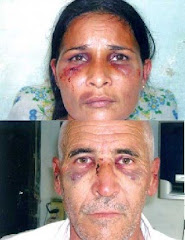
Jose Daniel Ferrer Will Not Allow Threats of Being Returned to Prison
Impede his Activism
Posted by Pedazos de la Isla on August 27, 2012
Former political prisoner and general coordinator of the Patriotic Union
of Cuba (UNPACU), Jose Daniel Ferrer Garcia, was kept in a dungeon for
more than 72 hours during his most recent detention and was threatened
by State Security agents that he could be sent back to prison if he
continues participating in and organizing dissident activities
throughout the Eastern region of the country. This time, his jailers
filmed him on numerous occasions, such as when they read him an official
warning letter which informed him that he'd be sent back to prison for
continuing to cause what they termed as "public disorders".
"They had that camera during the entire time, but they only filmed the
parts they found necessary", explained Ferrer Garcia, "for example, when
they put me in a cell with a terrible amount of heat, without food,
without communication, and without my medicines for my health
conditions- they didn't film any of that". The response of the dissident
leader when they read him the warning was "that until in Cuba human
rights are not respected, until there is no freedom, as long as Cubans
can't decide for themselves and be protagonists of their own destinies,
I am going to continue doing the same thing we have been doing, and many
other things- in a peaceful manner- in favor of freedom and democracy".
This most recent arrest of Ferrer Garcia took place on Friday, August
24th, when UNPACU was celebrating its 1 year anniversary of having been
created. For days prior to the date, combined forces of the political
police, the Rapid Response Brigades, and State Security unleashed a wave
of arrests and house raids against members of the mentioned organization
throughout Eastern Cuba.
One of the first cases was that of Jorge Cervantes García on August
23rd, when a number of armed officials raided his home in Contramaestre,
occupied many materials, threatened all those inside, and jailed
Cervantes Garcia and his two underage children. He still remains detained.
In the case of Ferrer, his home had been surrounded by police agents for
various days until they finally raided the house on the morning of the
24th. "They ransacked the house", said the dissident, "they robbed
everything they felt like, and what they did not steal they destroyed. I
am talking about even toys and belongings of my children…they have
robbed them or destroyed them".
In addition, in the home of Ferrer Garcia, as well as those of other
UNPACU activists, the police took printers, cameras, laptops, pamphlets
and other materials, none of which have been returned, as tends to happen.
Marta Beatriz Ferrer Cantillo, 14 year old Lady in White and daughter of
Jose Daniel, explained in an audio uploaded onto UNPACU's YouTube
account that police agents beat all those inside the house in the moment
of the arrest, including herself, her cousin, her mother (Belkis
Cantillo) and an aunt. Her elderly grandmother was also inside the house
and suffered a sharp increase in her blood pressure.
Other detainees on that day were Anyer Antonio Blanco, Rafael Miguel
Cabrera Montoya, Franklin Peregrino del Toro and Berta Guerrero Segura.
The latter, who is the representative of the Ladies in White in Holguin,
was arrested and mistreated along with her underage daughter, who she
was carrying at the time of her arrest and forceful entry into a police
vehicle.
Other reports denounced that another 6 homes were raided that day and
more than 60 arrests occurred.
Meanwhile, activist Luis Miguel Gomez Hernandez reported that a group of
UNPACU members were arrested in the municipality of Gibara on that same
Friday, among them Ladies in White like Yoandra Garrido Silva and
Maydaly Garrido Silva, as they too celebrated the anniversary. Gomez
Hernandez was one of the detainees that afternoon and explained that
they were all subjected to "interrogations and threats that we could not
leave Gibara and that we would not be allowed to carry out any dissident
activity, and that not even the Ladies in White could to Mass on
Sundays". This group was released but many other activists remain
imprisoned, and some are on hunger strike (Ferrer Garcia put the number
at more than 20).
"Despite all that they have done to us, our activists celebrated the
anniversary of UNPACU with marches, signs, pamphlets, slogans and other
diverse ways, not only in the East but also in the West", said Ferrer
Garcia, referencing the case of Hugo Damian Prieto Blanco, in Havana,
who was arrested after carrying out commemorative events.
Other activists of diverse pro-democracy groups also paid tribute to
UNPACU and demanded freedom for their detained members, as was the case
of Lady in White and member of the Rosa Parks Movement for Civil Rights
and the Pro-Human Rights Party of Cuba, Sara Marta Fonseca Quevedo, who
carried out a public protest in Havana to commemorate the Day of the
Resistance and in solidarity with the mentioned dissidents. In Placetas,
Villa Clara, dissident leader Jorge Luis Garcia Perez "Antunez" also
included messages of freedom for Jose Daniel Ferrer and congratulating
UNPACU as he also carried out a public protest along with other activists.
Jose Daniel Ferrer Garcia was released during the morning hours of
Sunday, August 26th and was quick to reiterate his compromise with the
pro-freedom movement in Cuba.
"The tyranny is very afraid", affirmed the dissident, "and like a
wounded beast, it will retaliate and cause lots of damage to peaceful
people who want freedom for all Cubans, but we are willing to give it
all. As Jose Marti said: 'Freedom has a high price, and it is necessary
to either give up and live without her, or decide to obtain it at its
price'".
–
For more information from Cuba:
Jose Daniel Ferrer Garcia – Phone: +5353-146-740 // Twitter: @jdanielferrer
http://pedazosdelaislaen.wordpress.com/2012/08/27/jose-daniel-ferrer-will-not-allow-threats-of-being-returned-to-prison-impede-his-activism/
Tuesday, August 28, 2012

Feminine Creativity in the Face of Natural Disasters in Cuba
Feminine Creativity in the Face of Natural Disasters in Cuba
By Ivet González
HAVANA, Aug 27 2012 (IPS) - Blanca Lima raises all her appliances above
flood level, puts boxes of clothes on top of wardrobes, and fills the
shelves she installed near the ceiling with all kinds of objects. In
less than an hour, she is ready to evacuate her home in case of a flood
in the Cuban capital.
"When they announce that there will be a high sea and flooding, I
already know where I'm going to put the refrigerator and set up a
platform to raise the mattresses. I have weathered so many floods that I
now have a whole system for dealing with them," Lima told IPS.
In their homes, Cuban women come up with strategies to minimise the
danger and losses during natural disasters like hurricanes. Gender
expert Isabel Moya says women have special talents in terms of
organising and empowering their communities during extreme events.
"The strengths of women have helped transform traditional practices and
dynamics, in environmental protection and risk management, for example,"
Moya told IPS. She advocates the recognition not only of the double
workday of women, their jobs and household responsibilities, but of a
triple workday, which includes their work in the community.
According to Moya, girls are educated in "the culture of care, a
capacity that is later transformed into strong neighbourhood involvement
by women.
"They relate to each other and establish solidarity among themselves in
a different way. These skills can generate a change in community ties,"
she said.
Lima travelled to the outskirts of Havana to try to buy scraps of
"jaimanitas", a typical flagstone used in Cuba to protect walls from the
damp, at a discount for herself and her neighbours.
"People who live in low-lying parts of this area are generally older,
retired persons, with little buying power," said Lima, who resides in
the low-lying area of the residential neighbourhood of Vedado, in the
Cuban capital.
"To reduce damage to housing, you need to pave with jaimanitas, but the
stone is very expensive," said Lima, a retired purchasing agent. At the
Havana office of the Empresa Mármoles Cubanos (Cuban marble company),
she got scraps for her home, and explained to the local government the
procedure for obtaining them at a low price for people in her community.
Especially during the June to November hurricane season, the sea floods
homes in this poor neighbourhood located near the Havana malecón – an
eight-km wall that lines the coast in the capital. During storms, the
water can penetrate several blocks uphill from the malecón, at a depth
of two metres, according to the Institute of Meteorology (INSMET).
An article published this year by INSMET researchers in the local
scientific journal "Ciencias de la tierra y el espacio" (Earth and Space
Sciences) analysed the data on flooding along the Havana malecón between
1901 and 2011, and concluded that the problem was becoming more frequent
and more intense, thus posing greater risks, as a result of climate change.
"I lost so much in 1993. That is not going to happen to me again," Lima
said, referring to the so-called "storm of the century", which caused
the greatest devastation to her home along with Hurricane Wilma in 2005.
The 1993 superstorm, the most intense registered up to then in the
Atlantic Ocean, did not touch land in Cuba. Nevertheless, it caused
severe flooding along the Havana coast. More than 20,000 people were
evacuated in Havana and some 200,000 from the areas at highest risk
throughout the country.
In the part of Havana where Lima lives, which mainly has buildings
several stories high, "almost no one goes to the designated shelters
anymore when there is a risk of flooding," she said.
"The tradition of taking in families from lower stories has been passed
down from generation to generation in my home," her fourth-floor
neighbour, Nélida Borigan, told IPS. She takes in Lima and her family
when natural catastrophes hit.
Borigan said women play a key role in making the maximum use of the
potential of each neighbourhood.
Current tendencies in integral disaster risk management take into
account gender inequality, women's leadership and community participation.
Because of the division of domestic labour, "giving shelter to other
people is a burden carried by women," Borigan said.
In a society that is still patriarchal, the weight of the home falls on
the shoulders of women, who in 2011 represented 60 percent of university
graduates and 63 percent of the technical staff employed in the public
sector, according to the National Office on Statistics and Information.
For that reason, Moya suggests using the civil defence office's public
service announcements to show both men and women involved in disaster
prevention and preparedness measures, in order to break with traditional
stereotypes.
The civil defence office is working to achieve a higher level of citizen
participation during disasters. Depending on the magnitude of the threat
and the characteristics of each locality, the office provides guidance
on how many people should take shelter, and keep certain possessions, in
nearby safe places to avoid transporting entire families and their
household goods.
Some people believe the civil defence office should provide them with
assistance, whereas others manage to organise themselves and
collectively solve their problems. "Women can generate a change with
respect to the care of the community," Moya said, referring to
initiatives that are not deeply rooted on the island, such as women's
networks.
"Refurbishing housing units (after a storm) depends on the drive of
local inhabitants and the neighbourhood. Participation by women is a
defining aspect when it comes to building, cleaning up and preventing
the spread of disease," journalist Ana Esther Zulueta, from the Isla de
la Juventud, the second-biggest island in the Cuban archipelago, told IPS.
"To address what the future has in store as a result of climate change,
people, especially women, have to gradually find their own systems of
adaptation and share their knowledge," said Lima, as she opened the
doors of her house to anyone interested in listening to her advice on
how to deal with floods.
http://www.ipsnews.net/2012/08/feminine-creativity-in-the-face-of-natural-disasters-in-cuba/
By Ivet González
HAVANA, Aug 27 2012 (IPS) - Blanca Lima raises all her appliances above
flood level, puts boxes of clothes on top of wardrobes, and fills the
shelves she installed near the ceiling with all kinds of objects. In
less than an hour, she is ready to evacuate her home in case of a flood
in the Cuban capital.
"When they announce that there will be a high sea and flooding, I
already know where I'm going to put the refrigerator and set up a
platform to raise the mattresses. I have weathered so many floods that I
now have a whole system for dealing with them," Lima told IPS.
In their homes, Cuban women come up with strategies to minimise the
danger and losses during natural disasters like hurricanes. Gender
expert Isabel Moya says women have special talents in terms of
organising and empowering their communities during extreme events.
"The strengths of women have helped transform traditional practices and
dynamics, in environmental protection and risk management, for example,"
Moya told IPS. She advocates the recognition not only of the double
workday of women, their jobs and household responsibilities, but of a
triple workday, which includes their work in the community.
According to Moya, girls are educated in "the culture of care, a
capacity that is later transformed into strong neighbourhood involvement
by women.
"They relate to each other and establish solidarity among themselves in
a different way. These skills can generate a change in community ties,"
she said.
Lima travelled to the outskirts of Havana to try to buy scraps of
"jaimanitas", a typical flagstone used in Cuba to protect walls from the
damp, at a discount for herself and her neighbours.
"People who live in low-lying parts of this area are generally older,
retired persons, with little buying power," said Lima, who resides in
the low-lying area of the residential neighbourhood of Vedado, in the
Cuban capital.
"To reduce damage to housing, you need to pave with jaimanitas, but the
stone is very expensive," said Lima, a retired purchasing agent. At the
Havana office of the Empresa Mármoles Cubanos (Cuban marble company),
she got scraps for her home, and explained to the local government the
procedure for obtaining them at a low price for people in her community.
Especially during the June to November hurricane season, the sea floods
homes in this poor neighbourhood located near the Havana malecón – an
eight-km wall that lines the coast in the capital. During storms, the
water can penetrate several blocks uphill from the malecón, at a depth
of two metres, according to the Institute of Meteorology (INSMET).
An article published this year by INSMET researchers in the local
scientific journal "Ciencias de la tierra y el espacio" (Earth and Space
Sciences) analysed the data on flooding along the Havana malecón between
1901 and 2011, and concluded that the problem was becoming more frequent
and more intense, thus posing greater risks, as a result of climate change.
"I lost so much in 1993. That is not going to happen to me again," Lima
said, referring to the so-called "storm of the century", which caused
the greatest devastation to her home along with Hurricane Wilma in 2005.
The 1993 superstorm, the most intense registered up to then in the
Atlantic Ocean, did not touch land in Cuba. Nevertheless, it caused
severe flooding along the Havana coast. More than 20,000 people were
evacuated in Havana and some 200,000 from the areas at highest risk
throughout the country.
In the part of Havana where Lima lives, which mainly has buildings
several stories high, "almost no one goes to the designated shelters
anymore when there is a risk of flooding," she said.
"The tradition of taking in families from lower stories has been passed
down from generation to generation in my home," her fourth-floor
neighbour, Nélida Borigan, told IPS. She takes in Lima and her family
when natural catastrophes hit.
Borigan said women play a key role in making the maximum use of the
potential of each neighbourhood.
Current tendencies in integral disaster risk management take into
account gender inequality, women's leadership and community participation.
Because of the division of domestic labour, "giving shelter to other
people is a burden carried by women," Borigan said.
In a society that is still patriarchal, the weight of the home falls on
the shoulders of women, who in 2011 represented 60 percent of university
graduates and 63 percent of the technical staff employed in the public
sector, according to the National Office on Statistics and Information.
For that reason, Moya suggests using the civil defence office's public
service announcements to show both men and women involved in disaster
prevention and preparedness measures, in order to break with traditional
stereotypes.
The civil defence office is working to achieve a higher level of citizen
participation during disasters. Depending on the magnitude of the threat
and the characteristics of each locality, the office provides guidance
on how many people should take shelter, and keep certain possessions, in
nearby safe places to avoid transporting entire families and their
household goods.
Some people believe the civil defence office should provide them with
assistance, whereas others manage to organise themselves and
collectively solve their problems. "Women can generate a change with
respect to the care of the community," Moya said, referring to
initiatives that are not deeply rooted on the island, such as women's
networks.
"Refurbishing housing units (after a storm) depends on the drive of
local inhabitants and the neighbourhood. Participation by women is a
defining aspect when it comes to building, cleaning up and preventing
the spread of disease," journalist Ana Esther Zulueta, from the Isla de
la Juventud, the second-biggest island in the Cuban archipelago, told IPS.
"To address what the future has in store as a result of climate change,
people, especially women, have to gradually find their own systems of
adaptation and share their knowledge," said Lima, as she opened the
doors of her house to anyone interested in listening to her advice on
how to deal with floods.
http://www.ipsnews.net/2012/08/feminine-creativity-in-the-face-of-natural-disasters-in-cuba/
Cuba’s Slow Awakening
Cuba's Slow Awakening
August 27, 2012
Erasmo Calzadilla
HAVANA TIMES — The following is an excerpt from a piece published in the
"Letters to the Editor" section of the Spanish edition of the official
Granma newspaper:
"There might be other reasons to explain why productivity hasn't
increased, but what has been demonstrated so far is that the methods
adopted haven't succeeded, despite the years they've been employed.
"A completely different situation is happening with the prices of
products and services that people have to buy for their everyday
household needs.
"With the exception of the few products that are still on the ration
book, but that only cover the needs for a part of the month, the other
prices are constantly increasing. Some of those are because they're
imported and prices are increasing globally, while others are because
these are artificially increased by self-employed vendors.
"Such prices are rising beyond the reach of the average family, whose
situation is becoming extremely tense and in time will become
unbearable." — E. Naranjo Torres
Almost all the letters in that section have a similar ring, with the
fault being directed at and falling on self-employed workers,
bureaucrats or capitalism – though the system itself remains intact.
The part saying the ration book "only covers the needs for a part of the
month" is an inaccurate expression; it covers only some basic products
for a fraction of the month. But apart from these digressions and
inaccuracies, I think the man made some very bold statements: the
economic reforms "haven't succeeded" and "the situation is becoming
extremely tense."
If this same thing had been said by some blogger, no supporter of the
revolution from abroad would have believed it. It's true that there's no
starvation or a humanitarian crisis, but things are looking ugly and in
time it's likely "they'll become unbearable."
Raul's reforms, at least in the capital, haven't been successful. The
GDP* has been on an uphill march since 1994, but the purchasing power of
the average Cuban family seems to be going backward. It's the same with
health care, education, the availability of food and public transportation.
I sense a growing discomfort, but one that shows no signs of evolving
into any kind of new political consciousness. It's as if they've
administered a vaccine against it.
If disturbances were to occur in the future, the political and economic
elites would make the most of that at the expense of those who are the
most passive and unorganized: the general public and the workers.
The distortion of political consciousness is a key in the construction
of "socialism" – but it's also its weakness.
—–
(*) http://www.ecured.cu/index.php/Producto_Interno_Bruto_en_Cuba
http://www.havanatimes.org/?p=77323
August 27, 2012
Erasmo Calzadilla
HAVANA TIMES — The following is an excerpt from a piece published in the
"Letters to the Editor" section of the Spanish edition of the official
Granma newspaper:
"There might be other reasons to explain why productivity hasn't
increased, but what has been demonstrated so far is that the methods
adopted haven't succeeded, despite the years they've been employed.
"A completely different situation is happening with the prices of
products and services that people have to buy for their everyday
household needs.
"With the exception of the few products that are still on the ration
book, but that only cover the needs for a part of the month, the other
prices are constantly increasing. Some of those are because they're
imported and prices are increasing globally, while others are because
these are artificially increased by self-employed vendors.
"Such prices are rising beyond the reach of the average family, whose
situation is becoming extremely tense and in time will become
unbearable." — E. Naranjo Torres
Almost all the letters in that section have a similar ring, with the
fault being directed at and falling on self-employed workers,
bureaucrats or capitalism – though the system itself remains intact.
The part saying the ration book "only covers the needs for a part of the
month" is an inaccurate expression; it covers only some basic products
for a fraction of the month. But apart from these digressions and
inaccuracies, I think the man made some very bold statements: the
economic reforms "haven't succeeded" and "the situation is becoming
extremely tense."
If this same thing had been said by some blogger, no supporter of the
revolution from abroad would have believed it. It's true that there's no
starvation or a humanitarian crisis, but things are looking ugly and in
time it's likely "they'll become unbearable."
Raul's reforms, at least in the capital, haven't been successful. The
GDP* has been on an uphill march since 1994, but the purchasing power of
the average Cuban family seems to be going backward. It's the same with
health care, education, the availability of food and public transportation.
I sense a growing discomfort, but one that shows no signs of evolving
into any kind of new political consciousness. It's as if they've
administered a vaccine against it.
If disturbances were to occur in the future, the political and economic
elites would make the most of that at the expense of those who are the
most passive and unorganized: the general public and the workers.
The distortion of political consciousness is a key in the construction
of "socialism" – but it's also its weakness.
—–
(*) http://www.ecured.cu/index.php/Producto_Interno_Bruto_en_Cuba
http://www.havanatimes.org/?p=77323
More than 400 Cuban beaches affected by erosion
More than 400 Cuban beaches affected by erosion
Published August 27, 2012
EFE
A total of 413 Cuban beaches show some signs of erosion, with the
coastline retreating at an estimated rate of 1.2 meters (3 feet 11
inches) per year, according to a recent scientific study released Monday
by official media.
Scientists from more than a dozen institutions took part in a long-term
study of potential coastal vulnerability with a view toward the years
2050 and 2100, which forecast the situation at beaches including those
at the Varadero resort, the most famous on the Caribbean island, an
article in the Communist Party daily Granma said.
The head of the Coastal Processes Department of the Oceanology
Institute, Jose Luis Juanes, said that in many cases the determining
cause of erosion may be described as unhelpful human activities.
Erosion is seen today at around 84 percent of the beaches from one end
of Cuba to the other.
Among the types of human intervention that cause erosion, the researcher
noted the removal of sand for different uses, the incorrect location of
docks and breakwaters at the entrance to canals, as well as construction
on areas of natural sand dunes.
Another factor contributing to this eating away of beaches is the impact
of storm surges during extreme weather events.
In that sense he noted that the studies carried out show how, during
powerful hurricanes, coastal flooding begins to swallow up the dunes at
several points.
He said that this process causes sand to be shifted to interior lagoons
and as a result leaves the coastline with significant structural changes.
The article also said that solutions applied to protect the coastline
include the replacement of sand, and as an example cited the case of
Varadero, where since 1987 some 2.9 million cubic meters (102 million
cubic feet) of sand have been deposited on different stretches along its
20 kilometers (12 miles) of beaches. EFE
http://latino.foxnews.com/latino/news/2012/08/27/more-than-400-cuban-beaches-affected-by-erosion/
Published August 27, 2012
EFE
A total of 413 Cuban beaches show some signs of erosion, with the
coastline retreating at an estimated rate of 1.2 meters (3 feet 11
inches) per year, according to a recent scientific study released Monday
by official media.
Scientists from more than a dozen institutions took part in a long-term
study of potential coastal vulnerability with a view toward the years
2050 and 2100, which forecast the situation at beaches including those
at the Varadero resort, the most famous on the Caribbean island, an
article in the Communist Party daily Granma said.
The head of the Coastal Processes Department of the Oceanology
Institute, Jose Luis Juanes, said that in many cases the determining
cause of erosion may be described as unhelpful human activities.
Erosion is seen today at around 84 percent of the beaches from one end
of Cuba to the other.
Among the types of human intervention that cause erosion, the researcher
noted the removal of sand for different uses, the incorrect location of
docks and breakwaters at the entrance to canals, as well as construction
on areas of natural sand dunes.
Another factor contributing to this eating away of beaches is the impact
of storm surges during extreme weather events.
In that sense he noted that the studies carried out show how, during
powerful hurricanes, coastal flooding begins to swallow up the dunes at
several points.
He said that this process causes sand to be shifted to interior lagoons
and as a result leaves the coastline with significant structural changes.
The article also said that solutions applied to protect the coastline
include the replacement of sand, and as an example cited the case of
Varadero, where since 1987 some 2.9 million cubic meters (102 million
cubic feet) of sand have been deposited on different stretches along its
20 kilometers (12 miles) of beaches. EFE
http://latino.foxnews.com/latino/news/2012/08/27/more-than-400-cuban-beaches-affected-by-erosion/
Cuba Vice President Marino Murillo’s daughter defected and is living in Tampa
Posted on Monday, 08.27.12
Cuba Vice President Marino Murillo's daughter defected and is living in
Tampa
By Juan O. Tamayo
jtamayo@ElNuevoHerald.com
The 24-year-old daughter of Cuban Vice President Marino Murillo,
sometimes mentioned as a possible successor to ruler Raúl Castro,
defected earlier this month and is now living in Tampa, knowledgeable
sources said.
Glenda Murillo Diaz crossed the Mexico border at Laredo, Texas, around
Aug. 16, the sources told El Nuevo Herald, meaning she was paroled under
the wet-foot, dry-foot policy, which allows Cubans who set foot on U.S.
land to stay.
Her decision to abandon communist-ruled Cuba and settle in the
historically antagonistic United States would be a vote of no-confidence
on the profound economic reforms that Castro has ordered and that her
father is in charge of enacting.
Marino Murillo, 51, known as Cuba's "reforms tsar," is vice president of
the ruling Council of State and member of the powerful political bureau
of the Cuban Communist Party. Castro last year put him in charge of
executing the reforms.
A portly economist reported to have served as a military officer, he
first came to public notice in 2006 when Castro, who served for decades
as defense minister before succeeding brother Fidel, named him minister
of internal commerce. He was later appointed as minister of planning and
economy.
Glenda Murillo Diaz is his daughter and never received a U.S. visa to
visit relatives or study in the United States, said the knowledgeable
sources, who asked to remain anonymous because they were not authorized
to officially comment on the case.
A person who claimed to have learned of Murillo Diaz's defection from
her relatives in Havana had been sending anonymous tips to El Nuevo
Herald since last Monday, but the information could not be totally
confirmed until Monday.
The young woman left Cuba about two weeks ago to attend a psychology
conference in Mexico and turned up later at the Tampa home of a maternal
aunt, Idania Diaz, who is married to Boris Loynaz, according to the person.
Her grandfather, Rolando Diaz, a Havana resident, happened to be
visiting Idania Diaz in Tampa when Murillo Diaz arrived, the person
added. Her father broke down crying when he learned of the defection,
another relative in Havana told several neighbors.
A young woman who identified herself only as Glenda Murillo started a
Facebook page last Tuesday that described her as a 24-year-old
psychology student at the University of Havana.
She posted one photo of herself somewhere hugging "Aunt Idy" and "Uncle
Boris" and another smiling and leaning against an Elvis fortune-telling
machine. El Nuevo confirmed the Elvis machine is at The Pier, a tourist
attraction in St. Petersburg, Fla.
Other photos she posted on Facebook and then removed showed her at a
Hooters restaurant, hugging an elderly man and at Sculleys, a popular
seafood restaurant in Madeira Beach north of St. Petersburg.
A man who answered the Cuban cell phone registered to Murillo Diaz and
identified himself as her husband first told El Nuevo that she was in
Tampa and would not be making any public comment. Asked if she had
defected, he then said she was in Mexico and later that she was in
Havana. He did not give his name and hung up.
A woman who identified herself as Rolando Diaz's wife, Norma, said she
could not comment when asked by phone if her niece had defected or
planned to return to Cuba after visiting relatives in Tampa.
Several messages sent by El Nuevo to the Facebook accounts of Glenda
Murillo and Idania Diaz were not returned. Glenda Murillo first accepted
a Facebook friend request from an El Nuevo reporter, then quickly
unfriended him. A woman who answered a phone listed to an Idania Diaz in
Tampa hung up.
The Glenda Murillo in the Facebook photos bears a strong resemblance to
the daughter of Marino Murillo, as shown in photos that were posted on
the Facebook page of another Murillo daughter, Claudia.
Murillo Diaz did not receive a U.S. visa to visit or study, according to
the knowledgeable sources. One Cuban man said he heard a vague report
recently that a daughter of the vice president had received a
scholarship to study in the United States.
Thousands of Cubans arrive in the United States each year by land from
Mexico, then present themselves to U.S. border authorities so that they
can be covered by the wet-foot, dry-foot policy.
One of the most senior Cuban government officials to defect in recent
years, Pedro Alvarez, 68, the former head of the government agency in
charge of all food and agricultural imports, also went to live with
relatives in Tampa in late 2010.
Alvarez, who had been under investigation for corruption at the Alimport
agency — which bought $711.5 million worth of U.S. products in 2008 —
has never publicly confirmed that he defected or that he lives in Tampa.
http://www.miamiherald.com/2012/08/27/2970877/cuba-vice-president-marino-murillos.html
Cuba Vice President Marino Murillo's daughter defected and is living in
Tampa
By Juan O. Tamayo
jtamayo@ElNuevoHerald.com
The 24-year-old daughter of Cuban Vice President Marino Murillo,
sometimes mentioned as a possible successor to ruler Raúl Castro,
defected earlier this month and is now living in Tampa, knowledgeable
sources said.
Glenda Murillo Diaz crossed the Mexico border at Laredo, Texas, around
Aug. 16, the sources told El Nuevo Herald, meaning she was paroled under
the wet-foot, dry-foot policy, which allows Cubans who set foot on U.S.
land to stay.
Her decision to abandon communist-ruled Cuba and settle in the
historically antagonistic United States would be a vote of no-confidence
on the profound economic reforms that Castro has ordered and that her
father is in charge of enacting.
Marino Murillo, 51, known as Cuba's "reforms tsar," is vice president of
the ruling Council of State and member of the powerful political bureau
of the Cuban Communist Party. Castro last year put him in charge of
executing the reforms.
A portly economist reported to have served as a military officer, he
first came to public notice in 2006 when Castro, who served for decades
as defense minister before succeeding brother Fidel, named him minister
of internal commerce. He was later appointed as minister of planning and
economy.
Glenda Murillo Diaz is his daughter and never received a U.S. visa to
visit relatives or study in the United States, said the knowledgeable
sources, who asked to remain anonymous because they were not authorized
to officially comment on the case.
A person who claimed to have learned of Murillo Diaz's defection from
her relatives in Havana had been sending anonymous tips to El Nuevo
Herald since last Monday, but the information could not be totally
confirmed until Monday.
The young woman left Cuba about two weeks ago to attend a psychology
conference in Mexico and turned up later at the Tampa home of a maternal
aunt, Idania Diaz, who is married to Boris Loynaz, according to the person.
Her grandfather, Rolando Diaz, a Havana resident, happened to be
visiting Idania Diaz in Tampa when Murillo Diaz arrived, the person
added. Her father broke down crying when he learned of the defection,
another relative in Havana told several neighbors.
A young woman who identified herself only as Glenda Murillo started a
Facebook page last Tuesday that described her as a 24-year-old
psychology student at the University of Havana.
She posted one photo of herself somewhere hugging "Aunt Idy" and "Uncle
Boris" and another smiling and leaning against an Elvis fortune-telling
machine. El Nuevo confirmed the Elvis machine is at The Pier, a tourist
attraction in St. Petersburg, Fla.
Other photos she posted on Facebook and then removed showed her at a
Hooters restaurant, hugging an elderly man and at Sculleys, a popular
seafood restaurant in Madeira Beach north of St. Petersburg.
A man who answered the Cuban cell phone registered to Murillo Diaz and
identified himself as her husband first told El Nuevo that she was in
Tampa and would not be making any public comment. Asked if she had
defected, he then said she was in Mexico and later that she was in
Havana. He did not give his name and hung up.
A woman who identified herself as Rolando Diaz's wife, Norma, said she
could not comment when asked by phone if her niece had defected or
planned to return to Cuba after visiting relatives in Tampa.
Several messages sent by El Nuevo to the Facebook accounts of Glenda
Murillo and Idania Diaz were not returned. Glenda Murillo first accepted
a Facebook friend request from an El Nuevo reporter, then quickly
unfriended him. A woman who answered a phone listed to an Idania Diaz in
Tampa hung up.
The Glenda Murillo in the Facebook photos bears a strong resemblance to
the daughter of Marino Murillo, as shown in photos that were posted on
the Facebook page of another Murillo daughter, Claudia.
Murillo Diaz did not receive a U.S. visa to visit or study, according to
the knowledgeable sources. One Cuban man said he heard a vague report
recently that a daughter of the vice president had received a
scholarship to study in the United States.
Thousands of Cubans arrive in the United States each year by land from
Mexico, then present themselves to U.S. border authorities so that they
can be covered by the wet-foot, dry-foot policy.
One of the most senior Cuban government officials to defect in recent
years, Pedro Alvarez, 68, the former head of the government agency in
charge of all food and agricultural imports, also went to live with
relatives in Tampa in late 2010.
Alvarez, who had been under investigation for corruption at the Alimport
agency — which bought $711.5 million worth of U.S. products in 2008 —
has never publicly confirmed that he defected or that he lives in Tampa.
http://www.miamiherald.com/2012/08/27/2970877/cuba-vice-president-marino-murillos.html
Monday, August 27, 2012
The Out-of-Date Updating
The Out-of-Date Updating
August 27, 2012
Alfredo Fernandez Rodriguez
HAVANA TIMES — Recently, I read with amazement about the news of
Professor Elaine Diaz announcing the "farewell" of her blog.
The fact somewhat dismayed me, because — though I don't share her faith
in the salvation of the Cuban regime — I do respect her for the
seriousness with which she generally presented her writings, well
removed from the rigidity of the national press.
Just over a month ago we witnessed the "death" of the website Joven
Cuba, run by pro-government young academics who also said they "decided"
to shut down their blog.
However shortly after they said they'd be reopening it with new
opportunities for access. After six weeks though, there's still no trace
of Joven Cuba. Hopefully it will reopen when their new school year begins.
There's an old saying that goes: "In politics, what's real is unseen."
If that's so, then we can speculate about the closing of these two sites
where young government supporters felt freer than in the written press.
There they criticized real things, though without going into too much
depth into the causes, while defending the revolution as a viable system
as long as the necessary changes are made.
Things must be going pretty bad for the Cuban government if it has to
pressure even its younger defenders to give up their efforts on the
Internet.
If there's anything indisputable about the "updating of the Cuban
model," it's that its essential to maintain people out-of-touch such as
always occurs with censorship and the abduction of words, all of this in
order to survive.
I should reiterate that I have no evidence that Joven Cuba or Elaine
Daiz were pressured by the agencies of state security to close their
respective blogs, but I find it all too suspicious.
Now that it seems that Raulism can't even put up with its "independent
defenders" in a medium such as the Internet — with very low impact on
Cuban public opinion — it seems logical to speculate on who will be the
next pro-government blogger to "say farewell."
http://www.havanatimes.org/?p=77318
August 27, 2012
Alfredo Fernandez Rodriguez
HAVANA TIMES — Recently, I read with amazement about the news of
Professor Elaine Diaz announcing the "farewell" of her blog.
The fact somewhat dismayed me, because — though I don't share her faith
in the salvation of the Cuban regime — I do respect her for the
seriousness with which she generally presented her writings, well
removed from the rigidity of the national press.
Just over a month ago we witnessed the "death" of the website Joven
Cuba, run by pro-government young academics who also said they "decided"
to shut down their blog.
However shortly after they said they'd be reopening it with new
opportunities for access. After six weeks though, there's still no trace
of Joven Cuba. Hopefully it will reopen when their new school year begins.
There's an old saying that goes: "In politics, what's real is unseen."
If that's so, then we can speculate about the closing of these two sites
where young government supporters felt freer than in the written press.
There they criticized real things, though without going into too much
depth into the causes, while defending the revolution as a viable system
as long as the necessary changes are made.
Things must be going pretty bad for the Cuban government if it has to
pressure even its younger defenders to give up their efforts on the
Internet.
If there's anything indisputable about the "updating of the Cuban
model," it's that its essential to maintain people out-of-touch such as
always occurs with censorship and the abduction of words, all of this in
order to survive.
I should reiterate that I have no evidence that Joven Cuba or Elaine
Daiz were pressured by the agencies of state security to close their
respective blogs, but I find it all too suspicious.
Now that it seems that Raulism can't even put up with its "independent
defenders" in a medium such as the Internet — with very low impact on
Cuban public opinion — it seems logical to speculate on who will be the
next pro-government blogger to "say farewell."
http://www.havanatimes.org/?p=77318
On the Day After, Who Could Replace the Castros?
On the Day After, Who Could Replace the Castros? / Ivan Garcia
Ivan Garcia, Translator: Unstated
Some people in Cuba are already placing bets. Everyone knows that within
five to ten years power could change hands. The unknowns are whether the
successor will have the last name of Castro, and if the inefficient
political and economic system will be preserved.
Raúl Castro crafted a law limiting time in political office to two
five-year terms. If he were to apply this to himself, he would have to
retire from national politics in 2016. If one assumes his official rise
to power occurred in 2008, then his retirement would begin in 2018.
But autocrats often do not abide by their decrees. Rules are for others,
not for themselves. And many on the island believe that as long he is of
sound mind and enjoys good health the general will continue to rule the
nation.
Cubans like to prognosticate. And to bet. The underground lottery is a
popular pastime. For example, baseball fans are making predictions about
the World Classic in 2013. On questions of politics, however, they are
cowardly. Fidel Castro always considered it a crime to be politically
ambitious, and his subordinates were always careful about saying
anything that might be construed as a declaration of a future possible
presidential candidacy.
More than a few heads have rolled for coveting the throne.Roberto
Robaina, a former foreign minister, has become the owner of a successful
private restaurant. Others, such as Felipe Pérez Roque y Carlos Lage,
fell from grace and are now two obscure, low-level bureaucrats. In the
last Communist Party Congress, the younger Castro warned of the dearth
of young politicians and functionaries, and stated that, in the future,
no president would be able to rule for more than a decade.
An eighteen-person survey a group of well-informed people, who have
access to the internet and illegal cable antennae, believe that, if the
nation continues on its present course, Raúl himself will handpick the
next president.
Who might be the successors? Seven believe it will be Alejandro Castro,
coordinator of the secret services. He is young and has the Castro name,
which would allow for the continuation of the family dynasty. Four
believe the next president will be someone from Raúl's old guard and
point to Leopoldo Cintras Frías, minister of the armed forces.
Two of those surveyed think that, in a Cuba of the future, a military
junta will rule. Five believe that Mariela Castro, Lázaro Expósito,
Marino Murillo, Luis Alberto López-Callejas or Miguel Díaz Canel might
be president given their family ties or political affinities with Raúl
Castro.
What would the political landscape look like? Those surveyed could not
even imagine, but speculated a bit and wagered some guesses. Nine felt
that, if Fidel Castro were no longer alive, the successor would opt for
a market economy and a strong government run by a committee with the
presidency rotating among its members.
They could craft a country with a democratic veneer like Russia. If the
United States negotiates, dialogs with and accepts whoever might be
Castro's successor—shielding itself from security concerns over illegal
immigration, terrorism and drug trafficking—it might prefer an
authoritarian government. It would not be overly concerned if such a
government discreetly violated individual freedoms, provided it
controlled its borders. This would be preferable to a weak or corrupt
democracy, which might turn the island into a giant raft or a fertile
ground for international narco-trafficking.
They also believe that Castro's successor would seek a relationship with
Washington that casts aside the Cold War diplomacy crafted by Fidel
Castro. Several of those interviewed felt that the United States would
not tolerate a "Castro light"government and would continue to press for
real democracy with the participation of all the political actors.
If it came to pass, which opposition politicians or dissident leaders
could govern the country the day after the Castros? Those surveyed felt
that, given the level of repression and lack of leadership, no one
figure stood outat the moment.
Some believe that Oswaldo Payá Sardiñas would have been a good
candidate, but after his unexpected death, they now favor Oscar Elías
Biscet. Others mention Manuel Cuesta Morúa because he has more
experience and a longer resumé than EliécerÁvila or Antonio Rodriles.
Although unknown by the general public, the blogger Yoani Sánchez was
mentioned by one person as a possible candidate. However, in an
extensive interview I did with Yoani, published in two parts—the first
in February, the second in September—she indicated she was neither an
opposition figure nor a dissident, and did not see herself in a
political role. She rejected it because she finds politics repulsive.
All eighteen of those surveyed think the opposition should focus its
work on the community and developing a viable, inclusive and coherent
political platform. They feel the future president of Cuba need not
necessarily be an opposition figure or someone tied to the current
regime. He or she could be an ordinary citizen, now walking among us,
who, at a given moment, could become a leading figure. Or a Cuban exile
with good political connections in the United States and to the
financial world. Someone brought up in a democratic and transparent
environment. Whichever version Cuba becomes after Castro, all agree that
the role Cuban exiles play will be fundamental.
Personally, I am leaning towards a woman, provided it is not Mariela
Castro or Aleida Guevara, who are too closely tied to the Castros. Cuba
is in need of the female soul. I would not mind if it were Miriam
Celaya, Laritza Diversent or Rosa María Payá. I am quite fed up with all
the chest thumping. There's been enough testosterone.
Photo: Rosa María Payá Acevedo, twenty-three years old, reading a few
wordsat Havana's Saviour of the World church on July 24, 2012during a
funeral mass for her father, Oswaldo Payá Sardiñas, shortly before his
internment at Cementerio de Colón. Taken from the blog, Razones de la
Palabra, Radio Netherlands.
August 26 2012
http://translatingcuba.com/on-the-day-after-who-could-replace-the-castros-ivan-garcia/
Ivan Garcia, Translator: Unstated
Some people in Cuba are already placing bets. Everyone knows that within
five to ten years power could change hands. The unknowns are whether the
successor will have the last name of Castro, and if the inefficient
political and economic system will be preserved.
Raúl Castro crafted a law limiting time in political office to two
five-year terms. If he were to apply this to himself, he would have to
retire from national politics in 2016. If one assumes his official rise
to power occurred in 2008, then his retirement would begin in 2018.
But autocrats often do not abide by their decrees. Rules are for others,
not for themselves. And many on the island believe that as long he is of
sound mind and enjoys good health the general will continue to rule the
nation.
Cubans like to prognosticate. And to bet. The underground lottery is a
popular pastime. For example, baseball fans are making predictions about
the World Classic in 2013. On questions of politics, however, they are
cowardly. Fidel Castro always considered it a crime to be politically
ambitious, and his subordinates were always careful about saying
anything that might be construed as a declaration of a future possible
presidential candidacy.
More than a few heads have rolled for coveting the throne.Roberto
Robaina, a former foreign minister, has become the owner of a successful
private restaurant. Others, such as Felipe Pérez Roque y Carlos Lage,
fell from grace and are now two obscure, low-level bureaucrats. In the
last Communist Party Congress, the younger Castro warned of the dearth
of young politicians and functionaries, and stated that, in the future,
no president would be able to rule for more than a decade.
An eighteen-person survey a group of well-informed people, who have
access to the internet and illegal cable antennae, believe that, if the
nation continues on its present course, Raúl himself will handpick the
next president.
Who might be the successors? Seven believe it will be Alejandro Castro,
coordinator of the secret services. He is young and has the Castro name,
which would allow for the continuation of the family dynasty. Four
believe the next president will be someone from Raúl's old guard and
point to Leopoldo Cintras Frías, minister of the armed forces.
Two of those surveyed think that, in a Cuba of the future, a military
junta will rule. Five believe that Mariela Castro, Lázaro Expósito,
Marino Murillo, Luis Alberto López-Callejas or Miguel Díaz Canel might
be president given their family ties or political affinities with Raúl
Castro.
What would the political landscape look like? Those surveyed could not
even imagine, but speculated a bit and wagered some guesses. Nine felt
that, if Fidel Castro were no longer alive, the successor would opt for
a market economy and a strong government run by a committee with the
presidency rotating among its members.
They could craft a country with a democratic veneer like Russia. If the
United States negotiates, dialogs with and accepts whoever might be
Castro's successor—shielding itself from security concerns over illegal
immigration, terrorism and drug trafficking—it might prefer an
authoritarian government. It would not be overly concerned if such a
government discreetly violated individual freedoms, provided it
controlled its borders. This would be preferable to a weak or corrupt
democracy, which might turn the island into a giant raft or a fertile
ground for international narco-trafficking.
They also believe that Castro's successor would seek a relationship with
Washington that casts aside the Cold War diplomacy crafted by Fidel
Castro. Several of those interviewed felt that the United States would
not tolerate a "Castro light"government and would continue to press for
real democracy with the participation of all the political actors.
If it came to pass, which opposition politicians or dissident leaders
could govern the country the day after the Castros? Those surveyed felt
that, given the level of repression and lack of leadership, no one
figure stood outat the moment.
Some believe that Oswaldo Payá Sardiñas would have been a good
candidate, but after his unexpected death, they now favor Oscar Elías
Biscet. Others mention Manuel Cuesta Morúa because he has more
experience and a longer resumé than EliécerÁvila or Antonio Rodriles.
Although unknown by the general public, the blogger Yoani Sánchez was
mentioned by one person as a possible candidate. However, in an
extensive interview I did with Yoani, published in two parts—the first
in February, the second in September—she indicated she was neither an
opposition figure nor a dissident, and did not see herself in a
political role. She rejected it because she finds politics repulsive.
All eighteen of those surveyed think the opposition should focus its
work on the community and developing a viable, inclusive and coherent
political platform. They feel the future president of Cuba need not
necessarily be an opposition figure or someone tied to the current
regime. He or she could be an ordinary citizen, now walking among us,
who, at a given moment, could become a leading figure. Or a Cuban exile
with good political connections in the United States and to the
financial world. Someone brought up in a democratic and transparent
environment. Whichever version Cuba becomes after Castro, all agree that
the role Cuban exiles play will be fundamental.
Personally, I am leaning towards a woman, provided it is not Mariela
Castro or Aleida Guevara, who are too closely tied to the Castros. Cuba
is in need of the female soul. I would not mind if it were Miriam
Celaya, Laritza Diversent or Rosa María Payá. I am quite fed up with all
the chest thumping. There's been enough testosterone.
Photo: Rosa María Payá Acevedo, twenty-three years old, reading a few
wordsat Havana's Saviour of the World church on July 24, 2012during a
funeral mass for her father, Oswaldo Payá Sardiñas, shortly before his
internment at Cementerio de Colón. Taken from the blog, Razones de la
Palabra, Radio Netherlands.
August 26 2012
http://translatingcuba.com/on-the-day-after-who-could-replace-the-castros-ivan-garcia/
Sarcasm
Sarcasm / Rosa Maria Rodriguez Torrado
Rosa Maria Rodriguez Torrado, Translating Cuba, Translator: Christopher
Andrew Smith
The Cuban government defends the rights of American citizens to travel
to Cuba.
For foreigners, they file complaints and take matters to court,
something they refuse to do for their own countrymen and women, where
they determine, without a moment's hesitation and with no qualms, those
able to temporarily travel wherever they like and those from whom they
snatch away this lofty ambition.<
And Cubans who reside elsewhere — including those within the United
States — do not escape this selective, discriminatory pointed-finger
which decides who gets to enter home soil and who doesn't.
These laws are capricious and one-sided: a fifty-year long, degrading
blockade of the rights and freedoms of the Cuban people.
Translated by Christopher Andrew Smith
August 25 2012
http://translatingcuba.com/sarcasm-rosa-maria-rodriguez-torrado/
Rosa Maria Rodriguez Torrado, Translating Cuba, Translator: Christopher
Andrew Smith
The Cuban government defends the rights of American citizens to travel
to Cuba.
For foreigners, they file complaints and take matters to court,
something they refuse to do for their own countrymen and women, where
they determine, without a moment's hesitation and with no qualms, those
able to temporarily travel wherever they like and those from whom they
snatch away this lofty ambition.<
And Cubans who reside elsewhere — including those within the United
States — do not escape this selective, discriminatory pointed-finger
which decides who gets to enter home soil and who doesn't.
These laws are capricious and one-sided: a fifty-year long, degrading
blockade of the rights and freedoms of the Cuban people.
Translated by Christopher Andrew Smith
August 25 2012
http://translatingcuba.com/sarcasm-rosa-maria-rodriguez-torrado/
Campaign for a National General Strike
Campaign for a National General Strike / Jorge Luis García Pérez Antunez
Antunez - Jorge Luis Garcia Perez, Translator: Unstated
The National General Strike is an important initiative sponsored by
theOrlando Zapata TamayoNational Front for Civic Resistance and
Disobedience. As its name indicates, this initiative seeks a partial
paralysis of the entire national infrastructure through strong and
systematic actions by the forces of internal resistance. In its first
and second stages the General Strike is part of a continuing campaign of
non-cooperation. This strike can be successful only after a real and
resolute decision by a significant number of citizens to deny
responsibility for, or to cooperate with, the oppressive regime.
It must be made clear that, although the National Front is calling for
and sponsoring this crucial campaign, it can only be viable with the
participation of each and every constituency for change, whether it be
the National Front, political parties, movements, regional coalitions—in
other words the energetic forces of Cuban resistance, which are the
primary vehicle of democratic change.
The campaign for the National General Strike will use only peaceful
means so that no constituencies which take part can in any way confuse
the strike with economic sabotage, or the destruction of or attacks on
state or private property.
It is the policy of the General Strike to be dissuasive and persuasive,
acknowledging that, to succeed, we must work patiently, motivated by
great faith and certainty. The only true potential for change comes from
citizens who support us, as well as those who simply look upon us with
indifference, fear or admiration for what we are doing. This includes
those we see walking beside us, in line behind us, from a private
office, and even those attacking us in so-called acts of repudiation.
All can unite with us and contribute to the great day of the General Strike.
The campaign for a General Strike can, in a powerful way, also help to
do away with the worrying fear of change that persists in many areas of
society, especially among those who are ill-informed and those most
compromised by the current regime.
The concept must be clearly understood, both by the promoters of the
General Strike as well as by those who hear its message. The purpose of
the strike is not to destroy, obstruct or cause damage to anyone or
anything. Its intention is to peacefully boycott the means of production
that confer profits on those who misgovern the millions of Cubans who
are hungry, oppressed, and without liberty or the right to protest.
The Strike is a decision and commitment by everyone, or by a great and
significant majority of Cubans, to say, "Enough!" The strategy of the
General Strike is in accordance with basic, universally recognized
rights and freedoms, which—together with the peaceful tactics it
employs—gives it legitimacy and puts it in harmony with human dignity
itself, something of primary importance.
Though a recent idea,one born that was born in Cuba, the strategy of the
General Strike Campaign is based on innumerable precedents and inspired
by similar actions around the globe. These have been successful in spite
of a number of differing circumstances, such as culture and language.
The change which the General Strike seeks is viable under any
circumstance in the struggle against the oppressive and totalitarian system.
The first phase of the campaign is outlined below:
To effect a total or partial strike before doing the necessary
preparation or raising public awareness is so unlikely as to be almost
impossible—even more so in a country like ours in which repression
affects everyone and is everywhere, where a sinister and comprehensive
system of repression controls, spies on, and penalizes the slightest and
most moderate expression of discontent or dissent. It is unthinkable and
impossible to bring the country to a total or partial standstill when
little or next to nothing has been done domestically to systematically
provide information to the average Cuban, who is misinformed and
bombarded by the state media monopoly.
Therefore, theOrlando Zapata Tamayo Front forCivic Resistance proposes
an introductory phase to develop an intense and on-going public
awareness campaign. This program will present the citizenry with mottoes
and slogans with social themes, which will initially identify us as
being concerned with the needs of the people.
This will help convince Cubans of the nature of their situation, that
they have rights, and that these right must be respected. This
information blitz will be carried out through visible channels such as
text messaging, Twitter accounts, CD's, flash drives, printed material,
as well as through pamphlets, placards and signs posted in visible,
public spaces.
We can also solicit support, through broadcasts and other media, from
friends who support the Cuban cause. This duration of this initial
campaign, to be called "Cubans, Defend Your Rights," will be open-ended
if it is determined that it can—given its importance—be postponed,or
rather extended,to other phases of the larger campaign.
This first phase is one of outreach, both internally and externally, to
the public, which has the potential to play a leading role in the very
necessary and essential change. It will be launched in light of the hard
reality that most Cubans lack access to the internet, satellite
television or cable.
Regrettably, outside of Cuba a not insignificant number of people are
able to analyze Cuban reality from the viewpoint of an open society with
a free flow of information, one of numerous advantages common in other
countries. In Cuban society only the official version can be published,
and only when and how the governing elite decide to publish it.
Luis García Pérez Antúnez
Secretary General of the Orlando Zapata Tamayo National Front for Civic
Resistance and Civil Disobedience, who will neither be silenced nor will
leave Cuba, and who reiterates that his primary objective today is the
"National General Strike."
Placetas, Cuba
August 24 2012
http://translatingcuba.com/campaign-for-a-national-general-strike-jorge-luis-garca-prez-antunez/
Antunez - Jorge Luis Garcia Perez, Translator: Unstated
The National General Strike is an important initiative sponsored by
theOrlando Zapata TamayoNational Front for Civic Resistance and
Disobedience. As its name indicates, this initiative seeks a partial
paralysis of the entire national infrastructure through strong and
systematic actions by the forces of internal resistance. In its first
and second stages the General Strike is part of a continuing campaign of
non-cooperation. This strike can be successful only after a real and
resolute decision by a significant number of citizens to deny
responsibility for, or to cooperate with, the oppressive regime.
It must be made clear that, although the National Front is calling for
and sponsoring this crucial campaign, it can only be viable with the
participation of each and every constituency for change, whether it be
the National Front, political parties, movements, regional coalitions—in
other words the energetic forces of Cuban resistance, which are the
primary vehicle of democratic change.
The campaign for the National General Strike will use only peaceful
means so that no constituencies which take part can in any way confuse
the strike with economic sabotage, or the destruction of or attacks on
state or private property.
It is the policy of the General Strike to be dissuasive and persuasive,
acknowledging that, to succeed, we must work patiently, motivated by
great faith and certainty. The only true potential for change comes from
citizens who support us, as well as those who simply look upon us with
indifference, fear or admiration for what we are doing. This includes
those we see walking beside us, in line behind us, from a private
office, and even those attacking us in so-called acts of repudiation.
All can unite with us and contribute to the great day of the General Strike.
The campaign for a General Strike can, in a powerful way, also help to
do away with the worrying fear of change that persists in many areas of
society, especially among those who are ill-informed and those most
compromised by the current regime.
The concept must be clearly understood, both by the promoters of the
General Strike as well as by those who hear its message. The purpose of
the strike is not to destroy, obstruct or cause damage to anyone or
anything. Its intention is to peacefully boycott the means of production
that confer profits on those who misgovern the millions of Cubans who
are hungry, oppressed, and without liberty or the right to protest.
The Strike is a decision and commitment by everyone, or by a great and
significant majority of Cubans, to say, "Enough!" The strategy of the
General Strike is in accordance with basic, universally recognized
rights and freedoms, which—together with the peaceful tactics it
employs—gives it legitimacy and puts it in harmony with human dignity
itself, something of primary importance.
Though a recent idea,one born that was born in Cuba, the strategy of the
General Strike Campaign is based on innumerable precedents and inspired
by similar actions around the globe. These have been successful in spite
of a number of differing circumstances, such as culture and language.
The change which the General Strike seeks is viable under any
circumstance in the struggle against the oppressive and totalitarian system.
The first phase of the campaign is outlined below:
To effect a total or partial strike before doing the necessary
preparation or raising public awareness is so unlikely as to be almost
impossible—even more so in a country like ours in which repression
affects everyone and is everywhere, where a sinister and comprehensive
system of repression controls, spies on, and penalizes the slightest and
most moderate expression of discontent or dissent. It is unthinkable and
impossible to bring the country to a total or partial standstill when
little or next to nothing has been done domestically to systematically
provide information to the average Cuban, who is misinformed and
bombarded by the state media monopoly.
Therefore, theOrlando Zapata Tamayo Front forCivic Resistance proposes
an introductory phase to develop an intense and on-going public
awareness campaign. This program will present the citizenry with mottoes
and slogans with social themes, which will initially identify us as
being concerned with the needs of the people.
This will help convince Cubans of the nature of their situation, that
they have rights, and that these right must be respected. This
information blitz will be carried out through visible channels such as
text messaging, Twitter accounts, CD's, flash drives, printed material,
as well as through pamphlets, placards and signs posted in visible,
public spaces.
We can also solicit support, through broadcasts and other media, from
friends who support the Cuban cause. This duration of this initial
campaign, to be called "Cubans, Defend Your Rights," will be open-ended
if it is determined that it can—given its importance—be postponed,or
rather extended,to other phases of the larger campaign.
This first phase is one of outreach, both internally and externally, to
the public, which has the potential to play a leading role in the very
necessary and essential change. It will be launched in light of the hard
reality that most Cubans lack access to the internet, satellite
television or cable.
Regrettably, outside of Cuba a not insignificant number of people are
able to analyze Cuban reality from the viewpoint of an open society with
a free flow of information, one of numerous advantages common in other
countries. In Cuban society only the official version can be published,
and only when and how the governing elite decide to publish it.
Luis García Pérez Antúnez
Secretary General of the Orlando Zapata Tamayo National Front for Civic
Resistance and Civil Disobedience, who will neither be silenced nor will
leave Cuba, and who reiterates that his primary objective today is the
"National General Strike."
Placetas, Cuba
August 24 2012
http://translatingcuba.com/campaign-for-a-national-general-strike-jorge-luis-garca-prez-antunez/
Over 20,000 evacuated in Cuba due to tropical storm
Over 20,000 evacuated in Cuba due to tropical storm
Published August 26, 2012
EFE
Tropical Storm Isaac caused the evacuations of more than 20,000 people
in Cuba, as well as minor flooding in coastal areas, overflowing rivers,
power outages and damage to homes while it moved over the waters north
of the island en route to Florida, state media reported Sunday.
In the eastern province of Holguin, which Isaac deluged on Saturday
afternoon, 20,312 people left their homes to take shelter with relatives
and 382 people had been evacuated and were being housed in official
shelters.
This is the largest number of displaced people in Cuba due to the
gusting winds and torrential rains associated with the storm.
The eastern provinces of Guantanamo, Santiago de Cuba, Granma, Las
Tunas, Holguin and Camaguey, which comprise almost half the country's
territory, were on storm alert when Isaac arrived.
Isaac made landfall in Cuba on Saturday at the southern town of Imias,
in Guantanamo province, some 80 kilometers (50 miles) from Punta de
Maisi, in the far eastern part of the island.
In Baracoa, a coastal town in Guantanamo prone to flooding, more than
2,000 people had to abandon their homes, a situation that also occurred
to a greater or lesser extent in Granma, Camaguey and Ciego de Avila.
Many of the evacuees were domestic tourists who had to break off their
summer vacations early to return to their homes from coastal resort areas.
In addition to the forced population flows, in Baracoa 23 houses
collapsed, and four of them were total losses, and banana and fruit
crops were damaged. There was also an eight-hour power outage there.
Other damage, mainly downed power lines and the like, occurred in the
towns of Gibara, Sagua de Tanamo and Rafael Freyre, all of which are in
Holguin's coastal area.
During the morning, the heavy rains continued to fall in the east and
the latest bulletin from the Cuban weather service said that that would
be the case across most of the country all day Sunday.
So far, no fatalities from Isaac, which is moving toward the northwest,
have been reported in Cuba.
On Sunday afternoon, heavy rains will continue to fall nationwide,
although the downpours will gradually diminish, Cuban weather service
Forecast Center chief Jose Rubiera said.
The threat remains of "light to moderate" coastal flooding in the south
central and northwest coastal - where Havana is located - parts of the
country, Rubiera said. EFE
http://latino.foxnews.com/latino/news/2012/08/26/over-20000-evacuated-in-cuba-due-to-tropical-storm/
Published August 26, 2012
EFE
Tropical Storm Isaac caused the evacuations of more than 20,000 people
in Cuba, as well as minor flooding in coastal areas, overflowing rivers,
power outages and damage to homes while it moved over the waters north
of the island en route to Florida, state media reported Sunday.
In the eastern province of Holguin, which Isaac deluged on Saturday
afternoon, 20,312 people left their homes to take shelter with relatives
and 382 people had been evacuated and were being housed in official
shelters.
This is the largest number of displaced people in Cuba due to the
gusting winds and torrential rains associated with the storm.
The eastern provinces of Guantanamo, Santiago de Cuba, Granma, Las
Tunas, Holguin and Camaguey, which comprise almost half the country's
territory, were on storm alert when Isaac arrived.
Isaac made landfall in Cuba on Saturday at the southern town of Imias,
in Guantanamo province, some 80 kilometers (50 miles) from Punta de
Maisi, in the far eastern part of the island.
In Baracoa, a coastal town in Guantanamo prone to flooding, more than
2,000 people had to abandon their homes, a situation that also occurred
to a greater or lesser extent in Granma, Camaguey and Ciego de Avila.
Many of the evacuees were domestic tourists who had to break off their
summer vacations early to return to their homes from coastal resort areas.
In addition to the forced population flows, in Baracoa 23 houses
collapsed, and four of them were total losses, and banana and fruit
crops were damaged. There was also an eight-hour power outage there.
Other damage, mainly downed power lines and the like, occurred in the
towns of Gibara, Sagua de Tanamo and Rafael Freyre, all of which are in
Holguin's coastal area.
During the morning, the heavy rains continued to fall in the east and
the latest bulletin from the Cuban weather service said that that would
be the case across most of the country all day Sunday.
So far, no fatalities from Isaac, which is moving toward the northwest,
have been reported in Cuba.
On Sunday afternoon, heavy rains will continue to fall nationwide,
although the downpours will gradually diminish, Cuban weather service
Forecast Center chief Jose Rubiera said.
The threat remains of "light to moderate" coastal flooding in the south
central and northwest coastal - where Havana is located - parts of the
country, Rubiera said. EFE
http://latino.foxnews.com/latino/news/2012/08/26/over-20000-evacuated-in-cuba-due-to-tropical-storm/
Cuba frees top dissident
Cuba frees top dissident
August 27 2012 at 09:46am
REUTERS
Havana -
Cuban police freed leading dissident Jose Daniel Ferrer on Sunday after
three days behind bars, without charge, a fellow activist said.
Ferrer was arrested at his home near Santiago de Cuba on Thursday, when
police raided his home and confiscated documents, work equipment and
other belongings, said Elizardo Sanchez, head of the banned but
tolerated Cuban Committee for Human Rights and National Reconciliation.
"He was released in the morning, without charge, as with previous
arrests," Sanchez told AFP.
Ferrer, 41, leader of the banned Patriot Union of Cuba, was among 75
dissidents jailed and sentenced to long prison terms in 2003. But he was
released last year through mediation from the Catholic Church.
The latest arrest was Ferrer's fourth this year alone. Police also took
him in for three other days earlier in August, for 27 days in April and
for 24 hours in May, due to his political activities against the
communist regime of Raul Castro.
All opposition is illegal in Cuba and the government considers
dissidents to be "mercenaries" in the pay of its top foe, the United
States. - Sapa-AFP
http://www.iol.co.za/news/world/cuba-frees-top-dissident-1.1370029#.UDtus6BAWU8
August 27 2012 at 09:46am
REUTERS
Havana -
Cuban police freed leading dissident Jose Daniel Ferrer on Sunday after
three days behind bars, without charge, a fellow activist said.
Ferrer was arrested at his home near Santiago de Cuba on Thursday, when
police raided his home and confiscated documents, work equipment and
other belongings, said Elizardo Sanchez, head of the banned but
tolerated Cuban Committee for Human Rights and National Reconciliation.
"He was released in the morning, without charge, as with previous
arrests," Sanchez told AFP.
Ferrer, 41, leader of the banned Patriot Union of Cuba, was among 75
dissidents jailed and sentenced to long prison terms in 2003. But he was
released last year through mediation from the Catholic Church.
The latest arrest was Ferrer's fourth this year alone. Police also took
him in for three other days earlier in August, for 27 days in April and
for 24 hours in May, due to his political activities against the
communist regime of Raul Castro.
All opposition is illegal in Cuba and the government considers
dissidents to be "mercenaries" in the pay of its top foe, the United
States. - Sapa-AFP
http://www.iol.co.za/news/world/cuba-frees-top-dissident-1.1370029#.UDtus6BAWU8
Sunday, August 26, 2012
Cuba squeezed by health care costs
Cuba squeezed by health care costs
Cuba's health sector has had millions of dollars in budget cuts and tens
of thousands of layoffs.
The Associated Press
HAVANA - Cuba's system of free medical care, long considered a
birthright by its citizens and trumpeted as one of the communist
government's great successes, is not immune to cutbacks under Raul
Castro's drive for efficiency.
The health sector has already endured millions of dollars in budget cuts
and tens of thousands of layoffs, and it became clear this month that
Castro is looking for more ways to save when the newspaper voice of the
Communist Party, Granma, published daily details for two weeks on how
much the government spends on everything from anesthetics and
acupuncture to orthodontics and organ transplants.
It's part of a wider media campaign that seems geared to discourage
frivolous use of medical services, to explain or blunt fears of a
drop-off in care and to remind Cubans to be grateful that health care is
still free despite persistent economic woes. But outside analysts
predict further cuts or significant changes to what has been a pillar of
the socialist system implanted after the 1959 revolution.
"Very often the media has been a leading indicator of where the economic
reforms are going," said Phil Peters, a longtime Cuba observer at the
Lexington Institute think tank. "My guess is that there's some kind of
policy statement to follow, because that's been the pattern."
The theme of the Granma pieces, posters in clinics and ads on state TV
is the same: "Your health care is free, but how much does it cost?"
The answer is, not much by outside standards, but quite a bit for Cuba,
which spends $190 million a year paying for its citizens' medical bills.
Based on the official exchange rate, the government spends $2 each time
a Cuban visits a family doctor, $4.14 for each X-ray and $6,827 for a
heart transplant.
It's not a luxury service, though. Scarcities now are common and
sanitary conditions fall short of the ideal in decaying facilities where
paint peels from the walls. Patients often bring their own bed sheets,
electric fans, food and water for hospital stays.
One Havana-based clinical physician applauded the campaign, saying it
targets a pervasive problem: Conditioned to think about health as an
inalienable right, many Cubans rush to the hospital whenever they come
down with a cough or the sniffles, demand expensive tests before they've
even been examined and sometimes get aggressive if doctors refuse.
"Respect for doctors has entirely been lost," he said. "Some will
indulge a patient for fear of how they might react."
The fact that the figures were published at all suggests a sea change in
conceptions about health care, said Nancy Burke, director of the Cuba
Program in Health Diplomacy at the University of California, San Francisco.
"It's interesting that the health care system, which has always been
touted as a basic human right, is now being put into market terms," said
Burke, a medical anthropologist who makes yearly research trips to Cuba.
"That says so much about Raul's market reforms and the ideology ...
informing that. It's a real shift, a major shift in the way of thinking
about health care."
She noted that the island's doctors are cash cows for Cuba as it sends
them abroad to countries such as Venezuela. The international missions
fulfill a humanitarian purpose but also offset a significant share of
the $28.5 billion in cash and subsidized oil that the South American
nation has sent Cuba since 2005, according to Venezuelan opposition
lawmaker Julio Borges.
To cut costs in Cuba, state media have urged doctors to use their
"clinical eye" before ordering pricey lab tests, and target the practice
of people stockpiling medicine to carry them through shortages.
In one TV spot, a woman visits a doctor and requests a long list of
pills. Asked why she needs so many, she replies: "Oh, doctor, it's for
my personal stash."
"I stop cold when I see that, not knowing whether to laugh or cry,"
blogger Greter Torres Vazquez wrote on a Cuban youth-issues website.
"Maybe they've never had the experience of going to the pharmacy and
asking for medicine that their aunt, their grandmother, their mother
needs urgently, only for the worker to say 'Sorry, we ran out five
minutes ago."'
Some seized on the campaign to complain about corruption in hospitals.
"They should also publish the miserable salary that doctors get paid;
that's an embarrassment," said Maria Soto, a 62-year-old Havana
resident. "And it's serious, because it leads to the problems everyone
knows about: You get bad service or, even worse, they charge you under
the table."
Cuban authorities continuously brag about keeping health care free and
universal despite its lightweight economy and the 50-year-old U.S. embargo.
Experts credit the government's emphasis on prevention and
doctor-patient relationships for life expectancy and infant mortality
rates that are on par with those of wealthy nations. Medical schools
churn out huge graduating classes; every last one of Cuba's 11 million
citizens is supposed to get a house call at least once a year.
Charging for care would be a dramatic and unlikely about-face, but with
15 percent of the budget devoted to health, Havana sees no choice but to
make the system more efficient wherever it can.
http://www.pressherald.com/news/nationworld/cuba-squeezed-by-health-care-costs_2012-08-26.html
Cuba's health sector has had millions of dollars in budget cuts and tens
of thousands of layoffs.
The Associated Press
HAVANA - Cuba's system of free medical care, long considered a
birthright by its citizens and trumpeted as one of the communist
government's great successes, is not immune to cutbacks under Raul
Castro's drive for efficiency.
The health sector has already endured millions of dollars in budget cuts
and tens of thousands of layoffs, and it became clear this month that
Castro is looking for more ways to save when the newspaper voice of the
Communist Party, Granma, published daily details for two weeks on how
much the government spends on everything from anesthetics and
acupuncture to orthodontics and organ transplants.
It's part of a wider media campaign that seems geared to discourage
frivolous use of medical services, to explain or blunt fears of a
drop-off in care and to remind Cubans to be grateful that health care is
still free despite persistent economic woes. But outside analysts
predict further cuts or significant changes to what has been a pillar of
the socialist system implanted after the 1959 revolution.
"Very often the media has been a leading indicator of where the economic
reforms are going," said Phil Peters, a longtime Cuba observer at the
Lexington Institute think tank. "My guess is that there's some kind of
policy statement to follow, because that's been the pattern."
The theme of the Granma pieces, posters in clinics and ads on state TV
is the same: "Your health care is free, but how much does it cost?"
The answer is, not much by outside standards, but quite a bit for Cuba,
which spends $190 million a year paying for its citizens' medical bills.
Based on the official exchange rate, the government spends $2 each time
a Cuban visits a family doctor, $4.14 for each X-ray and $6,827 for a
heart transplant.
It's not a luxury service, though. Scarcities now are common and
sanitary conditions fall short of the ideal in decaying facilities where
paint peels from the walls. Patients often bring their own bed sheets,
electric fans, food and water for hospital stays.
One Havana-based clinical physician applauded the campaign, saying it
targets a pervasive problem: Conditioned to think about health as an
inalienable right, many Cubans rush to the hospital whenever they come
down with a cough or the sniffles, demand expensive tests before they've
even been examined and sometimes get aggressive if doctors refuse.
"Respect for doctors has entirely been lost," he said. "Some will
indulge a patient for fear of how they might react."
The fact that the figures were published at all suggests a sea change in
conceptions about health care, said Nancy Burke, director of the Cuba
Program in Health Diplomacy at the University of California, San Francisco.
"It's interesting that the health care system, which has always been
touted as a basic human right, is now being put into market terms," said
Burke, a medical anthropologist who makes yearly research trips to Cuba.
"That says so much about Raul's market reforms and the ideology ...
informing that. It's a real shift, a major shift in the way of thinking
about health care."
She noted that the island's doctors are cash cows for Cuba as it sends
them abroad to countries such as Venezuela. The international missions
fulfill a humanitarian purpose but also offset a significant share of
the $28.5 billion in cash and subsidized oil that the South American
nation has sent Cuba since 2005, according to Venezuelan opposition
lawmaker Julio Borges.
To cut costs in Cuba, state media have urged doctors to use their
"clinical eye" before ordering pricey lab tests, and target the practice
of people stockpiling medicine to carry them through shortages.
In one TV spot, a woman visits a doctor and requests a long list of
pills. Asked why she needs so many, she replies: "Oh, doctor, it's for
my personal stash."
"I stop cold when I see that, not knowing whether to laugh or cry,"
blogger Greter Torres Vazquez wrote on a Cuban youth-issues website.
"Maybe they've never had the experience of going to the pharmacy and
asking for medicine that their aunt, their grandmother, their mother
needs urgently, only for the worker to say 'Sorry, we ran out five
minutes ago."'
Some seized on the campaign to complain about corruption in hospitals.
"They should also publish the miserable salary that doctors get paid;
that's an embarrassment," said Maria Soto, a 62-year-old Havana
resident. "And it's serious, because it leads to the problems everyone
knows about: You get bad service or, even worse, they charge you under
the table."
Cuban authorities continuously brag about keeping health care free and
universal despite its lightweight economy and the 50-year-old U.S. embargo.
Experts credit the government's emphasis on prevention and
doctor-patient relationships for life expectancy and infant mortality
rates that are on par with those of wealthy nations. Medical schools
churn out huge graduating classes; every last one of Cuba's 11 million
citizens is supposed to get a house call at least once a year.
Charging for care would be a dramatic and unlikely about-face, but with
15 percent of the budget devoted to health, Havana sees no choice but to
make the system more efficient wherever it can.
http://www.pressherald.com/news/nationworld/cuba-squeezed-by-health-care-costs_2012-08-26.html
Man's fatal fall in Cuba bewilders family
Aug 26, 2012 - 8:58 AM
Man's fatal fall in Cuba bewilders family
Tony Lumley looks dazed as he sits in his cramped Mississauga kitchen,
staring at a table piled with flowers and cards.
It has been only days since his 22-year-old son, Horace "Odaine" Lumley,
died in a mysterious balcony fall Wednesday at a Cuban resort hotel.
"I really have a hard time coping with it," Lumley says, his eyes
bloodshot. "He was such a comedian. He was the one making everybody
laugh all the time."
Since the news broke of the young man's death, a sense of tragedy has
gripped the small townhouse complex where Odaine Lumley grew up.
Neighbours have been streaming in and out of the tiny home at all hours
to share their grief.
On top of their grief, there's anger and bewilderment — that the Cuban
authorities have done little to investigate the death.
"I really don't know what happened to him. I play through different
scenarios in my head every night," said Monique Lewis, Odaine's half-sister.
Lumley was last seen alive at around midnight Wednesday at the Barcelo
Solymar Arenas Blancas Resort in Varadero Beach, where he was
vacationing with friends.
Kevin Dawson, who was sharing a hotel room with his friend, left for a
club while Lumley stayed behind, drinking with a young Toronto woman he
had met at the resort.
When Dawson returned at 4 a.m. to an empty room, he assumed Lumley was
spending the night with the woman. Then at 9 a.m. his phone rang. It was
the Cuban police.
They told him his closest friend was dead — crumpled on the pavement
outside the hotel — and he would have to identify the body.
"I broke down right away, just crying," he said. "That was my best
friend there. I loved him."
Lumley had fallen 16 metres from a third-floor balcony linked to a set
of stairs on the exterior of the building. Police told Dawson they
believed Lumley had been trying to walk down to his room on the second
floor and stumbled on the stairs.
But Dawson, who flew back to Canada on Friday, said they could not
explain why Lumley's hat and flip-flops had been removed and carefully
placed on the balcony.
"If you are drunk and stumbling around, why would you take off your
shoes and hat and lay them down like that?" he asked. "It doesn't add up."
He said he never saw police interview the woman with whom Lumley was
last seen. And when police returned Lumley's cellphone, all of his
contacts, text messages and photos had been deleted.
Back in Canada, the family, too, is wondering why the Canadian Embassy
in Cuba did not immediately contact them. They learned of their son's
death from Dawson, who called the manager at the store where he and
Lumley worked.
Family members said an autopsy carried out in Cuba has determined the
fall was the cause of death. They have not yet been contacted about the
body being released.
The Department of Foreign Affairs confirmed that consular officials are
assisting the family of a Canadian who died in Cuba, but it declined to
give further details, citing privacy reasons.
Cuban authorities could not be reached for comment.
The Varadero Beach area is one of Cuba's busiest tourist destinations.
Lumley's sister said this was the first time her brother had travelled
abroad other than to Jamaica.
On Friday, friends and family gathered at the family home remembered
Lumley as a charismatic, ambitious young man who had been planning to
study electrical engineering at Humber this fall.
Stepmother Ethlyn Barrett said she considered herself a second mother to
Lumley.
"I would like him remembered as a fun-loving guy," she said. "He was
always happy, always smiling. He was a people person."
The family hopes to bury Lumley in Jamaica, where his mother lives.
http://www.mississauga.com/news/article/1492233--man-s-fatal-fall-in-cuba-bewilders-family
Man's fatal fall in Cuba bewilders family
Tony Lumley looks dazed as he sits in his cramped Mississauga kitchen,
staring at a table piled with flowers and cards.
It has been only days since his 22-year-old son, Horace "Odaine" Lumley,
died in a mysterious balcony fall Wednesday at a Cuban resort hotel.
"I really have a hard time coping with it," Lumley says, his eyes
bloodshot. "He was such a comedian. He was the one making everybody
laugh all the time."
Since the news broke of the young man's death, a sense of tragedy has
gripped the small townhouse complex where Odaine Lumley grew up.
Neighbours have been streaming in and out of the tiny home at all hours
to share their grief.
On top of their grief, there's anger and bewilderment — that the Cuban
authorities have done little to investigate the death.
"I really don't know what happened to him. I play through different
scenarios in my head every night," said Monique Lewis, Odaine's half-sister.
Lumley was last seen alive at around midnight Wednesday at the Barcelo
Solymar Arenas Blancas Resort in Varadero Beach, where he was
vacationing with friends.
Kevin Dawson, who was sharing a hotel room with his friend, left for a
club while Lumley stayed behind, drinking with a young Toronto woman he
had met at the resort.
When Dawson returned at 4 a.m. to an empty room, he assumed Lumley was
spending the night with the woman. Then at 9 a.m. his phone rang. It was
the Cuban police.
They told him his closest friend was dead — crumpled on the pavement
outside the hotel — and he would have to identify the body.
"I broke down right away, just crying," he said. "That was my best
friend there. I loved him."
Lumley had fallen 16 metres from a third-floor balcony linked to a set
of stairs on the exterior of the building. Police told Dawson they
believed Lumley had been trying to walk down to his room on the second
floor and stumbled on the stairs.
But Dawson, who flew back to Canada on Friday, said they could not
explain why Lumley's hat and flip-flops had been removed and carefully
placed on the balcony.
"If you are drunk and stumbling around, why would you take off your
shoes and hat and lay them down like that?" he asked. "It doesn't add up."
He said he never saw police interview the woman with whom Lumley was
last seen. And when police returned Lumley's cellphone, all of his
contacts, text messages and photos had been deleted.
Back in Canada, the family, too, is wondering why the Canadian Embassy
in Cuba did not immediately contact them. They learned of their son's
death from Dawson, who called the manager at the store where he and
Lumley worked.
Family members said an autopsy carried out in Cuba has determined the
fall was the cause of death. They have not yet been contacted about the
body being released.
The Department of Foreign Affairs confirmed that consular officials are
assisting the family of a Canadian who died in Cuba, but it declined to
give further details, citing privacy reasons.
Cuban authorities could not be reached for comment.
The Varadero Beach area is one of Cuba's busiest tourist destinations.
Lumley's sister said this was the first time her brother had travelled
abroad other than to Jamaica.
On Friday, friends and family gathered at the family home remembered
Lumley as a charismatic, ambitious young man who had been planning to
study electrical engineering at Humber this fall.
Stepmother Ethlyn Barrett said she considered herself a second mother to
Lumley.
"I would like him remembered as a fun-loving guy," she said. "He was
always happy, always smiling. He was a people person."
The family hopes to bury Lumley in Jamaica, where his mother lives.
http://www.mississauga.com/news/article/1492233--man-s-fatal-fall-in-cuba-bewilders-family
Cuba campaign takes on 'free' health care
Posted on Saturday, 08.25.12
Cuba campaign takes on 'free' health care
By PETER ORSI
Associated Press
HAVANA -- Cuba's system of free medical care, long considered a
birthright by its citizens and trumpeted as one of the communist
government's great successes, is not immune to cutbacks under Raul
Castro's drive for efficiency.
The health sector has already endured millions of dollars in budget cuts
and tens of thousands of layoffs, and it became clear this month that
Castro is looking for more ways to save when the newspaper voice of the
Communist Party, Granma, published daily details for two weeks on how
much the government spends on everything from anesthetics and
acupuncture to orthodontics and organ transplants.
It's part of a wider media campaign that seems geared to discourage
frivolous use of medical services, to explain or blunt fears of a
drop-off in care and to remind Cubans to be grateful that health care is
still free despite persistent economic woes. But it's also raising the
eyebrows of outside analysts, who predict further cuts or significant
changes to what has been a pillar of the socialist system implanted
after the 1959 revolution.
"Very often the media has been a leading indicator of where the economic
reforms are going," said Phil Peters, a longtime Cuba observer at the
Lexington Institute think tank. "My guess is that there's some kind of
policy statement to follow, because that's been the pattern."
The theme of the Granma pieces, posters in clinics and ads on state TV
is the same: "Your health care is free, but how much does it cost?"
The answer is, not much by outside standards, but quite a bit for Cuba,
which spends $190 million a year paying for its citizens' medical bills.
Based on the official exchange rate, the government spends $2 each time
a Cuban visits a family doctor, $4.14 for each X-ray and $6,827 for a
heart transplant.
It's not a luxury service though. Scarcities now are common and sanitary
conditions fall short of the ideal in decaying facilities where paint
peels from the walls. Patients often bring their own bed sheets,
electric fans, food and water for hospital stays.
One Havana-based clinical physician applauded the campaign, saying it
targets a pervasive problem: Conditioned to think about health as an
inalienable right, many Cubans rush to the hospital whenever they come
down with a cough or the sniffles, demand expensive tests before they've
even been examined and sometimes get aggressive if doctors refuse.
"Respect for doctors has entirely been lost," he said. "Some will
indulge a patient for fear of how they might react."
The physician spoke on condition of anonymity because he was not
authorized to discuss health care with a foreign journalist. Interview
requests were not granted by the Health Ministry, though a spokeswoman
said in a brief email response that the costs in Granma were the result
of careful study.
The fact that the figures were published at all suggests a sea change in
conceptions about health care, said Nancy Burke, director of the Cuba
Program in Health Diplomacy at the University of California, San Francisco.
"It's interesting that the health care system, which has always been
touted as a basic human right, is now being put into market terms," said
Burke, a medical anthropologist who makes yearly research trips to Cuba.
"That says so much about Raul's market reforms and the ideology ...
informing that. It's a real shift, a major shift in the way of thinking
about health care."
She noted that the island's doctors are increasingly cash cows for Cuba
as it sends them abroad to treat the poor in countries such as
Venezuela. The international missions fulfill a humanitarian purpose but
also offset a significant share of the $28.5 billion in cash and
subsidized oil that the South American nation has sent Cuba since 2005,
according to Venezuelan opposition lawmaker Julio Borges, who says he
uses public records to track the figure.
To cut costs in Cuba, state media have urged doctors to use their
"clinical eye" before ordering pricey lab tests, and target the practice
of people stockpiling medicine to carry them through shortages.
In one TV spot, a woman visits a doctor and requests a long list of
pills. Asked why she needs so many, she replies: "Oh, doctor, it's for
my personal stash."
"I stop cold when I see that, not knowing whether to laugh or cry,"
blogger Greter Torres Vazquez wrote on a Cuban youth-issues website.
"Maybe they've never had the experience of going to the pharmacy and
asking for medicine that their aunt, their grandmother, their mother
needs urgently, only for the worker to say 'Sorry, we ran out five
minutes ago.'"
Some seized on the campaign to complain about corruption in hospitals.
"They should also publish the miserable salary that doctors get paid;
that's an embarrassment," said Maria Soto, a 62-year-old Havana
resident. "And it's serious, because it leads to the problems everyone
knows about: You get bad service or, even worse, they charge you under
the table."
Cuban authorities continuously brag about keeping health care free and
universal despite its lightweight economy and the 50-year-old U.S. embargo.
Experts credit the government's emphasis on prevention and
doctor-patient relationships for life expectancy and infant mortality
rates that are on par with those of wealthy nations. Medical schools
churn out huge graduating classes; every last one of Cuba's 11 million
citizens is supposed to get a house call at least once a year.
Charging for care would be a dramatic and unlikely about-face, but with
15 percent of the budget devoted to health, Havana sees no choice but to
make the system more efficient wherever it can.
After steadily rising over five decades to hit $206 million in 2009,
health spending has dropped, slipping to $190 million last year,
according to government figures. Officials hint at more cuts to come.
These days, authorities rail against "irrational expenses" and have
slashed more than 50,000 less-skilled health-sector jobs, singling out
overstaffed clinics and ambulances with multiple drivers.
Some Cubans say hospital wait times seem to be on the rise and medicine,
equipment and soap are increasingly in short supply.
The clinical doctor consulted by the AP said neither scarcity nor
complaints have worsened, though doctors still suffer heavy case loads
and low pay, about $25 a month.
Cuba is walking a delicate line on health: Too much change could be seen
in some camps as a betrayal of the socialist contract. Too little may
not ease the burden on a strained economy, said Sergio Diaz-Briquets, a
U.S.-based demographer and author of "The Health Revolution in Cuba.
"It is maybe a universal phenomenon that health care systems are
expensive," he said, "but Cuba perhaps cannot afford to have the kind of
services that they claim to have had in the past."
---
Associated Press writers Andrea Rodriguez and Anne-Marie Garcia
contributed to this report.
Peter Orsi on Twitter: http://www.twitter.com/Peter-Orsi
http://www.miamiherald.com/2012/08/25/v-fullstory/2967624/cuba-campaign-takes-on-free-health.html
Cuba campaign takes on 'free' health care
By PETER ORSI
Associated Press
HAVANA -- Cuba's system of free medical care, long considered a
birthright by its citizens and trumpeted as one of the communist
government's great successes, is not immune to cutbacks under Raul
Castro's drive for efficiency.
The health sector has already endured millions of dollars in budget cuts
and tens of thousands of layoffs, and it became clear this month that
Castro is looking for more ways to save when the newspaper voice of the
Communist Party, Granma, published daily details for two weeks on how
much the government spends on everything from anesthetics and
acupuncture to orthodontics and organ transplants.
It's part of a wider media campaign that seems geared to discourage
frivolous use of medical services, to explain or blunt fears of a
drop-off in care and to remind Cubans to be grateful that health care is
still free despite persistent economic woes. But it's also raising the
eyebrows of outside analysts, who predict further cuts or significant
changes to what has been a pillar of the socialist system implanted
after the 1959 revolution.
"Very often the media has been a leading indicator of where the economic
reforms are going," said Phil Peters, a longtime Cuba observer at the
Lexington Institute think tank. "My guess is that there's some kind of
policy statement to follow, because that's been the pattern."
The theme of the Granma pieces, posters in clinics and ads on state TV
is the same: "Your health care is free, but how much does it cost?"
The answer is, not much by outside standards, but quite a bit for Cuba,
which spends $190 million a year paying for its citizens' medical bills.
Based on the official exchange rate, the government spends $2 each time
a Cuban visits a family doctor, $4.14 for each X-ray and $6,827 for a
heart transplant.
It's not a luxury service though. Scarcities now are common and sanitary
conditions fall short of the ideal in decaying facilities where paint
peels from the walls. Patients often bring their own bed sheets,
electric fans, food and water for hospital stays.
One Havana-based clinical physician applauded the campaign, saying it
targets a pervasive problem: Conditioned to think about health as an
inalienable right, many Cubans rush to the hospital whenever they come
down with a cough or the sniffles, demand expensive tests before they've
even been examined and sometimes get aggressive if doctors refuse.
"Respect for doctors has entirely been lost," he said. "Some will
indulge a patient for fear of how they might react."
The physician spoke on condition of anonymity because he was not
authorized to discuss health care with a foreign journalist. Interview
requests were not granted by the Health Ministry, though a spokeswoman
said in a brief email response that the costs in Granma were the result
of careful study.
The fact that the figures were published at all suggests a sea change in
conceptions about health care, said Nancy Burke, director of the Cuba
Program in Health Diplomacy at the University of California, San Francisco.
"It's interesting that the health care system, which has always been
touted as a basic human right, is now being put into market terms," said
Burke, a medical anthropologist who makes yearly research trips to Cuba.
"That says so much about Raul's market reforms and the ideology ...
informing that. It's a real shift, a major shift in the way of thinking
about health care."
She noted that the island's doctors are increasingly cash cows for Cuba
as it sends them abroad to treat the poor in countries such as
Venezuela. The international missions fulfill a humanitarian purpose but
also offset a significant share of the $28.5 billion in cash and
subsidized oil that the South American nation has sent Cuba since 2005,
according to Venezuelan opposition lawmaker Julio Borges, who says he
uses public records to track the figure.
To cut costs in Cuba, state media have urged doctors to use their
"clinical eye" before ordering pricey lab tests, and target the practice
of people stockpiling medicine to carry them through shortages.
In one TV spot, a woman visits a doctor and requests a long list of
pills. Asked why she needs so many, she replies: "Oh, doctor, it's for
my personal stash."
"I stop cold when I see that, not knowing whether to laugh or cry,"
blogger Greter Torres Vazquez wrote on a Cuban youth-issues website.
"Maybe they've never had the experience of going to the pharmacy and
asking for medicine that their aunt, their grandmother, their mother
needs urgently, only for the worker to say 'Sorry, we ran out five
minutes ago.'"
Some seized on the campaign to complain about corruption in hospitals.
"They should also publish the miserable salary that doctors get paid;
that's an embarrassment," said Maria Soto, a 62-year-old Havana
resident. "And it's serious, because it leads to the problems everyone
knows about: You get bad service or, even worse, they charge you under
the table."
Cuban authorities continuously brag about keeping health care free and
universal despite its lightweight economy and the 50-year-old U.S. embargo.
Experts credit the government's emphasis on prevention and
doctor-patient relationships for life expectancy and infant mortality
rates that are on par with those of wealthy nations. Medical schools
churn out huge graduating classes; every last one of Cuba's 11 million
citizens is supposed to get a house call at least once a year.
Charging for care would be a dramatic and unlikely about-face, but with
15 percent of the budget devoted to health, Havana sees no choice but to
make the system more efficient wherever it can.
After steadily rising over five decades to hit $206 million in 2009,
health spending has dropped, slipping to $190 million last year,
according to government figures. Officials hint at more cuts to come.
These days, authorities rail against "irrational expenses" and have
slashed more than 50,000 less-skilled health-sector jobs, singling out
overstaffed clinics and ambulances with multiple drivers.
Some Cubans say hospital wait times seem to be on the rise and medicine,
equipment and soap are increasingly in short supply.
The clinical doctor consulted by the AP said neither scarcity nor
complaints have worsened, though doctors still suffer heavy case loads
and low pay, about $25 a month.
Cuba is walking a delicate line on health: Too much change could be seen
in some camps as a betrayal of the socialist contract. Too little may
not ease the burden on a strained economy, said Sergio Diaz-Briquets, a
U.S.-based demographer and author of "The Health Revolution in Cuba.
"It is maybe a universal phenomenon that health care systems are
expensive," he said, "but Cuba perhaps cannot afford to have the kind of
services that they claim to have had in the past."
---
Associated Press writers Andrea Rodriguez and Anne-Marie Garcia
contributed to this report.
Peter Orsi on Twitter: http://www.twitter.com/Peter-Orsi
http://www.miamiherald.com/2012/08/25/v-fullstory/2967624/cuba-campaign-takes-on-free-health.html
Saturday, August 25, 2012
Letter From a Young Man Who Has Left
Letter From a Young Man Who Has Left / Ivan Lopez Monreal
Ivan Lopez Monreal, Translator: Courtney Finkel, Translator: Regina Anavy
Site manager's note: This letter is not from one of our regular
bloggers. It is from a young Cuban who has emigrated to Bulgaria, and
was written in response to a post on (the now "paused") blog "La Joven
Cuba," detailing why young people should not emigrate from Cuba. The
letter is "going viral" on Cuba-related websites and we thought our
readers would want to read it.
Dear Rafael Hernández:
I have read with great interest your "Letter to a young man who is
leaving." I feel it applies to me, because two years ago I left Cuba,
I'm 28 years old and I live in Pomorie, a spa city situated in the east
of Bulgaria. The reason why I write to you is to try to explain to you
my stance as a young Cuban emigrant. Without solemnities nor absolute
truths, because if leaving my country has taught me anything, it's
discovering that such truths do not exist.
Maybe some of those who have left in the last few years (there are
thousands of us) are clear about the moment they decided to do it. Not
me. Mine was progressive, almost without my realizing it. It began with
that oh-so-Cuban resource that is the complaint. Trifling, perhaps.
About what isn't available, about what has not come, about what happens,
about what doesn't happen, about not knowing. Or not being able to.
The complaining is not serious, what's serious is that it becomes
chronic, like an illness, when nothing seems to resolve itself. And one
can accept that that's how it is, and that it's your country for better
or for worse, or move on to the next category, which is frustration. Or
discover that the solution to the majority of the problems is out of
your hands. Or they won't let you do it. Or even sadder: they don't seem
to matter.
To abandon or to remain in your country is a very personal decision that
should never be judged in moral terms. I chose this route because I
wanted a different future from the one that I foresaw in Cuba, and I
left to look for it knowing that it could go badly, but I wanted to run
that risk. I'm not going to lie and say it was painful. I did not cry in
the airport. On the contrary, I was happy. In fact, I freed myself.
You are right to say that my generation lacks those emotional ties that
generate experiences such as the Bay of Pigs, the Missile Crisis or the
Angola war. But make no mistake, I have also had my epics. At best not
as epic, but certainly equally devastating. In these twenty-two years
mentioned, I have watched the country for which my parents fought
degrade itself. I have seen my elementary and secondary school teachers
leave. I have seen families argue for the right to eat bread.
I have seen the Malecon full of nervous people screaming against the
government, and even more nervous people screaming in its favor. I have
seen young people building rafts to flee to who knows where, and a mob
throwing cat shit against the house of a "traitor." Rafael, I have even
seen a dog eating another dog on the corner of 27 and F in Havana.
And I have also seen my father, who was in Angola, his face pale,
without answers, the day a hotel custodian told him that he could not
keep walking along the Jibacoa beach (across from the international
camping area) because he was Cuban. I was with him. I saw it. I was ten
years old, and a ten-year-old boy does not forget how his father's
dignity goes to shit. Even though he had returned from a war with three
medals.
You talk to me about the social conquests of the Revolution. About
education and medicine. I am going to talk to you about my education. I
had good teachers, and when they left they were substituted for others
less prepared who, in turn, were replaced by social workers who wrote
"experience" with an S and who were incapable of pointing on a map to
five capitals of Latin America (they didn't tell me this, I lived it).
My parents had to hire private tutors so that I could truly learn. My
parents did not pay them; my aunt based in Toronto did.
To be honest, I owe a good part of my education to the clients of the
Greek restaurant where my aunt worked. But there is more. In my older
sister's time it was extremely rare that a student receive a grade of
100%. In my time a 100% came to be something common, not because we
students had become more brilliant, but because the professors lowered
their requirements to cover up the school's failure. And you know what?
I was lucky, because those who came after me had a television instead of
a teacher.
I have very little to say about medicine, because you live in Cuba. And
except for remaining free, which I admit is still commendable, the state
of the hospitals, the precariousness of badly-paid doctors and the
growing corruption push the health system even more toward that third
world you did so much to avoid. And the truth is that, today, a Cuban
who has hard currency has more opportunities to receive better treatment
(giving gifts or even paying) than one who doesn't, even though it's
illegal. And even though the constitution says otherwise. As sad as it
is to admit, Rafael, the education and medicine available to today's
Cubans are worse than those which my parents enjoyed.
You say that the country exerts a great effort, that there is an
embargo. And I respond to you that there is also a government that takes
fifty years to make decisions on behalf of all Cubans. And if we have
reached this point, it would be healthiest to admit that it has failed,
or was unable, or didn't want to do things differently. For whatever
reason. Because its failure is also full of reasons. And instead of
digging in with its historical figures in the Council of State, it
should give way to those who come after.
Rafael, it's very frustrating for a young person of my age to see that
50 years have passed in Cuba without producing a generational
change-over because the government has not allowed it. And I'm not
talking about giving the power to me, as a 28-year-old. I am talking
about those 40-, 50- or even 60-year-old Cubans who have never had the
chance to decide.
Because today's people who are of that age and who hold positions of
responsibility in Cuba have not been trained to make decisions, but
rather to approve them. They are not leaders, they are officials. And
that includes everyone from ministers to the delegates of the national
assembly. They are part of a vertical system that does not provide room
so that they can exercise the autonomy that corresponds with their
positions. Everything is a consultation. And contrary to the old the
saying: instead of asking for pardon, everyone would rather ask for
permission.
You say that in my country one can vote and be elected to a position
from age 16. And that the presence of young delegates has diminished
from the 80s until now. You even warn me that if we continue on like
this, there will be fewer young people who vote and therefore fewer who
are eligible. And I ask you: what purpose does my vote serve? What can I
change? What have the delegates of the national assembly done to spark
my interest in them?
Let's be honest, Rafael, and I believe that you are in your letter, so I
also want to be honest in mine, we both know that the national assembly,
as it is conceived, only serves to pass laws unanimously. It is ironic
to call an institution that meets one week a year an "assembly." Three
or four days in the summer and three or four days in December. And
during those days it limits itself to approving the mandates from the
Council of State and of its President, who is the one who decides what
happens and what doesn't happen in the country. Sadly, I cannot vote for
this president. And I'm not sure I would want to do so.
A few days ago I heard Ricardo Alarcón confess to a Spanish reporter
that he doesn't believe in Western democracy "because the citizens are
only free the day they vote, the rest of the time the parties do what
they want…" Even if that were the case, which it is not (at least not
all the time, and not in every democracy), he would recognize that since
I was born, in 1984, voters in the United States, for instance, have had
seven days of freedom (one every four years) to change their president.
A few times they have done this for the better, and others for the
worse. But that's another story. A young person my age from New Jersey
has already had two days of freedom to, for example, throw out Bush's
Republicans and elect Obama. Cubans have not been able to make a
decision like that since 1948 (not including Batista's elections, of
course). And if you tell me that the capacity to elect a president is
not relevant for a country, I insist that it is. And more relevant for a
young person who needs to feel like he's being taken into account. Even
though it may be only for one day.
You probably think that we who left chose the easier route, that the
more difficult one was to stay in order to solve problems. But I have to
tell you that my grandparents and my parents stayed in Cuba to wrestle
with those problems. To give me a country that would be more advanced,
equitable, progressive. And the one they have given me is one in which
the people celebrate being able to buy a car and sell a house as if it
were a conquest. But that is not a conquest, it's recovering a right
that we already had before the Revolution. Is this what we've come to?
Celebrating as a victory something so simple? How many other basic
things have we lost over the years?
For my parents it's painful to assume that failure, and they don't want
it for me. They don't want me, at 55, to have a salary I cannot afford
to live on, neither the salary nor the ration book. Because it's not
enough. And they don't want me to survive only by turning to the black
market, to corruption, to double standards, to pretending. They prefer
that I be far away. At 28 years old I have become my parents' social
security — how else do you believe two people could survive on 650 pesos?
Yes, Rafael, hundreds of thousands of us Cubans have had to leave so
that our country doesn't collapse. What Cuba receives in our remittances
is superior, in net value, to nearly all of its exports. Yes, the
country has lost youth and talent, and instead of opening a realistic
debate about how to stop the bleeding, it remains anchored to an
ideological immobility that is nothing more than fear for the future.
And what do I do in a country whose rulers are afraid of the future…?
Wait until they die…? Wait until they change the laws out of generosity
and not out of conviction? What do I do in a country that continues to
reward unconditional political loyalty over talent? What do I aspire to
if what I am and what I do is not enough? Do I become a cynic? Or do you
motivate me to face the consequences and say what I think out loud? Some
young people from my generation have already done so, and where are they?
Let's remember Eliécer Ávila, a student of Eastern University who had
the courage to ask Ricardo Alarcón why young Cubans could not travel
like other people, and who was retaliated against by the system. He was
not to blame for the presence of a BBC camera there, nor for the
ridiculous response that Alarcón gave him (the barbarity that planes
would fill the sky and crash into each other). Today Eliécer lives as an
outcast for political reasons. And he is not a terrorist nor a mercenary
nor an unpatriotic person, he is a humble young mullato man, an
academic, who made the mistake of being honest. How sad to have a
revolution that ends up condemning someone for being honest. You want me
to stay for that, Rafael?
Leaving your country and your family is not an easy path. Nor is it the
solution to anything, it is only a beginning. You go to another culture,
you have to learn another language, you have some very bad moments. You
feel alone. But at least you have the relief of knowing that with effort
you can get things. My first winter in Bulgaria was very difficult, I
found work as a driver and I spent four months loading and unloading
washing machines to save money to be able to travel to Turkey. A dream I
had when I was a young boy. And I went.
I did not have to ask permission to leave nor did my plane crash into
another. I could complete Eliécer's dream. And it made me happy to have
done so. I've known other realities, I've been able to compare. I've
discovered that the world is infinitely imperfect, and that we Cubans
are not the center of anything. We are admired for some things just as
we are hated for others.
I have also discovered that leaving has not changed my leftist
convictions. Because the Cuban left is not the left, Rafael. Call it
whatever you want, but it is not the left. I am part of those who search
for social progress with equality of opportunity and without exclusions.
Think what you want to think. Without sectarianism or trenches. Because
that only serves to confront society and substitute dogmas for truths.
Finally, Rafael, chance wanted me to end up in a country that was also
governed by one party and a single ideology. Here there was no Velvet
Revolution like in Czechoslovakia, nor did they demolish a wall like in
Berlin, nor did they shoot a president like in Romania. Here, as in
Cuba, the people did not know their dissidents. Here there were no
fissures, and nevertheless, in a week it went from being a socialist
state to a parliamentary republic. And nobody protested. Nobody
complained. I cannot help but ask myself: did they spend 40 years
pretending?
Since then it hasn't been a bed of roses; they have faced several
crises, and the population has even come to live with poorer quality
than what they had in the 80s, but curiously, the vast majority of
Bulgarians do not want to go back. And the socialism they left behind
was more prosperous than what we Cubans have today. But in this country
they don't think about the past, they think about the present. In
bettering the economy, in resolving the inequalities (they exist here,
as in Cuba), in fighting the double standard, the personalities and the
corruption that the state generated for decades.
The day that this present matters in Cuba, no doubt, we will see each
other in Havana.
Ivan López Monreal
Pomorie, Bulgaria
Translated by: Regina Anavy, Courtney Finkel
August 22 2012
http://translatingcuba.com/letter-from-a-young-man-who-has-left-ivan-lopez-monreal/
Ivan Lopez Monreal, Translator: Courtney Finkel, Translator: Regina Anavy
Site manager's note: This letter is not from one of our regular
bloggers. It is from a young Cuban who has emigrated to Bulgaria, and
was written in response to a post on (the now "paused") blog "La Joven
Cuba," detailing why young people should not emigrate from Cuba. The
letter is "going viral" on Cuba-related websites and we thought our
readers would want to read it.
Dear Rafael Hernández:
I have read with great interest your "Letter to a young man who is
leaving." I feel it applies to me, because two years ago I left Cuba,
I'm 28 years old and I live in Pomorie, a spa city situated in the east
of Bulgaria. The reason why I write to you is to try to explain to you
my stance as a young Cuban emigrant. Without solemnities nor absolute
truths, because if leaving my country has taught me anything, it's
discovering that such truths do not exist.
Maybe some of those who have left in the last few years (there are
thousands of us) are clear about the moment they decided to do it. Not
me. Mine was progressive, almost without my realizing it. It began with
that oh-so-Cuban resource that is the complaint. Trifling, perhaps.
About what isn't available, about what has not come, about what happens,
about what doesn't happen, about not knowing. Or not being able to.
The complaining is not serious, what's serious is that it becomes
chronic, like an illness, when nothing seems to resolve itself. And one
can accept that that's how it is, and that it's your country for better
or for worse, or move on to the next category, which is frustration. Or
discover that the solution to the majority of the problems is out of
your hands. Or they won't let you do it. Or even sadder: they don't seem
to matter.
To abandon or to remain in your country is a very personal decision that
should never be judged in moral terms. I chose this route because I
wanted a different future from the one that I foresaw in Cuba, and I
left to look for it knowing that it could go badly, but I wanted to run
that risk. I'm not going to lie and say it was painful. I did not cry in
the airport. On the contrary, I was happy. In fact, I freed myself.
You are right to say that my generation lacks those emotional ties that
generate experiences such as the Bay of Pigs, the Missile Crisis or the
Angola war. But make no mistake, I have also had my epics. At best not
as epic, but certainly equally devastating. In these twenty-two years
mentioned, I have watched the country for which my parents fought
degrade itself. I have seen my elementary and secondary school teachers
leave. I have seen families argue for the right to eat bread.
I have seen the Malecon full of nervous people screaming against the
government, and even more nervous people screaming in its favor. I have
seen young people building rafts to flee to who knows where, and a mob
throwing cat shit against the house of a "traitor." Rafael, I have even
seen a dog eating another dog on the corner of 27 and F in Havana.
And I have also seen my father, who was in Angola, his face pale,
without answers, the day a hotel custodian told him that he could not
keep walking along the Jibacoa beach (across from the international
camping area) because he was Cuban. I was with him. I saw it. I was ten
years old, and a ten-year-old boy does not forget how his father's
dignity goes to shit. Even though he had returned from a war with three
medals.
You talk to me about the social conquests of the Revolution. About
education and medicine. I am going to talk to you about my education. I
had good teachers, and when they left they were substituted for others
less prepared who, in turn, were replaced by social workers who wrote
"experience" with an S and who were incapable of pointing on a map to
five capitals of Latin America (they didn't tell me this, I lived it).
My parents had to hire private tutors so that I could truly learn. My
parents did not pay them; my aunt based in Toronto did.
To be honest, I owe a good part of my education to the clients of the
Greek restaurant where my aunt worked. But there is more. In my older
sister's time it was extremely rare that a student receive a grade of
100%. In my time a 100% came to be something common, not because we
students had become more brilliant, but because the professors lowered
their requirements to cover up the school's failure. And you know what?
I was lucky, because those who came after me had a television instead of
a teacher.
I have very little to say about medicine, because you live in Cuba. And
except for remaining free, which I admit is still commendable, the state
of the hospitals, the precariousness of badly-paid doctors and the
growing corruption push the health system even more toward that third
world you did so much to avoid. And the truth is that, today, a Cuban
who has hard currency has more opportunities to receive better treatment
(giving gifts or even paying) than one who doesn't, even though it's
illegal. And even though the constitution says otherwise. As sad as it
is to admit, Rafael, the education and medicine available to today's
Cubans are worse than those which my parents enjoyed.
You say that the country exerts a great effort, that there is an
embargo. And I respond to you that there is also a government that takes
fifty years to make decisions on behalf of all Cubans. And if we have
reached this point, it would be healthiest to admit that it has failed,
or was unable, or didn't want to do things differently. For whatever
reason. Because its failure is also full of reasons. And instead of
digging in with its historical figures in the Council of State, it
should give way to those who come after.
Rafael, it's very frustrating for a young person of my age to see that
50 years have passed in Cuba without producing a generational
change-over because the government has not allowed it. And I'm not
talking about giving the power to me, as a 28-year-old. I am talking
about those 40-, 50- or even 60-year-old Cubans who have never had the
chance to decide.
Because today's people who are of that age and who hold positions of
responsibility in Cuba have not been trained to make decisions, but
rather to approve them. They are not leaders, they are officials. And
that includes everyone from ministers to the delegates of the national
assembly. They are part of a vertical system that does not provide room
so that they can exercise the autonomy that corresponds with their
positions. Everything is a consultation. And contrary to the old the
saying: instead of asking for pardon, everyone would rather ask for
permission.
You say that in my country one can vote and be elected to a position
from age 16. And that the presence of young delegates has diminished
from the 80s until now. You even warn me that if we continue on like
this, there will be fewer young people who vote and therefore fewer who
are eligible. And I ask you: what purpose does my vote serve? What can I
change? What have the delegates of the national assembly done to spark
my interest in them?
Let's be honest, Rafael, and I believe that you are in your letter, so I
also want to be honest in mine, we both know that the national assembly,
as it is conceived, only serves to pass laws unanimously. It is ironic
to call an institution that meets one week a year an "assembly." Three
or four days in the summer and three or four days in December. And
during those days it limits itself to approving the mandates from the
Council of State and of its President, who is the one who decides what
happens and what doesn't happen in the country. Sadly, I cannot vote for
this president. And I'm not sure I would want to do so.
A few days ago I heard Ricardo Alarcón confess to a Spanish reporter
that he doesn't believe in Western democracy "because the citizens are
only free the day they vote, the rest of the time the parties do what
they want…" Even if that were the case, which it is not (at least not
all the time, and not in every democracy), he would recognize that since
I was born, in 1984, voters in the United States, for instance, have had
seven days of freedom (one every four years) to change their president.
A few times they have done this for the better, and others for the
worse. But that's another story. A young person my age from New Jersey
has already had two days of freedom to, for example, throw out Bush's
Republicans and elect Obama. Cubans have not been able to make a
decision like that since 1948 (not including Batista's elections, of
course). And if you tell me that the capacity to elect a president is
not relevant for a country, I insist that it is. And more relevant for a
young person who needs to feel like he's being taken into account. Even
though it may be only for one day.
You probably think that we who left chose the easier route, that the
more difficult one was to stay in order to solve problems. But I have to
tell you that my grandparents and my parents stayed in Cuba to wrestle
with those problems. To give me a country that would be more advanced,
equitable, progressive. And the one they have given me is one in which
the people celebrate being able to buy a car and sell a house as if it
were a conquest. But that is not a conquest, it's recovering a right
that we already had before the Revolution. Is this what we've come to?
Celebrating as a victory something so simple? How many other basic
things have we lost over the years?
For my parents it's painful to assume that failure, and they don't want
it for me. They don't want me, at 55, to have a salary I cannot afford
to live on, neither the salary nor the ration book. Because it's not
enough. And they don't want me to survive only by turning to the black
market, to corruption, to double standards, to pretending. They prefer
that I be far away. At 28 years old I have become my parents' social
security — how else do you believe two people could survive on 650 pesos?
Yes, Rafael, hundreds of thousands of us Cubans have had to leave so
that our country doesn't collapse. What Cuba receives in our remittances
is superior, in net value, to nearly all of its exports. Yes, the
country has lost youth and talent, and instead of opening a realistic
debate about how to stop the bleeding, it remains anchored to an
ideological immobility that is nothing more than fear for the future.
And what do I do in a country whose rulers are afraid of the future…?
Wait until they die…? Wait until they change the laws out of generosity
and not out of conviction? What do I do in a country that continues to
reward unconditional political loyalty over talent? What do I aspire to
if what I am and what I do is not enough? Do I become a cynic? Or do you
motivate me to face the consequences and say what I think out loud? Some
young people from my generation have already done so, and where are they?
Let's remember Eliécer Ávila, a student of Eastern University who had
the courage to ask Ricardo Alarcón why young Cubans could not travel
like other people, and who was retaliated against by the system. He was
not to blame for the presence of a BBC camera there, nor for the
ridiculous response that Alarcón gave him (the barbarity that planes
would fill the sky and crash into each other). Today Eliécer lives as an
outcast for political reasons. And he is not a terrorist nor a mercenary
nor an unpatriotic person, he is a humble young mullato man, an
academic, who made the mistake of being honest. How sad to have a
revolution that ends up condemning someone for being honest. You want me
to stay for that, Rafael?
Leaving your country and your family is not an easy path. Nor is it the
solution to anything, it is only a beginning. You go to another culture,
you have to learn another language, you have some very bad moments. You
feel alone. But at least you have the relief of knowing that with effort
you can get things. My first winter in Bulgaria was very difficult, I
found work as a driver and I spent four months loading and unloading
washing machines to save money to be able to travel to Turkey. A dream I
had when I was a young boy. And I went.
I did not have to ask permission to leave nor did my plane crash into
another. I could complete Eliécer's dream. And it made me happy to have
done so. I've known other realities, I've been able to compare. I've
discovered that the world is infinitely imperfect, and that we Cubans
are not the center of anything. We are admired for some things just as
we are hated for others.
I have also discovered that leaving has not changed my leftist
convictions. Because the Cuban left is not the left, Rafael. Call it
whatever you want, but it is not the left. I am part of those who search
for social progress with equality of opportunity and without exclusions.
Think what you want to think. Without sectarianism or trenches. Because
that only serves to confront society and substitute dogmas for truths.
Finally, Rafael, chance wanted me to end up in a country that was also
governed by one party and a single ideology. Here there was no Velvet
Revolution like in Czechoslovakia, nor did they demolish a wall like in
Berlin, nor did they shoot a president like in Romania. Here, as in
Cuba, the people did not know their dissidents. Here there were no
fissures, and nevertheless, in a week it went from being a socialist
state to a parliamentary republic. And nobody protested. Nobody
complained. I cannot help but ask myself: did they spend 40 years
pretending?
Since then it hasn't been a bed of roses; they have faced several
crises, and the population has even come to live with poorer quality
than what they had in the 80s, but curiously, the vast majority of
Bulgarians do not want to go back. And the socialism they left behind
was more prosperous than what we Cubans have today. But in this country
they don't think about the past, they think about the present. In
bettering the economy, in resolving the inequalities (they exist here,
as in Cuba), in fighting the double standard, the personalities and the
corruption that the state generated for decades.
The day that this present matters in Cuba, no doubt, we will see each
other in Havana.
Ivan López Monreal
Pomorie, Bulgaria
Translated by: Regina Anavy, Courtney Finkel
August 22 2012
http://translatingcuba.com/letter-from-a-young-man-who-has-left-ivan-lopez-monreal/
They Rule Because You Obey
"They Rule Because You Obey" / Angel Santiesteban
Angel Santiesteban, Translator: Unstated
I read this phrase that I chose as a title on Facebook, and in the
background were photos of Fidel and Raul Castro, the brothers who have
tyrannically ruled Cuba for more than fifty years.
It's true, those Dictators rule because we Cubans on the island obey,
because to confront them is to fear losing your life; we know that we
are waiting for hordes of mercenaries with machine guns and tanks that
will mercilessly drive over our bodies. What is also true and also sad
is that those who publicized it were other Cubans whose only rebellion
was to abandon the national territory. It's as if they have forgotten
their sufferings and their fears, as if they don't remember their past.
It seems unjust to me that those who saved their lives by putting
geographical distance between them and this island, now push us to make
decisions that could end in our deaths or in long prison terms, as
Cubans know well what awaits those who dare to challenge the Castro
brothers. It is dishonest that after putting the sea between them, they
now demand attitudes that they themselves were not willing to take.
On other occasions I have said that, for the most part those who have
emigrated, whom I unconditionally support for having taken this
decision, complied until the last possible moment and in a disciplined
way with all the laws and requirements of the regime. Most did not
renounce their membership in the Committees for the Defense of the
Revolutions (CDR), nor the Cuban Workers Union (CTC), nor the
Territorial Militia (MTT); intelligently they remained mute so as not to
attract the attention of the authorities and so they were granted the
"White Card" — the permission to leave the country — an action I don't
criticize, nor would it go well for anyone who did otherwise.
But for these same reasons it does not appear just or humane that they
now ask for self-immolations from those who, like them, at least desire
and need to survive the totalitarian system that rules the Cuban
archipelago.
As it is also true that if all of us had remained here, the country
would have exploded in a popular revolt like a pressure cooker, from the
pressure of the terror, freeing ourselves from these dictators whom we
have suffered for such a long time. Some would repeat the popular
phrase: it's easy to push without hitting.
To reach such conclusions is offensive, because to humiliate those on
either shore is useful only to our enemies. Better they should suffer
for their compatriots left inside here, and try to care for them,
because in the end most of the dead and the prisoners are those of us
who stayed from the conviction that we must find, together, the road
that leads us to the democracy that Jose Marti dreamed of in the century
before last, and that we still have to conquer.
I always say that those inside the island and the outside create the
perfect scream. Without them — without you — we would be only half, our
pain would find no echo, nor, therefore, any receptors. Our pain comes
from the mouths of those who are in the lands of freedom, those who are
not persecuted by censorship, and those who have no henchmen waiting at
the doors of their homes to silence them with blows.
And so, both sides, the exile and those of us who inhabit this island of
ghosts, we need strength, we are the perfect chemistry to oust the
tyrants of this place that belongs to everyone equally.
August 24 2012
http://translatingcuba.com/they-rule-because-you-obey-angel-santiesteban/
Angel Santiesteban, Translator: Unstated
I read this phrase that I chose as a title on Facebook, and in the
background were photos of Fidel and Raul Castro, the brothers who have
tyrannically ruled Cuba for more than fifty years.
It's true, those Dictators rule because we Cubans on the island obey,
because to confront them is to fear losing your life; we know that we
are waiting for hordes of mercenaries with machine guns and tanks that
will mercilessly drive over our bodies. What is also true and also sad
is that those who publicized it were other Cubans whose only rebellion
was to abandon the national territory. It's as if they have forgotten
their sufferings and their fears, as if they don't remember their past.
It seems unjust to me that those who saved their lives by putting
geographical distance between them and this island, now push us to make
decisions that could end in our deaths or in long prison terms, as
Cubans know well what awaits those who dare to challenge the Castro
brothers. It is dishonest that after putting the sea between them, they
now demand attitudes that they themselves were not willing to take.
On other occasions I have said that, for the most part those who have
emigrated, whom I unconditionally support for having taken this
decision, complied until the last possible moment and in a disciplined
way with all the laws and requirements of the regime. Most did not
renounce their membership in the Committees for the Defense of the
Revolutions (CDR), nor the Cuban Workers Union (CTC), nor the
Territorial Militia (MTT); intelligently they remained mute so as not to
attract the attention of the authorities and so they were granted the
"White Card" — the permission to leave the country — an action I don't
criticize, nor would it go well for anyone who did otherwise.
But for these same reasons it does not appear just or humane that they
now ask for self-immolations from those who, like them, at least desire
and need to survive the totalitarian system that rules the Cuban
archipelago.
As it is also true that if all of us had remained here, the country
would have exploded in a popular revolt like a pressure cooker, from the
pressure of the terror, freeing ourselves from these dictators whom we
have suffered for such a long time. Some would repeat the popular
phrase: it's easy to push without hitting.
To reach such conclusions is offensive, because to humiliate those on
either shore is useful only to our enemies. Better they should suffer
for their compatriots left inside here, and try to care for them,
because in the end most of the dead and the prisoners are those of us
who stayed from the conviction that we must find, together, the road
that leads us to the democracy that Jose Marti dreamed of in the century
before last, and that we still have to conquer.
I always say that those inside the island and the outside create the
perfect scream. Without them — without you — we would be only half, our
pain would find no echo, nor, therefore, any receptors. Our pain comes
from the mouths of those who are in the lands of freedom, those who are
not persecuted by censorship, and those who have no henchmen waiting at
the doors of their homes to silence them with blows.
And so, both sides, the exile and those of us who inhabit this island of
ghosts, we need strength, we are the perfect chemistry to oust the
tyrants of this place that belongs to everyone equally.
August 24 2012
http://translatingcuba.com/they-rule-because-you-obey-angel-santiesteban/
The Impossible Cuban Existence of Julian Assange
The Impossible Cuban Existence of Julian Assange / Yoani Sanchez
Translator: Unstated, Yoani Sanchez
I'm not going to analyze the ethical and journalistic implications of
Julian Assange's work. I confess that I sympathize in part with his
ideology, at least the part that proclaims the need for transparency in
diplomatic and government affairs. But in Cuba all the cables brought to
light by Wikileaks have not been published; they've barely even made
reference to those where the Cuban government comes out well. Hence, the
need for an Internet connection to get an objective idea of the scope
and objectives of the phenomenon headed by this Australian, now granted
asylum in the Ecuadorian Embassy in London.
I can, however, arrive at a couple of conclusion, at least with respect
to the use being made of the "Assange Case" by the official Cuban press.
As I don't need the elusive fiber optic cable, nor an illegal satellite
dish to watch the National News every day, this time I have all the
elements I need to form an opinion.
The first thing that comes to mind is that a government that has made
secrecy and silence a basic pillar of its power praises a hacker who
represents the exact opposite. As if the overbearing mother who has
locked her daughters in the house throws out a compliment to the
libertine whose offspring are running all over the neighborhood.
Ecuador's London Embassy where Assange has been given asylum. Photo:
Wikepedia
The declassifier of memos is now applauded on our small screen by a
system that has been careful not to leave any traces of its outrages on
paper. The "Robin Hood of Information" himself — as some have called him
— receives approval from the Sheriff who has locked us in the feudal
castle of censorship. Something doesn't fit, right? How is it possible
that the promulgators of so many omissions now wave the flag of a man
who promotes the exact opposite?
The sudden fascination of the Cuban media with the Wikileaks director
can only be understood as a part of a shabby "anti-imperialism" where
"the enemy of my enemy is my friend" is always true. They even apply
that maxim in cases where the means are obviously divorced from the
ends, as is true for the information policy of Raul Castro's government
and the massive "leaks" promoted by Julian Assange.
But the absurdity reaches incalculable heights when the "Roundtable" TV
program, known for its anti-journalism and complacency with power,
presents this young man of 41 as a hero of the web. This is, without a
doubt, the most contradictory thing I've seen lately… never mind that I
live in a land of great paradoxes.
If right now a young State Security official declassified the total
financial cost to the country of the operations focused on opponents and
the repudiation rallies against the Ladies in White, what would happen?
If tomorrow a doctor, motivated by personal and professional honesty,
published the real number of people infected with dengue fever in Cuba,
what would they do to him?
Let's imagine a soldier — in the style of Bradley Manning — who leaked
military memoranda between the governments in Havana and in Caracas.
Would there be any clemency for him? And were it to be the case that
someone revealed the true dimensions of Fidel Castro's personal fortune,
would they let us hear about it?
If a simple personal blog of opinions brings down the entire repressive
apparatus against a citizen, it makes chills run down my spine to
imagine what would happen to someone who created a page of leaks and
declassifications.
But, let's look at that; authoritarian regimes don't leave their
footprints on paper. Their archives rarely contain anything that
compromises them because orders are given verbally and without
witnesses. They are specialists in sending someone to kill their
adversaries merely by the raise of an eyebrow, fomenting guerrilla
actions across a whole continent by whispering a few phrases, deploying
nuclear missiles in their territory under the impunity of silence, and
postponing for 15 years the publication of the death toll suffered in a
war on African soil.
But what these systems that are enemies of information are most skilled
in, is detecting potential Julian Assanges within their own countries.
They sniff them out from when they are young, when they ask questions
here and poke around there, when they don't go along with the pap that
passes for news on official TV and try to investigate further.
They watch them from the minute they start to question what's wrong and
stick their noses into some thorny issues. And then they act quickly
against them. Either buying them with some ephemeral privileges, or
making their lives impossible so they'll go into exile, or demonizing
them so no one will believe them.
There is no way to become a Julian Assange in Cuba and stay alive,
believe me.
23 August 2012
http://translatingcuba.com/the-impossible-cuban-existence-of-julian-assange-yoani-sanchez/
Translator: Unstated, Yoani Sanchez
I'm not going to analyze the ethical and journalistic implications of
Julian Assange's work. I confess that I sympathize in part with his
ideology, at least the part that proclaims the need for transparency in
diplomatic and government affairs. But in Cuba all the cables brought to
light by Wikileaks have not been published; they've barely even made
reference to those where the Cuban government comes out well. Hence, the
need for an Internet connection to get an objective idea of the scope
and objectives of the phenomenon headed by this Australian, now granted
asylum in the Ecuadorian Embassy in London.
I can, however, arrive at a couple of conclusion, at least with respect
to the use being made of the "Assange Case" by the official Cuban press.
As I don't need the elusive fiber optic cable, nor an illegal satellite
dish to watch the National News every day, this time I have all the
elements I need to form an opinion.
The first thing that comes to mind is that a government that has made
secrecy and silence a basic pillar of its power praises a hacker who
represents the exact opposite. As if the overbearing mother who has
locked her daughters in the house throws out a compliment to the
libertine whose offspring are running all over the neighborhood.
Ecuador's London Embassy where Assange has been given asylum. Photo:
Wikepedia
The declassifier of memos is now applauded on our small screen by a
system that has been careful not to leave any traces of its outrages on
paper. The "Robin Hood of Information" himself — as some have called him
— receives approval from the Sheriff who has locked us in the feudal
castle of censorship. Something doesn't fit, right? How is it possible
that the promulgators of so many omissions now wave the flag of a man
who promotes the exact opposite?
The sudden fascination of the Cuban media with the Wikileaks director
can only be understood as a part of a shabby "anti-imperialism" where
"the enemy of my enemy is my friend" is always true. They even apply
that maxim in cases where the means are obviously divorced from the
ends, as is true for the information policy of Raul Castro's government
and the massive "leaks" promoted by Julian Assange.
But the absurdity reaches incalculable heights when the "Roundtable" TV
program, known for its anti-journalism and complacency with power,
presents this young man of 41 as a hero of the web. This is, without a
doubt, the most contradictory thing I've seen lately… never mind that I
live in a land of great paradoxes.
If right now a young State Security official declassified the total
financial cost to the country of the operations focused on opponents and
the repudiation rallies against the Ladies in White, what would happen?
If tomorrow a doctor, motivated by personal and professional honesty,
published the real number of people infected with dengue fever in Cuba,
what would they do to him?
Let's imagine a soldier — in the style of Bradley Manning — who leaked
military memoranda between the governments in Havana and in Caracas.
Would there be any clemency for him? And were it to be the case that
someone revealed the true dimensions of Fidel Castro's personal fortune,
would they let us hear about it?
If a simple personal blog of opinions brings down the entire repressive
apparatus against a citizen, it makes chills run down my spine to
imagine what would happen to someone who created a page of leaks and
declassifications.
But, let's look at that; authoritarian regimes don't leave their
footprints on paper. Their archives rarely contain anything that
compromises them because orders are given verbally and without
witnesses. They are specialists in sending someone to kill their
adversaries merely by the raise of an eyebrow, fomenting guerrilla
actions across a whole continent by whispering a few phrases, deploying
nuclear missiles in their territory under the impunity of silence, and
postponing for 15 years the publication of the death toll suffered in a
war on African soil.
But what these systems that are enemies of information are most skilled
in, is detecting potential Julian Assanges within their own countries.
They sniff them out from when they are young, when they ask questions
here and poke around there, when they don't go along with the pap that
passes for news on official TV and try to investigate further.
They watch them from the minute they start to question what's wrong and
stick their noses into some thorny issues. And then they act quickly
against them. Either buying them with some ephemeral privileges, or
making their lives impossible so they'll go into exile, or demonizing
them so no one will believe them.
There is no way to become a Julian Assange in Cuba and stay alive,
believe me.
23 August 2012
http://translatingcuba.com/the-impossible-cuban-existence-of-julian-assange-yoani-sanchez/
The Line for Fish
The Line for Fish / Eliecer Avila
Eliecer Avila, Translator: Unstated
It's six in the morning and they start coming early. They got up at the
crack of dawn because of the rumor that the fish had arrived today and,
as usual, there will not be enough for everyone; later it will be gone
and for weeks or months there will be no other chance for the workers'
pockets.
The few workers in what was once a thriving fish industry, today in
ruins, also come and avoid approaching the line: they might have
acquaintances there who would try to ask them about the mysterious
product or, still worse, ask them for help in ensuring their purchase.
Such a thing could get them in trouble, because even they don't know
what "those who call the shots" will decide, whether the fish will make
it to the market or not.
The morning wears on and people keep appearing. The sun has already hit
the line and the group is scattered, with people taking refuge under
some doorway or tree, without losing sight of everyone's position.
Waiting in silence is boring so soon the spontaneity of Cubans when
engaging in conversations with strangers emerges, "This is wrecked, I
worked here in '75 and we were up to our necks in fish, we had several
boats and there were times we had to throw the fish to the animals
because people only wanted the best and the kids and certain types
wouldn't touch it; you had to choose. Today if they offer you shit you
have to buy shit, because later it disappears," says a gentleman along
in years, his skin burned by the sun.
Another, younger, who looks like a teacher or an inspector with a
clipboard under his arm, intervenes, "How is there going to be fish if
there aren't any boats or fishermen, there are only four old ones left
in this neighborhood, it was the killing of the fish. What's worse, when
someone catches a fish that's worth anything, they immediately give it
to the intermediaries who take it to the yumas [the Americans], who will
pay for it in CUCs, hard currency. There's nothing for Cubans."
The conversation, beginning to get interesting, is cut off by the voice
of a boy running from the beach with an announcement that "the boat is
coming." It's difficult to know if, at his age, the boy fully
understands the importance of the matter; but judging by his jumping up
and down and the way he's wringing his hands as he shouts the news, it
seems he does.
People make the ultimate sacrifice and reassemble in a reasonably
straight line. But almost an hour after that informal announcement,
there's no indication of anything in the visible part of the
installation. Every now and then someone goes to look out and the comes
back in, apparently to let people know what the situation is outside.
Finally a custodian approaches. He's not looking good. And no wonder,
they've assigned him the high risk mission of telling everyone who has
lost half a day of their time that, "There isn't going to be any fish
sold today, the order is to refrigerate it and wait."
People go mad, mainly the early birds. "How is it there's no fish, it's
disrespectful to the people, this is why we're in the mess we're in,
it's an abuse." Phrases that are familiar to everyone's ears.
A woman who had been organizing the crowd comes forward and asks for the
floor and tells him directly, "Look at my legs (they're swollen and have
varicose veins from ankle to toe), I'm a sick woman and I don't have
anyone, my daughter also suffers from serious health problems and I
don't have anything feed her. Do you think it's fair that they don't
sell us the fish? Do you have children?"
Tears of indignation and sadness begin to run down the woman's face, but
a good part of those present have already left, cursing and protesting.
Accustomed to these discouragements, their hateful slogan is, "Why
argue, it's all for nothing."
Meanwhile, those who are still there have realized that, while the
discussion was going on, several cars and motorcycles with sidecars,
with bags strapped on the grill, have come and positioned themselves in
an inconspicuous area.
By the license plates, and because in a small town everyone knows
everything, there's no doubt that these have been sent by the heads of
the Communist Party, the government, the Ministry of the Interior, and
other institutions, ready to take the first and only share — because no
one else is going to touch a thing — their corresponding share.
They say this to the guy sent by the administration, but he just shrugs
his shoulders, like someone who doesn't have the power to do anything.
The "boss" is in a meeting and can't see anyone right now.
The sun ends up exhausting the forces, and the lady with the sick
daughter is the last to leave. "I would like to be a bomb and blow up
all of this," is the last sentence of the man who was first in line.
After that experience it's hard not to hate all the people associated
with these disgraces at the territorial level: they form part of a
larger system, created at the highest level of the country. And if many
of those who were standing in line could work in the fishing industry,
surely they would adopt the same attitudes of those who work in it
today. It happens in every corner of the country. Cuban society today
imposes the most ancestral sense of survival. So this is what happens
when there is not enough for everyone.
The ultimate, if not the only, responsibility belongs to he who has
disrupted the country's productive infrastructure with his inventions
and autocratic and unwise hallucinations. In second place, the
responsibility for this growing state of misery belongs to all of us,
for not acting decisively before (many still don't, even now), when
there was more to defend.
It's too bad that the cause of all this, and his friends, cronies and
sycophants, have never had to stand in line for fish.
Eliecer Avila, Puerto Padre
From Diario de Cuba
23 July 2012
http://translatingcuba.com/the-line-for-fish-eliecer-avila/
Eliecer Avila, Translator: Unstated
It's six in the morning and they start coming early. They got up at the
crack of dawn because of the rumor that the fish had arrived today and,
as usual, there will not be enough for everyone; later it will be gone
and for weeks or months there will be no other chance for the workers'
pockets.
The few workers in what was once a thriving fish industry, today in
ruins, also come and avoid approaching the line: they might have
acquaintances there who would try to ask them about the mysterious
product or, still worse, ask them for help in ensuring their purchase.
Such a thing could get them in trouble, because even they don't know
what "those who call the shots" will decide, whether the fish will make
it to the market or not.
The morning wears on and people keep appearing. The sun has already hit
the line and the group is scattered, with people taking refuge under
some doorway or tree, without losing sight of everyone's position.
Waiting in silence is boring so soon the spontaneity of Cubans when
engaging in conversations with strangers emerges, "This is wrecked, I
worked here in '75 and we were up to our necks in fish, we had several
boats and there were times we had to throw the fish to the animals
because people only wanted the best and the kids and certain types
wouldn't touch it; you had to choose. Today if they offer you shit you
have to buy shit, because later it disappears," says a gentleman along
in years, his skin burned by the sun.
Another, younger, who looks like a teacher or an inspector with a
clipboard under his arm, intervenes, "How is there going to be fish if
there aren't any boats or fishermen, there are only four old ones left
in this neighborhood, it was the killing of the fish. What's worse, when
someone catches a fish that's worth anything, they immediately give it
to the intermediaries who take it to the yumas [the Americans], who will
pay for it in CUCs, hard currency. There's nothing for Cubans."
The conversation, beginning to get interesting, is cut off by the voice
of a boy running from the beach with an announcement that "the boat is
coming." It's difficult to know if, at his age, the boy fully
understands the importance of the matter; but judging by his jumping up
and down and the way he's wringing his hands as he shouts the news, it
seems he does.
People make the ultimate sacrifice and reassemble in a reasonably
straight line. But almost an hour after that informal announcement,
there's no indication of anything in the visible part of the
installation. Every now and then someone goes to look out and the comes
back in, apparently to let people know what the situation is outside.
Finally a custodian approaches. He's not looking good. And no wonder,
they've assigned him the high risk mission of telling everyone who has
lost half a day of their time that, "There isn't going to be any fish
sold today, the order is to refrigerate it and wait."
People go mad, mainly the early birds. "How is it there's no fish, it's
disrespectful to the people, this is why we're in the mess we're in,
it's an abuse." Phrases that are familiar to everyone's ears.
A woman who had been organizing the crowd comes forward and asks for the
floor and tells him directly, "Look at my legs (they're swollen and have
varicose veins from ankle to toe), I'm a sick woman and I don't have
anyone, my daughter also suffers from serious health problems and I
don't have anything feed her. Do you think it's fair that they don't
sell us the fish? Do you have children?"
Tears of indignation and sadness begin to run down the woman's face, but
a good part of those present have already left, cursing and protesting.
Accustomed to these discouragements, their hateful slogan is, "Why
argue, it's all for nothing."
Meanwhile, those who are still there have realized that, while the
discussion was going on, several cars and motorcycles with sidecars,
with bags strapped on the grill, have come and positioned themselves in
an inconspicuous area.
By the license plates, and because in a small town everyone knows
everything, there's no doubt that these have been sent by the heads of
the Communist Party, the government, the Ministry of the Interior, and
other institutions, ready to take the first and only share — because no
one else is going to touch a thing — their corresponding share.
They say this to the guy sent by the administration, but he just shrugs
his shoulders, like someone who doesn't have the power to do anything.
The "boss" is in a meeting and can't see anyone right now.
The sun ends up exhausting the forces, and the lady with the sick
daughter is the last to leave. "I would like to be a bomb and blow up
all of this," is the last sentence of the man who was first in line.
After that experience it's hard not to hate all the people associated
with these disgraces at the territorial level: they form part of a
larger system, created at the highest level of the country. And if many
of those who were standing in line could work in the fishing industry,
surely they would adopt the same attitudes of those who work in it
today. It happens in every corner of the country. Cuban society today
imposes the most ancestral sense of survival. So this is what happens
when there is not enough for everyone.
The ultimate, if not the only, responsibility belongs to he who has
disrupted the country's productive infrastructure with his inventions
and autocratic and unwise hallucinations. In second place, the
responsibility for this growing state of misery belongs to all of us,
for not acting decisively before (many still don't, even now), when
there was more to defend.
It's too bad that the cause of all this, and his friends, cronies and
sycophants, have never had to stand in line for fish.
Eliecer Avila, Puerto Padre
From Diario de Cuba
23 July 2012
http://translatingcuba.com/the-line-for-fish-eliecer-avila/
Award-winning Cuban dissident detained
Award-winning Cuban dissident detained
Agence France-Presse
10:12 am | Saturday, August 25th, 2012
HAVANA – Leading Cuban dissident Guillermo Farinas was arrested by
police after an argument with agents guarding his home, his mother and
activists said Friday.
Farinas, who has gone on hunger strike about two dozen times against the
regime, was arrested late Thursday in front of his home in the central
city of Santa Clara, his mother Alicia Hernandez told AFP.
"He went to talk to the patrol… and then they had an argument and took
him into custody," she said.
Elizardo Sanchez, head of the banned but tolerated Cuban Committee for
Human Rights and National Reconciliation, said Farinas wanted to speak
to the agents because "the laptop of one of the members of his
organization had apparently gone missing."
Farinas, 50, was last arrested on July 24 along with about 50 others at
the funeral of fellow activist Oswaldo Paya, who was killed in a car
accident.
Hernandez said she was "worried" for her son due the poor sanitary
conditions of police stations amid outbreaks of cholera and dengue on
the communist island.
Farinas won the Sakharov prize — the European parliament's top human
rights award — in 2010 after his 135-day hunger strike to press for the
release of political prisoners.
A former soldier and supporter of Fidel Castro's revolution, Farinas
distanced himself from the regime in 1989 when he opposed the execution
of general Arnaldo Ochoa, who was accused of drug trafficking.
Jose Daniel Ferrer, another dissident, was also arrested Thursday at his
home in the southwestern town of Palmarito, Sanchez said.
He noted that dissidents are usually arrested for several hours or
several days by the government of Raul Castro, who took over in 2006
from his ailing brother Fidel.
In July, 406 dissidents were arrested, according to Sanchez's group. All
opposition is illegal in Cuba and the communist government considers
dissidents to be "mercenaries" in the pay of its top foe, the United States.
http://newsinfo.inquirer.net/257552/award-winning-cuban-dissident-detained
Agence France-Presse
10:12 am | Saturday, August 25th, 2012
HAVANA – Leading Cuban dissident Guillermo Farinas was arrested by
police after an argument with agents guarding his home, his mother and
activists said Friday.
Farinas, who has gone on hunger strike about two dozen times against the
regime, was arrested late Thursday in front of his home in the central
city of Santa Clara, his mother Alicia Hernandez told AFP.
"He went to talk to the patrol… and then they had an argument and took
him into custody," she said.
Elizardo Sanchez, head of the banned but tolerated Cuban Committee for
Human Rights and National Reconciliation, said Farinas wanted to speak
to the agents because "the laptop of one of the members of his
organization had apparently gone missing."
Farinas, 50, was last arrested on July 24 along with about 50 others at
the funeral of fellow activist Oswaldo Paya, who was killed in a car
accident.
Hernandez said she was "worried" for her son due the poor sanitary
conditions of police stations amid outbreaks of cholera and dengue on
the communist island.
Farinas won the Sakharov prize — the European parliament's top human
rights award — in 2010 after his 135-day hunger strike to press for the
release of political prisoners.
A former soldier and supporter of Fidel Castro's revolution, Farinas
distanced himself from the regime in 1989 when he opposed the execution
of general Arnaldo Ochoa, who was accused of drug trafficking.
Jose Daniel Ferrer, another dissident, was also arrested Thursday at his
home in the southwestern town of Palmarito, Sanchez said.
He noted that dissidents are usually arrested for several hours or
several days by the government of Raul Castro, who took over in 2006
from his ailing brother Fidel.
In July, 406 dissidents were arrested, according to Sanchez's group. All
opposition is illegal in Cuba and the communist government considers
dissidents to be "mercenaries" in the pay of its top foe, the United States.
http://newsinfo.inquirer.net/257552/award-winning-cuban-dissident-detained
Subscribe to:
Posts (Atom)