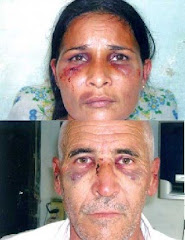
Guyanese medical student killed in altercation in Cuba
Written by Whitney Persaud
Saturday, 28 April 2012 21:29
- another in police custody
UNOFFICIAL information reaching Guyana is that a final-year male
Guyanese medical student pursuing studies in Cuba, through a government
scholarship has been killed in an altercation there.
This is according to Public Service Minister, Dr Jenifer Westford, who
indicated that her office was trying to ascertain the identity of the
suspect, presently in custody of Cuban police.
Contacted by this publication for a comment, Minister Westford said she
was still trying to ascertain the identity of the student and the
reasons behind the tragic incident. Until then, she would not be able to
disclose the name of the deceased. Nevertheless, she did disclose that
another student pursuing studies in Cuba has a name similar to that of
the deceased.
"We have a name, (but we) are trying to get more information before we
break it to the media, and before we contact the parents," Minister
Westford explained. According to Dr. Westford, Guyana is also awaiting a
detailed report of the incident from Cuban authorities.
Police have commenced investigating the incident, and have given
assurance that every effort would be made to unearth the truth behind
this whole matter.
http://www.guyanachronicleonline.com/site/index.php?option=com_content&view=article&id=42775:guyanese-medical-student-killed-in-altercation-in-cuba&catid=2:news&Itemid=3
Sunday, April 29, 2012

Actors in Cuba escape film say they're seeking US asylum
Actors in Cuba escape film say they're seeking US asylum
By David Adams, Reuters
MIAMI - Two lead actors from a prize-winning film about escaping Cuba
have emerged from hiding to confirm they are seeking political asylum in
the United States.
The young Cuban actors went missing last week while en route to the
Tribeca Film Festival in New York where they were due to appear at the
movie's U.S. premiere.
Actress Anailin de la Rua and actor Javier Nunez, cast members of "Una
Noche" ("One Night"), broke their silence Friday night in a TV
appearance on the Miami-based Spanish language channel America TeVe.
In an interview with Reuters, de la Rua and Nunez said their life
imitating art saga was not quite as dramatic in real life as the
harrowing story depicted in the film.
"Una Noche" follows three Cuban teenagers who try to escape their
homeland by sea on a raft to start a new life in Miami. De la Rua and
Nunez, who fell in love during filming, play a brother and sister, but
only one of them survives the risky journey.
Berlin trip gets them thinking
The pair said their real-life decision to leave Cuba stemmed from the
success of the film and invitations to travel to festival premieres -
Berlin in February and then New York.
They spent six days in Germany in February, their first overseas trip,
but returned to Cuba and only began to think of leaving the island
permanently when they got news of the invitation to New York.
"In part it's hard to leave your family and friends behind," said de la
Rua, who has two sisters and divorced parents in Havana. "But at the
same time you do it so you can help them. There's no future in Cuba."
Nunez said his mother lives alone in Cuba and he plans to help her out
economically along with his older brother who left Cuba for Ecuador
several years ago and works as a waiter.
The actors, both aged 20, said they were surprised by the film's
success, especially as it was their first - and only - acting roles.
They were 15 when they auditioned separately for the film, and then
spent two years preparing for their roles after being selected by the
film's director Lucy Mulloy.
"She told us what she liked and didn't like. She likes very natural
acting," said de la Rua.
But nearly three years passed before the film's release, during which
time the pair took regular day jobs. "Our friends in Cuba kept on asking
us 'when is the film coming out,' and they almost didn't believe it was
for real," said de la Rua, who worked at a Havana street stall selling
home-made handicrafts and jewelry to tourists. Nunez worked in a pizza
restaurant.
Athletes and artists
"It never entered our minds that we would get to travel because of the
film. We never imagined that it would go this far," de la Rua added.
There is a long history of Cuban athletes and artists defecting to
pursue careers outside their home country, including the 1997 defection
of baseball pitcher Orlando "El Duque" Hernandez who smuggled his way
out of Cuba by boat and became a star with the New York Yankees.
More recently the desertions have included talented ballet dancers and
soccer players.
A Miami immigration lawyer, Wilfredo Allen, who is representing the
actors, said he planned to file for political asylum on their behalf in
the next two weeks "based on possible persecution if they return to Cuba."
Under U.S. law Cuban citizens enjoy special immigration rights to remain
in the United States, either by applying for permanent residency or by
seeking political refugee status.
The couple's reappearance came a day after Nunez shared the best actor
award at the Tribeca festival, along with Dariel Arrechada, a fellow
actor in "Una Noche." Arrechada accepted the award on his own, and
apparently plans to return to Cuba.
"Una Noche" also picked up the Tribeca Festival's best cinematography
award and best new narrative director for Mulloy.
Mulloy, a London-born 32-year-old who shot the low-budget film in Havana
and was inspired by a tale she heard on a trip to the island nation 10
years ago, told Reuters she wished the missing actors could have
attended the award ceremony.
"I haven't heard from them," she said. "Honestly, it's all happened so
quickly ... it's a shock," she added.
"I'm sad for them because they are my friends," Arrechada told Reuters
in broken English and Spanish after accepting his award on Thursday,
referring to his missing fellow actors.
"I wish they were here, but ... you could be happy for them, for Javier
and for Anailin and for everyone. It's weird. I miss him."
The couple is staying with de la Rua's uncle in Miami and plans to move
into their own place as soon as they find jobs. They said they would
like to act again, but are willing to do any kind of job to kick off
their new lives.
They said the director of "Una Noche" is hoping to make a sequel, titled
"Una Noche Mas" (One More Night).
"We'd like to do that," said Nunez.
http://worldnews.msnbc.msn.com/_news/2012/04/28/11451903-actors-in-cuba-escape-film-say-theyre-seeking-us-asylum?lite
By David Adams, Reuters
MIAMI - Two lead actors from a prize-winning film about escaping Cuba
have emerged from hiding to confirm they are seeking political asylum in
the United States.
The young Cuban actors went missing last week while en route to the
Tribeca Film Festival in New York where they were due to appear at the
movie's U.S. premiere.
Actress Anailin de la Rua and actor Javier Nunez, cast members of "Una
Noche" ("One Night"), broke their silence Friday night in a TV
appearance on the Miami-based Spanish language channel America TeVe.
In an interview with Reuters, de la Rua and Nunez said their life
imitating art saga was not quite as dramatic in real life as the
harrowing story depicted in the film.
"Una Noche" follows three Cuban teenagers who try to escape their
homeland by sea on a raft to start a new life in Miami. De la Rua and
Nunez, who fell in love during filming, play a brother and sister, but
only one of them survives the risky journey.
Berlin trip gets them thinking
The pair said their real-life decision to leave Cuba stemmed from the
success of the film and invitations to travel to festival premieres -
Berlin in February and then New York.
They spent six days in Germany in February, their first overseas trip,
but returned to Cuba and only began to think of leaving the island
permanently when they got news of the invitation to New York.
"In part it's hard to leave your family and friends behind," said de la
Rua, who has two sisters and divorced parents in Havana. "But at the
same time you do it so you can help them. There's no future in Cuba."
Nunez said his mother lives alone in Cuba and he plans to help her out
economically along with his older brother who left Cuba for Ecuador
several years ago and works as a waiter.
The actors, both aged 20, said they were surprised by the film's
success, especially as it was their first - and only - acting roles.
They were 15 when they auditioned separately for the film, and then
spent two years preparing for their roles after being selected by the
film's director Lucy Mulloy.
"She told us what she liked and didn't like. She likes very natural
acting," said de la Rua.
But nearly three years passed before the film's release, during which
time the pair took regular day jobs. "Our friends in Cuba kept on asking
us 'when is the film coming out,' and they almost didn't believe it was
for real," said de la Rua, who worked at a Havana street stall selling
home-made handicrafts and jewelry to tourists. Nunez worked in a pizza
restaurant.
Athletes and artists
"It never entered our minds that we would get to travel because of the
film. We never imagined that it would go this far," de la Rua added.
There is a long history of Cuban athletes and artists defecting to
pursue careers outside their home country, including the 1997 defection
of baseball pitcher Orlando "El Duque" Hernandez who smuggled his way
out of Cuba by boat and became a star with the New York Yankees.
More recently the desertions have included talented ballet dancers and
soccer players.
A Miami immigration lawyer, Wilfredo Allen, who is representing the
actors, said he planned to file for political asylum on their behalf in
the next two weeks "based on possible persecution if they return to Cuba."
Under U.S. law Cuban citizens enjoy special immigration rights to remain
in the United States, either by applying for permanent residency or by
seeking political refugee status.
The couple's reappearance came a day after Nunez shared the best actor
award at the Tribeca festival, along with Dariel Arrechada, a fellow
actor in "Una Noche." Arrechada accepted the award on his own, and
apparently plans to return to Cuba.
"Una Noche" also picked up the Tribeca Festival's best cinematography
award and best new narrative director for Mulloy.
Mulloy, a London-born 32-year-old who shot the low-budget film in Havana
and was inspired by a tale she heard on a trip to the island nation 10
years ago, told Reuters she wished the missing actors could have
attended the award ceremony.
"I haven't heard from them," she said. "Honestly, it's all happened so
quickly ... it's a shock," she added.
"I'm sad for them because they are my friends," Arrechada told Reuters
in broken English and Spanish after accepting his award on Thursday,
referring to his missing fellow actors.
"I wish they were here, but ... you could be happy for them, for Javier
and for Anailin and for everyone. It's weird. I miss him."
The couple is staying with de la Rua's uncle in Miami and plans to move
into their own place as soon as they find jobs. They said they would
like to act again, but are willing to do any kind of job to kick off
their new lives.
They said the director of "Una Noche" is hoping to make a sequel, titled
"Una Noche Mas" (One More Night).
"We'd like to do that," said Nunez.
http://worldnews.msnbc.msn.com/_news/2012/04/28/11451903-actors-in-cuba-escape-film-say-theyre-seeking-us-asylum?lite
Immigration reform on agenda for Cuba: minister
Immigration reform on agenda for Cuba: minister
AFP
Cuba is making headway to normalize ties with its diaspora living in the
United States, the country's deputy foreign minister said Saturday, with
moves on immigration reform expected in coming months.
"Much has been achieved" towards normalizing relations with US-based
Cubans, Dagoberto Rodriguez said from Havana during a video
teleconference with immigrants in Washington organized by the Cuban
Foreign Ministry.
He called for a "respectful exchange of ideas" on "how we can continue
to build... this dialogue."
Rodriguez said the government of President Raul Castro aimed to tackle
migration reform to "eliminate unnecessary prohibitions" on Cubans
wishing to travel abroad.
Last year, some 400,000 people -- 100,000 more than the year before --
traveled to Cuba to visit relatives, work on cultural projects or for
business and academic purposes, according to the senior diplomat.
Cuban migration rights were in the spotlight this week after two actors
featured in an award-winning film about Cuban boat people themselves
went missing in Florida on their way to New York to promote the film.
Since 1966, Cubans have been granted automatic residence if they make it
to the United States from the communist-ruled island, and thousands
attempt the voyage each year, while others simply refuse to return if
they reach the United States on a short visit.
National Assembly President Ricardo Alarcon said earlier this month that
Havana planned to remove many of the restrictions that have prevented
its citizens from traveling abroad.
To travel abroad legally, Cubans need a permit that is valid for 30
days. It can be extended 10 times, after which they must return to Cuba
or lose the right to reside in their own country.
http://news.yahoo.com/immigration-reform-agenda-cuba-minister-194451756.html;_ylt=An.7QEJxXN8KWLWYOkiJfIL9SpZ4
AFP
Cuba is making headway to normalize ties with its diaspora living in the
United States, the country's deputy foreign minister said Saturday, with
moves on immigration reform expected in coming months.
"Much has been achieved" towards normalizing relations with US-based
Cubans, Dagoberto Rodriguez said from Havana during a video
teleconference with immigrants in Washington organized by the Cuban
Foreign Ministry.
He called for a "respectful exchange of ideas" on "how we can continue
to build... this dialogue."
Rodriguez said the government of President Raul Castro aimed to tackle
migration reform to "eliminate unnecessary prohibitions" on Cubans
wishing to travel abroad.
Last year, some 400,000 people -- 100,000 more than the year before --
traveled to Cuba to visit relatives, work on cultural projects or for
business and academic purposes, according to the senior diplomat.
Cuban migration rights were in the spotlight this week after two actors
featured in an award-winning film about Cuban boat people themselves
went missing in Florida on their way to New York to promote the film.
Since 1966, Cubans have been granted automatic residence if they make it
to the United States from the communist-ruled island, and thousands
attempt the voyage each year, while others simply refuse to return if
they reach the United States on a short visit.
National Assembly President Ricardo Alarcon said earlier this month that
Havana planned to remove many of the restrictions that have prevented
its citizens from traveling abroad.
To travel abroad legally, Cubans need a permit that is valid for 30
days. It can be extended 10 times, after which they must return to Cuba
or lose the right to reside in their own country.
http://news.yahoo.com/immigration-reform-agenda-cuba-minister-194451756.html;_ylt=An.7QEJxXN8KWLWYOkiJfIL9SpZ4
Has Cuba’s regime eased up? Depends who you ask
Posted on Saturday, 04.28.12
Cuban government | Analysis
Has Cuba's regime eased up? Depends who you ask
Raúl Castro's grudging reforms have sparked an intense debate in Cuba
and abroad on the current living conditions and future of the regime.
By Juan O. Tamayo
jtamayo@ElNuevoHerald.com
Is the Cuban government sinking or swimming? Are dissidents gaining or
losing ground? Is the economy headed for better times, or spiraling into
ruin?
Those are admittedly simplified versions of the many profound questions
about the island's future raised recently by Cuban activists in a string
of Internet columns as well as comments at conferences and other gatherings.
At heart, they reflect a broader and sometimes fierce debate, going on
in Cuba and abroad, sparked by Raúl Castro's grudging efforts to ease
some of the government's asphyxiating controls on the economy and other
sectors — just not politics.
Blogger and government critic Ernesto Hernandez Busto, for example,
argues that Castro's openings, including increased private enterprise,
are pushing some Cubans to focus more on monetary gains than calls for
democracy.
Some Cubans are "obsessed with the ordinary material goods that the
Cuban state now allows them to pursue," he wrote in the blog Penultimos
Dias. "It is doubtful they will choose to align themselves with the
'radioactives' " — dissident groups.
"The fundamental problem facing Cuban activists and dissidents today is
not just the State Security [police]. It is also this gap — social,
ethical and even generational — that the Castro regime has managed to
widen to its advantage," Hernandez Busto added.
Opposition activists Antonio Rodiles and Alexis Jardines argue the
reverse. Civil society is flowering, they wrote, and the government is
so weak that it has been forced to reach out to the Catholic Church and
some wealthy exiles for support.
"The Cuban regime knows fully that time is not on its side [and] the
country is drowning in an asphyxiating lack of mobility," they wrote in
a column published in the blog Diario de Cuba — Cuban Diary.
"Raúl Castro's precarious idea is to add up communists, Catholics and
docile exiles … while delegitimizing the growing civil society that is
demanding a transition toward democracy," the column added.
An optimistic Roberto Veiga, editor of the church magazine Espacio
Laical — Lay Space — predicted that while it would be difficult,
Castro's openings will lead to a "marvelous country" if Cubans work hard
at it.
"The economic readjustment will be traumatic," Veiga told a conference
this past week. "But if we manage an inclusive political model … we will
achieve, more quickly and with more efficiency, the country that we have
dreamed about for two centuries."
Several other Cubans interviewed for this story said, however, that the
reality on the Caribbean island today is just too complex and blurry for
simple declarations or blunt predictions.
Human rights activist Elizardo Sánchez Santa Cruz said that proof of the
opposition's growing power can be found in the government's growing
levels of repression, including the 1,100 political detentions last
month that marked a 50-year record.
Back 25 years ago, there were maybe 10 dissidents in Cuba, he noted,
"and today we are thousands." They include dissident as well as
independent groups of women, youths, blacks, bloggers, singers,
painters, farmers and all kinds of professionals.
But Sánchez acknowledged that most Cubans feel powerless to affect their
future, and compared the island to a baseball game in which the crowd
cheers for one side or the other, but it's the players on the field that
decide the winner.
Indeed, dissident groups are little-known inside Cuba and are being
undermined by Castro's decision to allow a broad debate on almost
everything from economics to culture, said Esteban Morales, a Havana
economist and Communist Party member.
"Our civil society has grabbed those issues, which in the past might
have been appropriated by the dissidents, and is amply discussing them,"
said Morales, who made a careful distinction between "dissident groups"
and government supporters who "dissent" from some policies.
Dissidents also have failed to connect with Cubans by failing to address
pressing economic problems like the lack of productivity, said
Cuban-born Nelson Valdes, a retired University of New Mexico professor
who opposes U.S. sanctions on the island.
Rodiles told El Nuevo Herald that it's not just dissident groups but all
of the island's civil society that are pushing for change, "because of
the deterioration that is visible in the island."
That's another key point of discussion — whether daily life has improved
since Castro succeeded ailing brother Fidel in 2006 and started
loosening some controls on the economy and society.
Castro has allowed Cubans to own cellphones and check into tourists-only
hotels, legalized the sale and purchase of homes and all used vehicles,
and allowed a strong expansion of small businesses such as restaurants
and nail parlors.
Fallow state-owned lands have been handed over to private farmers to
increase production, and Castro has moved to slash government payrolls
and subsidies for areas such as the monthly food ration card.
Morales acknowledged a crisis in public transportation — a disastrous
shortage of Chinese-made buses that was mentioned by almost everyone
interviewed for this article — but noted that there's more food and
other products available for sale now.
Dissident Havana economist Oscar Espinosa Chepe argued that food prices
rose 20 percent last year, however, while salaries increased by only 1.5
percent. Government spending on health and education fell significantly,
according to official figures.
New taxes imposed on the private businesses are too high, many Cubans
who tried their hand at enterprise gave up and turned in their
government licenses, and private restaurants and barber shops are not
enough to rescue the economy, he argued.
The economic reforms have been far too weak, too few and too slow for a
country that Castro himself admitted in 2010 it "was skirting around the
precipice," Espinosa added.
Another Havana resident said crime is on the rise, and so is domestic
violence and heavy drinking among youths. Corruption among the
government officials who inspect the new small businesses is endemic,
and state pharmacies had no aspirins last week.
"People are calling it a situation that makes them despair," the
resident said, asking that his full name not be used because of fear of
government retaliation. "They say the reforms do not satisfy the needs …
and some are afraid of a step backward."
In sum, Sánchez said, "for the average Cuban, the situation today is
worse than it was one year ago … And my expectations in the short and
medium term are not optimistic at all."
For his part, Espinosa credited Castro with accepting economic reforms
that would seem to be illegal under Cuba's constitution, such as
allowing the small private businesses to hire workers —the "exploitation
of man" in communist dogma.
Yet the economist, who has described Castro's reforms as designed to
produce only a limited private sector — "a Bonsai economy" — insisted
that the changes are far from what's needed to turn around the Cuban
economy.
"Yes, there have been changes, and I have no doubt that there will be
more," Espinosa said. "But much more is needed, and much more quickly."
http://www.miamiherald.com/2012/04/28/v-fullstory/2773541/has-cubas-regime-eased-up-depends.html
Cuban government | Analysis
Has Cuba's regime eased up? Depends who you ask
Raúl Castro's grudging reforms have sparked an intense debate in Cuba
and abroad on the current living conditions and future of the regime.
By Juan O. Tamayo
jtamayo@ElNuevoHerald.com
Is the Cuban government sinking or swimming? Are dissidents gaining or
losing ground? Is the economy headed for better times, or spiraling into
ruin?
Those are admittedly simplified versions of the many profound questions
about the island's future raised recently by Cuban activists in a string
of Internet columns as well as comments at conferences and other gatherings.
At heart, they reflect a broader and sometimes fierce debate, going on
in Cuba and abroad, sparked by Raúl Castro's grudging efforts to ease
some of the government's asphyxiating controls on the economy and other
sectors — just not politics.
Blogger and government critic Ernesto Hernandez Busto, for example,
argues that Castro's openings, including increased private enterprise,
are pushing some Cubans to focus more on monetary gains than calls for
democracy.
Some Cubans are "obsessed with the ordinary material goods that the
Cuban state now allows them to pursue," he wrote in the blog Penultimos
Dias. "It is doubtful they will choose to align themselves with the
'radioactives' " — dissident groups.
"The fundamental problem facing Cuban activists and dissidents today is
not just the State Security [police]. It is also this gap — social,
ethical and even generational — that the Castro regime has managed to
widen to its advantage," Hernandez Busto added.
Opposition activists Antonio Rodiles and Alexis Jardines argue the
reverse. Civil society is flowering, they wrote, and the government is
so weak that it has been forced to reach out to the Catholic Church and
some wealthy exiles for support.
"The Cuban regime knows fully that time is not on its side [and] the
country is drowning in an asphyxiating lack of mobility," they wrote in
a column published in the blog Diario de Cuba — Cuban Diary.
"Raúl Castro's precarious idea is to add up communists, Catholics and
docile exiles … while delegitimizing the growing civil society that is
demanding a transition toward democracy," the column added.
An optimistic Roberto Veiga, editor of the church magazine Espacio
Laical — Lay Space — predicted that while it would be difficult,
Castro's openings will lead to a "marvelous country" if Cubans work hard
at it.
"The economic readjustment will be traumatic," Veiga told a conference
this past week. "But if we manage an inclusive political model … we will
achieve, more quickly and with more efficiency, the country that we have
dreamed about for two centuries."
Several other Cubans interviewed for this story said, however, that the
reality on the Caribbean island today is just too complex and blurry for
simple declarations or blunt predictions.
Human rights activist Elizardo Sánchez Santa Cruz said that proof of the
opposition's growing power can be found in the government's growing
levels of repression, including the 1,100 political detentions last
month that marked a 50-year record.
Back 25 years ago, there were maybe 10 dissidents in Cuba, he noted,
"and today we are thousands." They include dissident as well as
independent groups of women, youths, blacks, bloggers, singers,
painters, farmers and all kinds of professionals.
But Sánchez acknowledged that most Cubans feel powerless to affect their
future, and compared the island to a baseball game in which the crowd
cheers for one side or the other, but it's the players on the field that
decide the winner.
Indeed, dissident groups are little-known inside Cuba and are being
undermined by Castro's decision to allow a broad debate on almost
everything from economics to culture, said Esteban Morales, a Havana
economist and Communist Party member.
"Our civil society has grabbed those issues, which in the past might
have been appropriated by the dissidents, and is amply discussing them,"
said Morales, who made a careful distinction between "dissident groups"
and government supporters who "dissent" from some policies.
Dissidents also have failed to connect with Cubans by failing to address
pressing economic problems like the lack of productivity, said
Cuban-born Nelson Valdes, a retired University of New Mexico professor
who opposes U.S. sanctions on the island.
Rodiles told El Nuevo Herald that it's not just dissident groups but all
of the island's civil society that are pushing for change, "because of
the deterioration that is visible in the island."
That's another key point of discussion — whether daily life has improved
since Castro succeeded ailing brother Fidel in 2006 and started
loosening some controls on the economy and society.
Castro has allowed Cubans to own cellphones and check into tourists-only
hotels, legalized the sale and purchase of homes and all used vehicles,
and allowed a strong expansion of small businesses such as restaurants
and nail parlors.
Fallow state-owned lands have been handed over to private farmers to
increase production, and Castro has moved to slash government payrolls
and subsidies for areas such as the monthly food ration card.
Morales acknowledged a crisis in public transportation — a disastrous
shortage of Chinese-made buses that was mentioned by almost everyone
interviewed for this article — but noted that there's more food and
other products available for sale now.
Dissident Havana economist Oscar Espinosa Chepe argued that food prices
rose 20 percent last year, however, while salaries increased by only 1.5
percent. Government spending on health and education fell significantly,
according to official figures.
New taxes imposed on the private businesses are too high, many Cubans
who tried their hand at enterprise gave up and turned in their
government licenses, and private restaurants and barber shops are not
enough to rescue the economy, he argued.
The economic reforms have been far too weak, too few and too slow for a
country that Castro himself admitted in 2010 it "was skirting around the
precipice," Espinosa added.
Another Havana resident said crime is on the rise, and so is domestic
violence and heavy drinking among youths. Corruption among the
government officials who inspect the new small businesses is endemic,
and state pharmacies had no aspirins last week.
"People are calling it a situation that makes them despair," the
resident said, asking that his full name not be used because of fear of
government retaliation. "They say the reforms do not satisfy the needs …
and some are afraid of a step backward."
In sum, Sánchez said, "for the average Cuban, the situation today is
worse than it was one year ago … And my expectations in the short and
medium term are not optimistic at all."
For his part, Espinosa credited Castro with accepting economic reforms
that would seem to be illegal under Cuba's constitution, such as
allowing the small private businesses to hire workers —the "exploitation
of man" in communist dogma.
Yet the economist, who has described Castro's reforms as designed to
produce only a limited private sector — "a Bonsai economy" — insisted
that the changes are far from what's needed to turn around the Cuban
economy.
"Yes, there have been changes, and I have no doubt that there will be
more," Espinosa said. "But much more is needed, and much more quickly."
http://www.miamiherald.com/2012/04/28/v-fullstory/2773541/has-cubas-regime-eased-up-depends.html
Cuban officials, exiles dialogue via video
Posted on Saturday, 04.28.12
Cuban officials, exiles dialogue via video
By ANDREA RODRIGUEZ
Associated Press
HAVANA -- Cuban officials reached out to U.S. exiles on Saturday with a
videoconference between Havana and Washington, promising a highly
anticipated migratory reform, but cautioning that its scope might not
satisfy everyone.
More than 100 Cuban-Americans and top Foreign Ministry officials
discussed President Raul Castro's ongoing economic changes in the
encounter, hosted by Vice Foreign Minister Dagoberto Rodriguez.
"There has been great advance in this process of normalizing relations"
with the Cuban diaspora, Rodriguez said.
Amid the economic reforms and liberalized travel rules instituted by
President Barack Obama, Cuba has increasingly sought to dialogue with
segments of its large exile community, with several high-profile
encounters recently.
Many exiles say they want nothing to do with government leaders in their
homeland until Raul and Fidel Castro are out of power, but others are
looking to play a role in the changes the island is undergoing.
A popular topic during Saturday's videoconference between the Foreign
Ministry in Havana and the Cuban Interests Section in Washington was a
much-anticipated reform of migratory rules that, among other things,
require Cubans to apply for an exit visa.
Cuban-Americans also questioned the officials about regulations that
strip those who leave permanently of the right to own property back
home, and bar them from investing or accessing Cuba's recently legalized
real estate market, which is currently only available to island residents.
Emigrants are treated as second-class citizens, complained a man who
identified himself as Julio Ruiz of Miami.
Rodriguez said reforms being studied will take into account the
realities of 50 years of emigration and make an "important contribution"
to bringing Cubans everywhere closer together. But he also cautioned
people not to expect too much.
"The migratory relaxation will take into account the revolutionary
state's right to defend itself from the interventionist plans of the
U.S. government and its allies, and at the same time, reasonable
countermeasures will be imposed to preserve the human capital created by
the revolution," Rodriguez said.
University of Denver scholar Arturo Lopez-Levy said it's clear the Cuban
government is looking to build bridges to exiles, but so far it has been
talking more than listening.
"The official statements indicate that the government is interested in
improving relations between the island and its diaspora," Lopez-Levy
said. "Nevertheless such improvement has not been conceived as part of a
dialogue, which implies two-way communication and decision-making.
Still, there have been a number of prominent exchanges in recent weeks.
During Pope Benedict XVI's recent visit to Cuba, hundreds of
Cuban-Americans came here as pilgrims including Miami Archbishop Thomas
Wenski, who called for a "soft landing" from Marxism during an emotional
sermon at the Havana Cathedral. Earlier this month, the Catholic Church
organized a conference of scholars from the Cuban diaspora in Havana.
And Cuban-American businessman Carlos Saladrigas, a one-time hardline
anti-Castro militant whose stance toward the island government has
softened somewhat, held a conference that was attended by people ranging
from dissidents to intellectuals to Communist Party members and others
to the left of the communist-run government.
Rodriguez said 400,000 Cuban-Americans came to the island last year to
see families or on religious or academic exchanges.
Such visits have increased sharply since Obama lifted restrictions on
how often Cuban-Americans can travel back home.
http://www.miamiherald.com/2012/04/28/2772971/cuban-officials-exiles-hold-dialogue.html
Cuban officials, exiles dialogue via video
By ANDREA RODRIGUEZ
Associated Press
HAVANA -- Cuban officials reached out to U.S. exiles on Saturday with a
videoconference between Havana and Washington, promising a highly
anticipated migratory reform, but cautioning that its scope might not
satisfy everyone.
More than 100 Cuban-Americans and top Foreign Ministry officials
discussed President Raul Castro's ongoing economic changes in the
encounter, hosted by Vice Foreign Minister Dagoberto Rodriguez.
"There has been great advance in this process of normalizing relations"
with the Cuban diaspora, Rodriguez said.
Amid the economic reforms and liberalized travel rules instituted by
President Barack Obama, Cuba has increasingly sought to dialogue with
segments of its large exile community, with several high-profile
encounters recently.
Many exiles say they want nothing to do with government leaders in their
homeland until Raul and Fidel Castro are out of power, but others are
looking to play a role in the changes the island is undergoing.
A popular topic during Saturday's videoconference between the Foreign
Ministry in Havana and the Cuban Interests Section in Washington was a
much-anticipated reform of migratory rules that, among other things,
require Cubans to apply for an exit visa.
Cuban-Americans also questioned the officials about regulations that
strip those who leave permanently of the right to own property back
home, and bar them from investing or accessing Cuba's recently legalized
real estate market, which is currently only available to island residents.
Emigrants are treated as second-class citizens, complained a man who
identified himself as Julio Ruiz of Miami.
Rodriguez said reforms being studied will take into account the
realities of 50 years of emigration and make an "important contribution"
to bringing Cubans everywhere closer together. But he also cautioned
people not to expect too much.
"The migratory relaxation will take into account the revolutionary
state's right to defend itself from the interventionist plans of the
U.S. government and its allies, and at the same time, reasonable
countermeasures will be imposed to preserve the human capital created by
the revolution," Rodriguez said.
University of Denver scholar Arturo Lopez-Levy said it's clear the Cuban
government is looking to build bridges to exiles, but so far it has been
talking more than listening.
"The official statements indicate that the government is interested in
improving relations between the island and its diaspora," Lopez-Levy
said. "Nevertheless such improvement has not been conceived as part of a
dialogue, which implies two-way communication and decision-making.
Still, there have been a number of prominent exchanges in recent weeks.
During Pope Benedict XVI's recent visit to Cuba, hundreds of
Cuban-Americans came here as pilgrims including Miami Archbishop Thomas
Wenski, who called for a "soft landing" from Marxism during an emotional
sermon at the Havana Cathedral. Earlier this month, the Catholic Church
organized a conference of scholars from the Cuban diaspora in Havana.
And Cuban-American businessman Carlos Saladrigas, a one-time hardline
anti-Castro militant whose stance toward the island government has
softened somewhat, held a conference that was attended by people ranging
from dissidents to intellectuals to Communist Party members and others
to the left of the communist-run government.
Rodriguez said 400,000 Cuban-Americans came to the island last year to
see families or on religious or academic exchanges.
Such visits have increased sharply since Obama lifted restrictions on
how often Cuban-Americans can travel back home.
http://www.miamiherald.com/2012/04/28/2772971/cuban-officials-exiles-hold-dialogue.html
The Cuban killer who fooled the CIA
Posted on Saturday, 04.28.12
The Cuban killer who fooled the CIA
By Brian Latell
To CIA, Rolando Cubela seemed the perfect prospect to assassinate Fidel
Castro. Young and fit, a battle-tested conspirator, he had killed in
cold blood before. Unlike most Cuban officials who toiled under the
suspicious gaze of the security services, he was allowed to travel
abroad freely where illicit meetings with his Agency handlers were easy
to arrange. He used a beach house adjacent to one reserved for Fidel at
Varadero, a resort a couple of hours east of Havana. There it could be a
simple hit, on the sand or in the surf where the Cuban leader and his
security would least expect it.
A medical doctor and wounded revolutionary hero, Cubela circulated in
the top ranks of the civilian and military hierarchies. When I met him
in Miami in the summer of 2009 to talk about his exploits, he proudly
showed me the long curving scar that ran from his right shoulder down
the length of his bicep. It was acquired in combat during one of the
watershed battles in the last months of the guerrilla war. He told me
that he had lost faith in Fidel during those days. Declassified CIA
files show that as early as March 1959 — three months after the victory
— Cubela was already confiding in friends a desire to kill Castro.
Cubela was one of the top two leaders of the Revolutionary Student
Directorate, originally a rival of the Castros' 26th of July Movement.
The two forces were integrated after Batista fell, and a few leaders of
the Directorate won important posts in the new regime, though tensions
between the groups would always fester. Cubela served as the
revolution's first university federation president but was never given a
position of greater responsibility or trust, neither commanding troops
nor managing a government agency.
He knew the Castros well, especially Raúl. The brothers respected his
heroic record but were wary of his charm, dashing good looks, and
cavalier nature. When flashing a capricious smile and swaggering, he was
for all appearances an unpredictable rogue and seducer. Cubela was "a
strange man,'' according to his first CIA case officer, temperamental
and often exasperating. Nestor Sanchez, his last handler and the one who
knew him best, remembered he was "moody, sensitive, mercurial.''
An Agency biographic and psychological profile oddly described his
"almost petulant mouth.'' A handwriting analysis characterized him as
"shrewd, clever, a role player, self-centered, and vain.'' It also held
that "he can exercise various deceptive mechanisms in the most adroit
fashion'' and "has not yet found his proper course.'' Some Agency case
officers in the 1960s and 1970s believed graphology could help in agent
assessment. This report turned out to be close to the mark.
Carlos Tepedino, a Cuban emigre jeweler and Cubela's co-conspirator with
CIA, told me in Miami that his lifelong friend never trusted Fidel but
that the Cuban leader "had great sympathy for him.'' Maybe, Tepedino
offered, it was because "Rolando always spoke directly; and Fidel liked
that.'' That may have been so, but modern Cuban history is littered with
disgraced officials more clever than Cubela who talked too candidly to
their commander in chief. Seven years younger than Castro, Cubela was
his favorite in the Student Directorate, but that could have been
because he was the most malleable, the most vulnerable to Fidel's charms
and suasion. To be sure, they shared many unfathomable affinities, not
least, similar violent pathologies.
In October 1956, Cubela carried out one of the most notorious
assassinations in Cuban history in the predawn hours on a quiet Sunday.
A group of police and army officers, some accompanied by their wives,
had been drinking and gambling at the Montmartre, an elegant Havana
nightclub. As they left the club, they were drenched in a merciless
barrage of gunfire. A colonel, Batista's military intelligence chief,
died instantly. A second colonel, his wife, and another woman were
severely wounded. Amid the mayhem, Cubela and his main accomplice fled
through the casino to safety.
In 1963, he was easily the best candidate the Agency ever had to
complete another murder mission, one that had failed many times. The
inspector general's report commissioned by CIA director Richard Helms in
1967, and now fully declassified, cataloged the sordid history of CIA
assassination plotting against Castro.
It took many years, but the truth about Rolando Cubela's true loyalties
gradually emerged. Evidence of his duplicity had been accumulating since
the mid-1960s, and now, with what I have learned from a knowledgeable
Cuban defector and a long-ignored CIA document, it can be stated
unequivocally that he conspired with Fidel.
The first hint came from Castro himself. On May 2, 1966, he met with New
York Times correspondent Herbert Matthews, whose archived notes of their
conversation were not released for public use until a number of years
later. Matthews quoted Fidel this way: "Cubela was a weak, neurotic type
that they nursed along, but he was not getting the jobs he thought he
deserved and he was in bad company.''
Matthews spoke to Interior Minister Ramiro Valdés the next day. Cubela,
the latter said, "had been reduced to supervisor of medical education in
a big Havana hospital, and his friends realized his discontent and
neurotic nature, so he was, in a sense being watched.''
Valdés spoke definitively about Cubela nineteen years later on June 5,
1985, in a meeting with another visiting journalist. "Yes, we had
information about his trip abroad, that he had contacts with the CIA,
that he had a mission to assassinate Fidel. We knew this.'' The
admission, stored at the University of Miami's Cuban Heritage
Collection, seems to have gone unnoticed by earlier researchers.
But how did Valdés know of the assassination plan, and when was it
compromised? Was there an informant close to Cubela? Could the crafty
jeweler Tepedino have been a double agent? Had Cubela himself been
reporting to Cuban intelligence, perhaps from the first meeting with a
CIA officer in Mexico City? In May 1997, Ricardo Alarcón, the
long-serving president of the rubber-stamp Cuban legislative body, the
National Assembly, was the first authoritative source to suggest the
answer. Alarcon was close to Cubela in 1960 when they served together in
the top two positions in the University of Havana student federation.
Author Richard Mahoney asked him about Cubela during a Havana interview.
He said, "Cubela may have been a Castro plant.''
It was in the spring of 2011 when I was finally convinced that Alarcon
had been right. It was then that I met Miguel Mir, another DGI (Cuban
intelligence service) defector living in the United States. He had
joined the DGI in 1973 at the age of sixteen, later serving at different
times on the personal security squads of Fidel, Raúl and Valdés. He had
worked his way up into those absolutely trusted positions, putting him
in daily proximity to the top leadership. From 1986 until 1992, Mir was
a principal bodyguard and security officer for Fidel.
It was during the first year of that assignment, as a DGI lieutenant,
that Mir also served as chief curator for sensitive military and
security archives. His title was Military Historian for Fidel Castro's
Personal Security. Mir told me that in that position, he was custodian
of the regime's records of historical memorabilia related exclusively to
the commander in chief. They were kept in a secret vault at a military
facility near Havana.
He told me, "I read documents there about Rolando Cubela, stating that
he was a double agent.'' They dated from the 1961 to 1963 period. There
were thousands of photos and records about Fidel. The archive, created
by Castro's aide and one-time paramour Cecila Sánchez, memorialized him.
"It was a record of all the attempts against his life,'' Mir told me.
"That's why these were kept and not destroyed.''
I have no reason to doubt what Mir shared with me about this and other
sensitive intelligence matters. What he saw in the archives indicates
that Cubela was dangled in March 1961 in Mexico City and that he went on
to report everything that took place in his meetings with CIA officers
to Fidel and the DGI.
Even more recently I discovered yet more convincing evidence of Cubela's
double game. Carlos Tepedino admitted during an aggressive CIA polygraph
examination in August 1965 that Cubela "had strong connections with
Cuban intelligence and was probably cooperating with them in various
ways.'' He "had daily contact with them . . . worked with them
closely...knew what was going on in intelligence circles.'' Even worse,
Tepedino said that Cubela had told "everyone'' about his CIA
relationships, "everyone knew.'' And Cubela had never tried to organize
"a conspiracy to overthrow Castro and had no plan or followers who would
work with him to achieve that.'' Tepedino said that "a group as such was
nonexistent.'' Cubela had been toying with his CIA handlers all along.
Results of the interrogation were shared with the Church committee — the
U.S. Senate committee that held hearings on the CIA in 1971 — and some
of its contents cited in the committee's final report in April 1976. But
Tepedino's startling admissions attracted no further attention. Until
now they have not been cited as a smoking gun proving Cubela's duplicity
and collaboration with Cuban intelligence, and thus with Fidel himself.
The nine-page polygraph report was not declassified until 1998, and then
filed away at the National Archives amid approximately five million
pages of records relating to the Kennedy assassination. It was
effectively lost until coming to my attention in October 2011.
But why did the CIA officers familiar with the case insist until their
deaths that Cubela had been a reliable secret agent even after the
results of Tepedino's polygraph exam were written up in September 1965?
A copy of that report is known to have been shared with headquarters
Cuba operations officers. Yet Helms and at least two other senior CIA
officials ignored it — or were never informed. They were not queried
about it during testimonies before the Church committee, nor were
several other CIA officers who testified. The polygraph results were not
mentioned in the 1967 inspector general's report on assassination plots.
An intentional cover-up? Quite possibly the information was too
incriminating, too embarrassing for those involved. If it were known
conclusively outside of CIA that Cubela had worked with the DGI all
along, grave concerns about possible Cuban government involvement in
Kennedy's death inevitably would have been raised. In any event, it
appears that Tepedino's reluctant confessions were filed away in 1965
with the hope that they would never have to be explained.
http://www.miamiherald.com/2012/04/28/v-fullstory/2773722/the-cuban-killer-who-fooled-the.html
The Cuban killer who fooled the CIA
By Brian Latell
To CIA, Rolando Cubela seemed the perfect prospect to assassinate Fidel
Castro. Young and fit, a battle-tested conspirator, he had killed in
cold blood before. Unlike most Cuban officials who toiled under the
suspicious gaze of the security services, he was allowed to travel
abroad freely where illicit meetings with his Agency handlers were easy
to arrange. He used a beach house adjacent to one reserved for Fidel at
Varadero, a resort a couple of hours east of Havana. There it could be a
simple hit, on the sand or in the surf where the Cuban leader and his
security would least expect it.
A medical doctor and wounded revolutionary hero, Cubela circulated in
the top ranks of the civilian and military hierarchies. When I met him
in Miami in the summer of 2009 to talk about his exploits, he proudly
showed me the long curving scar that ran from his right shoulder down
the length of his bicep. It was acquired in combat during one of the
watershed battles in the last months of the guerrilla war. He told me
that he had lost faith in Fidel during those days. Declassified CIA
files show that as early as March 1959 — three months after the victory
— Cubela was already confiding in friends a desire to kill Castro.
Cubela was one of the top two leaders of the Revolutionary Student
Directorate, originally a rival of the Castros' 26th of July Movement.
The two forces were integrated after Batista fell, and a few leaders of
the Directorate won important posts in the new regime, though tensions
between the groups would always fester. Cubela served as the
revolution's first university federation president but was never given a
position of greater responsibility or trust, neither commanding troops
nor managing a government agency.
He knew the Castros well, especially Raúl. The brothers respected his
heroic record but were wary of his charm, dashing good looks, and
cavalier nature. When flashing a capricious smile and swaggering, he was
for all appearances an unpredictable rogue and seducer. Cubela was "a
strange man,'' according to his first CIA case officer, temperamental
and often exasperating. Nestor Sanchez, his last handler and the one who
knew him best, remembered he was "moody, sensitive, mercurial.''
An Agency biographic and psychological profile oddly described his
"almost petulant mouth.'' A handwriting analysis characterized him as
"shrewd, clever, a role player, self-centered, and vain.'' It also held
that "he can exercise various deceptive mechanisms in the most adroit
fashion'' and "has not yet found his proper course.'' Some Agency case
officers in the 1960s and 1970s believed graphology could help in agent
assessment. This report turned out to be close to the mark.
Carlos Tepedino, a Cuban emigre jeweler and Cubela's co-conspirator with
CIA, told me in Miami that his lifelong friend never trusted Fidel but
that the Cuban leader "had great sympathy for him.'' Maybe, Tepedino
offered, it was because "Rolando always spoke directly; and Fidel liked
that.'' That may have been so, but modern Cuban history is littered with
disgraced officials more clever than Cubela who talked too candidly to
their commander in chief. Seven years younger than Castro, Cubela was
his favorite in the Student Directorate, but that could have been
because he was the most malleable, the most vulnerable to Fidel's charms
and suasion. To be sure, they shared many unfathomable affinities, not
least, similar violent pathologies.
In October 1956, Cubela carried out one of the most notorious
assassinations in Cuban history in the predawn hours on a quiet Sunday.
A group of police and army officers, some accompanied by their wives,
had been drinking and gambling at the Montmartre, an elegant Havana
nightclub. As they left the club, they were drenched in a merciless
barrage of gunfire. A colonel, Batista's military intelligence chief,
died instantly. A second colonel, his wife, and another woman were
severely wounded. Amid the mayhem, Cubela and his main accomplice fled
through the casino to safety.
In 1963, he was easily the best candidate the Agency ever had to
complete another murder mission, one that had failed many times. The
inspector general's report commissioned by CIA director Richard Helms in
1967, and now fully declassified, cataloged the sordid history of CIA
assassination plotting against Castro.
It took many years, but the truth about Rolando Cubela's true loyalties
gradually emerged. Evidence of his duplicity had been accumulating since
the mid-1960s, and now, with what I have learned from a knowledgeable
Cuban defector and a long-ignored CIA document, it can be stated
unequivocally that he conspired with Fidel.
The first hint came from Castro himself. On May 2, 1966, he met with New
York Times correspondent Herbert Matthews, whose archived notes of their
conversation were not released for public use until a number of years
later. Matthews quoted Fidel this way: "Cubela was a weak, neurotic type
that they nursed along, but he was not getting the jobs he thought he
deserved and he was in bad company.''
Matthews spoke to Interior Minister Ramiro Valdés the next day. Cubela,
the latter said, "had been reduced to supervisor of medical education in
a big Havana hospital, and his friends realized his discontent and
neurotic nature, so he was, in a sense being watched.''
Valdés spoke definitively about Cubela nineteen years later on June 5,
1985, in a meeting with another visiting journalist. "Yes, we had
information about his trip abroad, that he had contacts with the CIA,
that he had a mission to assassinate Fidel. We knew this.'' The
admission, stored at the University of Miami's Cuban Heritage
Collection, seems to have gone unnoticed by earlier researchers.
But how did Valdés know of the assassination plan, and when was it
compromised? Was there an informant close to Cubela? Could the crafty
jeweler Tepedino have been a double agent? Had Cubela himself been
reporting to Cuban intelligence, perhaps from the first meeting with a
CIA officer in Mexico City? In May 1997, Ricardo Alarcón, the
long-serving president of the rubber-stamp Cuban legislative body, the
National Assembly, was the first authoritative source to suggest the
answer. Alarcon was close to Cubela in 1960 when they served together in
the top two positions in the University of Havana student federation.
Author Richard Mahoney asked him about Cubela during a Havana interview.
He said, "Cubela may have been a Castro plant.''
It was in the spring of 2011 when I was finally convinced that Alarcon
had been right. It was then that I met Miguel Mir, another DGI (Cuban
intelligence service) defector living in the United States. He had
joined the DGI in 1973 at the age of sixteen, later serving at different
times on the personal security squads of Fidel, Raúl and Valdés. He had
worked his way up into those absolutely trusted positions, putting him
in daily proximity to the top leadership. From 1986 until 1992, Mir was
a principal bodyguard and security officer for Fidel.
It was during the first year of that assignment, as a DGI lieutenant,
that Mir also served as chief curator for sensitive military and
security archives. His title was Military Historian for Fidel Castro's
Personal Security. Mir told me that in that position, he was custodian
of the regime's records of historical memorabilia related exclusively to
the commander in chief. They were kept in a secret vault at a military
facility near Havana.
He told me, "I read documents there about Rolando Cubela, stating that
he was a double agent.'' They dated from the 1961 to 1963 period. There
were thousands of photos and records about Fidel. The archive, created
by Castro's aide and one-time paramour Cecila Sánchez, memorialized him.
"It was a record of all the attempts against his life,'' Mir told me.
"That's why these were kept and not destroyed.''
I have no reason to doubt what Mir shared with me about this and other
sensitive intelligence matters. What he saw in the archives indicates
that Cubela was dangled in March 1961 in Mexico City and that he went on
to report everything that took place in his meetings with CIA officers
to Fidel and the DGI.
Even more recently I discovered yet more convincing evidence of Cubela's
double game. Carlos Tepedino admitted during an aggressive CIA polygraph
examination in August 1965 that Cubela "had strong connections with
Cuban intelligence and was probably cooperating with them in various
ways.'' He "had daily contact with them . . . worked with them
closely...knew what was going on in intelligence circles.'' Even worse,
Tepedino said that Cubela had told "everyone'' about his CIA
relationships, "everyone knew.'' And Cubela had never tried to organize
"a conspiracy to overthrow Castro and had no plan or followers who would
work with him to achieve that.'' Tepedino said that "a group as such was
nonexistent.'' Cubela had been toying with his CIA handlers all along.
Results of the interrogation were shared with the Church committee — the
U.S. Senate committee that held hearings on the CIA in 1971 — and some
of its contents cited in the committee's final report in April 1976. But
Tepedino's startling admissions attracted no further attention. Until
now they have not been cited as a smoking gun proving Cubela's duplicity
and collaboration with Cuban intelligence, and thus with Fidel himself.
The nine-page polygraph report was not declassified until 1998, and then
filed away at the National Archives amid approximately five million
pages of records relating to the Kennedy assassination. It was
effectively lost until coming to my attention in October 2011.
But why did the CIA officers familiar with the case insist until their
deaths that Cubela had been a reliable secret agent even after the
results of Tepedino's polygraph exam were written up in September 1965?
A copy of that report is known to have been shared with headquarters
Cuba operations officers. Yet Helms and at least two other senior CIA
officials ignored it — or were never informed. They were not queried
about it during testimonies before the Church committee, nor were
several other CIA officers who testified. The polygraph results were not
mentioned in the 1967 inspector general's report on assassination plots.
An intentional cover-up? Quite possibly the information was too
incriminating, too embarrassing for those involved. If it were known
conclusively outside of CIA that Cubela had worked with the DGI all
along, grave concerns about possible Cuban government involvement in
Kennedy's death inevitably would have been raised. In any event, it
appears that Tepedino's reluctant confessions were filed away in 1965
with the hope that they would never have to be explained.
http://www.miamiherald.com/2012/04/28/v-fullstory/2773722/the-cuban-killer-who-fooled-the.html
An American rebel’s final defiant words before execution by Castro
Posted on Saturday, 04.28.12
The death of William Morgan
An American rebel's final defiant words before execution by Castro
A newly uncovered letter by an American rebel to his elderly mother on
the eve of his execution by Castro shows he had no regrets.
By Michael Sallah And Alfonso Chardy
msallah@MiamiHerald.com
Just one day before his own brutal execution, William Morgan sat in a
dingy Cuban prison cell and scrawled his final letter to his elderly
mother in Ohio.
Charged with trying to overthrow the Castro government, the man known as
el Yanqui Comandante wrote he had no regrets for fighting in a
revolution that changed Cuba, defended his role in battling the leaders
who seized control, and said he was ready to die.
"And if my life will help the people of Cuba, then I am glad to give
it,'' he wrote before he was hauled before a firing squad.
For 51 years, the original letter written by one of the most intriguing
figures of the revolucion remained buried — and never delivered to his
family.
Until now.
A half-century after Morgan was shot to death at La Cabana prison, the
man entrusted to pass the original letter onto Morgan's family found it
tucked away in his personal archives: five, simple folded pages.
Weeks later, he sent a copy of the note to a Miami Herald reporter, who
then forwarded it to Morgan's closest surviving heir: his widow in Ohio.
"It moved me very deeply," said Olga Morgan Goodwin, a Cuban native who
married Morgan during fighting in the Escambray Mountains. "William
wrote it in the final minutes of his life."
What's not clear is why the original letter written in the darkness of a
prison cell took so long to be delivered.
Henry Raymont, now 85, the UPI reporter who interviewed Morgan before
his trial, recalled watching the prisoner pen his final goodbye to his
mother from a bench in his cell, writing: "I am a very fortunate man to
at least know the time of my death and prepare for it."
After Morgan was shot against the wall by a firing squad, Raymont rushed
to send it on the UPI news wires with instructions to deliver it to
Loretta Morgan in Toledo.
"I know I sent it,'' said Raymont. "They ran the full text on the wire."
But when Loretta Morgan died in a nursing home in 1988, there was no
copy of the UPI dispatch in her prized collection of her son's
possessions, which included half a dozen letters he'd sent from the
mountains during the revolution, said Morgan's widow, now 76.
Five decades later, the letter offers a rare glimpse of the charismatic
street hero who led a band of guerrillas in a sweep across the mountains
that helped force President Fulgencio Batista to flee in 1959.
While the letter is expected to spark debates over Morgan's place in
revolutionary history, it comes as his relatives continue to mount a
rare campaign: to return his remains to the United States.
At the behest of the family, a delegation led by former President Jimmy
Carter asked Cuban leaders in 2011 to return the body from the Colon
Cemetery to the United States for reburial. Despite assurances the
request was being considered by the Castro government, it has yet to act.
"I am still waiting," said his widow.
At the height of the Cold War, Morgan splashed into history in dramatic
fashion when he led his own unit to a stunning series of victories in
the mountains.
A swaggering figure with underworld ties, he broke into the revolution
by running guns to the rebels, but later joined the cause after a fellow
gun smuggler was killed by Batista's guards, he told reporters.
The story has never been confirmed, but former rebels say the stocky,
tough-talking Ohioan showed up in the mountains in early 1958 showing
the skills to lead his own column.
While much was written about Morgan's exploits, including articles in
The Miami Herald and The New York Times, little is known about his final
hours.
Two reporters who covered his trial in March 1961 wrote that Morgan, 32,
declared his innocence, saying he would "walk to the wall with no
escort" if found guilty.
But the newly found letter provides a snapshot of the American rebel
leader that has long remained hidden from history: He had no regrets for
his actions.
Rather, he went on to blast the fledgling government for abandoning the
goals of "the Revolucion for which I fought."
"For no man has a right to impose his will or belief on others," Morgan
wrote. "All men have an in borne right to better themselves and their
families. I have spent my time in Cuba trying to help them do just that."
By getting rid of Morgan, Castro snuffed out one of the top rebel
fighters who could have sparked an insurrection in central Cuba, say
historians.
Just two years earlier, Morgan was hailed as a comandante — the only
American to achieve the top rank in the rebel forces — even helping
Castro smash a coup attempt by Dominican strongman Rafael Trujillo in 1959.
Their relationship began to strain at a news conference after the failed
coup when Castro handed Morgan a wad of cash seized from the plotters as
a reward, embarrassing Morgan on national TV.
"William was so angry," recalled Goodwin. "He did not do that for money."
As Castro began forging ties with the Soviets in 1960, Morgan broke with
him and began trucking guns and hand grenades to the mountains from a
government fisheries farm he was operating, interviews and FBI records show.
After his arrest in October, he was thrown in La Cabana, the notorious
prison, where he rose every day doing exercises and sprints around the yard.
"I want you to know that I have been prepared for this as long as I have
been in prison," he wrote to his mother. He also suspected his trial in
just a few hours was a fait accompli. "I leave a love of God and country."
Though Morgan noted in his letter he thought his wife and their two baby
daughters were safe — "and this gives me great peace of mind"— it was
not the case: Olga had bolted from the Brazilian Embassy where she was
granted asylum to rally other rebels to save her husband. She was soon
arrested and would spend the next 13 years in prison.
Even with his impending death, Morgan begged his mother "not to misjudge
either Cuba or its people who I have come to love," insisting the
revolution was still crucial to their rights.
"The way of freedom is hard — and the road is covered with the blood of
those who must die so that the rights of man can live," he wrote.
One Cuban historian who read the letter said he thought Morgan believed
the fate of the revolution had not been settled and was still "a work in
progress," said Juan Antonio Blanco, a Florida International University
professor. "It's easy to look back with 20/20 vision, but it wasn't so
clear to most people at the time."
One expert took it a step further, saying Morgan pleads with his mother
not to condemn the revolution. "The fact that he's facing the firing
squad is less important," said Louis Perez Jr., a University of North
Carolina historian. "He is still sympathetic to the [cause]."
At the time, he still believed there were enough guerrillas in the
mountains to defeat Castro's forces and bring about the reforms promised
during the fighting, said Goodwin.
By the time Morgan walked to the death wall at 9:45 p.m. March 11, 1961,
his mother's appeal for clemency had been ignored.
In his final moments, he asked that his handcuffs be removed, and then
leaned over to hug the head of the firing squad and John McKniff, the
priest who chronicled the event in a letter. "Tell the boys I forgive
them," Morgan said.
After stepping to the craggy, bloodstained wall — wearing his military
boots — he removed a rosary from his neck and handed it to the
55-year-old priest.
What followed is not clear, but in one version, Morgan was ordered to
kneel and beg for his life, prompting him to shout back, "I kneel for no
man!"
Sharpshooters then aimed for his knees, forcing him to collapse, and
then waited momentarily before shooting him in the chest, ending his
life. "He died with extraordinary valor," said his defense lawyer, Luis
Carro.
When the attorney phoned 65-year-old Loretta Morgan in Ohio to tell her
the news, "she was so upset she couldn't finish the conversation," he
told reporters.
Whether someone took the time to read the UPI dispatch of Morgan's
letter to his mother or personally deliver the transcribed words to her
is unclear.
Raymont insists she received the wired document. "I am certain of it,"
he said.
Morgan, who was denied a phone call to his mother, wrote that it was the
"longest letter I have ever written," but wanted her to know that "my
actions and my life I leave for others to judge and to you and dad I
leave my love."
In a final salute, he said he realized his death would be hard on her,
but signed off with a last request: "One thing mom," he wrote, "don't
cry for me."
http://www.miamiherald.com/2012/04/28/v-fullstory/2773707/an-american-rebels-final-defiant.html
The death of William Morgan
An American rebel's final defiant words before execution by Castro
A newly uncovered letter by an American rebel to his elderly mother on
the eve of his execution by Castro shows he had no regrets.
By Michael Sallah And Alfonso Chardy
msallah@MiamiHerald.com
Just one day before his own brutal execution, William Morgan sat in a
dingy Cuban prison cell and scrawled his final letter to his elderly
mother in Ohio.
Charged with trying to overthrow the Castro government, the man known as
el Yanqui Comandante wrote he had no regrets for fighting in a
revolution that changed Cuba, defended his role in battling the leaders
who seized control, and said he was ready to die.
"And if my life will help the people of Cuba, then I am glad to give
it,'' he wrote before he was hauled before a firing squad.
For 51 years, the original letter written by one of the most intriguing
figures of the revolucion remained buried — and never delivered to his
family.
Until now.
A half-century after Morgan was shot to death at La Cabana prison, the
man entrusted to pass the original letter onto Morgan's family found it
tucked away in his personal archives: five, simple folded pages.
Weeks later, he sent a copy of the note to a Miami Herald reporter, who
then forwarded it to Morgan's closest surviving heir: his widow in Ohio.
"It moved me very deeply," said Olga Morgan Goodwin, a Cuban native who
married Morgan during fighting in the Escambray Mountains. "William
wrote it in the final minutes of his life."
What's not clear is why the original letter written in the darkness of a
prison cell took so long to be delivered.
Henry Raymont, now 85, the UPI reporter who interviewed Morgan before
his trial, recalled watching the prisoner pen his final goodbye to his
mother from a bench in his cell, writing: "I am a very fortunate man to
at least know the time of my death and prepare for it."
After Morgan was shot against the wall by a firing squad, Raymont rushed
to send it on the UPI news wires with instructions to deliver it to
Loretta Morgan in Toledo.
"I know I sent it,'' said Raymont. "They ran the full text on the wire."
But when Loretta Morgan died in a nursing home in 1988, there was no
copy of the UPI dispatch in her prized collection of her son's
possessions, which included half a dozen letters he'd sent from the
mountains during the revolution, said Morgan's widow, now 76.
Five decades later, the letter offers a rare glimpse of the charismatic
street hero who led a band of guerrillas in a sweep across the mountains
that helped force President Fulgencio Batista to flee in 1959.
While the letter is expected to spark debates over Morgan's place in
revolutionary history, it comes as his relatives continue to mount a
rare campaign: to return his remains to the United States.
At the behest of the family, a delegation led by former President Jimmy
Carter asked Cuban leaders in 2011 to return the body from the Colon
Cemetery to the United States for reburial. Despite assurances the
request was being considered by the Castro government, it has yet to act.
"I am still waiting," said his widow.
At the height of the Cold War, Morgan splashed into history in dramatic
fashion when he led his own unit to a stunning series of victories in
the mountains.
A swaggering figure with underworld ties, he broke into the revolution
by running guns to the rebels, but later joined the cause after a fellow
gun smuggler was killed by Batista's guards, he told reporters.
The story has never been confirmed, but former rebels say the stocky,
tough-talking Ohioan showed up in the mountains in early 1958 showing
the skills to lead his own column.
While much was written about Morgan's exploits, including articles in
The Miami Herald and The New York Times, little is known about his final
hours.
Two reporters who covered his trial in March 1961 wrote that Morgan, 32,
declared his innocence, saying he would "walk to the wall with no
escort" if found guilty.
But the newly found letter provides a snapshot of the American rebel
leader that has long remained hidden from history: He had no regrets for
his actions.
Rather, he went on to blast the fledgling government for abandoning the
goals of "the Revolucion for which I fought."
"For no man has a right to impose his will or belief on others," Morgan
wrote. "All men have an in borne right to better themselves and their
families. I have spent my time in Cuba trying to help them do just that."
By getting rid of Morgan, Castro snuffed out one of the top rebel
fighters who could have sparked an insurrection in central Cuba, say
historians.
Just two years earlier, Morgan was hailed as a comandante — the only
American to achieve the top rank in the rebel forces — even helping
Castro smash a coup attempt by Dominican strongman Rafael Trujillo in 1959.
Their relationship began to strain at a news conference after the failed
coup when Castro handed Morgan a wad of cash seized from the plotters as
a reward, embarrassing Morgan on national TV.
"William was so angry," recalled Goodwin. "He did not do that for money."
As Castro began forging ties with the Soviets in 1960, Morgan broke with
him and began trucking guns and hand grenades to the mountains from a
government fisheries farm he was operating, interviews and FBI records show.
After his arrest in October, he was thrown in La Cabana, the notorious
prison, where he rose every day doing exercises and sprints around the yard.
"I want you to know that I have been prepared for this as long as I have
been in prison," he wrote to his mother. He also suspected his trial in
just a few hours was a fait accompli. "I leave a love of God and country."
Though Morgan noted in his letter he thought his wife and their two baby
daughters were safe — "and this gives me great peace of mind"— it was
not the case: Olga had bolted from the Brazilian Embassy where she was
granted asylum to rally other rebels to save her husband. She was soon
arrested and would spend the next 13 years in prison.
Even with his impending death, Morgan begged his mother "not to misjudge
either Cuba or its people who I have come to love," insisting the
revolution was still crucial to their rights.
"The way of freedom is hard — and the road is covered with the blood of
those who must die so that the rights of man can live," he wrote.
One Cuban historian who read the letter said he thought Morgan believed
the fate of the revolution had not been settled and was still "a work in
progress," said Juan Antonio Blanco, a Florida International University
professor. "It's easy to look back with 20/20 vision, but it wasn't so
clear to most people at the time."
One expert took it a step further, saying Morgan pleads with his mother
not to condemn the revolution. "The fact that he's facing the firing
squad is less important," said Louis Perez Jr., a University of North
Carolina historian. "He is still sympathetic to the [cause]."
At the time, he still believed there were enough guerrillas in the
mountains to defeat Castro's forces and bring about the reforms promised
during the fighting, said Goodwin.
By the time Morgan walked to the death wall at 9:45 p.m. March 11, 1961,
his mother's appeal for clemency had been ignored.
In his final moments, he asked that his handcuffs be removed, and then
leaned over to hug the head of the firing squad and John McKniff, the
priest who chronicled the event in a letter. "Tell the boys I forgive
them," Morgan said.
After stepping to the craggy, bloodstained wall — wearing his military
boots — he removed a rosary from his neck and handed it to the
55-year-old priest.
What followed is not clear, but in one version, Morgan was ordered to
kneel and beg for his life, prompting him to shout back, "I kneel for no
man!"
Sharpshooters then aimed for his knees, forcing him to collapse, and
then waited momentarily before shooting him in the chest, ending his
life. "He died with extraordinary valor," said his defense lawyer, Luis
Carro.
When the attorney phoned 65-year-old Loretta Morgan in Ohio to tell her
the news, "she was so upset she couldn't finish the conversation," he
told reporters.
Whether someone took the time to read the UPI dispatch of Morgan's
letter to his mother or personally deliver the transcribed words to her
is unclear.
Raymont insists she received the wired document. "I am certain of it,"
he said.
Morgan, who was denied a phone call to his mother, wrote that it was the
"longest letter I have ever written," but wanted her to know that "my
actions and my life I leave for others to judge and to you and dad I
leave my love."
In a final salute, he said he realized his death would be hard on her,
but signed off with a last request: "One thing mom," he wrote, "don't
cry for me."
http://www.miamiherald.com/2012/04/28/v-fullstory/2773707/an-american-rebels-final-defiant.html
Widow fights to reclaim American rebel’s remains
Posted on Saturday, 04.28.12
Quest for closure
Widow fights to reclaim American rebel's remains
Olga Morgan Goodwin is determined to fulfill the request of her
mother-in-law, a plea made 24 years ago.
By Michael Sallah and Alfonso Chardy
msallah@MiamiHerald.com
For Loretta Morgan, it was a final, desperate plea before dying 24 years
ago: bring her son's remains home from Cuba, so he can be reburied in
the United States.
In the ensuing years, letters were written on her behalf to President
Obama, members of Congress, and even Pope Benedict XVI. Top U.S. leaders
would travel to Havana, asking for the remains of William Morgan.
But to this day, the body of the Yanqui Comandante remains in a massive
cemetery in the heart of Havana — 51 years after he was shot by a firing
squad at La Cabana prison.
"This has been so hard," says Olga Morgan Goodwin, who married the
celebrated rebel fighter in Cuba in 1958.
For the past decade, the bequest made by Morgan's mother at a Toledo
nursing home has fallen on her daughter-in-law, who has waged letter
campaigns and even appealed to the exile community in Miami.
"I would hold her hand and sit on the floor next to her," said Goodwin,
a native Cuban who moved to her husband's hometown of Toledo in 1980. "I
made a promise to her. I knew her suffering."
Since then, the quest for the body has been an emotional roller coaster
for Goodwin, 76.
At first, she was hopeful that a meeting between veteran Ohio
congresswoman Marcy Kaptur and Fidel Castro in 2002 would lead to a
breakthrough. Castro said he would consider it.
Five years later, Cuban diplomats were willing to start the process, but
the U.S. State Department stepped in and barred the family's lawyer from
traveling to Havana.
"I was getting more help from the Cuban government than our own," said
G. Opie Rollison, a Toledo attorney working with the family.
It changed in 2009 when the Obama administration approved the family's
right to travel to Havana, but this time, the Cuban government balked.
Nine U.S. House members signed a letter to President Raúl Castro asking
for the family's lawyer to be allowed to travel to Havana to find the
grave, "but [Castro] never responded," said Rollison.
Just last year, a delegation led by former President Jimmy Carter said
it was assured by top Cuban representatives that the Castro government
was open to the idea.
"They said they were willing to work it out," recalled Robert Pastor,
national security advisor to the Carter White House who raised the issue
with Josefina Vidal, chief of the Cuban Ministry of Foreign Affairs'
North American unit.
But when family representatives tried to reach out to the Cuban
government to get a visa, they never got a response, they said.
"I feel frustrated for the Morgan family," Rollison said.
One expert said a major snag could be Morgan's own history in Cuba and
his public break with Castro over the government's growing ties with the
Soviets in 1960.
"It is risky in Cuba to talk about people who have challenged the
revolution," said Aran Shetterly, author of the book, Americano:
Fighting with Castro for Cuba's Freedom. "For whatever reason, the old
guard still seems to think Morgan's memory represents a threat even
though most young Cubans have never heard of him."
But there may be a more practical reason, he said. So far, no one knows
for sure if Morgan is still buried in the Colon Cemetery, where he was
laid to rest after his execution in 1961. "Are we sure that the Cubans
know where Morgan's remains are?" asked Shetterly.
Burial records show the body was interred in the massive graveyard, and
in 1971, was moved to a new site on the grounds. One visitor to the
cemetery told The Herald she located his gravesite three years ago,
displaying photos.
Goodwin, who managed to get friends in the exile community to raise
$2,500 to help pay expenses for the return of the body, said her husband
belongs in his native Ohio.
"To me, William was an American — and belongs here," she said. "I
promised his mother I would so this. I can't give up."
http://www.miamiherald.com/2012/04/28/2773710/widow-fights-to-reclaim-american.html
Quest for closure
Widow fights to reclaim American rebel's remains
Olga Morgan Goodwin is determined to fulfill the request of her
mother-in-law, a plea made 24 years ago.
By Michael Sallah and Alfonso Chardy
msallah@MiamiHerald.com
For Loretta Morgan, it was a final, desperate plea before dying 24 years
ago: bring her son's remains home from Cuba, so he can be reburied in
the United States.
In the ensuing years, letters were written on her behalf to President
Obama, members of Congress, and even Pope Benedict XVI. Top U.S. leaders
would travel to Havana, asking for the remains of William Morgan.
But to this day, the body of the Yanqui Comandante remains in a massive
cemetery in the heart of Havana — 51 years after he was shot by a firing
squad at La Cabana prison.
"This has been so hard," says Olga Morgan Goodwin, who married the
celebrated rebel fighter in Cuba in 1958.
For the past decade, the bequest made by Morgan's mother at a Toledo
nursing home has fallen on her daughter-in-law, who has waged letter
campaigns and even appealed to the exile community in Miami.
"I would hold her hand and sit on the floor next to her," said Goodwin,
a native Cuban who moved to her husband's hometown of Toledo in 1980. "I
made a promise to her. I knew her suffering."
Since then, the quest for the body has been an emotional roller coaster
for Goodwin, 76.
At first, she was hopeful that a meeting between veteran Ohio
congresswoman Marcy Kaptur and Fidel Castro in 2002 would lead to a
breakthrough. Castro said he would consider it.
Five years later, Cuban diplomats were willing to start the process, but
the U.S. State Department stepped in and barred the family's lawyer from
traveling to Havana.
"I was getting more help from the Cuban government than our own," said
G. Opie Rollison, a Toledo attorney working with the family.
It changed in 2009 when the Obama administration approved the family's
right to travel to Havana, but this time, the Cuban government balked.
Nine U.S. House members signed a letter to President Raúl Castro asking
for the family's lawyer to be allowed to travel to Havana to find the
grave, "but [Castro] never responded," said Rollison.
Just last year, a delegation led by former President Jimmy Carter said
it was assured by top Cuban representatives that the Castro government
was open to the idea.
"They said they were willing to work it out," recalled Robert Pastor,
national security advisor to the Carter White House who raised the issue
with Josefina Vidal, chief of the Cuban Ministry of Foreign Affairs'
North American unit.
But when family representatives tried to reach out to the Cuban
government to get a visa, they never got a response, they said.
"I feel frustrated for the Morgan family," Rollison said.
One expert said a major snag could be Morgan's own history in Cuba and
his public break with Castro over the government's growing ties with the
Soviets in 1960.
"It is risky in Cuba to talk about people who have challenged the
revolution," said Aran Shetterly, author of the book, Americano:
Fighting with Castro for Cuba's Freedom. "For whatever reason, the old
guard still seems to think Morgan's memory represents a threat even
though most young Cubans have never heard of him."
But there may be a more practical reason, he said. So far, no one knows
for sure if Morgan is still buried in the Colon Cemetery, where he was
laid to rest after his execution in 1961. "Are we sure that the Cubans
know where Morgan's remains are?" asked Shetterly.
Burial records show the body was interred in the massive graveyard, and
in 1971, was moved to a new site on the grounds. One visitor to the
cemetery told The Herald she located his gravesite three years ago,
displaying photos.
Goodwin, who managed to get friends in the exile community to raise
$2,500 to help pay expenses for the return of the body, said her husband
belongs in his native Ohio.
"To me, William was an American — and belongs here," she said. "I
promised his mother I would so this. I can't give up."
http://www.miamiherald.com/2012/04/28/2773710/widow-fights-to-reclaim-american.html
Saturday, April 28, 2012
Andrés Carrión: “I thought I wouldn’t return, I thought this would be the last day of my life.” / Yoani Sánchez
Andrés Carrión: "I thought I wouldn't return, I thought this would be
the last day of my life." / Yoani Sánchez
Translator: Unstated, Yoani Sánchez
A few weeks have already gone by since Pope Benedict XVI's visit to
Cuba, and one name comes up again and again to evoke those last days of
March. Andrés Carrión, age 40, the citizen who shouted at the Pope's
homily in Santiago de Cuba, "Down with Communism!" He turned the eyes of
the world from their contemplation of the Pope's miter to the face of a
man held by his captors and beaten by a supposed member of the Red
Cross. Today, still under the effects of passing from anonymity to
notoriety, he answers a few questions.
Yoani Sanchez: How did the idea come to you, of taking that action at
the Plaza Antonio Maceo? Was it a personal initiative or was there a group?
Andrés Carrión: I do not belong to any opposition party, even today I
still do not belong to any. However, these days I have received the
solidarity of various activist groups, especially in the east of the
country. The idea of this action came to me alone, and I didn't tell
anyone, fearing that the information would filter out and keep me from
carrying it out. José Martí said, "There are things that in order to
achieve them you have to keep very hidden." That was how I was able to
get there. I had a civic motivation and principles: Cubans should do
something so that the world will know about the violations and the great
problems confronting us here with the freedom of expression and human
rights. I carried all this inside for a long time and it was time to say
something.
YS: How did you reach the place despite the police cordon?
AR: I arrived about eleven in the morning. I saw the preparations for
the Mass and found a strategic place for my position. There I stood. In
my pocket I had some candy and a bottle of water, and with that I held
out until 5:40 in the afternoon, when I rushed into action. There were
two security cordons. At one point I decided, and crossed the first
cordon. Once inside I went running to stand before the altar and shouted
several slogans: 'Down with Communism! Down with dictatorship! Freedom
for the people of Cuba! ' and when they caught me and held me I managed
to shout 'Monsignor don't be fooled, the people of Cuba are not free!'
YS: Many have applauded your actions on March 26, but others criticize
you for using the space of a Catholic Mass to shout a slogan of a
political nature. What would you say to the latter?
AR: I sent a letter to the Archbishop of Santiago de Cuba to explain why
I did it and to apologize to the Pope and the entire Catholic community.
But they must understand and everyone should understand that we Cubans
do not have spaces in which to express ourselves. Because of that one
looks for a place to be heard and I think this was an opportunity that
could I not pass up. It was not my intention to tarnish the Mass, so
I've told several priests with whom I have spoken and they have
understood me. I'm Catholic and I did it with no interest in harming the
Church or the figure of the Pope.
YS: What were the main accusations leveled against you by the police
during the 20 days you were detained? What punishments did they threaten
you with?
AR: I was not physically abused. I know the beatings other opponents
have received, but I think with so many eyes on me or maybe because the
Pope had interceded, they decided not to retaliate physically against
me. Yes, they put me for several days in a cell that was very dark and
very smelly. There was no clean water there and the light went on only
for ten minutes at six in the morning and again for ten minutes at six
in the evening. After 20 days they released me but they made me sign a
paper where I am limited in my freedom. I have to show up every
Wednesday at the police station, I cannot leave town without permission,
I cannot meet with any opponents, I cannot give interviews, I cannot
participate in demonstrations. But I have complied with almost none of
this. They are not going to shut me up that way.
YS: A man, wearing the logo of the Red Cross, attacked you and even hit
you with a stretcher. What do you think they should do about such
aggressive behavior? How do you feel towards him right now?
AR: I feel sorry for him. I have a Christian vocation and I can not feel
any other way, because I think it is a product of 53 years of
indoctrination and decades of telling people that it is good to use
violence against those who express themselves freely. Some friends
brought me the address where the man lives and they said "we must take
action against him," but I do not think so. We would fall into the same
cycle of violence and revenge. I am against any violence.
YS: Some people claim that you shouted 'Down with Communism!' to get a
visa as a political refugee for the United States. Is that true? How do
you answer that question?
AR: That's not true. My main goal was, and so I told the State Security,
was a call to the conscience of the Cuban people. Let people see that
you can fight. Yet another objective was a call to the consciousness of
Raul Castro to recognize our rights. Today it was me, but tomorrow it
may be hundreds, thousands, or an entire people. I thought my screams
would be like an engine that would lead a lot of people who were in the
Plaza Antonio Maceo to do the same, but it didn't happen and I confess
that I was disappointed. I did not do it in order to seek political
asylum, but now I'm living with a harassment that is unsustainable. My
house is surrounded and they follow me wherever I go. For now they do
not dare do anything to me because many are watching my situation, but
sometimes I fear that in three or four months the worst will happen. I
am very concerned for my safety.
YS: Would you do it again?
AR: Yes, of course. I did it for my country, my people, and at that
moment I knew that this action could cost me my life. I even said
goodbye to my family without their knowledge. I said goodbye to my
mother, my sister, my wife … I told her that morning before leaving for
the Mass 'I love you very much.' I thought I wouldn't return, I thought
this would be the last day of my life.
Translated from original article in El Pais.
24 April 2012
http://translatingcuba.com/?p=17868
the last day of my life." / Yoani Sánchez
Translator: Unstated, Yoani Sánchez
A few weeks have already gone by since Pope Benedict XVI's visit to
Cuba, and one name comes up again and again to evoke those last days of
March. Andrés Carrión, age 40, the citizen who shouted at the Pope's
homily in Santiago de Cuba, "Down with Communism!" He turned the eyes of
the world from their contemplation of the Pope's miter to the face of a
man held by his captors and beaten by a supposed member of the Red
Cross. Today, still under the effects of passing from anonymity to
notoriety, he answers a few questions.
Yoani Sanchez: How did the idea come to you, of taking that action at
the Plaza Antonio Maceo? Was it a personal initiative or was there a group?
Andrés Carrión: I do not belong to any opposition party, even today I
still do not belong to any. However, these days I have received the
solidarity of various activist groups, especially in the east of the
country. The idea of this action came to me alone, and I didn't tell
anyone, fearing that the information would filter out and keep me from
carrying it out. José Martí said, "There are things that in order to
achieve them you have to keep very hidden." That was how I was able to
get there. I had a civic motivation and principles: Cubans should do
something so that the world will know about the violations and the great
problems confronting us here with the freedom of expression and human
rights. I carried all this inside for a long time and it was time to say
something.
YS: How did you reach the place despite the police cordon?
AR: I arrived about eleven in the morning. I saw the preparations for
the Mass and found a strategic place for my position. There I stood. In
my pocket I had some candy and a bottle of water, and with that I held
out until 5:40 in the afternoon, when I rushed into action. There were
two security cordons. At one point I decided, and crossed the first
cordon. Once inside I went running to stand before the altar and shouted
several slogans: 'Down with Communism! Down with dictatorship! Freedom
for the people of Cuba! ' and when they caught me and held me I managed
to shout 'Monsignor don't be fooled, the people of Cuba are not free!'
YS: Many have applauded your actions on March 26, but others criticize
you for using the space of a Catholic Mass to shout a slogan of a
political nature. What would you say to the latter?
AR: I sent a letter to the Archbishop of Santiago de Cuba to explain why
I did it and to apologize to the Pope and the entire Catholic community.
But they must understand and everyone should understand that we Cubans
do not have spaces in which to express ourselves. Because of that one
looks for a place to be heard and I think this was an opportunity that
could I not pass up. It was not my intention to tarnish the Mass, so
I've told several priests with whom I have spoken and they have
understood me. I'm Catholic and I did it with no interest in harming the
Church or the figure of the Pope.
YS: What were the main accusations leveled against you by the police
during the 20 days you were detained? What punishments did they threaten
you with?
AR: I was not physically abused. I know the beatings other opponents
have received, but I think with so many eyes on me or maybe because the
Pope had interceded, they decided not to retaliate physically against
me. Yes, they put me for several days in a cell that was very dark and
very smelly. There was no clean water there and the light went on only
for ten minutes at six in the morning and again for ten minutes at six
in the evening. After 20 days they released me but they made me sign a
paper where I am limited in my freedom. I have to show up every
Wednesday at the police station, I cannot leave town without permission,
I cannot meet with any opponents, I cannot give interviews, I cannot
participate in demonstrations. But I have complied with almost none of
this. They are not going to shut me up that way.
YS: A man, wearing the logo of the Red Cross, attacked you and even hit
you with a stretcher. What do you think they should do about such
aggressive behavior? How do you feel towards him right now?
AR: I feel sorry for him. I have a Christian vocation and I can not feel
any other way, because I think it is a product of 53 years of
indoctrination and decades of telling people that it is good to use
violence against those who express themselves freely. Some friends
brought me the address where the man lives and they said "we must take
action against him," but I do not think so. We would fall into the same
cycle of violence and revenge. I am against any violence.
YS: Some people claim that you shouted 'Down with Communism!' to get a
visa as a political refugee for the United States. Is that true? How do
you answer that question?
AR: That's not true. My main goal was, and so I told the State Security,
was a call to the conscience of the Cuban people. Let people see that
you can fight. Yet another objective was a call to the consciousness of
Raul Castro to recognize our rights. Today it was me, but tomorrow it
may be hundreds, thousands, or an entire people. I thought my screams
would be like an engine that would lead a lot of people who were in the
Plaza Antonio Maceo to do the same, but it didn't happen and I confess
that I was disappointed. I did not do it in order to seek political
asylum, but now I'm living with a harassment that is unsustainable. My
house is surrounded and they follow me wherever I go. For now they do
not dare do anything to me because many are watching my situation, but
sometimes I fear that in three or four months the worst will happen. I
am very concerned for my safety.
YS: Would you do it again?
AR: Yes, of course. I did it for my country, my people, and at that
moment I knew that this action could cost me my life. I even said
goodbye to my family without their knowledge. I said goodbye to my
mother, my sister, my wife … I told her that morning before leaving for
the Mass 'I love you very much.' I thought I wouldn't return, I thought
this would be the last day of my life.
Translated from original article in El Pais.
24 April 2012
http://translatingcuba.com/?p=17868
Cuba’s Left Must Roll Up its Sleeves
Cuba's Left Must Roll Up its Sleeves
April 26, 2012
Pedro Campos
HAVANA TIMES, April 26 — Cuba is going through critical moments in its
history that are marked by the physical decline of Fidel Castro, the
open recognition of the general failure of the "state socialist" model
(which is really nothing more than concealed state monopoly capitalism),
and the struggle for either the restoration of private capitalism or the
advance toward to a new truly democratic socialist society.
An additional factor is the complex situation facing our sister nation
of Venezuela and its possible impact on the Cuban economy.
The government-Communist Party — pursuing its politics of "updating the
model" — favors the continuation of wage-labor exploitation by the state
and by private domestic and foreign entities over self-managed
cooperative forms of production, which would epitomize socialism.
In the meantime, they are seeking to maintain absolute state control,
particularly over the economic activity of society.
At the same time, we can see contradictions in the official statements
concerning their willingness to carry out democratic transformations in
the political system: Raul Castro speaks of greater democracy within the
party and society, just like the party billboards express the idea that
these changes on the island are for more socialism; nevertheless
economic reform czar Marino Murillo bluntly says there will be no
political change in Cuba.
It's not possible to fully develop socialism without real freedom and
democracy, just as it's virtually impossible develop full freedom and
democracy without genuine socialism.
An emerging right alliance
However, facilitated by the democratic and libertarian deficits in the
current statist model of society, we see a realignment of the
pro-capitalist forces, some from within the state and others that are
outside of it. They are changing their approach from one of
confrontation to more peaceful means and to dialogue; while from the
diaspora, well-known capitalist figures are showing themselves willing
to join in the "updating" with their investments.
Some argue that these movements may reflect the existence of a tacit
sort of agreement between the pro-capitalist wing of the
party-government, part of the hierarchy of the Cuban Catholic Church,
major émigré investment groups and the reigning US Democratic Party, as
they seek a peaceful transition towards the restoration of private
capitalism – but like in China, maintaining strict communist party
control over society.
The recent visits to Cuba by the Pope and prominent Cuban-American
businessman Carlos Saladrigas could be contributing to this framework.
The US government maintains many of their laws to keep the
blockade/embargo in place, though they have loosened some of its strings
(remittances, the sales of food and medicine, Cuban-Americans, and
travel and cultural exchanges) while demanding "democratic changes" that
the Cuban government seems unwilling to undertake.
The possible re-election of Democrat Barack Obama is creating
expectations around the continued loosening of other strings of the
blockade.
The recent Summit of the Americas showed the isolation of the blockade
policy, something which the US government must take into account. Though
absent, Cuba was the real star of the event.
The inflamed and brutish north is ready to even intervene either
militarily (if Cuba were to apply massive repression) or with the
investment of "generous" amounts of its capital to "develop" the country
(like in China) and exploit (in collusion with the state) the huge
"human capital" created over the past 50 years of the revolution.
Continued Disarray on the Left
In the broad democratic Cuban left — critical of traditional statism but
also anti-capitalist — there abound concerns and warnings about the
future of the country and the outcome of the "updating." However, though
there are some programs and many individual statements, what is not
appearing is the necessary synthesis, harmonization or articulation of
our positions. There's considerable confusion.
Parenthetically, we recently heard about an official policy on
cooperatives around which experimentation is being conducted, but then
there appeared a local official on TV here in Havana arguing for greater
state control of the cooperatives.
He suggested that cooperatives of parking attendants for multi-unit
buildings – perhaps the most authentic of all existing forms of
cooperatives today in Cuba — should be returned to the State fold in
order to reach a higher level. Such occurrences indicate how all
socialists must be on alert!
It's time for the left — all those individuals and collective defenders
of anti-capitalist, socialist, and revolutionary democratic ideas,
ranging from intellectuals to certain officials within the party and the
government, and especially the many rank-and-file communists — to
consider regrouping our own forces to defend the popular gains
previously achieved (particularly free health care and education), and
for all of us to form a common front against private capitalist
restoration – whatever its source.
If we fail to realize the historical moment in which we're living, if
we're incapable of leaving behind sectarianism and one-upmanship, if we
do not form a broad front capable of upholding the revolutionary road,
we could be approaching the painful end of this socialist experience.
We will see ourselves overwhelmed by the full restoration of private
capitalism that is rapidly advancing with government compliance, or by
the possibility of imperial intervention (Cuba isn't China) to the
extent that the Cuban government continues to refuse to carry out the
democratic reforms that increasingly more people are demanding.
Time for rolling up our sleeves
Supporters of a more participatory and democratic socialism have always
expressed our readiness for national dialogue without exclusion, for
reconciliation among all Cubans in the search for a common path accepted
by all and for the good of all.
What is done must be based on the agreement of everyone and not just
those holding political or economic power. But in the meantime, the
broad left should come to an agreement on and harmonize our positions.
Democracy yes, but for everyone – where everyone as a whole decides on
the fundamental laws that affect us all, meaning there must be agreement
concerning what investment projects to pursue using the people's money,
consensus on the structuring of the national and municipality budgets
and the adoption of all public positions through referenda by direct
vote using secret ballots. This would mean direct, participatory
democracy, where the people themselves decide their own fate.
Everyone on the left must "roll up their sleeves," think about this
situation and try to take the position that they deem appropriate,
beyond the continued acceptance everything that is imposed on us in the
guise of participation.
http://www.havanatimes.org/?p=68526
April 26, 2012
Pedro Campos
HAVANA TIMES, April 26 — Cuba is going through critical moments in its
history that are marked by the physical decline of Fidel Castro, the
open recognition of the general failure of the "state socialist" model
(which is really nothing more than concealed state monopoly capitalism),
and the struggle for either the restoration of private capitalism or the
advance toward to a new truly democratic socialist society.
An additional factor is the complex situation facing our sister nation
of Venezuela and its possible impact on the Cuban economy.
The government-Communist Party — pursuing its politics of "updating the
model" — favors the continuation of wage-labor exploitation by the state
and by private domestic and foreign entities over self-managed
cooperative forms of production, which would epitomize socialism.
In the meantime, they are seeking to maintain absolute state control,
particularly over the economic activity of society.
At the same time, we can see contradictions in the official statements
concerning their willingness to carry out democratic transformations in
the political system: Raul Castro speaks of greater democracy within the
party and society, just like the party billboards express the idea that
these changes on the island are for more socialism; nevertheless
economic reform czar Marino Murillo bluntly says there will be no
political change in Cuba.
It's not possible to fully develop socialism without real freedom and
democracy, just as it's virtually impossible develop full freedom and
democracy without genuine socialism.
An emerging right alliance
However, facilitated by the democratic and libertarian deficits in the
current statist model of society, we see a realignment of the
pro-capitalist forces, some from within the state and others that are
outside of it. They are changing their approach from one of
confrontation to more peaceful means and to dialogue; while from the
diaspora, well-known capitalist figures are showing themselves willing
to join in the "updating" with their investments.
Some argue that these movements may reflect the existence of a tacit
sort of agreement between the pro-capitalist wing of the
party-government, part of the hierarchy of the Cuban Catholic Church,
major émigré investment groups and the reigning US Democratic Party, as
they seek a peaceful transition towards the restoration of private
capitalism – but like in China, maintaining strict communist party
control over society.
The recent visits to Cuba by the Pope and prominent Cuban-American
businessman Carlos Saladrigas could be contributing to this framework.
The US government maintains many of their laws to keep the
blockade/embargo in place, though they have loosened some of its strings
(remittances, the sales of food and medicine, Cuban-Americans, and
travel and cultural exchanges) while demanding "democratic changes" that
the Cuban government seems unwilling to undertake.
The possible re-election of Democrat Barack Obama is creating
expectations around the continued loosening of other strings of the
blockade.
The recent Summit of the Americas showed the isolation of the blockade
policy, something which the US government must take into account. Though
absent, Cuba was the real star of the event.
The inflamed and brutish north is ready to even intervene either
militarily (if Cuba were to apply massive repression) or with the
investment of "generous" amounts of its capital to "develop" the country
(like in China) and exploit (in collusion with the state) the huge
"human capital" created over the past 50 years of the revolution.
Continued Disarray on the Left
In the broad democratic Cuban left — critical of traditional statism but
also anti-capitalist — there abound concerns and warnings about the
future of the country and the outcome of the "updating." However, though
there are some programs and many individual statements, what is not
appearing is the necessary synthesis, harmonization or articulation of
our positions. There's considerable confusion.
Parenthetically, we recently heard about an official policy on
cooperatives around which experimentation is being conducted, but then
there appeared a local official on TV here in Havana arguing for greater
state control of the cooperatives.
He suggested that cooperatives of parking attendants for multi-unit
buildings – perhaps the most authentic of all existing forms of
cooperatives today in Cuba — should be returned to the State fold in
order to reach a higher level. Such occurrences indicate how all
socialists must be on alert!
It's time for the left — all those individuals and collective defenders
of anti-capitalist, socialist, and revolutionary democratic ideas,
ranging from intellectuals to certain officials within the party and the
government, and especially the many rank-and-file communists — to
consider regrouping our own forces to defend the popular gains
previously achieved (particularly free health care and education), and
for all of us to form a common front against private capitalist
restoration – whatever its source.
If we fail to realize the historical moment in which we're living, if
we're incapable of leaving behind sectarianism and one-upmanship, if we
do not form a broad front capable of upholding the revolutionary road,
we could be approaching the painful end of this socialist experience.
We will see ourselves overwhelmed by the full restoration of private
capitalism that is rapidly advancing with government compliance, or by
the possibility of imperial intervention (Cuba isn't China) to the
extent that the Cuban government continues to refuse to carry out the
democratic reforms that increasingly more people are demanding.
Time for rolling up our sleeves
Supporters of a more participatory and democratic socialism have always
expressed our readiness for national dialogue without exclusion, for
reconciliation among all Cubans in the search for a common path accepted
by all and for the good of all.
What is done must be based on the agreement of everyone and not just
those holding political or economic power. But in the meantime, the
broad left should come to an agreement on and harmonize our positions.
Democracy yes, but for everyone – where everyone as a whole decides on
the fundamental laws that affect us all, meaning there must be agreement
concerning what investment projects to pursue using the people's money,
consensus on the structuring of the national and municipality budgets
and the adoption of all public positions through referenda by direct
vote using secret ballots. This would mean direct, participatory
democracy, where the people themselves decide their own fate.
Everyone on the left must "roll up their sleeves," think about this
situation and try to take the position that they deem appropriate,
beyond the continued acceptance everything that is imposed on us in the
guise of participation.
http://www.havanatimes.org/?p=68526
Massive Cuba Layoffs to Continue
Massive Cuba Layoffs to Continue
April 27, 2012
HAVANA TIMES, April 27 — The Cuban government projects to lay off
170,000 workers this year as part of a reorganization plan aimed at
"updating" the island's socio-economic system, according to a news
report on national television on Thursday.
The current process is "more realistic than the one launched last year,"
said outspoken journalist Ariel Terrero, who specializes in economic issues.
He was speaking on his weekly news magazine program "Buenos Dias."
During his report, it was learned that more than 370,000 Cubans have
turned to non-state forms of employment since the beginning of this
drive by the government in October 2010.
It is expected that by the end of the year, that year this figure will
reach 600,000.
Large scale layoffs are a keystone of the government's attempt to rescue
the depressed economy. The only labor union federation, the CTC, fully
supports the layoff program.
http://www.havanatimes.org/?p=68619
April 27, 2012
HAVANA TIMES, April 27 — The Cuban government projects to lay off
170,000 workers this year as part of a reorganization plan aimed at
"updating" the island's socio-economic system, according to a news
report on national television on Thursday.
The current process is "more realistic than the one launched last year,"
said outspoken journalist Ariel Terrero, who specializes in economic issues.
He was speaking on his weekly news magazine program "Buenos Dias."
During his report, it was learned that more than 370,000 Cubans have
turned to non-state forms of employment since the beginning of this
drive by the government in October 2010.
It is expected that by the end of the year, that year this figure will
reach 600,000.
Large scale layoffs are a keystone of the government's attempt to rescue
the depressed economy. The only labor union federation, the CTC, fully
supports the layoff program.
http://www.havanatimes.org/?p=68619
Almost half of Cuba's foreign visitors are Canadians
Almost half of Cuba's foreign visitors are Canadians
United States America,Business/Economy, Sat, 28 Apr 2012 IANS
Havana, April 28 (IANS/EFE) Just over 48 percent of foreign tourists who
visited Cuba in the first quarter of 2012 came from Canada, according to
figures released Friday by the National Statistics Office, or ONE.
The number of international visitors to the Caribbean island between
January and March 2012 was 952,777, representing a growth of 5.3 percent
over the same period last year.
According to ONE figures, Canada remained the leading source of tourists
to the island during that quarter with 459,466.
Far behind in second place were the 37,191 French tourists who came to
Cuba in the first months of the year, an increase of 7.5 percent.
Argentina, with 37,130 visitors, was the third source of tourists to
Cuba and first in Latin America. Next came Britain with 35,837, Italy
with 35,064, Germany with 33,417, and Russia with 27,830.
Spanish tourists came in eighth in the number of foreign visitors with
17,685 in the first quarter of 2012, or 36.5 percent fewer than those
who travelled to Cuba in the same period last year.
In 2011, Cuba welcomed a record 2.7 million tourists.
Tourism, the second-largest sector for revenues in foreign currency
after technical and professional services, has topped $2.1 billion in
each of the last two years.
Cuba is hoping to receive almost 3 million foreign tourists in 2012.
--IANS/EFE
http://www.newstrackindia.com/newsdetails/2012/04/28/61--Almost-half-of-Cuba-s-foreign-visitors-are-Canadians-.html
United States America,Business/Economy, Sat, 28 Apr 2012 IANS
Havana, April 28 (IANS/EFE) Just over 48 percent of foreign tourists who
visited Cuba in the first quarter of 2012 came from Canada, according to
figures released Friday by the National Statistics Office, or ONE.
The number of international visitors to the Caribbean island between
January and March 2012 was 952,777, representing a growth of 5.3 percent
over the same period last year.
According to ONE figures, Canada remained the leading source of tourists
to the island during that quarter with 459,466.
Far behind in second place were the 37,191 French tourists who came to
Cuba in the first months of the year, an increase of 7.5 percent.
Argentina, with 37,130 visitors, was the third source of tourists to
Cuba and first in Latin America. Next came Britain with 35,837, Italy
with 35,064, Germany with 33,417, and Russia with 27,830.
Spanish tourists came in eighth in the number of foreign visitors with
17,685 in the first quarter of 2012, or 36.5 percent fewer than those
who travelled to Cuba in the same period last year.
In 2011, Cuba welcomed a record 2.7 million tourists.
Tourism, the second-largest sector for revenues in foreign currency
after technical and professional services, has topped $2.1 billion in
each of the last two years.
Cuba is hoping to receive almost 3 million foreign tourists in 2012.
--IANS/EFE
http://www.newstrackindia.com/newsdetails/2012/04/28/61--Almost-half-of-Cuba-s-foreign-visitors-are-Canadians-.html
Jailed Cuban Dissident Ends Hunger Strike
Jailed Cuban Dissident Ends Hunger Strike
HAVANA – Cuban dissident Jose Daniel Ferrer has ended the hunger strike
he launched to protest his arrest early this month, his wife told Efe on
Friday.
Coinciding with the end of the fast, Cuban authorities formally charged
the detainee with creating a public disturbance in the eastern city of
Santiago de Cuba on April 2, when he was taken into custody along with
other government opponents, Belkis Cantillo said.
Ferrer, the leader of the outlawed Patriotic Union of Cuba dissident
group who had begun the hunger strike on Monday, received notification
from the authorities of the "public disorder" charge.
Cantillo added that when she visited him at the detention facility he
told her not to obtain an attorney for him.
Ferrer, among a group of 75 dissidents rounded up and sentenced to
lengthy prison terms in a 2003 crackdown, was released a year ago on
parole following a Spanish-supported dialogue between President Raul
Castro's government and Cuba's Catholic hierarchy.
The dissident is one of 12 Group of 75 members who refused to travel to
Spain as a condition of his release.
In recent months, the 41-year-old Ferrer had been briefly detained in
Havana and the eastern province of Santiago de Cuba, where he lives, but
subsequently released on both occasions without charges.
Amnesty International had adopted all of the Group of 75 as prisoners of
conscience and Havana came under international pressure to release them
after one member, Orlando Zapata, died following a lengthy hunger strike
in February 2010.
But the Castro regime says there are no political prisoners on the
Communist-ruled island and does not acknowledge the existence of an
authentic internal opposition, instead referring to these individuals as
"mercenaries" at the service of the United States. EFE
http://www.laht.com/article.asp?ArticleId=498731&CategoryId=14510
HAVANA – Cuban dissident Jose Daniel Ferrer has ended the hunger strike
he launched to protest his arrest early this month, his wife told Efe on
Friday.
Coinciding with the end of the fast, Cuban authorities formally charged
the detainee with creating a public disturbance in the eastern city of
Santiago de Cuba on April 2, when he was taken into custody along with
other government opponents, Belkis Cantillo said.
Ferrer, the leader of the outlawed Patriotic Union of Cuba dissident
group who had begun the hunger strike on Monday, received notification
from the authorities of the "public disorder" charge.
Cantillo added that when she visited him at the detention facility he
told her not to obtain an attorney for him.
Ferrer, among a group of 75 dissidents rounded up and sentenced to
lengthy prison terms in a 2003 crackdown, was released a year ago on
parole following a Spanish-supported dialogue between President Raul
Castro's government and Cuba's Catholic hierarchy.
The dissident is one of 12 Group of 75 members who refused to travel to
Spain as a condition of his release.
In recent months, the 41-year-old Ferrer had been briefly detained in
Havana and the eastern province of Santiago de Cuba, where he lives, but
subsequently released on both occasions without charges.
Amnesty International had adopted all of the Group of 75 as prisoners of
conscience and Havana came under international pressure to release them
after one member, Orlando Zapata, died following a lengthy hunger strike
in February 2010.
But the Castro regime says there are no political prisoners on the
Communist-ruled island and does not acknowledge the existence of an
authentic internal opposition, instead referring to these individuals as
"mercenaries" at the service of the United States. EFE
http://www.laht.com/article.asp?ArticleId=498731&CategoryId=14510
Missing Cuban Actors Win Awards at Tribeca
Missing Cuban Actors Win Awards at Tribeca
Published April 27, 2012
Fox News Latino
"Una Noche," the movie that stars suspected Cuban defectors Javier Núñez
Florián and Anailín de la Rúa de la Torre, has won several awards at
this year's Tribeca Film Festival.
The awards were announced Thursday night. A Best Actor nod was given to
both Dariel Arrechada and Florián, who star in "Una Noche." The film is
about Cuban teenagers, struggling in poverty, who decide to flee to Florida.
The storyline, which is a fiction, became reality when Núñez Florián and
another actor from the film, de la Rúa de la Torre, disappeared in Miami
en route to Tribeca from Havana. They are presumed to have defected from
their native Cuba, where the film was shot. They have been missing since
last week.
"Una Noche" also won best cinematography for Trevor Forrest and Shlomo
Godder's photography, and Mulloy was cited as best new narrative director.
Best documentary went to Nisha Pahuja's "The World Before Her," a film
that juxtaposes the lives of Indian girls pursuing pageant glory as Miss
India with those participating in a Hindu fundamentalist movement.
The Dutch filmmaker Jeroen van Velzen, whose "Wavumba" depicts fishermen
on the coast of Kenya, was named best new documentary director.
The Tribeca Film Festival concludes Sunday.
In a recent interview with Fox News Latino, Arrechada said he has no
hard feelings about his castmates suddenly disappearing.
"I wish my co-stars could be here with me to join all of us in
celebrating "Una Noche" and share this incredible experience," said
Arrechada, who's in New York for the movie's premier at the Tribeca Film
Festival.
"Though we all miss them, and I miss them very much, I am confident they
will do what is best for them. My heart is with them and I hope they are
safe and well."
Mulloy agreed with Arrechada.
"Though they've made difficult choices about what to do at present, I
wish them the very best in all their endeavors and I hope I will get to
see them again soon," Mulloy told Fox News Latino in a statement. "It
was a pleasure working with them. I would love to know that they are well."
Other films like the African child soldier drama "War Witch" won best
film and its 15-year-old star earned best actress.
Tribeca announced its winners as the 11th annual edition of the New York
festival wound down.
Montreal filmmaker Kim Nguyen shot "War Witch" in the Congo, where his
young lead, Rachel Mwanza, was previously living on the streets.
Mwanza, who earlier won best actress at the Berlin Film Festival, plays
a pregnant teenager swept up in an unspecified revolution.
"I realized quickly that she has an immense talent," Nguyen said in an
earlier interview. "When I asked her how she does it — how she bursts
out in laughter, how she starts crying so normally — she just told me
that she thinks of her past."
The festival jury said "War Witch" ''balances scenes of crazy enemy
hatred with moments of luminous private love.
http://latino.foxnews.com/latino/entertainment/2012/04/27/missing-cuban-actors-win-awards-at-tribeca/
Published April 27, 2012
Fox News Latino
"Una Noche," the movie that stars suspected Cuban defectors Javier Núñez
Florián and Anailín de la Rúa de la Torre, has won several awards at
this year's Tribeca Film Festival.
The awards were announced Thursday night. A Best Actor nod was given to
both Dariel Arrechada and Florián, who star in "Una Noche." The film is
about Cuban teenagers, struggling in poverty, who decide to flee to Florida.
The storyline, which is a fiction, became reality when Núñez Florián and
another actor from the film, de la Rúa de la Torre, disappeared in Miami
en route to Tribeca from Havana. They are presumed to have defected from
their native Cuba, where the film was shot. They have been missing since
last week.
"Una Noche" also won best cinematography for Trevor Forrest and Shlomo
Godder's photography, and Mulloy was cited as best new narrative director.
Best documentary went to Nisha Pahuja's "The World Before Her," a film
that juxtaposes the lives of Indian girls pursuing pageant glory as Miss
India with those participating in a Hindu fundamentalist movement.
The Dutch filmmaker Jeroen van Velzen, whose "Wavumba" depicts fishermen
on the coast of Kenya, was named best new documentary director.
The Tribeca Film Festival concludes Sunday.
In a recent interview with Fox News Latino, Arrechada said he has no
hard feelings about his castmates suddenly disappearing.
"I wish my co-stars could be here with me to join all of us in
celebrating "Una Noche" and share this incredible experience," said
Arrechada, who's in New York for the movie's premier at the Tribeca Film
Festival.
"Though we all miss them, and I miss them very much, I am confident they
will do what is best for them. My heart is with them and I hope they are
safe and well."
Mulloy agreed with Arrechada.
"Though they've made difficult choices about what to do at present, I
wish them the very best in all their endeavors and I hope I will get to
see them again soon," Mulloy told Fox News Latino in a statement. "It
was a pleasure working with them. I would love to know that they are well."
Other films like the African child soldier drama "War Witch" won best
film and its 15-year-old star earned best actress.
Tribeca announced its winners as the 11th annual edition of the New York
festival wound down.
Montreal filmmaker Kim Nguyen shot "War Witch" in the Congo, where his
young lead, Rachel Mwanza, was previously living on the streets.
Mwanza, who earlier won best actress at the Berlin Film Festival, plays
a pregnant teenager swept up in an unspecified revolution.
"I realized quickly that she has an immense talent," Nguyen said in an
earlier interview. "When I asked her how she does it — how she bursts
out in laughter, how she starts crying so normally — she just told me
that she thinks of her past."
The festival jury said "War Witch" ''balances scenes of crazy enemy
hatred with moments of luminous private love.
http://latino.foxnews.com/latino/entertainment/2012/04/27/missing-cuban-actors-win-awards-at-tribeca/
Fla. Gov. Rick Scott will sign bill banning governments from hiring companies tied to Cuba
Posted on Friday, 04.27.12
Politics
Fla. Gov. Rick Scott will sign bill banning governments from hiring
companies tied to Cuba
The governor called a Miami Spanish-language radio station to say he
plans to travel to South Florida to sign the legislation. The bill's
critics have said the law is unconstitutional.
By Patricia Mazzei
pmazzei@MiamiHerald.com
Gov. Rick Scott said on Friday that he intends to sign contentious
legislation that would ban the state and local governments from hiring
companies with business ties to Cuba and Syria.
"As we all know, the record of the Castro and Assad governments are
undeniably repressive," Scott said in a phone call to Spanish-language
radio station WAQI-AM (710), known as Radio Mambí. "I'm going to sign
legislation that protects Florida taxpayers from unintentionally
supporting dictatorships that commit such despicable acts."
The governor told host Ninoska Pérez Castellón that he will sign Florida
House Bill 959 on Tuesday in Miami. Later, Sweetwater Mayor Manny
Maroño's office issued an invitation "on behalf" of the governor to the
signing, for 11 a.m. at downtown's Freedom Tower, a symbolic setting for
the Cuban exiles who were processed there when they first entered the
United States.
In throwing his support behind Florida House Bill 959, Scott sided with
the nearly-unanimous Legislature. The legislation was authored by
Miami-Dade Republicans who argued taxpayer dollars should not fund
companies connected to oppressive regimes in Cuba and Syria.
Influential business interests, including the Florida Chamber of
Commerce and the governments of Florida's top two trading partners,
Brazil and Canada, have warned the law would discourage investment from
foreign firms. It is unclear which, or how many, companies would be
affected by the legislation.
On Thursday, the board of the Greater Tampa Chamber of Commerce passed a
resolution urging the governor to veto the legislation, saying it would
deter efforts to attract new companies and jobs.
Florida Chamber President Mark Wilson, who has called the law
unconstitutional because foreign policy is a federal matter, said Friday
that while he agrees that companies should not work in places like Cuba,
the law could hurt the state's business-friendly reputation.
"We remain concerned about the constitutionality of it. We remain
concerned about unintended consequences," he said. "But it's impossible
to predict what the governor's message is going to be, how it's going to
be received."
"If there's some way we can assure the ambassadors and the trade
representatives from our large trading partners that we're going to work
to make sure this doesn't cause any damage — that's a really important
message here," he added.
Fourteen laws passed by the Republican-controlled Legislature in the
past year ended up in court, and several others appear headed that way,
including the Cuba measure.
The usually pro-business governor, who spoke on radio only briefly, said
governments in Cuba and Syria "seek to harm U.S. interests at every turn."
"We know they actively support international terrorism," Scott said.
Host Pérez Castellón and her guests, who were airing the show live from
West Hialeah, applauded the governor.
Signing the legislation is an olive branch of sorts from Scott to
Miami-Dade's older Cuban Americans, a coveted voting bloc. Earlier this
month, as part of his vetoes to the state budget, the governor cut
$500,000 that had been set aside for a Bay of Pigs Museum — on the 51st
anniversary of the invasion. The veto did not go unnoticed by
Cuban-American politicians and radio hosts.
"Kudos to the governor; he put Florida taxpayers over foreign
interests," said Mauricio Claver-Carone, executive director of the
Washington-based U.S.-Cuba Democracy Political Action Committee that
pushed for the legislation. "He did the right thing."
The legislation, sponsored by Sen. Rene Garcia of Hialeah and Rep.
Michael Bileca of Miami, appears aimed at Odebrecht, the Brazilian giant
whose Coral Gables-based, U.S. subsidiary has worked on some of South
Florida's biggest projects, including the Adrienne Arsht Center for the
Performing Arts, the American Airlines Arena and the North Terminal at
Miami International Airport. A separate subsidiary in Cuba is performing
major improvements to the Port of Mariel.
Once the governor signs the bill into law, it will go into effect on
July 1 and affect future state and local government contracts worth at
least $1 million. Odebrecht USA has been negotiating with Miami-Dade
aviation officials to build the proposed Airport City, a massive project
including two hotels, office and retail space on airport grounds.
The plan, under Federal Aviation Administration review, would have to
win approval from county commissioners. Several have already said they
are reluctant to award more projects to Odebrecht. The new law could
give them legal cover to back up their position.
County Attorney Robert Cuevas, however, has said Miami-Dade should not
enforce the new law because it conflicts with federal law.
http://www.miamiherald.com/2012/04/27/2771560/fla-gov-rick-scott-will-sign-bill.html
Politics
Fla. Gov. Rick Scott will sign bill banning governments from hiring
companies tied to Cuba
The governor called a Miami Spanish-language radio station to say he
plans to travel to South Florida to sign the legislation. The bill's
critics have said the law is unconstitutional.
By Patricia Mazzei
pmazzei@MiamiHerald.com
Gov. Rick Scott said on Friday that he intends to sign contentious
legislation that would ban the state and local governments from hiring
companies with business ties to Cuba and Syria.
"As we all know, the record of the Castro and Assad governments are
undeniably repressive," Scott said in a phone call to Spanish-language
radio station WAQI-AM (710), known as Radio Mambí. "I'm going to sign
legislation that protects Florida taxpayers from unintentionally
supporting dictatorships that commit such despicable acts."
The governor told host Ninoska Pérez Castellón that he will sign Florida
House Bill 959 on Tuesday in Miami. Later, Sweetwater Mayor Manny
Maroño's office issued an invitation "on behalf" of the governor to the
signing, for 11 a.m. at downtown's Freedom Tower, a symbolic setting for
the Cuban exiles who were processed there when they first entered the
United States.
In throwing his support behind Florida House Bill 959, Scott sided with
the nearly-unanimous Legislature. The legislation was authored by
Miami-Dade Republicans who argued taxpayer dollars should not fund
companies connected to oppressive regimes in Cuba and Syria.
Influential business interests, including the Florida Chamber of
Commerce and the governments of Florida's top two trading partners,
Brazil and Canada, have warned the law would discourage investment from
foreign firms. It is unclear which, or how many, companies would be
affected by the legislation.
On Thursday, the board of the Greater Tampa Chamber of Commerce passed a
resolution urging the governor to veto the legislation, saying it would
deter efforts to attract new companies and jobs.
Florida Chamber President Mark Wilson, who has called the law
unconstitutional because foreign policy is a federal matter, said Friday
that while he agrees that companies should not work in places like Cuba,
the law could hurt the state's business-friendly reputation.
"We remain concerned about the constitutionality of it. We remain
concerned about unintended consequences," he said. "But it's impossible
to predict what the governor's message is going to be, how it's going to
be received."
"If there's some way we can assure the ambassadors and the trade
representatives from our large trading partners that we're going to work
to make sure this doesn't cause any damage — that's a really important
message here," he added.
Fourteen laws passed by the Republican-controlled Legislature in the
past year ended up in court, and several others appear headed that way,
including the Cuba measure.
The usually pro-business governor, who spoke on radio only briefly, said
governments in Cuba and Syria "seek to harm U.S. interests at every turn."
"We know they actively support international terrorism," Scott said.
Host Pérez Castellón and her guests, who were airing the show live from
West Hialeah, applauded the governor.
Signing the legislation is an olive branch of sorts from Scott to
Miami-Dade's older Cuban Americans, a coveted voting bloc. Earlier this
month, as part of his vetoes to the state budget, the governor cut
$500,000 that had been set aside for a Bay of Pigs Museum — on the 51st
anniversary of the invasion. The veto did not go unnoticed by
Cuban-American politicians and radio hosts.
"Kudos to the governor; he put Florida taxpayers over foreign
interests," said Mauricio Claver-Carone, executive director of the
Washington-based U.S.-Cuba Democracy Political Action Committee that
pushed for the legislation. "He did the right thing."
The legislation, sponsored by Sen. Rene Garcia of Hialeah and Rep.
Michael Bileca of Miami, appears aimed at Odebrecht, the Brazilian giant
whose Coral Gables-based, U.S. subsidiary has worked on some of South
Florida's biggest projects, including the Adrienne Arsht Center for the
Performing Arts, the American Airlines Arena and the North Terminal at
Miami International Airport. A separate subsidiary in Cuba is performing
major improvements to the Port of Mariel.
Once the governor signs the bill into law, it will go into effect on
July 1 and affect future state and local government contracts worth at
least $1 million. Odebrecht USA has been negotiating with Miami-Dade
aviation officials to build the proposed Airport City, a massive project
including two hotels, office and retail space on airport grounds.
The plan, under Federal Aviation Administration review, would have to
win approval from county commissioners. Several have already said they
are reluctant to award more projects to Odebrecht. The new law could
give them legal cover to back up their position.
County Attorney Robert Cuevas, however, has said Miami-Dade should not
enforce the new law because it conflicts with federal law.
http://www.miamiherald.com/2012/04/27/2771560/fla-gov-rick-scott-will-sign-bill.html
Friday, April 27, 2012
The Great Bubble and the Complicit Silence / Estado de SATS, Alexis Jardines
The Great Bubble and the Complicit Silence / Estado de SATS, Alexis Jardines
Estado de Sats / State of Sats, Translator: Unstated
By Alexis Jardines
José Daniel Ferrer suffers in the dungeons of State Security in Santiago
de Cuba, subjected to psychological pressures and macabre practices
(like night attacks from swarms of mosquitoes) that seek to break his
health. What has Raul Castro gained by the detention and harassment of
the leader of the Patriotic Union of Cuba? Nothing at all. José Daniel
rises today from the dungeons of Versalles as the most charismatic and
active figure of the Cuban dissidence. His work has transcended the
east of the island, and from outside is seen with deep admiration and
respect. When such heights are reached, no such measure is effective.
His incarceration only produces more activism and others, inspired by
him, multiply his example.
Today this man, whose courage and integrity is surely the envy of more
than a few Cuban generals (if they say it's not so ask them whether or
not Military Counterintelligence fears him), has just declared a hunger
strike. For many Cubans, I'm sure, this news means nothing. They think
it is about one more criminal who wants his cell to be a room in a five
star hotel. The information blockade to which this government subjects
them makes them indifferent, and ever more ignorant, and also more
insensitive. By the time they get home after a thousand vicissitudes
with transportation, stealing, resolving, a little "business" and then
watching the ball game — to repeat the cycle again the next day — their
life has gone by. There are those who don't even have a job, but not a
few of them handle money, go on a little trip abroad, and even enjoy
Internet access.
Within the latter group — from which we don't exclude the shady dealers
— there are recognized and not recognized intellectuals and artists.
They can be seen full of their theories, critical thinking, convenient
reports, in permanent contact with their colleagues in exile. But there
are many others within this group (which has already ascended to the
middle class) who have never boarded public transportation, nor watched
national television. What prevents all these people — and I circumscribe
them in the interests of brevity — from knowing what happens in Cuba?
Recently I asked one of the most famous writers on the Island to say
something on behalf of José Daniel Ferrer. The reader can already
imagine his response. But this is not the most alarming: a great number
of our academics and intellectuals are unaware of the existence of civil
society. If you ask them about it they immediately think you are
referring to NGOs (which in Cuba, paradoxically, are governmental) and
community projects (also obliged to be linked to the government). The
full range of independent projects, the civic and political activism,
the opposition movement, the various forms of dissidence, the
alternative spaces, the rebellious groups and even individuals such as
Yoani Sanchez, all are unknown to this Intelligentsia that refuses to
leave the Big Bubble.
From the exile I have heard the opinion that culture and politics
should be separate so as not to run the risk of running out of artists
(as if staying inside the Bubble was nothing more than the way our
artists engage in politics). We can see how far the enchantment reaches.
We must break this immense bubble to access civic society and its
spaces, unique places where the opposition, the dissidence and the civic
movements can interact with the rest of the population. Thus, they
constitute, these sites of connection, the articulation that is needed
to make political reform viable.
It's not just for something to do that State Security spares no effort
to keep these bridges broken. It's time for Cubans outside and inside to
recognize the real Cuba, which is not confined in the Big Bubble, inside
of which float the organic intellectuals, the government, the State
institutions, the media images and the neighbors grouped into their
Committees for the Defense of the Revolution (CDRs).
Cuba is more than this: it is also — and better for it — this vibrant
civil society that involves citizens and their autonomy, dreams,
projects; their sequestered lives, the streets — our streets — the
decision to have our own voices.
San Juan, 23 April 2012
http://translatingcuba.com/?p=17798
Estado de Sats / State of Sats, Translator: Unstated
By Alexis Jardines
José Daniel Ferrer suffers in the dungeons of State Security in Santiago
de Cuba, subjected to psychological pressures and macabre practices
(like night attacks from swarms of mosquitoes) that seek to break his
health. What has Raul Castro gained by the detention and harassment of
the leader of the Patriotic Union of Cuba? Nothing at all. José Daniel
rises today from the dungeons of Versalles as the most charismatic and
active figure of the Cuban dissidence. His work has transcended the
east of the island, and from outside is seen with deep admiration and
respect. When such heights are reached, no such measure is effective.
His incarceration only produces more activism and others, inspired by
him, multiply his example.
Today this man, whose courage and integrity is surely the envy of more
than a few Cuban generals (if they say it's not so ask them whether or
not Military Counterintelligence fears him), has just declared a hunger
strike. For many Cubans, I'm sure, this news means nothing. They think
it is about one more criminal who wants his cell to be a room in a five
star hotel. The information blockade to which this government subjects
them makes them indifferent, and ever more ignorant, and also more
insensitive. By the time they get home after a thousand vicissitudes
with transportation, stealing, resolving, a little "business" and then
watching the ball game — to repeat the cycle again the next day — their
life has gone by. There are those who don't even have a job, but not a
few of them handle money, go on a little trip abroad, and even enjoy
Internet access.
Within the latter group — from which we don't exclude the shady dealers
— there are recognized and not recognized intellectuals and artists.
They can be seen full of their theories, critical thinking, convenient
reports, in permanent contact with their colleagues in exile. But there
are many others within this group (which has already ascended to the
middle class) who have never boarded public transportation, nor watched
national television. What prevents all these people — and I circumscribe
them in the interests of brevity — from knowing what happens in Cuba?
Recently I asked one of the most famous writers on the Island to say
something on behalf of José Daniel Ferrer. The reader can already
imagine his response. But this is not the most alarming: a great number
of our academics and intellectuals are unaware of the existence of civil
society. If you ask them about it they immediately think you are
referring to NGOs (which in Cuba, paradoxically, are governmental) and
community projects (also obliged to be linked to the government). The
full range of independent projects, the civic and political activism,
the opposition movement, the various forms of dissidence, the
alternative spaces, the rebellious groups and even individuals such as
Yoani Sanchez, all are unknown to this Intelligentsia that refuses to
leave the Big Bubble.
From the exile I have heard the opinion that culture and politics
should be separate so as not to run the risk of running out of artists
(as if staying inside the Bubble was nothing more than the way our
artists engage in politics). We can see how far the enchantment reaches.
We must break this immense bubble to access civic society and its
spaces, unique places where the opposition, the dissidence and the civic
movements can interact with the rest of the population. Thus, they
constitute, these sites of connection, the articulation that is needed
to make political reform viable.
It's not just for something to do that State Security spares no effort
to keep these bridges broken. It's time for Cubans outside and inside to
recognize the real Cuba, which is not confined in the Big Bubble, inside
of which float the organic intellectuals, the government, the State
institutions, the media images and the neighbors grouped into their
Committees for the Defense of the Revolution (CDRs).
Cuba is more than this: it is also — and better for it — this vibrant
civil society that involves citizens and their autonomy, dreams,
projects; their sequestered lives, the streets — our streets — the
decision to have our own voices.
San Juan, 23 April 2012
http://translatingcuba.com/?p=17798
Eliecer Avila’s Father Denounces Cuban State Security’s Threats to Him and His Son / Eliécer Ávila
Eliecer Avila's Father Denounces Cuban State Security's Threats to Him
and His Son / Eliécer Ávila
Eliécer Ávila, Translator: Unstated
I Eliécer Avila Perez, father of Eliecer Avila Cicilia, desire to make
public that at 9:30 AM on April 24, 2012, an Official from State
Security, Manuel Sosa Lozada, met with me on the premises occupied by
the administrator of Servi CUPET Puerto Padre. Following is a summary of
the salient features of the conversation:
He started by telling me that my son Eliécer Avila, "is a
counterrevolutionary and a mercenary," and that "he meets with elements
linked to the Cuban American Foundation, paid by the U.S. Government,
and that he receives money from this foundation to issue opinions
opposed to the government Cuba and the Revolution."
The officer insinuated to me that there are all the elements of the
above. But his idea was that I would influence my son to immediately
abandon what he is doing and stop meeting with all those elements, and
otherwise they would have no alternative but to take action against him.
And once he is included on this list, he will not have the freedom of
movement he has now and also will not be able to live in Havana as they
will prevent it.
The officer continued by saying that my son called all the "leaders of
the Counterrevolution" to tell the whole world about the arrests that
took place on the occasion of the visit of the pope. They had taken
these measures for the safety of the Pope himself.
He further informed me that friends and family had sent my son many
warning messages and that he does not listen to anyone, but they know
that the only person he is listening to is me, hence how important it is
that I "exercise my influence to make him reflect" as he is "immature
and manipulated as the enemy wants" and is very clear that his attitude
is in the interests of the U.S. government.
He also said that "Security is far from repressing him, they are trying
to protect him, because otherwise citizens would have beaten him on the
street as they have with others." The officer reiterated that they are
handling this due to his great immaturity and the money paid to him by
members of the Cuban American Foundation. Also he told me that they had
"gotten him a permanent job in DESOFT and he had not accepted it because
it is quite clear that he is living on the money the U.S. Government
pays him through the office of the United States Interest Section and
the Foundation."
He said if that if all this was not true, how can he justify that he
gets so many recharges on his phone or that some "Lorenzo" sent him a
laptop via "Cecilia."
When it was my turn, I said my son is not a Communist, but he is a
Revolutionary, who speaks his mind with total honesty, front and center,
leaving no room for doubt about where he stands.
Nor had he ever been called undisciplined nor disorderly. He always
expressed his views with respect. On the other hand, it is not true that
he has spoken ill of the Revolution, on the contrary, he speaks well, in
favor of the people and in disagreement with those who operate for their
own benefit in the name of "Revolution."
I affirmed with full knowledge: his statements had never been
conditioned on any payment, that what they are doing now is discrediting
him before the people and so they are hanging a sign on him of
"Counterrevolutionary and Mercenary," accusations we will never accept.
After discussing the matter with great force the officer tells me that
he is not interested or concerned about what my son says, that's his
problem, and he will have to bear the consequences, what they are not
going to allow is that he continue with his attitude, they have all the
means and the elements to act at any moment, to talk to him and convince
him or "he is going to get into serious trouble."
As for me, I had not spoken up on these issues before now but today's
threats force me to do so.
First: I do not know, nor do I want to doubt the integrity of the
officials of State Security, but after talking with him long enough, I
am convinced that basically what he is telling me is lies. And in cases
where he said something that was, in fact, true, he interpreted it and
manipulated it to make perfectly normal questions into crimes, tricks
that I know well having been in the Interior Ministry (MININT) for a
number of years.
Second: I know the man well, because he was born and raised at my side,
he is my son. So I have known him his whole life and I know his
activities in detail. And I can affirm that so far what he has done,
defended or denounced reflects the sense of justice that, in good part,
I myself taught him and of which we, his whole family, are deeply proud.
Third: As a parent I will not tolerate even to the least extent, that
some puppet, of the many with which State power arms its theaters, will
touch a hair on his head. If this happens look for those responsible
even to the earth below at the cost of my life if necessary.
Fourth: Both my son and I respect the work of any authority when it is
exercised with a sense of responsibility, on behalf of the citizen and
respecting his rights, on these terms we are at their complete disposal.
But someone who orchestrates a show, or tries, without showing any
identification, using unjustified force, to violate our integrity or our
home, can find themselves at a perfect meeting with the blade of a
machete and then they will not claim anything at all.
Fifth: I urge these same authorities to dedicate their resources and
efforts to finding those responsible for countless cases of theft and
even murder that we have pending in this small town, where more and more
people are unprotected at the mercy of the criminals, while the
government continues to invest all our money on going after young people
like my son, who are exercising their right to participate and comment
on the indefensible and permanent evils of this country.
Eliecer Avila Perez
—————
Eliécer Avila Cicilia responds to defamatory actions of State Security:
I write these explanatory lines as an exception. I do not propose to
occupy even a second of my time in the future to responding to anything
that comes out of the laboratories of Cuban State Security. To alter my
infinite tranquility and to upset myself are not pleasures that I will
give to anyone.
I'd rather spend my time reading and learning and enjoying the victories
of my team in the Baseball National Series. But the comments that have
been floating around my neighborhood are very suspicious, that I am
imprisoned; and the recent meeting with my father, to test the waters
and prepare some very crude play cannot be tolerated. I respond here to
the slanders made by this gentleman on behalf of State Security:
SS: "Your son is a mercenary paid by the USIS and the CANF."
Me: In my life I've never stood before anyone who identifies themselves
as an officer of the Interests Section nor the Foundation. I know no
member or employee of either one of them. Much less has anyone offered
me work or money.
The only time I saw, from the distance of a few meters, an official of
the Interests Section was at an excellent program of Estado de SATS that
my friend Antonio Rodiles organized to talk about US-Cuba academic and
cultural exchanges, the video of which is fully available to the public
on the Internet.
SS: "Your son is a mercenary because he meets with terrorist elements."
Me: Gentlemen, they are abusing the lack of logic. If there are
terrorists in Cuba, what have you done to arrest them? What terrorist
acts are those that my friends have committed? The alleged people have
records as unblemished as mine. I do not know of one offender among
them. Although it is obvious that you use those terms right and left to
refer to anyone who does not sit well with you.
SS: "Your son called on the international Counterrevolutionary leaders
to denounce the arrests that we conducted during the visit of Pope."
Me: Most true, now they are saying something that works. Although again
they give it the wrong labels: You kidnapped — listen well — Willian, a
musician who is almost a child, church pastors, the grandson of that
great of Cuban literature Eliseo Diego, who is a filmmaker and
interested in nothing having to do with the Pope. And I will not
continue with the long list… of normal guys who are not leaders of
anything. For all of them, their families desperately searched hospitals
and police stations and no one gave them any information. That is called
abuse, and if you do not want the world and the rest of Cuba to find out
about it, don't do it and that's it.
SS: "If your son is not a mercenary, how is it that his phone is
recharged so much and they send him a laptop."
Me: Gentlemen, we are already out of control to be playing with this
nonsense. With these statements and the purchase of the empanadas* —
that were the snack for that historic Estado de Sats meeting — I am
beginning to believe that some of you are immature. You know full well
that Cubans scattered all over the world, from time to time will
recharge phones through the webpages you have enabled for them to do
that, and that I find out about it when it's done. Normally I only get
the typical call:
"Hello Eliezer, I'm So-and-So, I live in Germany and I agree 100% with
your ideas and so I put money on your phone so you can communicate
better, hugs."
I know it drives you crazy when someone shows solidarity with those who
think differently from your bosses, but imagine, if it weren't so, with
the huge scam that you impose on the prices of calls, we couldn't
communicate. Why don't you, instead, offer fair prices for all Cubans to
have a mobile phone as has been normal everywhere for years, and not a
basic and backward service like what you provide?
The laptop I have, taking advantage of the chance here to thank him him
for it, was sent perfectly legally and paying the abusive tax by Lorenzo
Garcia, who does not live in Miami and is a computer scientist like I
am, through Cecilia, whose parents, a wonderful elderly couple whom I
also salute, live in the city of Santa Clara.
None of these people have anything to do, as far as I can see, with any
foundations or interest sections. Although it is clear that here anyone
can be anything, including you yourselves, who don't skimp on sending me
charlatans, excuse me, "agents," terrible in their simulation, guys
without character who for a snack or a certificate would sell their own
mother.
SS: "They offered me a job and I didn't accept it."
Me: For more than 6 months, after you fired me from my job, I went
everywhere I could think of to try to find work: Constructive
Maintenance Division, Directorate of Finance and Prices, the Port of
Cayo, Pre and IPI, etc… and nobody wanted to give me a job thanks to
you. Now, after I speak up in the Estado de Sats program, you come with
this odd job in Desoft, for which you've deceived all my compañeros so
only they would hire me. Telling me from the beginning that the job was
every day and that if I was late or absent for any reason I could lose
the only thing that someone works for here: a bonus in hard currency.
I do not accept such treatment, I do not manipulate or chain anyone.
And indeed, while I know how to make a living, as I have always had to
do it, even while employed or studying, I don't want to know about odd
jobs that jeopardize my freedom.
SS: "What we've done is protect him, because otherwise citizens would
have beaten him on the street as they have with others."
Me: This hardly deserves an answer because ordinary Cubans you said this
to would laugh in your face. I have traveled around the country invited
by people who want to have a serious conversation. I have talked for
hours with doctors, architects, artists, teachers, athletes, housewives,
young students of all kinds, members of the Cuban Communist Party and
even military. And never has anyone disrespected me in the least, on the
contrary, people express their respect and at times I feel terrible
because the people who want to talk to me are endless and I don't have
enough time. The same thing happens at Coppelia, and in any countryside.
You do not have that satisfaction, and you know it. Your complicit
silence in the face of the growing needs of people, and your repressive
activities and threats, they want nothing to do with. But don't worry,
if one perfectly likely day, you are not the authority but just one more
Cuban, almost certainly this society will change, mature, progress
mentally, and nobody is going to do to you want you want to do to me.
However, if you want to travel around Cuba I invite you to come with me,
while you go with me you won't miss a meal.
Gentlemen, unless you fabricate them, I have no enemies and I sleep very
well.
Finally, I just want to propose something to you: Broadcast a televised
Roundtable for all of Cuba and ask me a thousand questions in front of
the people, I know I can answer them all without any problems. And then
reverse the telescope, let me ask five questions of the maximum leaders,
let's see who can respond and what they say. We will see whose hands are
cleaner.
Eliécer Avila Cicilia
*Translator's note: Estado de SATS ordered empanadas for a snack at one
of their events. State Security arrived at the baker's early, claiming
to be from Estado de SATS, and paid for and took the empanadas so there
would be no snacks at the event.
Translated from Penultimos Dias.
27 April 2012
http://translatingcuba.com/?p=17862
and His Son / Eliécer Ávila
Eliécer Ávila, Translator: Unstated
I Eliécer Avila Perez, father of Eliecer Avila Cicilia, desire to make
public that at 9:30 AM on April 24, 2012, an Official from State
Security, Manuel Sosa Lozada, met with me on the premises occupied by
the administrator of Servi CUPET Puerto Padre. Following is a summary of
the salient features of the conversation:
He started by telling me that my son Eliécer Avila, "is a
counterrevolutionary and a mercenary," and that "he meets with elements
linked to the Cuban American Foundation, paid by the U.S. Government,
and that he receives money from this foundation to issue opinions
opposed to the government Cuba and the Revolution."
The officer insinuated to me that there are all the elements of the
above. But his idea was that I would influence my son to immediately
abandon what he is doing and stop meeting with all those elements, and
otherwise they would have no alternative but to take action against him.
And once he is included on this list, he will not have the freedom of
movement he has now and also will not be able to live in Havana as they
will prevent it.
The officer continued by saying that my son called all the "leaders of
the Counterrevolution" to tell the whole world about the arrests that
took place on the occasion of the visit of the pope. They had taken
these measures for the safety of the Pope himself.
He further informed me that friends and family had sent my son many
warning messages and that he does not listen to anyone, but they know
that the only person he is listening to is me, hence how important it is
that I "exercise my influence to make him reflect" as he is "immature
and manipulated as the enemy wants" and is very clear that his attitude
is in the interests of the U.S. government.
He also said that "Security is far from repressing him, they are trying
to protect him, because otherwise citizens would have beaten him on the
street as they have with others." The officer reiterated that they are
handling this due to his great immaturity and the money paid to him by
members of the Cuban American Foundation. Also he told me that they had
"gotten him a permanent job in DESOFT and he had not accepted it because
it is quite clear that he is living on the money the U.S. Government
pays him through the office of the United States Interest Section and
the Foundation."
He said if that if all this was not true, how can he justify that he
gets so many recharges on his phone or that some "Lorenzo" sent him a
laptop via "Cecilia."
When it was my turn, I said my son is not a Communist, but he is a
Revolutionary, who speaks his mind with total honesty, front and center,
leaving no room for doubt about where he stands.
Nor had he ever been called undisciplined nor disorderly. He always
expressed his views with respect. On the other hand, it is not true that
he has spoken ill of the Revolution, on the contrary, he speaks well, in
favor of the people and in disagreement with those who operate for their
own benefit in the name of "Revolution."
I affirmed with full knowledge: his statements had never been
conditioned on any payment, that what they are doing now is discrediting
him before the people and so they are hanging a sign on him of
"Counterrevolutionary and Mercenary," accusations we will never accept.
After discussing the matter with great force the officer tells me that
he is not interested or concerned about what my son says, that's his
problem, and he will have to bear the consequences, what they are not
going to allow is that he continue with his attitude, they have all the
means and the elements to act at any moment, to talk to him and convince
him or "he is going to get into serious trouble."
As for me, I had not spoken up on these issues before now but today's
threats force me to do so.
First: I do not know, nor do I want to doubt the integrity of the
officials of State Security, but after talking with him long enough, I
am convinced that basically what he is telling me is lies. And in cases
where he said something that was, in fact, true, he interpreted it and
manipulated it to make perfectly normal questions into crimes, tricks
that I know well having been in the Interior Ministry (MININT) for a
number of years.
Second: I know the man well, because he was born and raised at my side,
he is my son. So I have known him his whole life and I know his
activities in detail. And I can affirm that so far what he has done,
defended or denounced reflects the sense of justice that, in good part,
I myself taught him and of which we, his whole family, are deeply proud.
Third: As a parent I will not tolerate even to the least extent, that
some puppet, of the many with which State power arms its theaters, will
touch a hair on his head. If this happens look for those responsible
even to the earth below at the cost of my life if necessary.
Fourth: Both my son and I respect the work of any authority when it is
exercised with a sense of responsibility, on behalf of the citizen and
respecting his rights, on these terms we are at their complete disposal.
But someone who orchestrates a show, or tries, without showing any
identification, using unjustified force, to violate our integrity or our
home, can find themselves at a perfect meeting with the blade of a
machete and then they will not claim anything at all.
Fifth: I urge these same authorities to dedicate their resources and
efforts to finding those responsible for countless cases of theft and
even murder that we have pending in this small town, where more and more
people are unprotected at the mercy of the criminals, while the
government continues to invest all our money on going after young people
like my son, who are exercising their right to participate and comment
on the indefensible and permanent evils of this country.
Eliecer Avila Perez
—————
Eliécer Avila Cicilia responds to defamatory actions of State Security:
I write these explanatory lines as an exception. I do not propose to
occupy even a second of my time in the future to responding to anything
that comes out of the laboratories of Cuban State Security. To alter my
infinite tranquility and to upset myself are not pleasures that I will
give to anyone.
I'd rather spend my time reading and learning and enjoying the victories
of my team in the Baseball National Series. But the comments that have
been floating around my neighborhood are very suspicious, that I am
imprisoned; and the recent meeting with my father, to test the waters
and prepare some very crude play cannot be tolerated. I respond here to
the slanders made by this gentleman on behalf of State Security:
SS: "Your son is a mercenary paid by the USIS and the CANF."
Me: In my life I've never stood before anyone who identifies themselves
as an officer of the Interests Section nor the Foundation. I know no
member or employee of either one of them. Much less has anyone offered
me work or money.
The only time I saw, from the distance of a few meters, an official of
the Interests Section was at an excellent program of Estado de SATS that
my friend Antonio Rodiles organized to talk about US-Cuba academic and
cultural exchanges, the video of which is fully available to the public
on the Internet.
SS: "Your son is a mercenary because he meets with terrorist elements."
Me: Gentlemen, they are abusing the lack of logic. If there are
terrorists in Cuba, what have you done to arrest them? What terrorist
acts are those that my friends have committed? The alleged people have
records as unblemished as mine. I do not know of one offender among
them. Although it is obvious that you use those terms right and left to
refer to anyone who does not sit well with you.
SS: "Your son called on the international Counterrevolutionary leaders
to denounce the arrests that we conducted during the visit of Pope."
Me: Most true, now they are saying something that works. Although again
they give it the wrong labels: You kidnapped — listen well — Willian, a
musician who is almost a child, church pastors, the grandson of that
great of Cuban literature Eliseo Diego, who is a filmmaker and
interested in nothing having to do with the Pope. And I will not
continue with the long list… of normal guys who are not leaders of
anything. For all of them, their families desperately searched hospitals
and police stations and no one gave them any information. That is called
abuse, and if you do not want the world and the rest of Cuba to find out
about it, don't do it and that's it.
SS: "If your son is not a mercenary, how is it that his phone is
recharged so much and they send him a laptop."
Me: Gentlemen, we are already out of control to be playing with this
nonsense. With these statements and the purchase of the empanadas* —
that were the snack for that historic Estado de Sats meeting — I am
beginning to believe that some of you are immature. You know full well
that Cubans scattered all over the world, from time to time will
recharge phones through the webpages you have enabled for them to do
that, and that I find out about it when it's done. Normally I only get
the typical call:
"Hello Eliezer, I'm So-and-So, I live in Germany and I agree 100% with
your ideas and so I put money on your phone so you can communicate
better, hugs."
I know it drives you crazy when someone shows solidarity with those who
think differently from your bosses, but imagine, if it weren't so, with
the huge scam that you impose on the prices of calls, we couldn't
communicate. Why don't you, instead, offer fair prices for all Cubans to
have a mobile phone as has been normal everywhere for years, and not a
basic and backward service like what you provide?
The laptop I have, taking advantage of the chance here to thank him him
for it, was sent perfectly legally and paying the abusive tax by Lorenzo
Garcia, who does not live in Miami and is a computer scientist like I
am, through Cecilia, whose parents, a wonderful elderly couple whom I
also salute, live in the city of Santa Clara.
None of these people have anything to do, as far as I can see, with any
foundations or interest sections. Although it is clear that here anyone
can be anything, including you yourselves, who don't skimp on sending me
charlatans, excuse me, "agents," terrible in their simulation, guys
without character who for a snack or a certificate would sell their own
mother.
SS: "They offered me a job and I didn't accept it."
Me: For more than 6 months, after you fired me from my job, I went
everywhere I could think of to try to find work: Constructive
Maintenance Division, Directorate of Finance and Prices, the Port of
Cayo, Pre and IPI, etc… and nobody wanted to give me a job thanks to
you. Now, after I speak up in the Estado de Sats program, you come with
this odd job in Desoft, for which you've deceived all my compañeros so
only they would hire me. Telling me from the beginning that the job was
every day and that if I was late or absent for any reason I could lose
the only thing that someone works for here: a bonus in hard currency.
I do not accept such treatment, I do not manipulate or chain anyone.
And indeed, while I know how to make a living, as I have always had to
do it, even while employed or studying, I don't want to know about odd
jobs that jeopardize my freedom.
SS: "What we've done is protect him, because otherwise citizens would
have beaten him on the street as they have with others."
Me: This hardly deserves an answer because ordinary Cubans you said this
to would laugh in your face. I have traveled around the country invited
by people who want to have a serious conversation. I have talked for
hours with doctors, architects, artists, teachers, athletes, housewives,
young students of all kinds, members of the Cuban Communist Party and
even military. And never has anyone disrespected me in the least, on the
contrary, people express their respect and at times I feel terrible
because the people who want to talk to me are endless and I don't have
enough time. The same thing happens at Coppelia, and in any countryside.
You do not have that satisfaction, and you know it. Your complicit
silence in the face of the growing needs of people, and your repressive
activities and threats, they want nothing to do with. But don't worry,
if one perfectly likely day, you are not the authority but just one more
Cuban, almost certainly this society will change, mature, progress
mentally, and nobody is going to do to you want you want to do to me.
However, if you want to travel around Cuba I invite you to come with me,
while you go with me you won't miss a meal.
Gentlemen, unless you fabricate them, I have no enemies and I sleep very
well.
Finally, I just want to propose something to you: Broadcast a televised
Roundtable for all of Cuba and ask me a thousand questions in front of
the people, I know I can answer them all without any problems. And then
reverse the telescope, let me ask five questions of the maximum leaders,
let's see who can respond and what they say. We will see whose hands are
cleaner.
Eliécer Avila Cicilia
*Translator's note: Estado de SATS ordered empanadas for a snack at one
of their events. State Security arrived at the baker's early, claiming
to be from Estado de SATS, and paid for and took the empanadas so there
would be no snacks at the event.
Translated from Penultimos Dias.
27 April 2012
http://translatingcuba.com/?p=17862
Subscribe to:
Posts (Atom)