Wednesday, April 27, 2011

Loans and taxes may prove daunting for Cuba economic reforms

Posted on Tuesday, 04.26.11
Cuba economy

Loans and taxes may prove daunting for Cuba economic reforms

The Cuban government's massive economic overhaul is hinged on taxes and
access to capital.
By Frances Robles
frobles@MiamiHerald.com

Ernesto is a 26-year-old mechanical engineer turned entrepreneur.

Laid off, he chose a new profession among the list of nearly 200 new
private businesses legalized by the Cuban government. He decided to
become a locksmith, because a relative recently brought the required
machine from Italy. But he still needed cash to buy blank keys.

"When you start a business, you need money," said Ernesto, who spoke by
phone from Havana and asked that his last name not be published. "Money
is something not too many people in Cuba have."

Ernesto borrowed $50 from two friends, tapping into an informal credit
economy that is surging as the backbone of massive new reforms the Cuban
government hopes will help it shed 1.8 million workers in the next three
years.

But experts say there's only so far fundamental changes to the Cuban
economy can go as long as small business owners have to rely on friends
and family to finance their endeavors. A lack of access to capital,
crushing taxes and improvisation from the government on a system it has
little experience testing are among the daunting list of challenges that
test Cuba's economic future.

"The Cuban government started off with a bomb by saying 'we have to lay
off 500,000 people,'" said economist Carmelo Mesa-Lago, a professor at
the University of Pittsburgh. "They should have begun by saying, 'we are
going to create 500,000 new private jobs,' then, once successful,
announce the layoffs. They put the solution before the problem."

The Cuban Communist Party met last week for the first time since 1997
and just the sixth time in its history. Nearly 1,000 delegates from
around the country met in Havana to tinker with a long list of so-called
"guidelines" aimed at fixing a troubled economy.

Back-to-back hurricanes, falling commodities prices and a bloated
workforce finally forced the Castro regime to tap into what it had long
avoided: a market economy. Castro approved some 178 new businesses, and
for the first time made it legal for Cubans to hire employees.

The party congress made changes, but the revisions have not yet been
published. Among the details experts are waiting for are updates to item
No. 51, which says the Cuban government will create a credit system for
new businesses, considered key to the program's success.

"I guess loans would be welcome here, but you would have to know if your
business is going to pay off," Ernesto said. "There are a lot of new
businesses and a lot of competition. Are we going to make enough to pay
the loans back — with interest?"

The informal loans he received were interest-free favors.

A lot is at stake. The Cuban government doled out huge swaths of
unproductive land to peasants in the past few years, but acknowledges
that much of that land is still idle. Farmers faced too many unexpected
obstacles, including being unable to purchase required supplies.

"This is a major issue," said Gary Maybarduk, a former U.S. diplomat in
Havana. "The tiny guy on the street maybe doesn't need a lot of capital,
and they say there's a lot of money under mattresses in Cuba. But if you
want to do anything significant — make something, hire five people — it
takes money."

Although the Cuban government's party guidelines said it would "provide
necessary banking services," it did not say how. The cash-strapped Cuban
government already has a heavy debt load.

"Where are they going to get the money for this?" Mesa Lago said. "They
did not say when they are going to do this, or how."

The European Union, Spain and Brazil have offered to finance
micro-lending projects, but the Cuban government hasn't said whether it
will accept the offers, Mesa-Lasgo said. The Cuba Study Group, a
U.S.-based organization that advocates better relations between the two
countries, recently announced a plan to raise $50 million for a
micro-loan fund — if the Cuban government ever allowed such a thing.

"It's not possible under Cuban law to distribute the money, so no sense
having it pile up in banks," said Carlos Saladrigas, who heads the Cuba
Study Group. "We believe it's more important than ever to assist the
Cuban entrepreneur. Given the lack of liquidity, the mortgages process
will likely be slow and fraught with problems."

A recent report commissioned by the group suggested web sites such as
www.kiva.org — where people donate or loan money to small business
owners around the world — could provide the solution. It also suggested
the Obama administration further increase the amount of money Americans
can send to people on the island, currently capped at $2,000 a year.

Americans send $1 billion a year to Cuba, and much more financing is
expected during the 380,000 visits that U.S. residents make there
annually. But that dependence on relatives abroad could pose problems
for the island's large Afro-Cuban population, which has far fewer family
members in the United States.

"Blacks have the most to lose as government subsidies dry up,"
Saladrigas said.

Cuban business owners also lack the training in accounting, financing
and marketing to make their ventures work, he said.

Mesa-Lago stressed that financing may not be the most serious of the new
business owner's problems. The proposed guidelines levied several
different taxes and fees on the self-employed at rates that increase as
the number of employees grows.

"That's killing the goose before it lays the golden egg," Mesa-Lago
said. "It's clear to me that taxes are very high, must be studied and
corrected."

Cuban economist Pavel Vidal Alejandro, a professor at the Center for the
Study of the Cuban Economy in Havana, said he and other colleagues had
recommended fewer taxes and a grace period to pay them.

Speaking at a recent conference in New York, Vidal noted that there
could be more minefields ahead. About two-thirds of the 171,000 new
business licenses granted so far this year went to people who were
already out of work, suggesting that the vast reforms may not be enough
of a safety net for the half-million people who are expected to soon be
out of a job.

"If those business licenses were intended for people who are now getting
laid off, and they are being occupied by people who did not have jobs,"
he said, "then you could have a gap there."

The Cuban government has said the changes may have to be delayed for up
to three years to work out the kinks.

"This started three months ago; all these things can't be answered yet,"
Cuban economist Omar Everleny Perez said at the City University of New
York Graduate Center conference. "But there's a decision to change the
country, and that's what's important."

http://www.miamiherald.com/2011/04/25/v-fullstory/2184921/loans-and-taxes-may-prove-daunting.html

Cuba's politburo threatened by senility

Posted on Tuesday, 04.26.11
CUBAN POLITBURO

Cuba's politburo threatened by senility
By PEDRO ROIG
proig@miami.edu

It is not difficult to understand that the discourse of the Cuban
revolution has been manipulating dreams for 50 years in a delirious
frenzy of unfulfilled promises.

Fidel Castro, the elderly Marxist dictator, appeared briefly at the
Sixth Congress of the Communist Party, looking very fragile, not
speaking, raising the arm of his brother Raúl, now confirmed as First
Party Secretary, and surrounded by the 15 members of the Politburo, half
of whom are generals between the ages of 72 and 83.

Fidel himself, 84, appeared weak and walked with difficulty, but it was
clear that, despite his precarious health, he is dying stunningly
slowly, which, some analysts say, hinders Raúl Castro's work.

Half a century into the failure of the revolution, the Sixth Congress
concluded with an incoherent report that contained contradictory signals
about five-year plans to establish bank credit, decentralize the state's
economy, set up commercial contracts to solve conflicts and give Cubans
the right to own their homes and buy and sell cars. But at the end, the
hard line of the decrepit Marxist socialist imposed itself.

Arteriosclerosis clung to power. The visceral intolerance of an
"irreversible" socialism, along with the crushing presence of the
military high command and the absence of a generational relay, formed
the framework of the Sixth Congress of the PCC that ended with the
delegates singing the Internationale, whose lyrics mention "the poor of
the world and the slaves without bread."

These concepts are applicable to socialist Cuba, which in the past 50
years has become one of the world's poorest nations, without civil
liberties. Perhaps this was the Congress' most lucid moment.

Pervaded by a high dose of senility, the Politburo admitted only three
new members and confirmed José Ramón Machado Ventura, 80, the hardest of
the dogmatic leaders, as Second Secretary, with the support of the
hardline generals, including Ramiro Valdés, another veteran of the
Sierra Maestra.

Machado Ventura refuses to abandon the Marxist-Leninist model and, like
Fidel Castro, only admits economic concessions of a superficial and
cosmetic nature.

There's no room for doubt. The Old Revolutionary Guard remained in
charge of the Cuban government — something like socialist control of
Jurassic Park.

In his report to the Sixth Congress, Raúl Castro referred to his
Marxist-Leninist commitment, describing the guidelines as the way "to
actualize the economic and social model for the purpose of guaranteeing
the irreversibility of socialism."

Reaffirming the dogma's hard line, Raúl Castro invoked the memory of
Lenin, saying: "There are some very well-defined concepts that, in
essence, are just as valid as when Lenin formulated them almost 100
years ago. These must be taken up again."

How can anyone generate prosperity and emerge from the misery in which
the Cuban nation is mired by insisting on the continuity and
irreversibility of socialism? That's simply impossible.

About the generational relay, Raúl Castro stated that the revolution
does not have "a reserve of trained substitutes." That pessimism reminds
us of the case of Gen. Arnaldo Ochoa, which led to the process called
"the rectification of errors."

After the execution of Ochoa, Fidel Castro expressed his concern about
the evident failure of the schools that trained the new socialist
leaders. Everything is the same. Fifty years of revolution, and the
state still doesn't have "a reserve of trained substitutes."

Two years ago, Carlos Lage, Fernando Remírez de Estenoz and Felipe Pérez
Roque, three young promises of the revolution, were eliminated from the
line of succession by being removed from their positions.

However, Raúl Castro has found safety in his sons-in-law, Lázaro
Expósito Canto, party secretary in Santiago de Cuba, and Luis Alberto
Rodríguez López Calleja, head of the Armed Forces' business group.

That's how things are going in Cuba under "irreversible" socialism. The
good news out of the Sixth Congress is that they promised not to stay in
power one minute beyond 10 years.

Pedro Roig is senior adviser at the Institute for Cuban and
Cuban-American Studies of the University of Miami.

http://www.miamiherald.com/2011/04/26/2186673/cubas-politburo-threatened-by.html

Senior official at U.S. Embassy in Caracas to lead U.S. mission in Cuba

Posted on Tuesday, 04.26.11

Senior official at U.S. Embassy in Caracas to lead U.S. mission in Cuba
By JUAN O. TAMAYO
McClatchy Newspapers

MIAMI -- John Caulfield, the veteran diplomat running the U.S. Embassy
in Venezuela amid Washington's testy relations with President Hugo
Chavez, has been picked to head the American diplomatic mission in Cuba,
according to U.S. officials.

Caulfield will replace Jonathan Farrar, who has been named as ambassador
to Nicaragua after a three-year assignment in Havana marked by
complaints from some Cuban dissidents that he did not meet with them
often enough and criticized them too harshly.

The U.S. officials said his replacement of Farrar was a routine
reassignment for both diplomats. They requested anonymity because they
were not authorized to comment for this story.

Secretary of State Hillary Clinton has approved Caulfield's new
assignment but not yet made it official, the officials added. The
Senate, which must approve all ambassadors, is not required to endorse
his posting because the mission in Cuba is not a full-fledged embassy.

He will have the title of chief of mission of the U.S. Interests Section
in Havana, established by President Jimmy Carter in 1977 after decades
of no bilateral diplomatic relations. The State Department declined
comment, and Caulfield could not be reached.

Caulfield, who spent much of his diplomatic career of more than 30 years
in consular posts, is regarded in Washington and Venezuela as a
professional and quiet diplomat who did the best he could running the
embassy in Caracas in the absence of an ambassador.

He was appointed as deputy chief of mission in 2008 but has been charge
d'affaires, responsible for the day-to-day management of the embassy,
since Chavez expelled Ambassador Patrick Duddy in 2010 and then rejected
his nominated replacement, Larry Palmer.

"Notwithstanding his attributes as a senior diplomat, his job in Caracas
has been very difficult because of Chavez," said Pedro Burelli, an
anti-Chavez activist in Washington.

One U.S. official who knows his work called him a "good and competent
officer with solid political judgment." Another said his cool demeanor
and lack of ambassadorial rank undercut his ability to "change the
dynamics" of U.S.-Venezuela relations.

A 2009 dispatch by the embassy, signed by Caulfield and made public by
the WikiLeaks Web site, noted that although rumors that Chavez was
providing Iran with Venezuelan uranium "may help burnish the
(Venezuelan) government's revolutionary credentials, there seems to be
little basis in reality to the claims."

His State Department biography shows Caulfield served as Consul General
in the U.S. embassies in England and the Philippines and as consul in
Ciudad Juarez, Mexico. He also served in Peru, Colombia, Portugal, and
Brazil. Originally from New Jersey, Caulfield earned a degree in
International Relations and Latin American Studies from St. Joseph's
University in Philadelphia.

Farrar, also a career diplomat, has a reputation for keeping a certain
distance from dissidents - a shift away from the more supportive role
played by his predecessors first noticed in the final years of the
George W. Bush administration and maintained by the Obama administration.

"He is the only one (U.S. Interests Section chief) who has not
communicated well with us," said Havana dissident Martha Beatriz Roque.
"I've only seen him two or three times in my life. It seems that it's
hard for him to communicate."

"My impression was always that he's a very professional diplomat, and
therefore very discrete," said Havana human rights activist Elizardo
Sanchez Santa Cruz. "But he was also personable, affable and kind. And
that's my opinion, in public and in private, even though I know his
opinion of us."

A cable sent by the U.S. mission in Havana on April 15, 2009 and signed
by Farrar said the dissidents deserved U.S. support as "the conscience
of Cuba" but described them as old, with little popular support and
penetrated by Cuban intelligence agents who fuel their already bitter
internal rivalries.

Their "very valid" focus on human rights, the dispatch added, does not
resonate with Cubans "who are more concerned about having greater
opportunities to travel freely and live comfortably."

http://www.miamiherald.com/2011/04/26/2186768/senior-official-at-us-embassy.html

Tuesday, April 26, 2011

Blogger Claudia Cadelo Speaks for Cuba's Younger Generation

Blogger Claudia Cadelo Speaks for Cuba's Younger Generation
April 26, 2011
by Erik Silk

Cuban blogger Claudia Cadelo will not tell you about her Web posting
habits, at least not via phone or email. And, even though she is someone
who writes and tweets regularly, the way she gets online is a closely
guarded secret.

That's because Cadelo–better known by the title of her blog, Octavo
Cerco–is one of the best-known members of the Cuban blogging community.

Made of up just a handful of writers–a tightly networked community of
Cuban "blogeras"–they walk the fine line of being public figures, while
also knowing that their every post is monitored by a watchful government.

Still, calling herself the "Queen of Incredulity," she writes with a
candor that no visitor to Cuba should expect to hear in any but the most
private places, airing grievances to her online audience with no hesitation.

"Having access to free information is a human right," Cadelo said in a
phone interview recently. "I, personally, want to be heard, and I want
the right to know what is going on outside of the borders of this island."

Of course, that's no easy thing in Cuba, one of the most closed
countries in the world, where typical Internet blogging free-for-alls
are not tolerated.

Which is why Cadelo writes that her country denies its citizens access
to mass media, while offering low Internet connectivity, with "arbitrary
laws against freedom of expression and with the impunity to defame,
distort, lie and lay waste on national television to those who think
differently."

And while President Raul Castro started allowing Cuban citizens to use
the Internet offered to guests in hotels in 2008, Cadelo was quick to
point out that the average cost of such services is $10.00 per hour.

That makes one hour of Web access cost between one and two weeks of work
under the average Cuban wage.

Cadelo, who was born in 1983, had a comfortable upbringing in Cuba, rife
with Communist indoctrination, until the collapse of the Soviet Union
when she was six years old, which resulted in a severe economic crisis
in Cuba and increased repression by the government.

"By 13, I already knew what I could and could not say," she said in an
essay detailing her background. "By 18, I was completely disillusioned
with the system and couldn't even really pretend to myself any more,
although I was careful not to externalize it."

It all started for her three years ago, when the lead singer of Cuban
punk rock band Porno para Ricardo, a group known for its
anti-establishment message, was arrested on the charge of "pre-criminal
dangerousness." That translates to the potential that one might commit a
crime.

Cadelo went into action, along with several friends, and began a
campaign to have the singer, Gorki Aguila, released.

"For a novice in the uses of freedom of expression it had everything:
Beatings, a police operation and arrests," she wrote of the experience.

Following Aguila's eventual release, Cadelo's disillusionment and
activism continued to grow, and her career as a blogger was nurtured by
another long-time Cuban voice of dissent, Yoani Sanchez. Cadelo began
writing that same year, and now has thousands of followers and readers.

Her involvement with Porno para Ricardo continues as well: she is
married to Ciro Díaz, the band's lead guitarist.

While Cadelo writes on contemporary events in Cuba, much of her musings
consist of her feelings on daily life in a country she hopes to someday
leave. Although she would not speak at length about her political
opinions and feelings on what was almost certainly a monitored phone
conversation, she has no qualms about broadcasting them to the world on
her blog.

"I get up in the morning and get my bath of unreality watching the
morning news on TV," she began a recent post. In fact, arguing with the
television was a method of the teenaged Cadelo's for venting her
dissatisfaction with the government, years before having access to an
online platform.

But vent she does.

"It's a fact: This island is governed by madmen," she wrote in reference
to the country's effective shutdown to commemorate the 50th anniversary
of the Bay of Pigs. "We Cubans say we are paranoid, and, honestly, if we
weren't we'd be really sick, because there is nothing more chilling than
to stand on the balcony and see a squad of soldiers screaming
obscenities and stomping the ground."

Feelings of frustration and hopelessness are central themes in her
writing. Even the title of her blog, translated to "Eighth Circle,"
refers to a poem by a Polish dissident who likens living in a satellite
country of Soviet Russia to being in one of the deepest parts of hell.

At times, Cadelo, who seems to be speaking for her generation, clearly
feels the same way about Cuba. Although her writing is often
informative, she frequently waxes poetic.

"Havana has been asleep since I was born. I like to stand at the end of
Calle 12 and look at the line the sea draws in the distance," Cadelo
wrote in March. "Almost all my friends live, or intend to live, on the
other side of that line. Where my eyes cannot go."

(While many blogeras do not know enough of English or any other foreign
language to write in them, there are resources to ensure that their work
is translated to reach a much wider audience. Hemos Oido, meaning "We
Have Heard," is an online initiative to translate Cuban blogs into
English, French, German, Danish and others, and is the means by which
Octavo Cerco reaches as many readers as it does. You can visit the
English version of Cadelo's blog here.)
http://octavocercoen.blogspot.com/

Tags: Blog, Internet

http://voices.allthingsd.com/20110426/blogger-claudia-cadelo-speaks-for-cubas-younger-generation/

Cuba adjusts plans amid price hikes, weather fears

Cuba adjusts plans amid price hikes, weather fears
Tue Apr 26, 2011 12:00pm EDT

* Government adjusting 2011 economic plans
* Imports to cost $800 million more than expected
* Business partners and residents fret

By Marc Frank

HAVANA, April 26 (Reuters) - Rising food and fuel prices and fears that
an active hurricane season looms have Cuba tightening its belt,
according to government leaders and local economists.

"Just a few months into 2011 and according to the most recent data,
imports this year will cost an additional $800 million for the same
amount of goods we planned to purchase, forcing us to adjust the plan
approved in December," President Raul Castro told a Communist Party
Congress last week.

The country imports between 60 percent and 70 percent of the food it
consumes and 50 percent of its fuel.

High fuel prices also increase prices of most other products the island
purchases abroad, and the cost of transporting them.

Rainfall has been less than 10 percent of the average over much of the
country this year, which could force more food imports.

Hurricanes on average hit the Caribbean island every other year, but the
last major storm was in 2008, so the country is fearing the worst this
season.

All this has creditors and foreign business partners raising their
eyebrows as they remember 2008, when high international food and fuel
prices, hurricanes and the international financial meltdown left debts
and dividends unpaid and their local bank accounts frozen.

The government was forced to slash imports 37 percent in 2009 and kept
them at a similar level last year, which eased the 2008 financial
crisis, but slowed growth to less than 2 percent.

Local economists said Castro had improved management of the
state-dominated economy and built up reserves since 2008, making the
prospects of a liquidity crisis less likely.

According to the Bank for International Settlements, Cuba had $5.3
billion in deposits at international banks at the close of 2010,
compared with $2.6 billion at the end of 2008.

Credit was tight, with outstanding bank loans to the country at $1.7
billion, down $200 million over the same period.

VENEZUELA LENDS A HAND

The economists said the amount socialist ally Venezuela pays for some
40,000 healthcare and other professionals working in the South American
country is pegged to oil prices, which helps offset rising prices.

Oil-rich Venezuela is Cuba's only petroleum supplier.

But there are no such deals for food.

Igor Montero, president of Alimport, the state-run food import monopoly,
told local media earlier in the month that imports of bulk foods such as
wheat, corn, soy, powdered milk and cooking oil would cost the country
25 percent more than planned this year, or $308 million.

"Our price for a pound of chicken has gone from $0.33 in February to
$0.51 for delivery in June, up 52 percent," said a U.S. businessman who
sells poultry to the country under an amendment to the trade embargo
that allows agricultural sales for cash. He spoke on condition of anonymity.

In the end, this means Cubans, who have already seen gas and food prices
go up this year, must brace for more.

"This will increase external financial tensions and it will be necessary
to apply new adjustments, which in the end, will impact negatively the
population," said a Cuban economist, asking that his name not be used.
(Editing by Jeff Franks and Jan Paschal)

http://www.reuters.com/article/2011/04/26/cuba-economy-idUSN2626225620110426

China to buy more sugar, but not from Cuba

China to buy more sugar, but not from Cuba

China will take advantage of easing sugar prices to buy up to 1.8
million tons of sugar over the next three or four months, Reuters
informed, citing an ANZ Bank report.

Although China is its largest sugar buyer, Cuba probably won't be able
to sell more than contracted amounts to China. While the Cuban sugar
industry's productivity is slowly rising, the total yield of the current
harvest will continue to hover around the record-low of 2 million tons
last year. Meanwhile, Brazil is expected to increase its sugar exports
this year.

Prices of domestically produced sugar in China have surged to record
levels of around 50 cents per pound in recent months, while imported
sugar from Brazil has slipped to near 25 cents. Due to the price
disparity, China imported a record 1.766 million tons last year, 62
percent of which came from Brazil, according to Reuters. With an
expected 15.5 million tons needed, China expects a deficit of around 2
million tons this year. If sugar prices drop to 20 cents, China would
not only cover its deficit but also replenish its sugar reserves, an
official told Reuters.

http://www.cubastandard.com/2011/04/26/china-to-buy-more-sugar-but-not-from-cuba/

Chronicle of a Kidnapping / Miguel Iturria Savón

Chronicle of a Kidnapping / Miguel Iturria Savón
Miguel Iturria Savón, Translator: Unstated

On Friday, April 22, at the corner of H and Calzada, in Vedado, Havana,
I was intercepted at 3:45 pm by a Lada car without police plates, out of
which came four security agents in plain clothes. Surprised, I tried to
ask for the warrant; meanwhile the driver commands, "Get in, Iturria
your time has come!" And one of the two gendarmes punches me and pushes
me in with the help of another.

In the vehicle they stripped me of my belongings (cell phone, camera,
book, papers and identity card). Already underway, they went down G
Street to 23rd and from there to 41st and 31st. At the Marianao Military
Hospital they turned to Siboney and got out at the San Augustine police
station in the municipality of La Lisa.

Part of the way they kept me with my arms behind me and my head down.
The driver responded to phone calls on his mobile with phrases like "I'm
bringing the charge, call later", or "get ten teams and wait in Section
30." At his side an officer in his fifties, tall, black, thick lips and
a face of disgust; the only one wearing military boots.

At the station they searched me thoroughly. I was in the lobby under the
supervision of the guy who punched me — a swarthy thirty-something with
a face full of hatred — and the young mulatto from the back seat, until
an officer took me to a shabby office, where one of the military who was
at my house on March 8, when I refused a summons to an interview with
the "official Octavio," came looking for two chairs; but Captain Tamayo
came and moved me to a room with air conditioning, beginning the
repetitive "verbal exchange" with Tamayo, escorted by subordinated who
were at the house, both brave little things, and silent.

Tamayo is white, of medium height and light eyes. He suffers from oral
incontinence and likes to dazzle with statistics showing State
Security's control of the peaceful opposition, exile organizations,
independent journalists and alternative bloggers, whom he incessantly
denigrates and minimizes, which contradicts the low importance he gives
them.

He mentioned with contempt Elizardo Sanchez Santa Cruz, President of the
Cuban Commission for Human Rights, Wilfredo Vallín Almeida, leader of
the Cuban Association of Jurists; communicators Juan González Febles,
director of Weekly Digital Spring, Julio Aleaga Pesant, Jose Alvarez and
others like me "who pass the limits of tolerance limit we have set" and
"dare to refuse the subpoenas of State Security, not knowing that we
don't need to comply with the articles of the Criminal Procedure Act, a
verbal summons is enough; figure it out so we don't have to detain you
in the street again."

In his monologue, Tamayo combines the information and statistics with
praise for the Commander-in-Chief, "the man of the century,",and General
Raul Castro, "modest and humane like the Commander." He ponders the
"historic generation that leads the revolution," the health system,
education, achievements in sports and the participation of the people in
elections and political events. To compensate, he unleashes his
grievances against the hardships of the past in Cuba (although he was
born in 1970), attacks the aggression of United States toward the island
(quoting the words of President Obama in Chile), global capitalism and
poverty in Africa, Asia and Latin America. As if that weren't enough, he
blames the economic embargo as the cause of our problems and thinks "if
the Yankees opened up tourism and allow us to drill for oil in the Gulf
of Mexico, we would save socialism and live better."

Speaks of his farming background and the poverty of his family, he was
born in a hamlet in the Sierra Maestra in the Contramaestre
municipality, Santiago de Cuba province. He reiterates that has 23 years
in the Ministry of Interior, where he barely earns enough to eat despite
having a house in Havana and being a communist. He regrets not being
able to have a bottle of rum every week and to bring boxes with gifts to
relatives in the mountains.

Instead of questioning me, Tamayo combines his speech about power with
threats against those who think differently. He warns that his
department has the record of each of the 109 independent journalists in
the country, "ready for submission to the prosecutor, as we did in
2003." He adds that "State Security determines who gets permission to
leave or who rots on the island."
Faced with a mentality so codified, I limit myself to asking some ironic
questions and clarifying certain views with conflicting data. I told him
that he serves a totalitarian tyranny, not a socialist revolution, that
what's left are the slogans, rituals and masks of the most frightened
who depend on the State, increasingly like a Arab sultanate; that the
economic embargo and the alleged external aggressions are not the causes
of the national disaster, rather it's the inefficiency, corruption and
lack of freedoms and opportunities to unleash the productive forces and
citizen initiatives.

At eight pm, the officer handed me my belongings as a "goodwill gesture"
in the hopes that I would not "make a circus out of what happened." I
assure him that I will continue to write without censorship, and will
denounce the abduction arranged by him.

Miguel Iturria
Havana

26 April 2011

http://translatingcuba.com/?p=9186

Cuba's next revolution

Cuba's next revolution

President Raul Castro has endorsed sweeping economic reforms and
proposed term limits for government and Communist Party officials.

April 26, 2011

Last week, Cuban President Raul Castro endorsed sweeping economic
reforms, proposed term limits for government and Communist Party
officials, and conceded that the party's failure to groom a new
generation of leaders will make it harder to find a successor.

The proposed reforms could usher in major changes. For the first time
since the 1959 revolution, the government would allow Cubans to own and
sell houses and cars. Taxis, barbershops, restaurants and other
privately run businesses would be allowed to expand and hire workers.
And the party's top leadership would be limited to two consecutive terms
in office, making another 50-year president a thing of the past.

At the same time that Castro was bluntly calling for these reforms,
however, he named two aging Communist Party hard-liners to help him
implement them and cautioned that it might take as long as five years.

Any changes that might improve the lives of the Cuban people are
welcome. But it's hard to imagine how successful such reforms will be if
left to a party leadership that has spent much of the last 50 years
defending a bankrupt ideology.

There is no question that Cuba is in need of swift and deep changes. The
economy is anemic; some estimate that it grew by just 1.9% last year.
(By comparison, Peru's economy grew by 9%.) Cuba imports more than half
of its food supplies. It relies heavily on foreign help; Venezuela
provided upward of $3 billion in oil and other subsidies in 2009. And
the government has postponed plans to shed nearly a million state
workers from its payroll because they are unlikely to find work in the
nascent private sector.

This isn't the first time Cuba has experimented with reforms. But these
proposals come in a very different time. Nearly 60% of all Cubans were
born after the revolution, and the veterans of the Sierra Maestra who
fought alongside Fidel and Raul Castro and Che Guevara are dying off.
Surely, the president and his Politburo know that the best way to ensure
the survival of their revolution is to allow it to adapt to global
economic realities. Ideologues have made concessions and adjustments in
Vietnam and China, and the economies and standards of living in those
countries — at least in the urban centers — have benefitted. Cubans
deserve better than their country's planned economy, which has failed
over the years to deliver on its promises.

http://www.latimes.com/news/opinion/la-ed-cuba-20110426,0,3224829.story?track=rss

Cuba's Military with Unprecedented Power

Cuba's Military with Unprecedented Power
April 26, 2011
Haroldo Dilla Alfonso

HAVANA TIMES, April 26 — At this very moment in which I'm writing this
article, we still don't know what will be the multiple changes made to
the "Guidelines" that served as the pre-convention discussion document
for the Sixth Congress of the Communist Party of Cuba.

Because of this, little is known about what was discussed and in what
direction the rudder is steering. Undoubtedly, when we find these out,
we will have a clearer idea of how the Cuban political elite plans to
continue advancing its "socialist updating."

It is possible, however, to put forward some ideas about what has
happened among the political elite based on some references by Raul
Castro in his main speech and from the composition of the new Political
Bureau (BP).

I believe there are three issues worth mentioning: the embarrassing mea
culpa of the general/president, the deluge of military officers, and the
emergence of new heirs who will have to walk a tightrope of being and
not being to make it to the final act.

Short on replacements

In the first sense, I am obliged to borrow from Lord Acton's axiom that
"power tends to corrupt, and absolute power corrupts absolutely.

This is just what the president/general demonstrates to us when he
speaks of the poor recruitment of leaders, referring to the errors of
diffused third parties; or when praising the renewal of leaders in
public responsibilities as a condition for good governance, as if the
immense majority of people at that congress, on its political bureau and
he himself were international consultants evaluating a situation from
afar over which they have no responsibility.

They are very not very elegant concessions to the shamelessness that
occurs when there exists no space for opposition or for public opinion
to remind the rulers that political impudence has its limit.

Secondly, and this was the most interesting, the congress confirmed the
absolute predominance of the military (the principal political
supporters of the pro-market orientation and of the technocracy
constructing it) over the other fragment of the elite: the anachronistic
party bureaucrats headed by Machado Ventura.

There were 12 politburo members eliminated (with nine seats going
unfilled due to the reduction in the membership from 24 to 15), the most
visible of which being the minister of Culture, Abel Prieto, who was
said to have threatened the Cuban public with devoting more of his time
to his vocation as a writer.

Of the 15 members of the new Politburo, eight are active officers in the
military or come from its ranks. However among these members are six
people who hold their position in the PB while also holding presidencies
or vice-presidencies in two other more important bodies: the Council of
State and the Council of Ministers. Four of them are organically tied
to the military: Raul Castro, Colome Ibarra, Casas Regueiro and Marino
Murillo; as well as Ramiro Valdes, who is not alien to this club and its
opportunities. Six others have seats with at least one of the two other
institutions and three of these individuals are from the military.

In summary, if being in several of these institutions at the same time
is an indicator of power within the elite, one would have to assume that
of the 12 members of the PB in this situation, seven are tied to the
military group – a degree of concentrated power greater than ever before.

This correlation has been developing since those distant times when
Carlos Lage and Felipe Perez Roque were hunted down like frightened
rabbits. But what catches one's attention is the intensity with which
the president/general laid into his allies of the party bureaucracy,
accustomed to their stingy prosperity at the expense of the state budget
and resolved to put the brakes on any change that implies distancing
them from that budget.

This is another shameless waste, because the president/general has been
the second secretary of the Communist Party for almost five decades, and
he has frequently devoted himself to aspects and internal workings of
institutional life, concerns with which his brother never involved himself.

Nor are the arguments new, because they are continuing to use that same
parroted phrase that "the party guides but does not administer," which
has been the standard line in so many repeated speeches. But what is
indeed new is the context, and in this is what's different within the
interior of the elite. Machado Ventura's guys have not only been
reduced in their public positions, but have also been called to order,
all of which I suppose we will be able to see in more detail in the
party conference scheduled for January 2012.

Lastly, as the whole process of the recruitment of younger leaders
failed, the age of the new archons is extremely high. This makes the
disinterested offer by Raul Castro to govern for only five more years
ring hollow. The press has highlighted that the average age is 68,
which doesn't seem bad. But let's not forget that this factors in a
45-year-old girl scout and two schoolboys in their 50s. Perhaps it
would be more revealing to point out that the median age is 73, and that
a third of these gladiators of socialism are over the average life
expectancy on the island. This is all record setting.

The rising star?

Above all, however, what stands out is the figure of a relatively young
rising star: Marino Murillo. Recruited from Raul's own office, Murillo
has displayed a meteoric career, first substituting for a person very
close to Machado Ventura in the Ministry of Domestic Commerce, and then
taking the place of Jose Luis Rodriguez at the Ministry of the Economy.

In 2009 he was named a member of the Council of State, and in 2011
became a sort of super minister of the Economy and Finance. What is
distinctive about Murillo is that he combined his reign in the area of
the economy with a very conservative discourse. Unlike other figures
who have flirted openly with the renovating side of "updating," Murillo
has always clung to the more traditional side: he speaks disparagingly
of the market, he emphasizes the need for planning in all its details,
he swears that no one will be left abandoned by the state; and he sings
praises of equality, which is not egalitarianism because it's equality
of opportunity, etc.

All of this makes me think that he is vehemently denying exactly with
what wants to do, perhaps because he knows that this is how politics is
played, particularly when it's necessary to do it in a field mined by
the resentments of displaced bureaucrats, along with the appetites of
officials-making-themselves-bourgeoisie and the sensitivity of the
quasi-octogenarian generals who perceive themselves anointed by the
intangibility of the historic leaders.

Murillo is not indicating a solution to that great bottleneck that
affects the Cuban elite: the shortage of regular mechanisms for
recruitment and circulation. But at least he's opening a window in a
room full of smoke. His acid test will be to succeed at achieving real
economic growth. If this results, Murillo as much as the other Cuban
leaders will begin moving the discussion toward greater economic
opening, moving only what is indispensable on the political chessboard
so that the economic opening functions.

If the Fourth Congress (1991) represented hope for socialist and
democratic renovation, and the Fifth Congress (1997) was a setback in
the slight advance that could be achieved, the Sixth Congress is the one
that initiates the process of capitalist restoration in Cuba by the hand
of the Communist Party and the technocratic-military elite. Surely
Murillo also understands this, though I don't believe this generates the
slightest ideological conflict for him.

Murillo knows — from the times when he was a diligent student in
military school — that the leaders who have governed Cuba for half a
century and each one of those who will do so for the next decade will
take advantage of the peculiar polysemous sense of the word socialism,
doing whatever they do but always shielding themselves behind it.

In this way they have associated it indistinctly with Guevarism,
centralized Soviet planning, the Chinese model and always with Jose
Marti, who serves all their aims. Using one or another reference, they
are building, consolidating and improving "socialism."

The fact that they are now updating socialism is nothing strange. In
the end, Murillo — with his short 50 years of life — will say there is
still time to continue with the rhyme for some time as long as they
don't fail in the immediate future with two things: remittances and the
police. And that in the end a semi-submergible oil rig will report the
good news hoped for by Hindus, Norwegians, Brazilians, Venezuelans,
Vietnamese and Spaniards – the same news that Halliburton is observing
through the perforated blockade/embargo.

http://www.havanatimes.org/?p=42401

Businesses will be checked at random

Businesses will be checked at random
04 / 26 / 2011

About 750 state-run companies will be targeted for a surprise audit
beginning Monday, April 25, as part of the Nationwide Verification of
Internal Controls, Cuba's Comptroller General (gbp) announced.

Gladys Bejerano Portela told journalists that between April 25 and May
31 about 3,000 auditors, economists and accountants will visit business
companies chosen at random, to check on their activities in the first
quarter of the year.

If necessary, the audits may be expanded to previous or later months,
she said.

The results will be turned over to the top government officials on July
20, Bejerano said, adding that the audit seeks "to guarantee that the
political will contained in the Guidelines for the Economic and Social
Policy is applied with discipline, order and respect for legality."

Companies that fail the audit due to inefficiency could be shut down,
according to the Guidelines drawn by the ruling Communist Party.

Among the most common problems detected during last year's surprise
audit were past-due accounts, undocumented charges, inaccurate
inventories, cash shortages, and commercial transactions made without
contracts.

Also, payrolls that listed "phantom employees" who had left a company
but continued to receive wages.

Bejerano said that the audits are conducted "not only to combat
corruption but also to bring us closer to the efficiency that the
national economy needs."

http://www.cubaheadlines.com/2011/04/26/30946/businesses_will_be_checked_at_random.html

Monday, April 25, 2011

Amazing Parade / Miguel Iturria Savón

Amazing Parade / Miguel Iturria Savón
Miguel Iturria Savón, Translator: CIMF

Michael Novas, a resident of El Cotorro, in Havana, was surprised by the
text message his wife sent on Saturday April 16 from Valencia, Spain,
where she saw television images of the "amazing parade" held at the
Plaza of the Revolution to celebrate the 50th anniversary of the
socialist nature of the Castro government.

Noting that his cell phone beeped, he was enjoying the third part of the
American film Pirates of the Caribbean American, "more fascinating than
the political shows mounted from time to time by the gang of senile
night owls who misgovern Cuba."

He declined, however, to contaminate the euphoria of the lady with his
critiques against such events. "She called me half an hour later for
catharsis on the spot. She knows that our dictatorship revives the
ghosts of the past and seeks legitimacy with populist acts, but she
doesn't not lose the sense of wonder. What worried me most was the
teenagers shouting slogans and the old hierarchy who presided over the
ceremony."

Like Michael, other neighbors beyond the rhetorical contortions of
supposed battles and victories, speak with disgust about the parade on
April 16 and the forms of coercion to secure the assistance of thousands
of children and adults.

"They refused to pay me the hard currency for the month for refusing to
go to the Plaza to represent the workplace," says Miguel, a sports
trainer of 42 who returned months ago from Venezuela. He adds that "both
the administration and the union responded to the Party for the
mobilization of the assigned quota of workers."

Jorge Hernandez, 59, an unemployed taxi driver, said, "This isn't
change, it's the same political song as in the sixties; my oldest
daughter went to keep her job in the Habaguanex store where she works;
the younger one got out of it with a medical certificate."

The artisan Orestes C. A. thinks that "most of those attending the
parades don't do so on their own initiative, nearly all are called to go
by their school or workplace. Even the officials go because they have
to. The case of the military and the "militia" is different; the
officials govern and organize as if they owned the country; the military
are like zombie guerrillas trained months in advance in exchange for
promises and perks for their loyalty."

I ask a colleagues from the independent press about the "amazing
parade"; he makes a face of disgust and says, "It's a matter of image,
the Castro propaganda apparatus needs to display the supposed support of
the people. Our army does not serve to confront any external enemy, but
to intimidate Cubans. The act shows it is anchored in the past and in
the manipulation of the masses."

Translated by: Ariana

April 22 2011

http://translatingcuba.com/?p=9170

Cuba libre?

Cuba libre?
By John Paul Rathbone and Marc Frank
Published: April 24 2011 17:54

Rummaging round the Communist party's central committee headquarters
building in Havana, Raúl Castro finds an old lamp. Curious, he gives it
a rub. A genie emerges and offers two wishes. "Only two?" asks Cuba's
president. "Yes," replies the genie. "Times are tough. We've cut back."

Mr Castro, a straight-talking former general, might be inclined to agree
with the joke doing the rounds in one of the world's last bastions of
state communism more than 20 years since the end of Soviet subsidies
holed his country's economy below the waterline. Though today the lights
are back on, there is water in the taps and far more food on the table,
industrial and agricultural production have stagnated in recent years
and the nation's debt burden has grown.

Mr Castro, however, is promising change. Half a century after the
communist revolution, last week's party conference adopted a package of
economic reforms to move the country to a more market-oriented system
over the next five years. In addition, he promised political reforms
including an injection of fresh blood into a leadership dominated by the
ageing revolutionary generation and the imposition of presidential term
limits.

"We are convinced that the main enemy we face and will continue to face
is our own shortcomings," Mr Castro said at the closing of the watershed
congress.

Many, both inside and outside the country, wonder whether he will be
able to pull off such a profound shift in a country that has been a
long-standing symbol of third world revolution – and potentially
transform the tone of US relations with its southern neighbours, for
which Cuba has long been a kind of Palestine.

"This is the most exceptional ... [indication] of future paths that the
revolution has shown since the 1960s," says Hal Klepak, a Canadian
military historian who has written extensively on Cuba. "We are truly at
a historic moment, full of promise if things can be kept on track – and
probably in many ways for Latin America, where the island's influence
remains significant."

Cuba's bitter history with the US, including the trade embargo that has
been in place since shortly after the 1959 revolution, and Washington's
fear of a mass exodus should the country implode, ensures the island
remains a keystone feature of US foreign policy, one of the last
unresolved problems of the cold war.

The country no longer poses the profound foreign policy threat it did
during the 1962 missile crisis. However, its alliance with Hugo Chávez,
the socialist president of Venezuela – Havana provides intelligence and
doctors in return for subsidised oil – means Cuba remains a thorn in
America's side.

Furthermore, the recent release of many political prisoners is a
reminder of the state repression that has dimmed Cuba's regional appeal.
Most Latin Americans now aspire to the bourgeois social democratic
prosperity of Costa Rica, Chile or Brazil.

In addition, this year's overthrow of Middle Eastern gerontocracies has
highlighted the gulf between Havana's self-proclaimed progressiveness
and the age of its leaders. Despite the promise of new blood, 12 of the
15-member political bureau elected at the congress were also in the
previous one. Only three are younger than 60. The president himself is
almost 80; Fidel Castro, his brother, almost 85. Between them, the
Castros have overseen for more than 50 years an economy that even Fidel
– progenitor of the slogan "socialism or death" – admits does not work.

Since Fidel stepped down as president in 2006 for health reasons, Raúl,
who assumed all his posts, has made it his priority to modernise the
economy "to ensure the revolution's very survival". At last, after five
years in power, his liberalising economic programme has been ratified.

"There have been other congresses," says Rafael Hernández, editor of
Temas, a government-supported magazine at the forefront of internal
debates about reform. "But this one endorsed for the first time a
fundamental change in the political and economic model."

In keeping with the president's at times corrosive criticism of state
inefficiency, the mooted changes are by Cuban standards sweeping. The
centrepiece is a structural adjustment so harsh it would make even
advocates of the "shock therapy" meted out in the former Soviet bloc
wince. In the next few years, even as unemployment benefits are slashed
to just a few months' duration, more than 1m workers will be taken off
the state payroll and expected to find jobs as private farmers or in
newly created small businesses.

Increasing the numbers of those in private employment will reduce the
hold of a state long seen by many Cubans as almost divine in its
omnipresence. It employs about 85 per cent of the 5m-strong workforce.

The measures would end state administration of companies in favour of
regulation through taxation and other financial means. They would also
open the door to more foreign investment, for example by developing
special economic zones and allowing long-term leasing of property in the
tourism sector.

The reforming president admits this congress is likely to be the last he
– or any other member of the "historic generation" – will oversee. Which
reinforces the urgency of a question that has troubled 11 US presidents
and more than 1m exiles: what will a post-Castro Cuba look like?

Changes are already under way. East of Havana, the central highway
passes through red-earthed provinces traditionally given over to sugar
and cattle farming. In recent years, passers-by would have seen fields
of spiny marabu, an invasive weed. Now, however, private farmers toil on
once fallow state lands and sell their produce from roughly built
roadside kiosks. This would have been forbidden a year ago but, ahead of
the congress, the government leased vacant land to more than 140,000
small farmers.

Separately, the state has issued about 200,000 self-employment licences
since October. Makeshift businesses have sprouted on city blocks.
Thoroughfares nationwide are now crowded with private vendors selling
snacks, trinkets, manicures, handicrafts, mobile phone repair and,
especially, pirated CDs and DVDs.

Cuba-charts

Given that Fidel Castro introduced self-employment in 1994 as a
"temporary concession to capitalism", this represents a major change.

. . .

For the pragmatic Raúl, former head of the armed forces, the shift is
born of necessity but also of a desire to assert his differences from
Fidel. Indeed, one common view holds that while the president
acknowledges there would have been no revolution without Fidel, he also
believes the former leader led his country down an economic dead end.

"Raúl believes he can sort out the disaster," says Carlos Alberto
Montaner, an exiled Cuban writer. "It will be his great personal victory
in the secret competition he has long had with his elder brother."

However, the only way to do this is through self-help, given that
international credit is scarce; much of Cuba's estimated $20bn foreign
debt burden is in arrears; and China, a recent creditor, is pressing for
repayment.

"Without an increase in efficiency and productivity, it is impossible to
raise salaries, increase exports ... and sustain the enormous social
expenditures of our socialist system," Mr Castro has said. This
conclusion might be obvious elsewhere but has become widely accepted in
Cuba only after a painful five-year process.

Behind closed doors, the president has replaced Fidel's men in
government with his own friends from the military. Marino Murillo, the
former economy minister, is now in charge of reforms. Luis Alberto
Fernández, Raúl's son-in-law and a colonel who manages the military's
expanding business interests, serves as the president's leading economic
adviser.

Raúl appears to see as his model countries such as China that have
transformed themselves into fast-growing economies. But "Raúlonomics",
as his policy approach is nicknamed, is stronger on diagnosis than
prescription.

The reforms are "too little, too limited and too late", says Oscar
Chepe, a dissident economist. More than 170 self-employed categories are
allowed, including palm-tree trimmer and toy repairer. But the rubric
remains that anything not allowed is forbidden. Nor are there any
wholesale markets to buy the goods needed to run small businesses. Bank
credit is available, in theory, but the financial system lacks liquidity.

Finally, there are taxes. Given that they are levied on gross revenues
rather than profits, and only a portion of production costs are
deductible, in some cases taxes will exceed earnings, points out
Archibald Ritter, economics professor at Carleton University in Canada.
All this will stifle the private sector, and its ability to absorb
workers taken off the state payroll, which is why the president recently
slowed the pace of the 500,000 job cuts meant to have been completed by
March.

. . .

Now the congress is over, the speed of reform may pick up. But with
ration books being phased out and food prices rising, tensions will
inevitably rise among Cubans already struggling to get by.

So far, there are no signs of unrest. On a Saturday night in Santiago, a
humid port known as the "cradle of the revolution", thousands gather on
the main avenue to dance and drink as they do every weekend. Even as
jobless youths overthrow ageing autocrats in the Middle East, these
Cubans appear to have little thought of protest. In Cuba, where 14 per
cent of the population uses the internet (compared, for example, with
about 21 per cent in Egypt), there is no Facebook generation.

"No one is desperate," says one reveller, when asked if the
government-sponsored fiesta might become a protesta. "Those who govern
are not greedy fools and know how to pacify the masses," adds his companion.

Older generations are less sure. "It isn't easy," says 40-year-old Maria
Eugenia, who lost her bookkeeping job in January. "The future is dark,
more uncertain."

That is as true for Havana's new technocratic military elite as it is
for the genie in the joke who granted the president only two wishes.
"I'd like you to turn the Hotel Nacional into gold so I can sell it and
pay off Cuba's debts," Raúl tells the genie. "Impossible – I am a genie,
not a magician. You have one wish left."

"In that case," says Raúl, "I'd like the Cuban system to become
efficient and productive so we can emerge from the crisis." The genie's
response is heavy with resignation: "Where was that hotel again?"

In real life, Mr Castro has released a political genie by raising
long-frustrated expectations of economic and political change. Now he
must deliver – or struggle to return the spirit to its bottle.

http://www.ft.com/cms/s/0/fd76b7f8-6e8f-11e0-a13b-00144feabdc0,dwp_uuid=3d806e42-a627-11db-937f-0000779e2340.html#axzz1KYiNMF67

Foreign Residents in Havana Live in a Different, Privileged, World

Yoani Sanchez - Award-Winning Cuban Blogger

Foreign Residents in Havana Live in a Different, Privileged, World
Posted: 04/24/11 08:49 PM ET

The capitol, rum, salsa music played on street corners, cars that look
like collector's pieces although under the hood they are falling to
pieces. This and more in the episode of the TV Serial, Spaniards in the
World, filmed here in Havana. Fifty minutes with stories of immigrants
from Asturias, Galicia, Andalusia, which have transported their dreams
from the other side of the Atlantic. Everything is nice and blue,
sprinkled with salt; but something doesn't fit.

While I watch the serial I have the impression that what they're showing
me is another country, a distant dimension in sepia tints. The life
stories of the seven main characters happen, for me, in a space far from
the daily life I know. And though I repeat -- to calm myself down --
that the serial is about Spaniards spread across the globe and not about
Cubans lost in their own geography, as the credits run I can't escape
the feeling of having been conned.

The writers cleverly hide the detail that those interviewed possess
prerogatives unattainable for natives. They fail to say that spending a
night at the Bodeguita del Medio, or at the Tropicana cabaret, renting
an office in the Bacardi building, managing cosmetic or tobacco
companies, dining on lobster and wine, are privileges accessible --
almost exclusively -- to the wallets of foreigners. Not to mention the
beautiful sail on the yacht in one of the final scenes, prohibited by
law to the nation's 11 million people. It lacks, this modern and
diverting program, the explanation of the imbalance, the story about the
gap that separates the world of these Spanish who come here from the
world of the Cubans who were born here.

"The video: Españoles en el mundo - La Habana"
http://www.rtve.es/alacarta/videos/espanoles-en-el-mundo/espanoles-en-el-mundo-la-habana/1046370/

http://www.huffingtonpost.com/yoani-sanchez/foreign-residents-in-hava_b_853061.html

Raul Castro's same old Cuba

Raul Castro's same old Cuba
By Editorial, Sunday, April 24, 7:52 PM

IT HAS NOW been five years since Raul Castro assumed control of the
Cuban regime from his ailing older brother, Fidel. In that time, the
younger Mr. Castro — an accurate, if strange, description for a man who
will turn 80 in June — has repeatedly reflected on the economic failings
of the Cuban Revolution and promised to correct them. Over the past
year, in fact, Raul Castro has sounded almost apocalyptic. "Either we
change course, or we sink," he declared in December. "We have the basic
duty to correct the mistakes we have made over the course of five
decades of building socialism in Cuba." Such rhetoric raised
expectations that Raul would at last bring the free enterprise and
political opening that Cuba so desperately needs.

But Cuba's Communist Party congress last week, the first such meeting
since 1997 and the first ever under Raul's direction, confirmed that
talk of reform in Cuba is mostly just that. Instead of liberating the
economy, Raul sketched a program of limited privatization that could
take "at least" five years to phase in. The most dramatic measure would
authorize Cubans to buy and sell houses and cars for the first time
since 1959, but Raul provided few details, except to assure Cubans that
no one would be allowed to accumulate too much property. The plan calls
for more licenses for small service businesses — a measure partly aimed
at converting black market enterprises into taxable ones.

Even more disappointing was the lack of political reform — or even a
shake-up of the Communist hierarchy. Yes, Raul suggested choosing more
non-Communists for government posts, but he offered no plan for
elections or actual party competition. Instead, Raul promoted Jose Roman
Machado Ventura, a longtime crony and fellow octogenarian, to the No. 2
spot in what is still the "vanguard" Communist party. Nor was there any
indication that Cuba plans a conciliatory gesture toward the Obama
administration, such as the release of Alan Gross, the 61-year-old U.S.
aid worker recently sentenced to 15 years on trumped-up subversion charges.

The Cuban "revolution" has devolved into a confused gerontocracy. Raul
ostensibly recognizes that the "mistakes" of the past half-century have
left the country nearly bankrupt; yet this clashes with his "firm
conviction and commitment of honor that the First Secretary of the
Central Committee of the Communist Party has as his main mission and
meaning of his life: to defend, preserve and continue perfecting
Socialism, and never allow the capitalist regime to return," as the
Cuban state media put it. This is a contradiction that his bid to
"update" the Cuban model cannot square — any more than the previous
reform campaigns that litter the revolution's history could.

Raul Castro's speeches at the congress were full of the usual attacks on
slothful Cuban workers, inefficient party cadre and perfidious U.S.
imperalism. But the truth is that Cuba's problems are mostly of the
Castro brothers' own making. They may never end until the Castros'
regime does.

http://www.washingtonpost.com/opinions/raul-castros-same-old-cuba/2011/04/21/AFXxbtdE_story.html

Coast Guard repatriated 13 Cuban migrants

Posted on Monday, 04.25.11

Coast Guard repatriated 13 Cuban migrants
By Lidia Dinkova
ldinkova@MiamiHerald.com

It was a two-way journey for 13 Cuban migrants.

Coast Guard crews repatriated them to Bahia de Cabanas, Cuba, Sunday
after they spotted them in vessels off the South Florida coast,
officials reported.

It all began Wednesday when someone called the Coast Guard and told them
he has spotted six migrants who were aboard a rustic vessel near Baker's
Haulover Inlet in Miami.

The other seven were seen near Marquesas Key on the same day.

After it was determined the migrants were Cuban, Coast Guard crews
embarked them on The Drummond and The Sawfish, both Coast Guard vessels.

Crews provided them with food, water, shelter and basic medical
attention before repatriating them to Cuba.

For information on how to legally immigrate to the United Stated, call
1-800-375-5283 or visit www.uscis.gov.

http://www.miamiherald.com/2011/04/25/2184062/coast-guard-repatriates-13-cuban.html

Sunday, April 24, 2011

Dialectic Traps / Reinaldo Escobar

Dialectic Traps / Reinaldo Escobar
Reinaldo Escobar, Translator: Unstated

Underlying the idea "to change everything that has to be changed," is a
contradiction between the subject and the object of change. When Cuban
communists turn this maxim into their new motto, that are thinking
"everything that needs to change" in order for socialism to survive, and
what they don't realize is that for the survival of the nation what has
to change is socialism.

When I say "socialism" I'm talking about the political, social and
economic model with a limited dose of flexibility whose golden rule has
four inviolable parts:

The purpose of producing to satisfy the ever-growing needs of the
population.
That each contributes according to his capacity and receive
according to what he contributes.
That the fundamental means of production are socially owned.
Implementing the dictatorship of the proletariat to eradicate the
bourgeois class and to prevent new generations born under the system
from resuscitating the appetite for property, the insatiable desire to
prosper more than others.

To reject any one of these rules constitutes, according to Lenin, an
unpardonable revisionism with disastrous consequences. What the Cuban
Communists have not detailed in their Sixth Congress, and probably won't
detail in their upcoming Conference, is whether among what they propose
to change is the ideological basis of Marxist-Leninism. If so, they are
deciding once and for all to change the name of their organization and
baptize it the Cuban Fidelist Party, or whatever occurs to them. This is
where you go to find a guaranteed failure if what you are trying to
change is human nature, far from the fanciful laws of history imagined
in the nineteenth century.

24 April 2011

http://translatingcuba.com/?p=9166

An End to Eternity / Reinaldo Escobar

An End to Eternity / Reinaldo Escobar
Reinaldo Escobar, Translator: Unstated

I already know that eternity has no end, or even beginning, but let's be
dialectic and apply the theory of relativity to the concept. If, from
the time one begins to have a notion that the country where one was born
has a leader who maintains power until retirement and we run out of
projects, that, in terms of finite human life, is an eternity.

So I felt a fleeting crisis of optimism to hear Raul Castro announce
that as of now the senior government and party positions would be
limited to a maximum of ten years, or, and it's the same thing, two
five-year terms with only one reelection allowed.

Everyone I tried to infect with my enthusiasm looked at me with pity or
indignation. And I was upset with myself when I remembered that the
previous assembly of the fourth Party Congress in 1991, which gave us
permission to say whatever we liked, and it occurred to me to propose
the same thing now that it would be approved. Was I ahead of my time, as
befits a great visionary? Or perhaps this was a belated measure that
should have been applied 20 years ago?

Had it happened that way, the then First Secretary would have begun
counting his term from that time and in 2001 the second would have
become the first, so it's precisely this year that Raul Castro would
have finished his second term, assuming his assured reelection in 2006!

Do we have to wait until 2021 to know the name that will be chanted and
acclaimed by the delegates to the Eighth Party Congress of the Cuban
Communist Party? Or will a hole in time open and we will jump, without
prior notice, to another dimension?

20 April 2011

http://translatingcuba.com/?p=9162

Cuban independent journalists detained and beaten by Castro dictatorship

Cuban independent journalists detained and beaten by Castro dictatorship
By Alberto de la Cruz on 04/24/2011

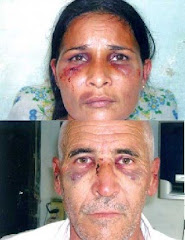
This past April 15, 2011, Cuban independent journalist Dania Virgen
Garcia, along with three other independent journalists (David Águila
Montero, Leydi Coca Quesada, and Michel Iroy Rodríguez) were approached
by 20 agents from Castro State Security as they walked down the street.
The four democracy activists were then brutally and violently forced
into police cars and the women were taken to one police station for
questioning, while the men were transported to another.

While Dania Virgen Garcia and Leydi Coca Quesada were being questioned
in a room, Quesada was grabbed by several women and held up against the
wall while one official beat her. Moments later, the lieutenant colonel
unit commander entered the room with other officials and grabbed Dania
by the arms, shaking her violently in an effort to force her to
cooperate. When Dania refused, the man struck her and continued to
forcibly twist her arms around. After the beating both women received,
they were put into a jail cell where another official sprayed her face
with pepper spray.

You can read Dania's account of the violent and brutal attack on her
blog, where you will also find more photographs of the injuries they
received.

http://www.favstocks.com/cuban-independent-journalists-detained-and-beaten-by-castro-dictatorship/2448986/

Spaniards in the World / Yoani Sánchez

Spaniards in the World / Yoani Sánchez
Translator: Unstated, Yoani Sánchez

The capitol, rum, salsa music played on street corners, cars that look
like collector's pieces although under the hood they are falling to
pieces. This and more in the chapter, "Spaniards in the World," filmed
here in Havana. Fifty minutes with stories of immigrants from Asturias,
Galicia, Andalusia, which have transported their dreams from the other
side of the Atlantic. Everything is nice and blue, sprinkled with salt;
but something doesn't fit.

While I watch the serial I have the impression that what they're showing
me is another country, a distant dimension in sepia tints. The life
stories of the seven main characters happen, for me, in a space far from
the daily life I know. And though I repeat — to calm myself down — that
the serial is about Spaniards spread across the globe and not about
Cubans lost in their own geography, as the credits run I can't escape
the feeling of having been conned.

The writers cleverly hide the detail that those interviewed possess
prerogatives unattainable for natives. They fail to say that spending a
night at the Bodeguita del Medio, or at the Tropicana cabaret, renting
an office in the Bacardi building, managing cosmetic or tobacco
companies, dining on lobster and wine, are privileges accessible —
almost exclusively — to the wallets of foreigners. Not to mention the
beautiful sail on the yacht in one of the final scenes, prohibited by
law to the nation's 11 million people. It lacks, this modern and
diverting program, the explanation of the imbalance, the story about the
gap that separates the world of these Spanish who come here from the
world of the Cubans who were born here.

The video Españoles en el mundo – La Habana
http://www.rtve.es/alacarta/videos/espanoles-en-el-mundo/espanoles-en-el-mundo-la-habana/1046370/

23 April 2011

http://translatingcuba.com/?p=9158

Changes Lie Ahead, on Obstacle Course

Changes Lie Ahead, on Obstacle Course
By Dalia Acosta

HAVANA, Apr 22, 2011 (IPS) - Although it failed to bring about the
hoped-for generational renewal at the highest level of Cuba's governing
Communist Party, the recent party congress may have marked the start of
a new stage of socialist development, if the resistance to change among
the most conservative sectors is overcome.

Not a few observers lamented that the Cuban Communist Party (PCC) sixth
congress ended Apr. 19 with the presentation of a 15-member political
bureau mainly made up of the old guard, with an average age of 67.
Others stress that any real change in the country will depend on new
ways of thinking.

"Years of reductionist thinking and simplifications, of wilfulness,
weigh down on those who must push the changes through," psychologist and
professor of communications José Ramón Vidal told IPS. "Awareness of
these limitations and barriers is the first condition for preventing
them from distorting or frustrating the proposed changes."

Vidal said it is clear that the "desired scenario" would require
strengthened institutions, a break with the state monopoly over all
economic activities, greater autonomy for public enterprises, and
administrative decentralisation to make management of municipal
governments more independent.

However, "popular participation is still limited to consultation
processes, to listening to public demands, and no new ideas have been
set forth for how to boost the role of citizens in political
decision-making or how to increase citizen oversight over the country's
institutions and leaders," he said.

The new first secretary of the PCC, President Raúl Castro, acknowledged
the need for a change in mentality.

At the four-day party congress, he said Cubans would have to overcome a
"mentality of inertia," and the only thing that could threaten the
revolution was "our inability to rectify errors."

However, the resistance to change is not only identified with a specific
generation, but with sectors that could see the proposed transformations
as a threat to privileges they have gained in their careers as
politicians or civil servants.

Since Raúl Castro first became acting president when his brother Fidel
fell ill in 2006, he has insisted on the need to be wary of a false
sense of unanimity and to respect diversity of opinion.

But in Castro's case, that respect may end where dissident groups start.

In the party congress, Castro called for doing away with prejudice
against private enterprise or "self-employment," insisted on delinking
the party and the government, and reiterated the need to move forward
without "haste or improvisation."

The party congress's "approval of the Guidelines for Economic and Social
Policy gave us the main tool, the 'what'; now we need the 'how': the
legal framework, regulations and even changes to the constitution,"
economist Armando Nova, a researcher at the Centre for the Study of the
Cuban Economy (CEEC), told IPS.

In the analyst's view, the country is facing "a realignment, more than
an updating," of the social economic model. "There is the development of
different forms of property, spaces are opening up to a non-state sector
in the economy, and more rational labour and wage policies" are being
introduced, he said.

The touchiest changes, he said, are the restructuring of the labour
market – which involves the dismissal of half a million public sector
workers this year alone – and the elimination of the ration card, which
guarantees heavily subsidised food and other basic products to the
entire population.

These changes are necessary for economic reasons, "but it is good that
it has been clarified that conditions will be created for these things
to happen, that the process will be gradual, and that in the case of
cuts to state payrolls, the modifications will be linked to the workers'
employment possibilities and options," added Nova, one of the leading
scholars on agriculture in Cuba.

Gender and racial inequalities acknowledged

One of the questions that drew the most attention from civil society was
the recognition of the persistence of gender and racial inequalities –
issues that tend to be ignored and denied by government authorities, who
prefer to highlight the achievements and downplay the shortcomings of
the socialist system.

"We have to remain alert, to avoid falling into the traps of the past,
when the idea was that by declaring the abolition of a society divided
into antagonistic classes, all social, political and cultural problems
would disappear," writer Tomás Fernández, a member of the Cofradía de la
Negritud – an association of black people aimed at raising awareness of
the problem of racial discrimination – told IPS.

"Social problems have always been shouldered aside by economic and
political problems; let's not fall into this same mistake again," said
Fernández, who warned against "closing our eyes to the social problems"
that plague the segments of the population in greatest need of
assistance, like blacks.

Blogger Sandra Álvarez recognised that the number of women and blacks on
the 115-member PCC Central Committee had grown. But she called for close
monitoring of "racial inequalities that could be generated or
exacerbated" in the process of the implementation of the new economic
and social policy guidelines.

"I hope the debate on race-based inequality in Cuban society will also
be taken up by the PCC National Conference," added the writer of the
blog "Negra cubana tenía que ser".

The conference, which will focus on internal party questions, is slated
for Jan. 28, 2012.

Professor Vidal commended Castro's criticism of the party's policy of
hastily promoting "inexperienced and immature cadres" based on the
mistaken "idea that an unspoken premise to occupy a leading position was
to be a member of the Party or the Young Communist League."

Castro linked the errors of this policy to the impossibility of
"rejuvenating" the political bureau.

The professor also mentioned the president's call for the eradication of
prejudice against religion and people of faith.

With respect to the national press, Vidal said it would live up to its
"social responsibility" when it overcame its current role, which is
heavily focused on "propaganda," and once it strengthened its
informative and educational functions and became a vehicle for the
exchange of ideas for "the construction of inclusive consensuses."

Analysing the significance of the congress, historian and anthropologist
Jesús Guanche said "it is still necessary to struggle with those who
have not yet understood that the means and the end of development are
human beings, in all their diversity of cultural expression and personal
choice, and that the economy, no matter how successful it is, is only a
means.

"All of the necessary changes, especially the loosening up of the knot
of productive forces, must head in the direction of dealing a
devastating blow to corruption, at both the low and, especially, the
high levels, which also contributes to blocking everything that can be
blocked," he told IPS in an email interview.

http://ipsnews.net/news.asp?idnews=55360

Full circle for Cuba's revolution

Full circle for Cuba's revolution

Fifty years after their bay of pigs victory, Cuba's Castro brothers are
finally loosening their grip on the country's economy. But it may be too
late
By Christopher Hart, The Telegraph April 24, 2011 2:03 AM

In a choreographed display of communist propaganda, Cuba's aging rulers
celebrated the 50th anniversary of their greatest victory over the U.S.
last week with a showpiece military parade in central Havana.

Army veterans and students waving bright red bandanas led the march
commemorating the defeat of the CIA-backed invasion by Cuban exiles at
the Bay of Pigs in April 1961. Under a strong Caribbean sun,

President Raul Castro, in his trademark olive green fatigues, returned
the salutes of youth groups, workers' associations and soldiers filing
through Revolution Square.

Absent from the podium as the tanks rolled by and MiG fighter jets
roared overhead, however, was his ailing older brother, El Commandante
Fidel Castro, 84, the father of the revolution that was being lauded.

"The young people will continue the struggle of Fidel and Raul for
generations to come," insisted Guillermo Valdez, a student holding a
placard declaring, "Homeland or Death."

But despite the highly scripted show of nostalgia and fervour, it was
actually an exercise in myth and reality for the country's communist cadres.

For all the parade banners boldly declaring the "Victory of Socialism,"
it is the failings of Cuba's experiment in tropical communism that has
dominated the agenda in recent weeks.

Last week, 1,000 delegates sat down for the first party congress in 14
years. Their task -to discuss the final throw of the dice by Raul Castro
to salvage the regime and its ailing economy.

The stakes are high as the 79-year-old president, who stepped into the
post after an intestinal infection almost killed his older brother,
attempts to usher in market reforms to bolster a Soviet-style economy
that is close to collapse.

"The time that we have left is short, and the work that we have to do is
gigantic," Castro announced

recently, as he conceded that changes that would once have been viewed
as a heretical embrace of capitalism were desperately needed.

In a country where 90 per cent of the economy is still state run, even
these reforms are limited, aimed at promoting small business while
central planning and major industries remain in the hands of military
and party chiefs.

But some 170,000 Cubans have already taken out selfemployment licences,
running outfits such as pizza joints and trinket stalls, even though
many feel that Raul's measures are too little too late.

"Cuba is certainly changing, but too little and too slowly," said
Victoria Garcia, 58, who is now licensed to rent out rooms to tourists
in her central Havana apartment.

"The government is handing out small business licences, but we are all
just buying and selling more cheap stuff to each other.

"Bracelets and pizza are great, but you can't create an economy that
way. It's not creating jobs and we are not investing in the future.

"The changes here are only surface deep. It's the same people
controlling the same things when you scratch beneath the surface. The
congress is a sideshow for most Cubans."

Raul Castro has issued guidelines that would cut rations and subsidies
and eliminate more than million state jobs -one fifth of the workforce
-by 2015. But he has already been forced to postpone the layoffs, amid
delaying tactics by midlevel party officials.

Still, the forces of the free market are gradually making their claim on
Havana's crumbling colonial facades. Buildings neglected for decades are
getting belated makeovers, while new business signs bear testimony to a
new class of microentrepreneurs -barbers, manicurists, plumbers, taxi
drivers, car mechanics and pizza-makers.

Cubans are also desperately hoping, but dare not expect, that the
congress may also consider scrapping the loathed bans on the private
sale of property and cars as a gesture of appeasement.

What is not on the agenda, however, is any loosening in the strict
system of one-party rule. If the insular Castros and their cronies see
any role model, it is China and Vietnam, where the communist parties
have allowed economic reforms while maintaining their tight grip on power.

Their nightmare scenario is that which befell the old Soviet bloc, where
market forces ousted Marx almost overnight.

In a country whose people often boast that they have three national
pastimes -baseball, sex and gossip -the rumour mill about who might
replace the Castro duo has been in full swing.

Several contenders to succeed them have fallen by the wayside in recent
years, accused of corruption or indeed simply over-ambition, so firm
predictions are in short supply. Meanwhile, as delegates debate the
reforms, Cubans recall a long popular, but bitter, joke.

"What are the triumphs of the Revolution?" it begins, to which the
requisite answer is: "Education, health care and sports."

"And what are the failures of the Revolution?" The answer runs:
"Breakfast, lunch and dinner."

Indeed, for a Caribbean island that is so lush and fertile, some 80 per
cent of food is now imported and last year's sugar harvest was the worst
in more than a century.

Inefficiency, incompetence, mismanagement and corruption have crippled
the economy and, after the loss of its Soviet benefactor in 1990, the
country is now effectively bankrolled by Hugo Chavez, Venezuela's
firebrand socialist president and a disciple of Fidel.

The oil-rich South Americans supply the country with 90 per cent of its
fuel on hugely-discounted "noncommercial terms," ostensibly in return
for well-trained Cuban doctors "exported" to provide health care in the
slums of Caracas.

But for the Cuban elite and foreigners with hard currency in their
pocket, it is finally possible to eat extremely well thanks to Raul's
reforms. Private restaurants can now employ staff (previously all
workers were supposed to be family members), seat as many as they can
cater (the limit had been set before at 12) and buy food privately
rather than through state concerns.

On just one night last week, off the courtyard at La Fontana restaurant,
European investors hoping to develop the country's first luxury golf
resort dined on fresh octopus and squid as a popular jazz crooner sang
boleros.

As they lamented the frustrations of dealing with communist bureaucrats,
they ran up bills of $50 a head for seafood and mojitos -a fortune in a
country where the average monthly wage for doctors is $20.

The warped world of Cuban economics throws up Alice in Wonderland
distortions, with artists and musicians becoming wealthy, while doctors
and sportsmen struggle to survive.

Cuban art and music is fashionable internationally, and the artists are
paid in hard currency for their talents. They are granted licences to
attend arts fairs in Miami and or give concerts in New York, as long as
they do not hold forth on taboo political subjects.

After decades of such ruinous economics, the changes that the congress
will endorse this week are the first of many hurdles.

It remains to be seen how many Cubans have the capitalist instinct to
set up their own businesses, especially after half a century of moribund
state socialism that has bred an expectation of a job for life, with
rations to make up for paltry pay.

http://www.calgaryherald.com/news/Full+circle+Cuba+revolution/4666384/story.html

Measuring Stick for Cuba's Reforms

Measuring Stick for Cuba's Reforms
April 23, 2011
By Circles Robinson

HAVANA TIMES, April 23 — Taking a look at the reforms being/to be
implemented in Cuba's economy, I came up with some indicators that we
can evaluate five years down the road (and consider along the way) to
see if the reforms have a positive impact on life under Cuban socialism.

- If Cuban workers can meet their basic needs with their salaries.

- If Cuba greatly increases its food production and distribution
networks and can thus considerably lower imports without decreasing
already low consumption levels.

- If Cuba's housing infrastructure sees more repairs and/or new
construction than collapse and further deterioration.

- If getting to and from work on public transportation ceases to be a
second job in itself for most people.

- If low and high level theft and corruption cease to be a generally
recognized norm at State companies/institutions.

- If there is an improvement in public education and health care or at
least a break in the decline experienced over the last decade.

- If social inequalities sure to increase do not reach the typical Latin
American proportions.

- If young people generally feel positive about their future in Cuba.

- If child-bearing age women increasingly feel secure enough to have
children.

- If the immigration status of Cubans is normalized with clear policies,
eliminating the current restrictions.

Achieving some of these indicators partially depends on other civil
rights and liberties issues, scheduled to be addressed in a Communist
Party policy conference next January.

http://www.havanatimes.org/?p=42205

Cuba's congress a requiem for an old man

Posted on Sunday, 04.24.11

Cuba's congress a requiem for an old man
BY YOANI SANCHEZ
www.desdecuba.com/generation

HAVANA -- And now, the end is near

and so I face the final curtain . . .

To say goodbye can be accomplished with just a brief note left on the
table, or by a telephone call where we say our final farewells.

In the preparations to leave the country, at the end of a relationship,
or of life itself, there are people who try to control the smallest
details, draw up those limits that oblige the ones they leave behind to
follow their path.

Some leave slamming the door behind them, and others demand before
taking off the great tribute they think they deserve. There are those
who equitably distribute all their worldly goods, and also beings with
so much power they change the constitution of a country so that no one
can undo their work when they're gone.

The preparations for the Sixth Congress of the Cuban Communist Party and
its sessions in the Palace of Conventions were like a great public
requiem for Fidel Castro. The scene of his farewell, the meticulous
ceremonial demanded by him and realized — sparing no expense — by his
younger brother. In the organizational excesses of the military parade,
held last Sunday, was seen the intention to "spare no expense" in a
final tribute to someone who could not be there on the podium.

It was clear that the announcement of the names of those who would
assume the highest positions in the Cuban Communist Party would not be
read by the man who decided the course of this nation for almost 50
years. But he sat at the head table of the event to validate, with his
presence, the transfer of power to Raúl Castro. Being there was like
coming — still alive — to the reading of his own will.

Then came the standing ovation, the tears of this or that delegate to
the party conclave, and the phrases of eternal commitment to the old man
with the almost white beard.

Through the television screen some of us sensed the crackling of
dried-up flowers or the sound of shovelfuls of dirt. It remains to be
see if the General-cum-President can sustain the heavy legacy he has
received, or if under the watchful supervision of his Big Brother he
would prefer not to contradict him with fundamental reforms. It's just
left to check the authenticity of Fidel Castro's departure from public
life, and whether his substitute will choose to continue disappointing
us, or to reject him.

* * *

Laughter is still an effective cure for the daily trials. Thus, on this
island, we bend our lips into a smile more for self-therapy than for
happiness. Then the tourists take our pictures and go home saying we are
a happy people, that we haven't lost our sense of humor before all the
difficulties.

Ahh! The tourists and their explanations! We tour the world with the
instant of that laugh on our faces — a laugh that preceded a gesture of
disgust — or with the image of satisfaction that overwhelms us on
resolving, after a year's effort, a pair of graduated lenses for a child.

Splitting our sides laughing can also be preventative medicine to avoid
disappointments to come. Perhaps for this reason, every time I ask
someone about the possible reforms likely to grow out of the Sixth
Communist Party Congress, they answer me with a giggle, an ironic
"teeheehee." Next they shrug their shoulders and come out with a phrase
such as, "Well, no one should have any illusions… and maybe they'll
authorize the purchase of houses and cars."

They end their words with another enigmatic grimace of pleasure,
confusing me still more. It's difficult to know if the majority of my
compatriots today would prefer that transformations be approved at the
Party Congress, or for it to be a fiasco to demonstrate the system's
inability to reform itself.

Although expectations have faded considerably in recent months, some
part remains, especially among the most materially destitute and the
most ideologically fervent. The image of a pragmatic Raúl Castro has
been replaced by that of a hesitant ruler, trapped by a situation beyond
his control. The Congress some assumed would lead to reforms has come
too late and forfeited, with this waiting, many of the hopes it once
unleashed. Behind the enigmatic smiles of the taxi drivers, pizza
sellers, students, and even Communist Party militants, is now concealed
the insolence of those who know how little things change, and who use
silent mockery to vaccinate themselves — in advance — against the
frustration.

Yoani Sánchez is a Cuban blogger who has received international awards
for her critical portrayal of life in Cuba's dictatorship, which has
blocked her blog from public Internet sites on the island. She relies on
friends abroad to post texts she sends by e-mail.

http://www.miamiherald.com/2011/04/24/2181048/cubas-congress-a-requiem-for-an.html