Tuesday, October 26, 2010

Cuba unveils more self-employment rules, hefty tax hits

Cuba unveils more self-employment rules, hefty tax hits
afp
On Monday 25 October 2010, 22:45 EST

Cuba Monday unveiled rules for broader self-employment which it hopes
can pick up slack as the Americas' only communist government lays off
half a million state workers over six months.

The government already has unveiled guidelines for free enterprise
activities in 178 fields, as part of the plan to absorb workers to be
laid off into a larger if still marginal private sector.

Havana plans to cut the 500,000 state jobs by March 2011.

Reforms announced earlier will allow Cubans to operate a wide range of
micro businesses -- accountants, masseuses, park custodians, or even
open small fruit and vegetable stores.

But many economists have doubts that the experiment can absorb so many
former state workers.

Among rules detailed in the government gazette Monday, it was announced
that self-employed will pay a 25-50 percent income tax; a 10 percent
sales tax; 25 percent tax for hiring workers; and a 25 percent tax to
social security.

The income tax scale for these workers will run from 25 percent for an
income of 5,000 Cuban pesos (about 200 dollars) a year, to 50 percent
for those with an income over 50,000 pesos (about 2,000 dollars) a year,
the rules showed.

One novelty: self-employed people will be able to hire workers outside
their families. That will be allowed in 83 of the 178 job classes.

In theory, that opens the door to small and mid-sized businesses which
were eliminated by the communist government in 1968.

But the employer will pay steadily increasing taxes based on the number
of workers he employs to avoid concentration of wealth, the Cuban
Communist Party newspaper Granma reported.

On September 13, Cuba announced plans to slash one million state jobs,
including half a million between October and March.

http://au.finance.yahoo.com/news/Cuba-unveils-self-employment-afp-2141668783.html?x=0

Cubans queue for business permits

Cubans queue for business permits
Last Modified: 26 Oct 2010 07:20 GMT

Cubans have begun queuing outside government offices across the capital,
Havana, to register their own businesses as the country made official a
sweeping economic overhaul announced last month.

Cuba unveiled new rules for broader self-employment in the government
Gazette on Monday, a month after announcing new guidelines for free
enterprise activities in 178 fields.

The government said last month that it planned to expand its private
sector in an effort to help preserve socialism, but the rules did not
become law until they were published on Monday.

Under the new measures, Cubans will be able to open restaurants, repair
homes and cars, train animals, sell wine, provide transport, work as
clowns and open many other businesses, some currently prohibited by the
communist-led government.

"I hope this licence will bring me a better future," the Associated
Press news agency quoted Lazaro Ramos, who was one of about 20 people
waiting outside a government office in Havana's 10 de Octubre
neighbourhood, as saying on Monday.

Ramos, 34, said he was unemployed but was hoping to get permission to
make piñatas for children's parties. "The economy is not good. But with
this, I will be able to make ends meet."

Simplified tax system

Under the rules detailed in the Gazette, authorities said the majority
of the country's new self-employed license owners will be eligible for a
simplified tax system that establishes a monthly quota regardless of
revenue.

For example, parking attendants would pay 80 pesos ($4) a month, while
typing instructors would have to pay more than 100 pesos ($5) monthly,
and barbers would be forced to pay the highest fees at 200 pesos ($10) a
month.

Those not eligible for the simplified tax system - with jobs such as
taxi driver, plumber and rooming house operator - will pay a 25 per cent
income tax on the first 10,000 pesos ($476) earned each year, with the
rate rising for those who earn more.

Income exceeding 50,000 pesos ($2,381) a year will be taxed at 50 per cent.

State worker layoffs

The guidelines are part of a plan to deal with some half a million state
workers to be laid off by March 2011. Authorities announced on September
13 that the government would lay off 500,000 workers and absorb many of
them into the private sector.

The new rules will allow Cubans over the age of 17 to start their own
business, so long as they are permanent residents.

Cuba's inefficient economy, crippled by a US trade embargo for nearly
five decades, has been suffering for years, and the government of Raul
Castro has begun to allow an expansion of small-scale private enterprise.

Similar steps were taken in the 1990s as Cuba struggled to survive when
its economy collapsed after the fall of the Caribbean island's principal
benefactor, the Soviet Union.

In 1996, the number of self-employed peaked at 209,000, but when the
economy improved, the government, in the name of ideological purity,
backed off the reforms and restricted the issuance of new licences.

http://english.aljazeera.net/news/americas/2010/10/2010102643720407749.html

Cuba self-employed to pay taxes up to 50 percent

Cuba self-employed to pay taxes up to 50 percent
Reuters

By Nelson Acosta Nelson Acosta – Mon Oct 25, 1:41 pm ET

HAVANA (Reuters) – Cuba has set income tax rates at 25 to 50 percent for
its soon to be expanded private sector, with the biggest earners paying
the most taxes, according to official decrees published on Monday.

The rates will range from nothing for those making 5,000 pesos --
equivalent to $225 -- or less a year to 50 percent for those in the
highest bracket, which is more than 50,000 pesos, or $2,252.

The new tax rates came out in the Official Gazette as the government
prepares to cut 500,000 workers from state payrolls and issue 250,000
new licenses for self-employment to create new jobs in President Raul
Castro's biggest economic reform so far.

Those making more than 5,000 pesos will have to pay taxes, starting at a
rate of 25 percent and rising from there as income increases.

The cash-strapped government is looking to the self-employed to increase
tax revenues to help pay for expensive social programs such as free
health care and education.

Last week the government, in a story in Communist Party newspaper
Granma, warned that tax scofflaws "will feel the weight of the law
imposed upon them by those mandated to enforce it, the National Tax Office."

The gazette, where the government publishes in thick legalese its new
laws and decrees, is not usually a hot seller, but on Monday in Havana
people could be seen lining up at newsstands to buy copies, then quickly
leafing through them on the street.

INTEREST IN STARTING BUSINESSES

Many Cubans have expressed interest in opening their own businesses,
with the hope of earning more than the country's $20 a month average salary.

Currently, about 85 percent of the country's labor force of more than 5
million works for the state. Castro, who took over from his ailing older
brother Fidel Castro in 2008, wants to trim that number and cut costs.

As of the end of 2009, there were only 143,000 licensed self-employed,
although thousands more worked for themselves illegally.

Reaction on the street to the thick decrees, which came out in two
separate editions of the gazette, was mixed.

Antonio Soria, a shoemaker working for the state, said he intends to
start his own business and views it as a chance to help both himself and
the state.

"As a private shoemaker I can retire and have financial support for the
future," he said.

"This is a way to contribute to the state's income. Remember that health
care and education are free and now that we have the chance to have
small businesses, we have to help the country."

Transport worker Ibrahim Fernandez said he supports the private sector
expansion, but worried taxes will be too high to encourage small businesses.

"From what I've been able to understand, the topic of the licenses has a
defect, which is that they are overcharging taxes. Very expensive, the
taxes," he said.

In last week's Granma story, the government outlined a new tax code it
said was friendlier to small businesses because while it requires new
taxes, it also allows bigger tax deductions.

For the first time since Cuba nationalized small businesses in 1968, the
self-employed will be able to legally hire workers.

The regulations issued on Monday said they would have to pay a labor tax
amounting to 25 percent of the average salary for their work.

(Additional reporting by Esteban Israel; Editing by Jeff Franks and
Jerry Norton)

http://news.yahoo.com/s/nm/20101025/wl_nm/us_cuba_reform_taxes_1

Schwarzenberg: EU not to change stance on Cuba

Schwarzenberg: EU not to change stance on Cuba
ČTK |
26 October 2010

Luxembourg, Oct 25 (CTK) - The European Union will not change its
current stance on the Cuban regime though Cuba released some political
prisoners in the past weeks, the EU countries' foreign ministers agreed
Monday, Czech Foreign Minister Karel Schwarzenberg has said.

The EU will be willing to negotiate with Cuba only if human rights
protection improves in this country, he added.

The EU has practically not changed its stance since 1996 when it adopted
a common position on Cuba.

Spain, which wants the EU to normalise relations with Cuba, has
criticised this position in the long run.

However, a number of the member states stand up against the Spanish
view. The Czech Republic has been among the strongest opponents of
softening the EU policy towards the Cuban totalitarian regime.

The Czech Republic and Sweden, with support of Germany, Monday succeeded
in persuading most of the EU member states that not even the release of
some prisoners of conscience was a sufficient reason to mitigate the
stance, Schwarzenberg said.

Last week, the Cuban government approved the release of five political
prisoners who, however, do not belong to the group of 52 dissidents
arrested, along with another 23 regime opponents, in 2003.

These people are being gradually released prom prison on the basis of
the July agreement between the Cuban government and Spain which was
mediated by the Catholic Church.

http://www.praguemonitor.com/2010/10/26/schwarzenberg-eu-not-change-stance-cuba

Sakharov Prize recipient shows 'Cubans have a right to rights,' says dissident

Sakharov Prize recipient shows 'Cubans have a right to rights,' says
dissident

Havana, Cuba, Oct 25, 2010 / 10:04 pm (CNA).- The leader of the
Christian Liberation Movement, Oswaldo Paya, has offered his
congratulations to Guillermo Farinas, the recipient of the European
Union's 2010 Sakharov Prize, saying that the selection of Farinas proves
that "Cubans have a right to rights."

In a letter to Europe, Paya wrote, "Within Cuba we peacefully fight for
these rights and we hope to receive the solidarity of everyone so Cubans
themselves can bring about these changes in an atmosphere of
reconciliation."

Paya received the Sakharov Prize in 2002.

The Sakharov Prize for Freedom of Conscience is named after Soviet
dissident Andrei Sakharov. It was established in December of 1985 by the
European Parliament in order to honor persons or organizations devoted
to the defense of human rights and freedom."

http://www.catholicnewsagency.com/news/sakharov-prize-recipient-shows-cubans-have-a-right-to-rights-says-dissident/

Shock measures a la Cubana

Tuesday, October 26, 2010
Shock measures a la Cubana
Authors:
Luis Alberto López Rafaschieri and José Alberto López Rafaschieri
www.morochos.net

When Fernando de la Rua in Argentina proposed an agenda of fiscal
discipline and privatizations that copied the IMF's recipe, several
leftist sympathizers in Latin America had to be hospitalized due to
sudden heart diseases. Ironically, neither in the Domingo Cavallo's
Argentina, nor in the current indebted Greece, the IMF technocrats came
up with an economic program as ruthless as the one that the Cuban
government has been pursuing.

With words similar to that of Milton Friedman, the Cuban regime is now
talking about the need to eliminate "unreasonable expenses", but prefers
an economic policy that would embarrass even the father of
neoliberalism. 10% of the Cuban labor force was fired from its state
employment as a saving measure and thrown into the streets to survive at
its own, without social security, fixed income or solid legal guarantees
to start its own business. 500 thousand human beings who are also only
allowed to open small hair salons or mobile food sales, which means that
a whole mass of people will start, at the same time, identical
businesses to compete savagely in an archaic market with very little
money movement.

To make matters worse, as these people have been working during years
for a Marxist bureaucracy, they do not have the preparation or
experience needed to succeed in private businesses.

As if it was not enough, these new local micro entrepreneurs must cope
with the giants that come from outside the country, because Cuba is also
privatizing several sectors of its economy into the hands of
international private capital, with the hope to generate the development
that the communist government was never able to materialize.

And like most governments looking for help of the International Monetary
Fund, Cuba is forced to practice emergency measures once it is in the
brink of a more extreme economic disaster, resulting in traumatic
adjustments.

We can add the words humanism, socialism or global warming, which
combine better with a Leninist propaganda, but economically, what Castro
is doing is a grip so cruel that we do not remember having seen
something similar in any of the IMF's bailouts.

http://www.morochos.net/2010/10/shock-measures-la-cubana.html

Czechs grant asylum to Cuban political prisoner

Posted on Tuesday, 10.26.10
Czechs grant asylum to Cuban political prisoner
The Associated Press

PRAGUE -- Officials say the Czech Republic has become the second
European Union country after Spain to grant asylum to a Cuban political
prisoner.

The Foreign Ministry says Rolando Jimenez Posada arrived in Prague on
Tuesday.

He's one of dozens political prisoners Cuba's communist government
agreed to free on condition they leave the island.

Pavla Holcova of the People In Need human rights organization says
Jimenez Posada, a lawyer, was arrested in 2003 and received a 12-year
prison term three years later for subversion. Holcova said Posada
arrived with his wife, brother, son and niece.

The Czech Republic is one of the strongest critics in the EU of Cuba's
human rights record. The ministry says the country is ready to take 10
Cuban political prisoners.

http://www.miamiherald.com/2010/10/26/1891494/czechs-grant-asylum-to-cuban-political.html

Europe should keep heat on Cuba

Posted on Tuesday, 10.26.10
Europe should keep heat on Cuba
OUR OPINION: Island dictatorship still holds prisoners of conscience

Europe's ambivalence toward Cuba was on display again this week when
foreign ministers from a few countries tried and failed to ease the
European Union's sanctions against the Castro regime. If these friends
of Cuba don't know what's wrong with the island's 51-year-old
dictatorship, maybe they should just ask the European Parliament.

Last week, the European Union's legislative arm awarded the prestigious
Sakharov Prize to Cuban dissident Guillermo Fariñas, whose 140-day
hunger strike forced the Cuban government to release political
prisoners, thus avoiding the embarrassment of having yet another
political prisoner die in protest against the dictatorship.

The award to Mr. Fariñas marks the third time in a decade that the E.U.
prize has gone to a Cuban -- Oswaldo Payá received it in 2002 and the
Ladies in White in 2005. That should make it clear to all but those who
are deliberately blind to the facts that Cuba's human rights situation
is scandalous and that the government is a repeat offender when it comes
to crimes against human liberty -- and has no intention of changing its
ways.

That didn't stop Spain and a few other benighted countries with false
notions of how the regime treats dissidents to try to put aside the
``Common Position'' that has governed the E.U.'s policy toward Cuba
since 1996. The policy ties improvement in Europe's relations with Cuba
to progress on human rights.

Spain reportedly led the charge in trying to do away with the Common
Position, with Italy, France and Ireland among those in agreement.
Sadly, and somewhat surprisingly, the effort came just a few days after
Spain's new foreign minister, Trinidad Jiménez, came on board.

Ms. Jiménez was considered a welcome change from her predecessor, Miguel
Angel Moratinos, who labored long and hard, ultimately without success,
to undermine the Common Position. According to reports from Luxemburg,
where the meeting of the 27 E.U. foreign ministers was held, she made an
impassioned plea for Europe to improve relations with Havana.

Fortunately, the majority of top diplomats from Europe's other countries
refused to go along. Perhaps they are aware that Europe would be accused
of foreign policy schizophrenia in giving a human rights prize to a
Cuban dissident one week and improving relations with Havana the next.
Ultimately, the E.U.'s top diplomat, Catherine Ashton of Britain, was
directed ``to explore ways to try and make progress'' in relations with
Cuba, according to news reports from the meeting, and report back in
December.

Ms. Jiménez tried to portray this as a significant victory for those
seeking to soften Europe's common stance, but Sweden's foreign minister,
Carl Bildt, set her right. He said the Common Position will endure until
Europe sees significant changes on the human rights front in Cuba. We
won't hold our breath.

To make the case for Cuba, Spain's foreign ministers and like-minded
diplomats say Cuba's promise to release 52 political prisoners -- whose
crime consists of expressing dissent in peaceful ways -- should be seen
as a major step forward. Forty of them have already been released.

What they don't bother to say is that these prisoners should never have
been arrested in the first place. Or that after being released they were
summarily exiled along with their families. Or that the jails still
contain hundreds of political prisoners, who have no hope of freedom.

Every release of a blameless prisoner constitutes a victory for human
liberty. But these releases are no more than a self-serving gesture by
Cuba, an effort to use human beings as pawns in a cynical game of
international diplomacy.

Europe should maintain its common position until all political prisoners
are freed and peaceful dissent is allowed in Cuba. True freedom of
thought and expression will spell the end of the Castro brothers'
regime, though. That's why they will never let it happen.

http://www.miamiherald.com/2010/10/26/1891111/europe-should-keep-heat-on-cuba.html

Cuba makes self-employment rules official

Posted on Monday, 10.25.10
Cuba makes self-employment rules official
By PAUL HAVEN
Associated Press Writer

HAVANA -- Potential entrepreneurs lined up outside government offices
around the capital on Monday after Cuba made official the grand economic
changes it announced last month, raising hopes that eagerly anticipated
licenses for the newly self-employed could be issued soon.

The economic overhaul - the most significant undertaken in communist
Cuba since the early 1990s - was outlined in nearly 100 pages of rules
and regulations for small businesses published in the government Gazette.

"I hope this license will bring me a better future," said Lazaro Ramos,
who was one of about 20 people waiting outside a government office in
Havana's 10 de Octubre neighborhood. Ramos, 34, said he was unemployed
but was hoping to get permission to make pinatas for children's parties.
"The economy is not good. But with this, I will be able to make ends meet."

Officials took down personal details and told applicants to come back in
a couple of weeks for more information. It was not clear how long it
would take to process the licenses.

Cuba announced on Sept. 13 that it would lay off half a million workers
and push many of them into the private sector. It later detailed some
178 private jobs that will be allowable. But the rules did not become
law until they were published Monday.

The rules published Monday detail four kinds of taxes for the private
sector: a sliding personal income tax, a sales tax, a public service tax
and a payroll tax. It also establishes minimum monthly fees for
different kinds of businesses, as well as deductions Cuban can take to
reduce their tax burden.

Some of the tax rules were detailed in the Communist Party newspaper
Granma last week, but the newspaper account lacked crucial details and
contained several contradictions.

The lengthy rules laid out in the government Gazette clear up most of
the uncertainty.

The law establishes 178 private activities for which licenses can be
granted - everything from restaurateur to taxi driver, from button maker
to party planner. The majority of those businesses will be eligible for
a simplified tax system that establishes a monthly quota regardless of
revenue.

For instance, parking attendants would pay 80 pesos ($4) a month, while
typing instructors would have to fork over 100 pesos ($5) monthly.
Barbers have one of the highest fees: 200 pesos ($10) a month.

Those not eligible for the simplified tax system - jobs like taxi
driver, plumber and rooming house operator - will pay a 25 percent
income tax on the first 10,000 pesos ($476) earned each year, with the
rate rising for those who earn more. Income exceeding 50,000 pesos
($2,381) a year will be taxed at 50 percent.

Businesses will also be subject to a 10 percent levy on the total value
of their sales, and those that use public services like electricity and
water will have to pay a 10 percent tax on top of normal utility rates.
The government heavily subsidizes public utilities, meaning the tax
should amount to pennies for most businesses.

Entrepreneurs who hire employees will have to pay a 25 percent payroll
tax on their salaries, and all Cubans who are self-employed must 25
percent of their income into a social security system from which they
will eventually draw a pension.

The rules mean that, theoretically, a successful businessperson could
face taxes of nearly 75 percent, between personal income tax and social
security.

But the law also establishes many deductions for raw materials,
transportation and other business expenses that make such a high rate
unlikely.

The new regulations will allow Cubans over the age of 17 to start their
own business, so long as they are permanent residents. Citizens can also
apply for licenses for more than one business. They will even be allowed
to sell their services to the state, though there will be strict
transparency rules to try to stave off corruption.

The law also establishes up to six months of sick leave and a year of
maternity leave so that self-employed workers don't have to pay tax
while they are not earning.

Cuba is in the midst of a major restructuring of its economy under
President Raul Castro. The half million workers will be laid off by
March 2011, and the Cuban leader has warned that another 500,000 state
jobs must shed within the next five years. In total, that would be about
20 percent of the island's labor force.

Castro has insisted the changes do not mean the end of Cuba's socialist
system. But he says the cash-strapped government can no longer afford to
subsidize every aspect of Cuban life and has warned Cubans they will
have to work hard to make their own way.

The government currently employs about 85 percent of the labor force,
paying workers about $20 a month but providing free or nearly free
education, health care, housing, transportation and basic food.

http://www.miamiherald.com/2010/10/25/1890520/cuba-makes-self-employment-rules.html

Monday, October 25, 2010

Cuba's pre-existing condition

José Azel:
Cuba's pre-existing condition
12:00 AM CDT on Sunday, October 24, 2010

José Azel is a senior scholar at the Institute for Cuban and
Cuban-American Studies at the University of Miami and author of "Mañana
in Cuba." This essay was first published in Foreign Policy. He can be
reached at jazel@miami.edu.

Last month, the Cuban government said it planned to fire 500,000 state
employees, and perhaps more than 1 million, saying "our state cannot and
should not continue supporting ... state entities with inflated
payrolls, losses that damage the economy, are counterproductive,
generate bad habits and deform the workers' conduct."

Some heralded the announcement as a long-awaited sign that Havana under
Gen. Raúl Castro is finally moving toward a market economy, others
voiced substantial skepticism, and Marxists denounced it as a betrayal
of communist orthodoxy. So, where is Cuba headed? Most likely, nowhere
fast. Far from being a hopeful indication that Raúl is serious about
economic reform, the abrupt layoffs reveal a government that is simply
desperate to make ends meet. And they offer yet more evidence that Cuba,
one of the last countries in the world to cling to Joseph Stalin's
bankrupt ideology, is not interested in joining – or, to be charitable,
does not know how to join – the globalized, 21st-century world.

Ironically, the official announcement of the firings was made by the
Cuban Workers Union – the labor union controlled by the Communist Party.
Anywhere but in repressive totalitarian regimes, the dismissal of 10
percent of all government workers would have been met with massive
protests. But this is Cuba, where even though about 85 percent of the
workforce of 5 million is employed by the state, there was nary a peep
on the streets.

No room for growth

The announcement, couched in typical Orwellian doublespeak, raises more
questions than it answers. "It is necessary to revitalize the socialist
principle of distribution and pay to each according to the quantity and
quality of their work," it read, a blundering contradictory attempt to
tie the layoffs to Karl Marx's socialist maxim, "from each according to
his ability, to each according to his needs." The government also said
it would grant permits for those fired to seek to make a living "outside
the state sector" as if it is unspeakable to talk of a private sector.

In Cuba, a state permit is required even to shine shoes – along with 178
other private economic activities that include mostly individual service
activities from baby-sitting to washing clothes. It is also unclear
exactly how those selected for dismissal will be chosen; seniority,
patronage, friendship, ideological purity or some form of capitalist or
socialist merit? Will race or gender play a role in these massive
firings? Will the dismissals disproportionately target those who receive
remittances from abroad? Perhaps more important, how are those fired
supposed to find jobs? In an economy with developed private competitive
markets, employees dismissed from one firm have a fighting chance of
securing employment in another. But in Cuba's economic system, the
government controls most economic activity. There is no private sector
to absorb the unemployed. Where will they find employment?

Perhaps most bizarre is that the dismissal measure seems to assume that
everyone is temperamentally suited to be an entrepreneur and make a
living in fields that might be far from his or her work experience and
professional training. The Cuban government is betting on the
resourcefulness and entrepreneurship of the Cuban people to somehow make
up for the inefficiencies of the state sector and do so without access
to cash, credit, raw materials, equipment, technology or any of the
inputs necessary to produce goods and services. Ironically, the most
likely source for these inputs will be the Cuban diaspora, which will be
eager to help its unemployed relatives and friends. Manuel Orozco, a
remittances expert at the Washington-based think tank Inter-American
Dialogue, underlines that, telling Reuters, "Liberalizing the economy
could lead to 10 percent of Cubans receiving remittances to invest in
small businesses."

This could be a motivation for the Cuban government to
disproportionately target remittance-receiving workers for dismissal.
Cubans will somehow make do, but in terms of actual economic
development, these measures will not work; they are not designed to.
Allowing Cubans to baby-sit or make paper flowers to sell to tourists
are not serious economic development measures. But just in case, hoping
to capitalize on any additional economic production, the government is
ready to collect onerous taxes of 25 percent for social security and as
much as 40 percent on income depending on the economic activity (e.g.,
food production will be taxed at 40 percent, artisans at 30 percent, etc.).

Ripe for black market

The government is projecting a 400 percent increase in tax revenues,
presumably to be collected from the fired employees turned
entrepreneurs. More likely, Cubans will find ways to avoid paying taxes
by relying on the black market for these economic activities. Cuban
economist and dissident Oscar Espinosa Chepe writes from Havana of the
impact of Cuba's economic situation on civil society: Cuban children, he
tells us, grow up witnessing how their parents, obligated by
circumstances, live by theft and illegality.

Because Cubans cannot live by the results of their legitimate labors and
work has ceased to be the principal source of one's livelihood, a
survival ethic has evolved that justifies everything. One lesson to be
learned from the transitions in the former Soviet bloc is that the
success of reforms hinges on placing individual freedoms and empowerment
front and center. In the decade following the collapse of the Soviet
Union, the most successful transitioning countries were those that
embraced political rights and civil liberties decisively: the Czech
Republic, Estonia, Poland, Slovenia, East Germany and Hungary. This is
not where Cuba is headed with its "actualization of socialism."

The main reason is Cuba's Stalinist political order, which remains
unchanged by this announcement. In a system that denies basic freedoms,
society is debilitated and corrupted by a miasma of fear. For five
decades, fear has been an integral part of the everyday Cuban existence.
This fear must be conquered if any national project of transition is to
stand a chance of success.

The Cuban penal code that is used to suppress dissent defines
disobedience, disrespect, illicit association, possession of enemy
propaganda and socially dangerous and more as "crimes against socialist
morality." In Cuba, the crime of "social dangerousness" permits the
government to imprison people for activities they may commit in the
future. Until this totalitarian document is reformed or wiped away,
expect little to change.

Yet, some Cuba observers characterize Raúl Castro as a more pragmatic
leader than his older brother. And though this might be the case in some
aspects of governance, it is not a pragmatism that will lead him to
embrace policy changes that may jeopardize his hold on power. More
likely, this pragmatism that will induce him to formulate policies
designed to perpetuate power. When Soviet leader Mikhail Gorbachev
visited Cuba in 1989, Fidel Castro reportedly warned him "if you open a
window [to democracy] you will lose all power." Even after his brother's
passing, Raúl is unlikely to open the window.

Hope in succession

There is another model that Cuban leaders ought to know well: Spain's
rapid transformation in the 1970s from a dictatorship led by another
aging tyrant, Francisco Franco, to a vibrant democracy that has posted
some of the most impressive growth numbers of the last few decades. The
ideal Cuban transition would look at lot like Spain's, though Cuba most
likely doesn't have a strong enough civil society to pull it off.

Another, less hopeful parallel is that Cuba goes the way of the Soviet
gerontocracy epitomized by Leonid Brezhnev, who was barely functional
before his death in 1982. His successor Yuri Andropov, who was 68 years
old, died two years later. He was, in turn, succeeded by the also
elderly Konstantin Chernenko, who died a year after and was succeeded by
Gorbachev. Compare this progression to Cuba: Fidel Castro is 84 years
old and in poor health, Raúl is 79, and his supposed successor, José
Ramón Machado Ventura, will turn 80 this month.

A new generation of Cuban leaders eventually will assume power. To be
sure, they will likely favor continuity over radical change, but unlike
the Castros, they might be receptive to democratic reform. These (likely
military) officials will inherit not only a bankrupt economy, but also
paralyzed, dysfunctional institutions, a discredited ideology, a
disenchanted society, myriad social problems and more. Cuba will be
close to meeting the technical definition of a failed state, one that
can no longer reproduce the conditions necessary for its own existence.

The Castros' successors will become heirs to a dangerous, unstable
situation. With questionable legitimacy and a repressive apparatus in
disarray, they will have to confront significant internal and external
opposition. Their options will be very limited.

They can stay the totalitarian course and face the potential unfolding
of uncontrollable events, culminating in a Ceausescu-like bloodbath, as
happened in Romania. Or they can choose to become leaders of a
democratic political opening and confront more manageable political
loses. It may take the death of both Castros for this to pass, but they
will likely conclude that, for them, the safer and more prosperous life
is the latter.

For now, the firings only highlight the dismal state of the Cuban
economic model, perhaps best depicted by the old Soviet joke: "We
pretend to work, and they pretend to pay us." The regime in Havana is
peddling a similar story today: They will pretend to reform, expecting
that the world will pretend to believe it. Let us hope nobody in
Washington is buying.

José Azel is a senior scholar at the Institute for Cuban and
Cuban-American Studies at the University of Miami and author of "Mañana
in Cuba." This essay was first published in Foreign Policy. He can be
reached at jazel@miami.edu."

http://www.dallasnews.com/sharedcontent/dws/dn/opinion/points/stories/DN-azel_24edi.ART.State.Edition1.33237d5.html

Namibia: Govt Imports Cuban Town Planners

Namibia: Govt Imports Cuban Town Planners
Tileni Mongudhi
22 October 2010

LOCAL Government Minister Jerry Ekandjo will abolish the Namibian
Council for Town and Regional Planners within the next six months.

Ekandjo said on Wednesday that the professional body was discriminating
against black people, as only people who studied at South African
universities got admitted.

He said he was not going to approve another term for a new council and
would give them six months to wind up.

He said the ministry would set up a department of technical services and
would employ its own town and regional planners.

Ekandjo said the Government has already signed an agreement with the
Cuban government for Namibia to import 13 town planners and 13 civil
engineers who will be attached to all of Namibia's 13 regional councils.

Ekandjo added that dependence on local planners and engineers has caused
delays in service delivery, especially with delivering serviced erven in
towns. He said local professionals sometimes took two years with
projects that could be concluded in six months.

With the Cuban professionals on the way, Government has already entered
into another round of negotiations with the Cuban government to pave the
way for an additional 54 civil engineers and 54 town planners, one for
every local authority in the country, to come to Namibia.

According to Ekandjo, this will speed up the process of making town
erven available at a reduced price.

He said Government is now going to be servicing undeveloped land for the
local authorities so that local authorities do not pass the price of
servicing the land on to the people.

Some town planners say the move is short-sighted and ill informed. The
president of the Namibia Institute of Regional and Town Planners,
Jacques Korrubel, who is also a member of the council, said he could not
comment on the issue because Government had not yet officially
communicated its intentions to the council.

http://allafrica.com/stories/201010250145.html

Jamaica Air Shuttle eyes flights to Cuba and Haiti

Jamaica Air Shuttle eyes flights to Cuba and Haiti
Published: Monday | October 25, 2010
Janet Silvera, Senior Gleaner Writer
WESTERN BUREAU:

The upgrading of the Boscobel Aerodrome in St Mary has re-energised
talks of flights between Santiago de Cuba and Jamaica, says Jamaica Air
Shuttle Chairman Christopher Read.

Read, whose company is already approved to operate scheduled charters
into Cayman Brac, is currently awaiting the go-ahead by the Jamaica
Civil Aviation Authority (JCAA) to operate as Jamaica's designated
carrier into Port-au-Prince, Haiti, and has also turned his attention to
Cuba.

Under bilateral agreements with most of these countries and Jamaica,
each is allowed one carrier to serve between the destinations, and in
most cases, Air Jamaica is the designated carrier from the Jamaican
side. However, the former national carrier does not fly on any of these
routes.

"We have had several talks with the Cuban civil aviation and have now
submitted all our Jamaican approvals to the Cubans and are awaiting the
issuance of a permit," said Read.

The permit would allow access to all international airports in Cuba.

The Jamaica Air Shuttle head said there is an existing interest by tour
operators in Jamaica to reinstitute day tours for tourists between
Montego Bay and Santiago de Cuba, but there is no sufficiently regular
air service to support that market.

In addition, there are special-interest tourists and business groups
that require direct service from Jamaica to eastern Cuba, returning two
or three days later.

Importantly, there are 110 Jamaican students in Santiago, with no direct
means of getting there, even though the flight is a mere 50 minutes from
Montego Bay.

Chairman hopeful

Read said that by November 12, the 400 Jamaicans living and working in
Cayman Brac would have direct service to Sangster International Airport
in Montego Bay. And by December 1, the Haitian route should be up and
running, if not affected by unforeseen circumstances.

"Cayman Brac (CYB) was chosen as one of our first international
destinations for a number of reasons," Read explained. "It is the
closest island to ours - only 30 minutes' flying time from Montego Bay -
and there is no direct air service between CYB and Jamaica."

According to him, passengers are now forced to travel via Grand Cayman
to Kingston, then on to Montego Bay, which takes a full day of travel,
and sometimes an overnight in Grand Cayman.

"Most of the Jamaicans working in CYB are from western Jamaica and have
no need to travel to Kingston to get to Trelawny, St James or
Westmoreland," he argued, adding that CYB had been completely rebuilt -
hotels, condominiums, hospital, university, roads, power-generation
plant - since major damage by Hurricane Paloma.

"They need tourism to restart their economy and we see the Sangster
International Airport hub in Montego Bay as the ideal gateway for
attracting passengers from Europe, UK, South America, North America, the
Far East to travel quickly and conveniently and directly to CYB."

In the case of Haiti, Port-Au-Prince is a 70-minute flight from the
Norman Manley International Airport, versus an overnight journey to
travel through Panama or Miami, Read explained.

He said there was currently no way to travel to Haiti directly from any
CARICOM member state; passengers have to transit Miami or Panama to get
there. Both Cayman Brac and Port-au-Prince have significant time and
cost implications, Read argued, as well as requiring visas in most
instances.

Jamaica Air Shuttle is also eyeing Antigua in the Eastern Caribbean as well.

janet.silvera@gleanerjm.com

http://jamaica-gleaner.com/gleaner/20101025/lead/lead7.html

Wife of American Held in Cuba Pleads for His Release and Apologizes to Castro

Wife of American Held in Cuba Pleads for His Release and Apologizes to
Castro
By GINGER THOMPSON
Published: October 24, 2010


WASHINGTON — The wife of an American contractor detained in Cuba nearly
a year ago has sent a letter to President Raúl Castro, apologizing for
her husband's actions and pleading for his release.

"To the extent his work may have offended you or your government," Judy
Gross wrote, referring to her husband, Alan P. Gross, "he and I are
genuinely remorseful."

Excerpts of the letter, which was dated Aug. 4, were first reported on
Sunday by Reuters. A lawyer who represents Mrs. Gross said she wanted
news of the letter to coincide with debates about Cuba — Latin America's
last Communist outpost — that are scheduled to begin Monday at the
United Nations and in the European Union.

In a vote that has become an annual ritual at the United Nations, most
members, except for a handful of the United States' closest allies, are
expected to adopt a resolution condemning Washington's four-decade
embargo against Cuba.

Meanwhile, the European Union is scheduled to take up debate of its
so-called common position on Cuba, which calls on member nations to urge
Cuba to embark on "a process of transition to pluralistic democracy."

Mr. Gross's detention is expected to loom large over both debates. A
61-year-old diabetic and the father of two, he was detained last
December while traveling in Cuba as part of a semi-covert program of the
United States Agency for International Development, the foreign
assistance arm of the State Department, aimed at undermining the Cuban
government.

American officials have acknowledged that Mr. Gross entered Cuba without
the proper visa, and have said he was distributing satellite telephones
to religious dissidents.

The Cuban authorities have said Mr. Gross's activities amounted to
espionage, though they have yet to file formal charges against him,
raising questions about their motives for detaining him.

In an effort to win Mr. Gross's release, administration officials and
Congressional aides said Usaid had quietly changed the way it
administers its programs in Cuba, shifting the focus from those intent
on "regime change" to those that support educational exchanges and the
growth of small businesses.

The officials said the United States had enlisted many Latin American
heads of state to advocate on behalf of Mr. Gross. Washington's top
envoy to Latin America, Arturo Valenzuela, discussed Mr. Gross's
detention with Cuba's foreign minister, Bruno Rodríguez, at a meeting in
September.

And in recent months, the United States allowed the wife of a convicted
Cuban spy, Gerardo Hernández, to visit her husband in prison for the
first time since his arrest 12 years ago.

In recent months, Cuba allowed Mrs. Gross and one of her daughters to
visit Mr. Gross in the Havana military medical facility where he is held
because of serious health problems.

In an interview last week, Havana's representative in Washington, Jorge
Bolaños, criticized the United States for continuing to uphold its
embargo despite President Obama's criticism of the policy during his
presidential campaign.

"I see Alan Gross as one episode," Mr. Bolaños said. "I don't think his
detention should be used to justify a failed policy that has existed for
decades."

In her plea to Mr. Castro, according to the Reuters report, Mrs. Gross
said that Cuba and the United States were using her husband as a "pawn."

"I recognize today that the Cuban government may not like the type of
work that Alan was doing in Cuba," she wrote. "But I want you to know
that Alan loves the people of Cuba, and he only wanted to help them."

She added, "He never intended them, or your government, any harm."

https://www.nytimes.com/2010/10/25/world/americas/25cuba.html

Cuba Ahoy? Travel Writer Finds the 'Inviting Isle' Can't Even Provide a Decent Toilet

Cuba Ahoy? Travel Writer Finds the 'Inviting Isle' Can't Even Provide a
Decent Toilet
By Tim Graham | October 24, 2010 | 16:56
Tim Graham's picture

The Travel section in Sunday's Washington Post featured a huge picture
of a sailboat in the spray with the words "Cuba AHOY! Just 90 miles
offshore, the embargoed yet inviting isle calls out to a sailing family.
But there are provisions to consider." The headline writer was
overselling what former Post reporter Megan Rosenfeld had to say about
their sailing trip to Cuba, and "inviting" is definitely not the word
most would use:

Much has been written about the glories of Havana, the fabulous but
fading Spanish architecture, the amazing old American cars, the friendly
people. All true. But don't expect to buy a piece of fruit to tide you
over until lunch, and don't forget to take your own toilet paper - and
if possible, your own toilet.

Yes, there are "provisions to consider." As much as the Post might have
wanted to paint a romantic picture of Castro's paradise ("the journey
seemed so inviting"), Rosenfeld just couldn't find much to praise:

Other sailors have reported the entrance procedure as taking anywhere
from half an hour to 90 minutes. Ours lasts three hours....

This marina was built in 1958 and appears not to have been repaired
since....In the outward canals we find the legion of the lost: scores of
untended, abandoned and half-sunken boats, apparently left to rot in the
blazing sun and the humid nights. Long-missing owners and crews have
painted names and home ports on the concrete, giving an eerie sense of a
graveyard of sailing dreams....

Much of the information we'd found on the Internet about Marina
Hemingway is seriously out of date. There is no swimming pool, just a
cordoned-off section of the boat canals. The "modern facilities" are
hand-held showers without heads and - as we will find everywhere in Cuba
except in expensive hotels and private bed and breakfasts - the toilets
are without seats or paper. Only one of the six sinks in the ladies'
room works, with the broken faucets of the others lined up uselessly on
a windowsill. The chandlery, which in most marinas is a store for boat
owners to buy items such as paint, rope and turnbuckles, sells only rum,
beer and Bailey's Irish Cream.

The first question a Post reader may have had is: How is it legal with
for the Post reporter's U.S. party to go on a tourist trip around the
Treasury Department restrictions (and penalties)? Rosenfeld explained:

Officially, Americans may travel to Cuba only with a license, obtainable
for journalistic purposes, for academic research or to visit relatives
you've been sending money to. The problem is that you are not supposed
to buy anything in Cuba unless you have a license. This is not as hard
as you might think, because there isn't much to buy. The grocery store
in the marina, for example, although gleaming and air-conditioned, has
beautiful displays of toilet brushes and bottles of rum, but no milk for
Josie [the reporter's young granddaughter].

The restaurant scene also offered too much socialist realism:

But the food in them is pretty dreadful: The worst I had was a grilled
fish covered with a sauce that looked and tasted like library paste,
with a side dish of canned vegetables doused in vinegar. Friends who had
visited Cuba had advised us to go to paladares, small restaurants in
private homes. For a tourist, finding a private home that happens to
have a restaurant is a little daunting, but the one we do find is
through a waiter in a really bad public restaurant. Aside from the meals
we cook on the boat, it's the best food we have in Cuba.

But surely the infrastructure is better in a socialist system? No:

We rent a car for a few days from the state-run Cubacar. It's the first
car rental agency in our experience to instruct us to remove the antenna
and the radio whenever we leave the vehicle, and to do our best to avoid
potholes. Whoops! Too late. Driving on the highway we take south is like
slaloming on skis to avoid the craters in the road. But it is blessedly
free of traffic.

The best verdict Rosenfeld could render is hey, children play outside,
because no one has a video game system:

There is life on the streets: children playing outside instead of
staring at video games, a woman with her hair set in old-fashioned metal
crimpers giving herself a manicure, a boy climbing to the roof of a
collapsing house to tend his pigeon coops. I wonder how they can keep
those old cars running but not the water faucets.

Rosenfeld concluded "the thing about Cuba" was "For every discomfort or
inconvenience, there's a flip side, a charming scene or a delightful
contradiction." That's not what the reader would conclude at the end of
this dreary story.

http://newsbusters.org/blogs/tim-graham/2010/10/24/cuba-ahoy-travel-writer-finds-inviting-isle-cant-even-provide-decent-toi

Free Cuba

OCTOBER 25, 2010

Free Cuba
Europe shouldn't normalize relations with the Castro regime until it
transitions toward real democracy.
By JUAN ADOLFO FERNáNDEZ SAíNZ

The Spanish government believes that by releasing a few political
prisoners, Cuba has now made enough advances in human rights and
democracy to allow the European Union to normalize relations with the
island. Madrid couldn't be more wrong.

Although I was one of the lucky ones to be released and to arrive here
in Spain with 38 other former Cuban political prisoners, my home country
remains under the stern grip of an oppressive regime. Let me tell you
the stories of some of those brave dissidents still left behind.

Among the many victims of the 2003 crackdown on regime critics is Felix
Navarro Rodriguez, who was sentenced to 25 years in jail. I knew him for
a long time as a peaceful oppositionist with great popular roots in his
village, where he had been a high-school principal. We met again in
Canaleta prison, where I was serving a 15-year sentence for my fight for
democracy. He never even considered leaving Cuba. His daughter, Sayli
Navarro, was expelled from university as a further punishment for his
"crimes."

Another Castro victim is Arnaldo Ramos Lauzurique, an economist
sentenced to 18 years in jail. At 68 he is the oldest of all the 75
dissidents imprisoned in 2003. He has always said that he wants to die
in Cuba. His old and fragile mother is still awaiting his release.

Or consider the fate of Pedro Arguelles Moran, who is 62 and was
sentenced to 20 years for his work as an independent journalist. We were
both in Canaleta prison, but never in the same section. He suffers from
cataracts and when we met at the dining hall, always separated by iron
bars, he would recognize me first by my voice. He says no one will ever
get him out of Cuba.

Felix, Arnaldo and Pedro are three out of 12 political prisoners who
have decided to remain in Cuba. The Cuban regime says it will release
all the remaining political prisoners from the group of 75, even those
who have no intention of leaving Cuba after being freed. But so far they
all still remain in jail.

I respect the mediation of the Spanish government. Partly thanks to
Madrid's efforts, I am free today. But the fact that a group of us are
now in Spain when a couple of months ago we were in prison, does not
mean that the Cuban dictatorship has fundamentally changed.

We were unjustly jailed and arbitrarily condemned in a sham trial with
no real access to defense counsel. (I saw my lawyer only once for five
minutes just before the hearing.) We were given very harsh sentences—on
average almost 20 years—for our peaceful and civic opposition. Searches
of our homes produced no weapons, and nothing we wrote contained any
incitement to violence.

We were kept under inhuman conditions, in overcrowded cells that we had
to share with common criminals. We were locked away far from our
families—in my case 777 kilometers from Havana—which, given the
difficulties of transportation in Cuba, imposed an additional, cruel
punishment on my loved ones.

Spain wants to normalize relations with Cuba because Havana
quasi-banished us, with no documentation recognizing that we had been
set free, when we should have never been sent to prison in the first
place. Even if all political prisoners had been freed in Cuba and given
the opportunity to decide their own fate and to continue their struggle
in Cuba for democracy and for human rights, it would have been merely a
first step. It would have been an indispensable but not sufficient
condition to determine that Cuba has started its transition toward
democracy.

Until the Castro regime repeals all its laws violating human rights,
allows multi-party elections, free trade unions and independent media,
and lets Cubans participate fully in our economy and travel freely, any
attempt to normalize relations with Cuba would be premature.

By giving the Sakharov Prize last Thursday to Cuban dissident Guillermo
Farinas, who has spent 11 years in jail as a political prisoner, the
European Parliament has made a clear statement that the struggle for
freedom in Cuba is far from over. What should be on the negotiating
table is not a token group of political prisoners, but a real prospect
for a democratic Cuba.

Mr. Saínz is a journalist and translator who, in the spring of 2003 was
sentenced to 15 years in prison for exercising freedom of expression.
Since last August he resides in Spain.

http://online.wsj.com/article/SB10001424052702304741404575563851096503476.html

Sunday, October 24, 2010

Cuban Health Care is in a Coma

Cuban Health Care is in a Coma
Iván García
Posted by Translating Cuba in Iván García, Translator: Unstated

Youtube video-Cuba, Hospitals (Hijas de Galicia, Luyano)
http://www.youtube.com/watch?v=dNhgym2bMtA&

Armando, 71, was admitted at "Miguel Enriquez" Hospital, in the Havana's
suburb of Luyano, for what it as supposed to be a low risk surgery in
one leg.

Armando, who is diabetic, was hoping to leave the operating room with no
complications and say goodbye to his daughter with a traditional meal
and rum, whom would be returning to New York — where she has been living
for the past 12 years – the day after his surgery. It didn't happen.

After the apparently successful surgery, he repeatedly had seizures and
loss of consciousness. After being checked, the doctor found out that a
rapidly growing bacterial infection had already started to devour his body.

Nothing could save his life. The doctor met with the family and, staring
at the floor, informed them that the patient had only a few hours of
life. "You can say your 'goodbyes' now," said the doctor.

Between tears and surprise, the family kept wondering where did he got
the lethal bacteria. And the answer left them in awe: right there in the
hospital.

The worse part is that this is not an isolated incident. A person who
preferred to remain anonymous said that in this year, in the "Miguel
Enriquez" hospital, about 30 patients have died after contracting lethal
bacteria. "In the bathrooms and in the operating rooms is where they are
contracting those bacterial infections," added the person.

I went to several hospitals and urgent care clinics in Havana and what I
saw scared me. With the exception of the National Hospital which was
recently remodeled, the former Covadonga Clinic, and the "Luis de la
Puente Uceda" urgent care clinic, the rest of the medical facilities'
buildings are in a deplorable state and in embarrassing hygienic conditions.

And the bad news keeps coming. The Cuban public health system is also
sinking in the areas of pediatrics and OB/GYN facilities. It was
confirmed to me by an employee of the OB/GYN hospital "Hijas de Galicia"
in the 10 de Octubre municipality. According to her, last year five
newborns died in that hospital due to viruses they caught in the same
hospital where they were born.

Adela, mother of a three-year-old admitted in "Hijas de Galicia," said
she spent the night killing the roaches that were all over the room.
"It's an embarrassment. The bathrooms are depressing. The food is
disgusting. And, as usual in Cuban hospitals, patient's relatives need
to bring everything from home; fan, sheets, towels and containers to
save water. If my son has to go to that operating room, he could get an
infection there."

Despite the deterioration and lack of minimal hygiene, in the hospitals
that I visited, there was always a team of doctors in the ER. They lack
everything, and they still do everything they can.

The former "Dependiente" hospital is bad, but the absolute worst on the
list is the "Miguel Enriquez" hospital. The interior ceiling is
nonexistent and you can see perfectly all the electrical wires and AC
ducts. On rainy days, the housekeeping staff spreads containers
everywhere to catch the water filtering through the roof. Floors are
being cleaned with no soap or disinfectant. Where there is some, they
usually leave the premises in the personal bag of the employees.

In mental institutions and nursing homes for the elderly, the picture is
even worse. One just needs to remember that in January 2010, 26 patients
at the Psychiatric Hospital "Mazorra" died of hunger and abuse. In many
nursing homes, the elderly have to go out to the streets to sell
newspapers and cigarettes, and with that little money they make, the go
to some state-ran small eatery to eat a meal as poorly prepared as the
one at the nursing home, but at least a little bit bigger.

Without making a big fuss about it, the government of the Castro
brothers has tried to do something about it. Last July they deposed the
public health minister, Jose Ramon Balaguer, one of the Revolution's
"historical figures."

But things are still bad.

Because of the evident lack of money, the hospitals are repaired in baby
steps. People can't understand how Cuba can send medical help to other
countries when the island is in need.

The excuse of the 'embargo', when it comes to the purchase of medicines
and equipment put forward by the government is questionable. In clinics
designated to treat people form the outside, like Cira Garcia or in
facilities for the Miraculous Operation patients, a project for eye
operations for Latin American people, the hosting conditions and the
food are of a great quality.

"Of course, they pay with dollars and the care we receive is free,"
pleaded Joaquin, who has been waiting for two years for an operation of
minimum access to his knee. Also the military high hierarchy and the
government officials have well equipped clinics and latest generation
medicines.

The Cuban public health care is one of the achievements the revolution
most boasts about. If the situation is not reversed in time, everything
achieved could be lost. That, for a Third World country, believe me, has
not been a small achievement.

October 13, 2010

http://translatingcuba.com/?p=3254

A review of Yoani Sánchez's 'Cuba Libre'

Politics and the Spanish Language:
A review of Yoani Sánchez's 'Cuba Libre'
By Antonio Sosa 8:49 AM 10/24/2010

In his famous essay describing the character of the Enlightenment, Kant
adopted Horace's exhortation, "Sapere aude," as the unofficial motto for
the age. Today, we may find a modest and beleaguered exemplar of this
18th century precept –which means, simply, "dare to discern" — in the
influential Cuban dissident Yoani Sánchez. Her recently published book,
Cuba Libre, collects her blog posts over a period of three years, from
April of 2007 to October of 2009. In them, Sánchez reflects on the
myriad of obstacles and vicissitudes affecting her and millions of
ordinary Cubans: the precariousness and meagerness of the rationed food
system; the absurd hardship of earning a salary in one currency while
having to buy victuals and necessities in another; the invigilated and
highly restricted state of the Internet, access to which remains
prohibitively exorbitant; the infantilizing prohibition on free
expression and association; and the impossibility of leaving the country
without first obtaining the State's permission, to name some of the most
salient issues. Although an English translation of the book has not yet
come out, most of her vignettes are available in English either through
the site Generation Y or the through thoughtfulness of the Huffington Post.

Those who take the time to peruse her brief essays will be delighted to
find that the most praiseworthy thing about Sánchez, however, is not the
open manner in which she has voiced her dissent, nor the uncompromising
content of her criticism –courageous though both are — but rather her
literary skill, her ability to evoke arresting images and situations. In
a 2009 blog post entitled "Incredulous Grandchildren," [all translations
are mine unless otherwise noted] Sánchez imagines the joy of taking a
walk with her hypothetical grandson in a free Cuba of the distant
future. Picturing the expression of boredom and bemusement with which he
might meet her stories of a Cuba under Castro, Sánchez imagines that she
might make the following reflection:

This boy doesn't know that the premonition of his existence allowed me
to maintain my sanity forty years back. Anticipating him — with his
expression of disbelief sitting on a park bench in the Havana of the
future — kept me from taking the way of the sea, pretending, or silence.

Political criticism aside, Sánchez is communicating a longing to see a
Cuban posterity so completely emancipated that the trials of her own day
are unintelligible to them. In imagining her grandson as belonging to
this emancipated generation, however, she is also conveying a sober
assessment of the dictatorship's sclerotic obduracy. Sánchez could've
made both these points without having to resort to imagery and
speculation, but then she could not have made them so compellingly.
Images and metaphors are essential to her writing because she wishes to
convey more than mere information about injustices in a given country;
she wishes to convey the feelings — such as helplessness, trepidation,
and fear — that such injustices elicit. For a blogger forced by
circumstance to post articles in a furtive and hurried manner, this
method carries definite advantages.
Commenting on the cruel and arbitrary nature of the food rationing
system, Sánchez writes: "To tell a Cuban family that, starting tomorrow,
they won't have the limited quantities…they receive from the ration
store is to saw off the piece of floor on which they stand." In a 2009
post, Sánchez expresses mixed feelings over the desire to escape Cuba —
by means of a raft or a fake marriage — that she imagines her young son,
Teo, will one day surely feel; as a result, she puts the following
aphoristic question to herself: "How can I try to have him lay down
roots in a country where few can bear fruit?" Or consider the precise
way in which she describes and qualifies the slightly improving human
rights situation in Cuba: "With the gradual disappearance of the
inquisitors, the heretics are gaining confidence, which does not mean
the bonfires [for burning people at the stake] have been put out."
Immediately, one understands the moral atmosphere Sánchez has described:
the obscure mixture of modest gains constantly and abruptly followed by
episodes of Castroite revanchism, which seeks to salvage a decaying order.

Sánchez never strays far from levity, however, and is occasionally
playful in her criticism of the dictatorship's deceitfulness. When the
Cuban government publishes its economic growth figures in late 2007,
Sánchez pretends not to notice that such figures are self-evident
fabrications: "I, particularly, have looked in my wallet, in the
kitchen, and especially in the refrigerator, yet economic progress does
not appear to be evident there."

The reason I highlight the quality of her writing is because I believe
it is intimately related to her integrity as a witness. During a
memorable 1968 episode of "Firing Line," William F. Buckley excoriated
Norman Mailer for having proffered a glib apologia of Castro. After
listing a series of basic freedoms the Caribbean Leninist had abolished,
Buckley teased Mailer by concluding that he was "a wonderful writer, but
a terrible witness." One could say Sánchez is a wonderful writer because
she is a wonderful witness. When reading her pieces, one is reminded of
the oft-forgotten relationship between well-written prose — which Orwell
once described as resembling a windowpane — and the disinterested search
for the truth. Those who write clearly often write honestly, in other
words, and this, in turn, points to a kinship between good prose and
good faith. In a 2007 post, Sánchez expounds on this crucial
relationship between a lack of clarity in language and a lack of
soundness in politics:

What I detest immensely is hollow talk, theorization that avoids calling
things by their name, the verbal pivot that conceals or disguises. For
example, the economic term 'monetary duality' says very little about the
devastating fact that you are not able to buy, with the currency you are
paid in, the things you need in order to live. [My translation.]

Later in the post, Sánchez insists that Cubans "should not let academics
and bureaucrats name what we live. We should not allow them to cover
over our day-to-day with incomprehensible technical terms." Her point is
that by reclaiming the proper names of things, Cubans edge closer to
forming a proper judgment of them. To develop a moral distaste for
abstruse and bureaucratic language is to inoculate oneself against the
worst effects of propaganda. In this vein, Sánchez's blog could be seen
as a modest attempt to inoculate Cubans against deceptive language by
showing them the perpetual, laughable, and obvious difference between
government propaganda and the plain reality it purports to describe. The
ultimate goal of such an inoculation would be the exacerbation of
disgust with the disease itself, rather than merely its symptoms.

The Internet, which Sánchez refers to in a post as a "virtual raft," is
her inexorable ally in this worthy project, the sine qua non of her
resistance. In a 2008 post, she describes the World Wide Web, which
remains effectively out of reach to most Cubans, as "the tapestry
wherein we attempt to weave the shreds of our civil society." In a 2009
post, she describes the overwhelming, Internet-based student resistance
in Iran (sparked by that year's general election fraud) as a "lesson for
Cuban bloggers," adding: "Authoritarians must also be taking note of how
dangerous Twitter, Facebook, and mobile phones can turn out to be."

Sánchez's clever use of the Internet is also fascinating in a
philosophical sense. In expressing her hope that the Internet and
related technologies will enable Cubans to associate and, through a
collective effort, effectively impugn the authority of the island's
political class, Sánchez reveals her deepest political faith: she is a
real Enlightenment progressive. She believes the dissemination of and
access to information — a process made exponentially faster and more
democratic by the Internet and other modern technologies — hastens the
destruction of tyranny and heralds the advent of Karl Popper's open
society. As more Cubans learn the truth about their regime, in other
words, they will naturally grow to despise and resist it with greater
tenacity. By simply logging on, ordinary Cubans gain the power to debunk
the lies and expose the secrecy upon which the authority of their
dictatorship rests. Today, Cubans no longer need to rely exclusively on
state-sanctioned media in order to obtain information, and this seems to
be having a slow but significant effect on the relations of power. "It
seems it is no longer possible," Sánchez writes, "to deactivate that
precarious and clandestine web that brings us 'news of ourselves'."
The reason why Sánchez' Enlightenment idealism has had such an
invigorating effect on American readers (as is evidenced by her sudden
notoriety) is because it is the opposite of the cynical and derisive
attitude adopted by many contemporary American progressives, whom one
often hears insisting that until problems like poverty and health care
are totally resolved, concepts like "freedom" and "democracy" can only
ever be meaningless illusions intended to cajole the support of
simple-minded yokels. Sánchez, for her part, is too desperate to succumb
to such cynicism and too threatened to fall for such utopianism. Her
simple and undaunted belief in the possibility of establishing human
rights in Cuba, amid the ubiquitous threat of state-sponsored
invigilation and intimidation, reminds one of Orwell's nostalgic verse
about an Italian militiaman he'd met during the Spanish Civil War:

For the flyblown words that make me spew
Still in his ears were holy,
And he was born knowing what I had learned
Out of books and slowly.

Concerning the U.S. embargo against Cuba, Sánchez makes a point of
calling it an "embargo/blockade" in order to stress what she regards as
its dual nature: the "external" embargo against Cuba by the US, with
which everyone is familiar, and the "internal" blockade against Cuba by
the Communist Party of Cuba, which is not often brought up by those who
criticize the "injustice" of the American embargo. Sánchez laments that
"this internal blockade, constructed on the basis of limitations,
control, and censorship, has cost Cubans considerable material and
spiritual losses." And given the transformative power of American
commerce, she believes the "external" embargo represents a missed
opportunity for the U.S., whose Cuba policy has only exacerbated the
plight of millions of Cubans by making it harder for them to make ends
meet. At one point, Sánchez describes the remittances sent from the
United States as the "indispensable oxygen needed for survival."

Of course, if the U.S. government is presently (and rightfully) being
called upon to end the embargo against Cuba, then the Cuban government
should, with the same vigor, be called upon to end its blockade against
Cubans. The "problem of the embargo" — which is so often and so glibly
lamented by many of today's forward-looking Latin Americanists — should
not be understood exclusively as an outdated and feckless Cold War
policy to which the U.S. stubbornly adheres to, but rather as a two-way
obstruction requiring, for its solution, the cooperation of two states.
Americans who want their government to lift the embargo should, if they
are acting in good faith, argue for the removal of Cuba's "internal
embargo" as well.

Sánchez's insistence on using the dual term "embargo/blockade" to
describe the issue is yet another illustration of her dedication to the
precise use of language as a means of exercising political liberty. If
one cannot be free, one can at least think, and therefore write, as if
one is free. Her blogging project — in conjunction with the broader
movement of Cuban bloggers that have appeared in recent years — proves
that language is the truest refuge of those seeking to think outside the
strictures of fanatical ideology in the hopes of developing a society
worth calling civil.
In a 2009 entry, she meditates on the state of language in Cuba by
recalling the low orthographical standards she'd witnessed as both
student and teacher ("Quijote" spelled with a "k," for instance). She
relates having once revised a history exam in which someone had spelled
"civil" (which means "civilian") as "sibir," and finds meaning in the
incident by humorously adding, "Of course, it is understandable in this
case, given that the concept is little known in this society, where
citizens are considered soldiers and not beings with rights." In a later
post, she remarks on the political significance inherent in the manner
people speak to one another. As an example, she interprets the gradual
abatement of "compañero" (a term akin to "comrade") as a form of address
among Cubans to be an auspicious sign. Proffering the reader an epigram,
she concludes a paragraph by writing, "Language can validate or bury any
utopia."

If this is so, then Sánchez is among Cuba's most eloquent soldiers in
the struggle to bury the pathetic remnants of communist tyranny in the
Western Hemisphere. Sánchez's faux-naïve playfulness and ironic
detachment, her predilection for metaphor and imagery, constitute her
literary arsenal. By continually describing the occurrences of her
incidental life with arresting metaphors, she transforms the abstract
injustices of her situation into palpable and personally offensive
crimes that are felt and seen, and in a way even witnessed, by the
reader. One sympathizes with her the way one would sympathize with a
hero in a novel, and one detests the cast of villains tormenting her
because they seek to prevent our hero from realizing a complete human
life — a life in which one can write and think and associate as one's
conscience demands. For these reasons, she epitomizes everything Castro
detests and has striven to extirpate.

But Sánchez has given no sign of being the kind of human being that can
be intimidated into capitulation and servitude. When she first found
out, in May of 2008, that her "case" was being looked into by Cuban
authorities, she posted an entry in which she poked fun at her
tormentors by assuring them that she did "not keep weapons under the
bed." She then happily confessed to having done what she knew they would
always detest her for doing: "I have committed a systematic and
execrable crime: I have believed myself to be free.""

http://dailycaller.com/2010/10/24/politics-and-the-spanish-language-a-review-of-yoani-sanchezs-cuba-libre/

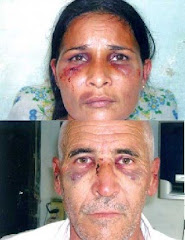
Wife of jailed Jewish worker in Cuba apologizes

Wife of jailed Jewish worker in Cuba apologizes
October 24, 2010

(JTA) -- The wife of a Jewish U.S. aid worker jailed in Cuba accused of
being a spy has written a letter to the country's president expressing
his regret.

Reuters also reported that Judy Gross, wife of U.S. Agency for
International Development employee Alan Gross, said that President Obama
has done little to help secure her husband's release.

Alan Gross, 61, was arrested on Dec. 3, 2009, for assisting the Cuban
Jewish community to connect to the Internet and with world Jewry.

In an Aug. 4 letter to Cuban President Raul Castro, Judy Gross wrote
that her husband is needed at home since their daughter was diagnosed
recently with breast cancer and is undergoing chemotherapy, according to
Reuters. She apologized for her husband's work in Cuba on behalf of both
of them.

"I recognize today that the Cuban government may not like the type of
work that Alan was doing in Cuba," she wrote. "But I want you to know
that Alan loves the people of Cuba, and he only wanted to help them. He
never intended them, or your government, any harm."

Castro has not responded to the letter, according to the report.

No official charges have been filed against Alan Gross, who Cuban
officials say committed "serious crimes," Reuters reported.

Judy Gross praised U.S. Secretary of State Hillary Rodham Clinton for
her efforts on behalf of her husband, but said Obama had yet to take up
the case.

Alan Gross suffers from several health ailments that have worsened in
prison. Reuters reported that he has lost more than 80 pounds.

http://www.jta.org/news/article/2010/10/24/2741412/wife-of-jewish-worker-jailed-in-cuba-apologizes

Goal of liberty crosses lines of partisanship

Posted on Sunday, 10.24.10
Goal of liberty crosses lines of partisanship
By MYRIAM MARQUEZ
mmarquez@MiamiHerald.com

They've been called intransigent. Hard-line. Even dinosaurs. No matter.
They proudly accept the characterization -- a mucha honra, as we say in
Cuban, with much honor.

They are the members of the Cuban Liberty Council, which split with the
Cuban American National Foundation after the death of CANF's founder,
Jorge Mas Canosa. CANF was taking a more moderate approach to U.S.
policy toward Cuba than older members wanted. The hard-liners bolted and
formed the council.

Two other Cuban Americans have been called Obama boot-lickers. Traitors.
Even communists. No matter. They proudly accept the characterization --
a mucha honra.

They are Emilio and Gloria Estefan, our local kids done good. The
politically independent super stars made a calculated move in April when
President Obama asked them to host a Democratic Party fund-raiser at
their Star Island home. They aren't Democrats and didn't contribute a
penny; their goal was to get the president's ear on Cuba's awful human
rights record.

No matter. It caused a firestorm among some older, predominantly
Republican exiles who had marched with the Estefans on Calle Ocho just
two weeks earlier.

The march, which attracted more than 100,000 people of all ages and
political persuasions, was a defining moment. All sought to get world
leaders to pay attention to Cuba's atrocities. It happened after Orlando
Zapata Tamayo died after an 83-day hunger strike in prison. After the
Ladies in White were beaten by mobs in Havana. After another former
political prisoner, Guillermo Fariñas, went on a hunger strike and vowed
not to end it until the Castros Crazy released all political prisoners.

Last week, Fariñas, who ended his hunger strike this summer after Cuba
began releasing prisoners, was awarded the European Parliament's
prestigious Sakharov Prize for Freedom of Thought. From his humble home
in Villa Clara, the ex-soldier who became a peaceful change agent took
calls from reporters. He praised the Estefans and exiles throughout the
world for coming together to defend human rights.

And on Saturday, the Cuban Liberty Council honored the Estefans as
``Heroes of Liberty'' in downtown Miami, where 500 people came to see
them accept an award given in the past to such luminaries as Vaclav
Havel of the Czech Republic and Cuban blogger Yoani Sánchez.

Surprised? No one should be. Gloria and Emilio have a long history in
defense of human rights.

``If you follow their careers, you realize that all that they have done
has been to benefit the Cuban people,'' said Ninoska Pérez Castellón, a
founder of the council. Whether before the pope, asking that he pray for
Cuba's freedom, or during a concert tour in Argentina, where Gloria
asked Cuba to end the embargo against its own people, the Estefans have
sought to build conscience about a 51-year-old dictatorship that quashes
the human spirit.

And for all of their ``intransigence,'' the council has embraced those
with different approaches to helping Cubans secure democracy. Yoani was
awarded her prize even though she supports opening Cuba to American
tourists.

For Gloria and Emilio, the award is bittersweet as Cubans still aren't
free. Yet so much has been accomplished in just six months -- a lesson
Emilio learned from Mas Canosa, a childhood friend in Santiago.

``Jorge offered a great example. He spoke to any president who would
listen. ... I knew that in the long term, having us host the fund-raiser
would give us the opportunity to help the president learn about Cubans'
pain.''

With honor, anything is possible.

http://www.miamiherald.com/2010/10/24/1888746/goal-of-liberty-crosses-lines.html

Jailed U.S. contractor, sour U.S.-Cuba relations

Jailed U.S. contractor, sour U.S.-Cuba relations
Sun Oct 24, 2010 8:21am EDT

(Reuters) - American Alan Gross has been held in Cuba since December on
suspicions of espionage, although he has not been officially charged
with a crime. The U.S. government has said he was not a spy but was in
Cuba setting up Internet systems for Jewish groups under a federally
funded contract promoting political change on the island.

The following are facts about the case, which has stalled progress in
U.S.-Cuba relations:

* Gross, 61, was detained by Cuban authorities at the Havana airport as
he was preparing to fly home on December 3.

* He is said to have been in Cuba installing satellite equipment to
provide Internet access for Cuban Jewish groups.

* He was working as a contractor for Maryland-based company DAI under a
U.S. Agency for International Development program aimed at promoting
democracy in Cuba.

* U.S.-Cuba relations had warmed slightly under President Barack Obama,
but U.S. officials say there will be no major initiatives with its
longtime ideological enemy as long as Gross is held.

* Cuba views the USAID program as part of the United States'
long-standing campaign to subvert the island's communist-led government.

* Cuban officials have said Gross was suspected of espionage and
providing illegal satellite communications equipment to dissidents, but
the case is under investigation.

* Cuba's Law 88 says that anyone who "participates in the distribution
of financial, material or other resources that come from the United
States government ... faces a sanction of three to eight years in prison."

* Gross is being held in a Havana military hospital, but his wife, Judy
Gross, visited him in Cuba in late July.

* She has written a letter to President Raul Castro, expressing remorse
for her husband's work and asking for his release due to their
daughter's illness.

* New Mexico Governor Bill Richardson came to Cuba in late August to
meet with Cuban officials about Gross, but left empty-handed.

* A U.S. State Department spokesman said on September 2 there was no
truth to reports the United States may swap five jailed Cuban agents for
Gross.

* Cuban Foreign Minister Bruno Rodriguez and U.S. Assistant Secretary of
State Arturo Valenzuela discussed the Gross case on September 24 on the
sidelines of U.N. General Assembly in New York.

* Judy Gross said the U.S. government had done little to help her husband.

(Reporting by Jeff Franks; Editing by Peter Cooney)

http://www.reuters.com/article/idUSTRE69N0RS20101024

Saturday, October 23, 2010

Exotic Shrimp Found in Cienfuegos Bay

Exotic Shrimp Found in Cienfuegos Bay
CIENFUEGOS, Cuba, Oct 22 (acn) A shellfish species known as kinglet rock
shrimp, which is not typically found in the warm waters of the
Caribbean, was reported by Cuban scientists in Cienfuegos Bay.
Cuban News Agency

According to researcher Raul Fernandez Garcia of the Environmental
Studies Center of Cienguegos (CEAC), this type of shrimp of the genus
Sicyonia typical has never been seen in the bay.
The expert told the local press that finding does not have a commercial
value, but only a biological value because kinglet rock shrimps captured
in the Cuban coast are not bigger than eight centimeters.
Other sea species had been previously sighted such as the green-lipped
mussel that was widely expanded in the bay and the lionfish, which has
turned out to be more attractive than ferocious.
Because of its favorable weather and little contamination despite the
industrial development, Cienfuegos bay is home to the white and pink
shrimp and to important colonies of green and red algae. Throughout his
scientific career, Fernandez Garcia has reported around 30 species of
mussels close or linked to the bay.

http://www.cubanews.ain.cu/2010/1022Exotic-Shrimp-Found-in-Cienfuegos-Bay.htm

Analysts see award to Fariñas as fourth setback in a week to the Castro regime

Analysts see award to Fariñas as fourth setback in a week to the Castro
regime

A prestigious human rights prize awarded to dissident Guillermo Fariñas
on Thursday was the fourth admonition to the Cuban government this week
that its reforms are not enough, Cuba watchers said Thursday.
(fot5) Fariñas, 48, a psychologist and independent journalist whose
135-day hunger strike earlier this year put him near death, was awarded
the Sakharov prize and more than $60,000 by the European Parliament.
The Raúl Castro government had no immediate comment on Fariñas' prize,
but Cuba watchers noted that it was the latest in a string of setbacks
that Havana suffered just this week:
• President Barack Obama declared that Cuba has not changed enough to
merit U.S. gestures.
• Spanish Foreign Minister Miguel Angel Moratinos, often criticized as
too friendly to Havana, was replaced.
• The European Union was reported unlikely to end a policy that ties
assistance to Cuba's human rights record.
"These are four messages to Cuba that it's not doing enough, that it
needs a more defined policy of change," dissident Havana economist Oscar
Espinosa Chepe told El Nuevo Herald.

To read the entire analysis, click here:
http://www.miamiherald.com/2010/10/21/1885570/dissidents-prize-another-cuba.html

http://miamiherald.typepad.com/cuban_colada/2010/10/analysts-see-award-to-fari%C3%B1as-as-fourth-setback-in-a-week-to-the-castro-regime.html

Venezuela, Cuba to begin laying undersea fiber optic cable in early 2011, diplomat says

Venezuela, Cuba to begin laying undersea fiber optic cable in early
2011, diplomat says
October 23, 2010
(Canadian Press DataFile Via Acquire Media NewsEdge) CARACAS, Venezuela

Work to lay an undersea fiber optic cable that will dramatically improve
telecommunications in Cuba should begin by February, Cuba's ambassador
to Venezuela said Friday.

Ambassador Rogelio Polanco said the line should start working in
mid-2011 _ about two years after initial projections.

Venezuela's government has an agreement with Paris-based Alcatel-Lucent
SA to produce and install the fiber optic line, a project first
announced in 2007.

Cuba is the only nation in the Western Hemisphere that is not linked to
the outside world by fiber optics. Instead, it relies on slow, expensive
satellite links because the U.S. government's embargo has prevented most
trade between the island and the United States and has made companies in
other countries shy away from doing business with Cuba.

The link would likely mean cheaper overseas phone calls and faster
Internet service for Cubans, though the Cuban government imposes strict
limits on access to cyberspace.

``Soon Cuba and Venezuela can count on a connection by undersea fiber
optic cable that will allow the development of our communications,
access to the Web ... in conditions that are more favourable for Cuba _
impeded today by the blockade,'' Polanco said at a news conference.

Venezuelan President Hugo Chavez has been a staunch supporter of Cuba,
helping it survive economic difficulties.

Polanco said more than 40,000 Cubans now work in the South American
country in roles ranging from doctors staffing free clinics to sports
trainers. In payment, Venezuela ships badly needed oil to the island.

Cuban officials have said previously that the undersea cable project is
expected to cost about $70 million.

Polanco said the cable is to be laid from the Venezuelan port of La
Guaira and would reach the eastern Cuban city of Santiago.

``They are doing civil construction work at the two points where the
cable is going to go, and it should then start to be laid toward the end
of the month of January, early February,'' Polanco told The Associated
Press. ``We think that in late June, early July it could be working.''

http://www.tmcnet.com/usubmit/2010/10/23/5087128.htm

Citrus fruits of Camagüey to be processed in neighboring Ciego de Avila

Cuba:
Citrus fruits of Camagüey to be processed in neighboring Ciego de Avila

More than 7,200 metric tons of orange and grapefruit harvested by the
Sola Citrus Products Company of Camagüey, will be processed as
concentrated and simple juices in the Ceballos citrus processing plant,
located in the neighboring Ciego de Avila province.

Engineer Orestes Reyes Pérez, director of Camagüey-based business,
pointed out that Sola Citrus Products Company has picked up more than
9,200 metric tons of these fruits by the end of September.

The executive added that the recent granting of land plots in free
usufruct makes possible to recover and improve the citrus fruits fields
in the borough of Sierra de Cubitas, some 60 km north of Camagüey city,
and consequently this will increase the yields.

As part of a program designed to diversify the crops, the Sola Citrus
Products Company of Camagüey already owns three comprehensive fruit tree
farms, properly irrigated thanks to equipment supplied by the Bolivarian
Alliance for the Americas (ALBA), and will deliver productions of guava,
mango, coconut and papaya in the forthcoming months.

Avocado trees, one of the fruits preferred by the Cuban consumers,
protect these crops against diverse meteorological phenomena,
particularly hurricanes which batter the island nation every year from
June to November.

Source: cadenagramonte.cu

Publication date: 10/22/2010

http://www.freshplaza.com/news_detail.asp?id=70785

Cuba details taxes for the self-employed

22 October 2010 Last updated at 17:28 GMT

Cuba details taxes for the self-employed

The Cuban government has outlined the taxes that will have to be paid by
the country's growing number of self-employed workers.

It is the latest stage of President Raul Castro's reforms to move Cuba
away from a solely state-run economy.

Self-employed workers will have to pay 10% income tax, while those who
take on staff will pay more.

It comes after the government announced last month that it was laying
off half a million state workers.

Cuba's new tax code is detailed in the latest edition of the country's
Communist Party newspaper - Granma.

The article includes an explanation that no government can provide
services without gaining tax revenues.

In addition to the 10% income tax, workers will pay another 25% into a
social security account from which they will in time draw a pension.

The coverage in Granma adds that successful businesses will see their
tax burden rise as they take on more staff.

The government is reducing the once all-encompasing role of the state in
the hope that it will boost a stagnant economy.

However, people setting up their own firms will be limited to just 178
professions, including car maintenance and rabbit farming.

http://www.bbc.co.uk/news/business-11610429