Handicapped Girl Still Without Social Assistance / Wendy Iriepa and
Ignacio Estrada
Translator: AnonyGY, Wendy Iriepa and Ignacio Estrada
Some days ago a brief note denounced to the world, what a mother
described as hell. After she knew from the workers from Social Security
that that agency decided to withdraw the pension given to her each
month, for her handicapped daughter Keylis Caridad Alemán Rodríguez.
A month after such arbitrariness, the situation is the same and the
mother of the minor, in order to be able to support her, has had to do
what we know as a part-time job during the week, while the minor is at
school. So that she can make some money and take home some relief.
The decision to withdraw the pension of social assistance from the minor
of divorced parents, is because — according to the Social Security
agency of the municipality of Santo Domingo and the municipal group of
Social Prevention of the Municipal Assembly of Municipal Power, this
last entity ruled by Rafael know as the Cat — it's due to the fact that
the mother of the minor has informal relations which someone who is now
her partner.
Yamayki Rodríguez, mother of the girl, recognizes the fact that she has
a new relationship with someone she plans to marry in the future if both
decide, but with what she doesn't agree with is with the fact that the
governmental entities question her personal life and that they cite it
as an excuse to withdraw the assignment to the minor, that her new
partner has to take the responsibility of her minor daughter.
Keylis Caridad Alemán Rodríguez is a 15 year old girl, handicapped, with
congenital malformations in the hips, knees, and ankle to which can be
added that the girl's heart was operated on during the first months
after she was born, for which illness she gets regular check ups, being
check up followed by a specialist in cardiology.
At the time of writing the note Keylis Caridad Alemán Rodríguez, a
native of Santo Domingo, province of Villa Clara, is being analyzed by
the municipal entity of education to see if she can continue her
studies. Her mother and the girl prefer that she study at the
"preuniversity" high school nearby, but her school performance,
according to the educational directives, doesn't not allow her to have
access to this superior level.
It is important to clarify that rating given to her school performance,
is the result of the non-participation of the girl in sports activities,
her non-participation in the schools in the countryside, and her
non-cooperation in voluntary activities of her school. According to
Yamayki despite her disagreement the directors of municipal education
say that they would let the girl attend higher education but it's not
possible simply because of the problem that this educational center has
not eliminated the architectural barriers and that they don't have
resources for this.
Up to the moment she's only be given the possibility to graduate as a
qualified worker doing manicures and pedicures. Yamayki cites that the
girl is not physically suitable to do such job and that she is suitable
to continue her studies.
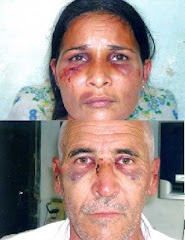
The pictures before you show the minor, in one of the snapshots she
poses next to her mother and in the others are proof and testimonies of
each of the surgeries she's been submitted to, surgical operations that
despite the effort of the relatives, some have not been finished so some
are pending.
Despite what they go through, for both hope is not lost, they believe
something can be done for them and that somebody can listen to them.
According to the minor and her mother that hope is what motivates them
in front of these adversities caused by those who have the local power,
to continue knocking on the doors of any necessary institution
denouncing what they call an injustice.
Keylis Caridad Alemán Rodríguez and her mother Yamayki Rodríguez live at
Calle Agramonte # 38, on the corner of Calle Maceo, in the municipality
of Santo Domingo, Villa Clara.
Translated by Anony GY
May 14 2012
http://translatingcuba.com/?p=18350
Tuesday, May 15, 2012

Bus accident in eastern Cuba kills 5
Bus accident in eastern Cuba kills 5
English.news.cn 2012-05-15 09:22:54
HAVANA, May 14 (Xinhua) -- A passenger bus fell off a cliff in eastern
Cuba on Monday, killing five people, including a little girl, and
wounding several others, the national police force (PNR) said.
The accident occurred when the vehicle overturned on a slope in the town
of Rafael Freyre, Holguin province, 735 km east of Havana, PNR officer
Juan Carlos Fonseca told Cuban news media.
A team of experts was trying to determine the cause of the accident, he
said, adding that the victims died on the spot.
Road accidents are the fifth leading cause of deaths in Cuba, which
reported 10,553 accidents in 2011, or 1,126 more than in 2010.
Drunken Driving and general recklessness among both drivers and
pedestrians are the main causes of accidents in Cuba, where legislators
are proposing more severe sanctions against these violations.
http://news.xinhuanet.com/english/world/2012-05/15/c_131587923.htm
Cuban raw sugar output up 11.7 percent
Cuban raw sugar output up 11.7 percent
May 15, 2012
Business Recorder Logo Cuban raw sugar production rose 11.7 percent, or
an estimated 140,000 tonnes, this year over 2011's 1.2 million tonnes,
with 29 of 46 mills still grinding, the state-run Trabajadores newspaper
said on Monday.
According to the paper, the mills will continue grinding "until rains
and industrial yields permit in an effort to come close to reaching the
plan now at 92 percent."
The industry announced plans to produce around 1.45 million tonnes of
sugar when the harvest began, meaning 1.33 million tonnes have left the
mills to date.
The industry had hoped to end milling by May when the rains and hot
weather usually set in and cane yields drop.
This year's rainy season began early in April, making further milling
difficult and costly.
The Sugar Ministry was closed late last year and replaced by a state-run
holding company.
The industry hopes to reverse a long decline in output from 8 million
tonnes in 1990 to 1.2 million tonnes last year.
http://www.brecorder.com/agriculture-a-allied/624:/1189804:cuban-raw-sugar-output-up-117-percent/?date=2012-05-15
A dream fullfilled after a daring escape from Cuba
A dream fullfilled after a daring escape from Cuba
by Jason Berry
Posted on May 14, 2012 at 1:47 PM
PHOENIX -- Every few months or so, there's a big ceremony for new
American citizens at the US District Court building in Phoenix.
On Friday, 100 people from 44 countries pledged their allegiance to the
United States of America.
One family's story stood out among the group of new citizens. It's a
story of faith and sacrifice and it starts on the high seas.
Eighteen years ago, with a storm bearing down on his homeland of Cuba, a
new father made a decision after hearing the cries of his infant son.
"One night he was crying. You know, Cuba have a really hard situation
about political problems. We be having oppression for so long. I
remember we don't even have milk for him. He was crying and he was
hungry and we was really desperate," said Raudelis Rivera.
So Rivera built a raft out of tires and wood and jumped in the ocean
with his family.
"We don't know where we're going, but we just want to get out from
Cuba," explained Rivera.
Raudelis, his wife, his son and Raudelis' brothers floated around the
churning waters for five days.
"We was very close to die. Very close to die. I remember I said to one
of my brothers, you know, 'I want to pray for first time in my life'
because in communist country we not supposed to believe in God,"
explained Rivera.
Whether it was the prayers, fate, or something else, the US Coast Guard
found the soaking wet family and brought them to the United States where
they were granted asylum.
Fast forward 18 years.
"Hello, my name is Junior Rivera and I cannot express how happy I am to
be here today."
Raudelis Rivera's son Junior became a US citizen on Friday. He will
graduate from Mountain View High School this year.
"It's really hard for me to imagine that my parents would give up so
much of their lives just for me to come to America," said Junior Rivera.
He is humbled by his parents sacrifice. They risked so much for him to
grow up in the United States.
"We came here with no family, no friends, no possessions, nothing and we
started from scratch," Junior explains.
Junior is planning to go to college and hopes to work in public relations.
When his father reflects on that decision he made 18 years ago, he
remembered those long days in the middle of the ocean.
"I say, 'Look what I did to my son. I'm killing him at 6 months old.' I
was feeling so guilty."
Now he's feeling proud.
One story of sacrifice among many who became US citizens on this day --
people from all over the world who discovered there's an American dream
for them, too.
Sometimes, it just takes a leap of faith.
Just ask Junior -- a grateful young man with a bright future. "That is
my biggest blessing, my parents sacrificing so much for me."
http://www.azfamily.com/news/A-dream-fullfilled-after-a-daring-escape-from-Cuba-151435875.html
'Project Paladar': New York Chefs Team Up with Cuban Culinary Entrepreneurs
'Project Paladar': New York Chefs Team Up with Cuban Culinary Entrepreneurs
Published May 14, 2012
Fox News Latino
For those who love and appreciate good food, Old Havana is the place to
be these days.
Foreign art lovers are breaking bread with Cuban waiters, drivers and
parking lot attendants this week in a unique experience that forces
diners and chefs alike to overcome barriers of culture, language and
five-plus decades of animosity between Washington and Havana.
Ten prominent New York City chefs are teaming up this week with 10
culinary entrepreneurs from Havana's budding private restaurant scene,
cooking up savory and sweet multi-course meals from an improvised
kitchen built in a shipping container. The diners are mostly foreigners
in town for a major art exhibition and Cubans who are being invited to
participate in the free meals by the visiting chefs who meet them during
the course of their stay.
Blending contemporary American, Italian, Japanese, even Burmese cuisines
with Caribbean Creole classics, it's a rare culinary treat in a country
where many state-run and independent restaurants serve up dull,
unimaginative fare. It's also a performance art spectacle that's about
bridging the gap between estranged neighbors and socioeconomic classes.
"The easiest and most interesting way into understanding another culture
is food," said Sara Jenkins, the project's chef director and proprietor
of East Village eateries Porchetta and Porsena. "And the easiest, most
uncomplicated way to make friends is to break bread at the same table."
"Project Paladar," named after Cuba's popular independent restaurants,
is part of Havana's 11th Biennial, an irreverent bash attracting 180
artists from 43 countries as well as thousands of art aficionados and
collectors. The dining project is being funded by the donations of
American individuals.
For 10 days the chefs will take turns pairing off and serving up gourmet
meals in the back patio of a cultural center in colonial Old Havana.
Guests are greeted with a mojito and escorted to a table for 12 in
homage to the maximum number of seats that the government allowed
paladars to have when they first opened in the 1990s.
With two tables of 12 seats, the organizers plan to feed up to five
groups, or as many as 60 people, every evening.
At the project's Friday night launch, an aproned Jenkins sweated over a
pan of Burmese coconut-milk curry sauce, preparing it to poach filets of
freshly caught red snapper. Accompanying the main dish were tuna tartar
and a green mango salad that one could order takeout in New York but
particularly tickled the palates of Cuban food professionals.
Conversation at the tables was lively as diners introduced themselves,
hesitantly tried out second languages and turned to bilingual guests to
translate reactions to each course: "Is this basil?" ''No, it's mint!"
"I think this is an experience that has never been done in the Biennial,
a very interesting sociocultural project," said Kenia Echenique, a
25-year-old lawyer and actress who fanned her mouth after consuming the
curry but said she enjoyed the flavor before the heat kicked in. "I
think this can enrich our culture, our paladars, and contribute to
exchange between our nations."
"In the kitchen everything's simple. A sauce is a sauce," said Hector
Higuera Martinez, Jenkins' cooking partner and the man behind the
stylish Le Chansonnier in Havana's Vedado neighborhood. "These things we
have in common, independent of the language barrier. It has been
spontaneous."
"Project Paladar" is the brainchild of Craig Shillitto, a New York
architect, artist and restaurant designer who was fascinated to read
about the explosion of private restaurants in Cuba after President Raul
Castro revived a 1990s policy allowing them to exist, then lifted many
restrictions that kept them from flourishing.
Many paladars are still little better than Cuba's dreary state
restaurants and must contend with the daily struggle to find ingredients
on an island long accustomed to scarcity. Some are languishing as they
struggle to tap the limited number of visiting tourists and other
foreigners, and the small number of Cubans with enough disposable income
to patronize private restaurants.
But an increasing number of paladar owners are forming a maturing
restaurant scene with creative, experimental chefs who are out to change
Cuba's reputation for culinary blandness.
"It's hard to educate people .... because rice, beans, roast pork are
really linked to our history," Higuera said. "Many (chefs) stick with
what's easy to find. But I think there are many people who want to try
different things."
Part of the inspiration behind "Project Paladar" was to support Cuba's
budding foodie culture.
"The idea that people still cared about food and cuisine and still tried
hard despite having no market for it was fascinating," Shillitto said.
Jenkins brought down her own cooking knives, as well as ingredients that
would seem exotic not just in Cuba but in many American kitchens: kaffir
lime leaf, Szechuan peppercorns, a quarter-wheel of Grana Padano cheese
(it's like Parmesan, only made in a different part of Italy).
Anita Lo, executive chef and owner of Annisa, a Michelin-starred
restaurant in the West Village, stuffed her suitcase with white soy and
yuzu juice for her cooking partner, one of the few Cuban chefs making sushi.
"For someone to push ahead and still try to do something that's almost
impossible on this island ..." Lo marveled, her voice trailing off.
"Fish is hard to come by. Japanese ingredients are very hard to come by."
For all their sophistication, the New Yorkers, including several of whom
have written books and appeared on cooking shows such as Iron Chef
America, are also learning from the Cubans.
How to make do with what's available, for one thing. The Americans also
had high praise for urban gardening in Havana, a local agroponic farm
they visited where crops are grown without soil and a leafy,
nutrient-rich green known as "maringa." Jenkins described it as
"slightly citrusy with a weird spice ... and an undercurrent of bitterness."
"Whether we'll ever see it again," she said, "to taste something new and
like it and think it's interesting and how can you use it ... it's
fascinating."
Organizers said they hope the project may create opportunities for
future culinary exchanges, perhaps a chef-in-residence program. More
such exchanges have occurred since President Barack Obama loosened rules
on so-called people-to-people travel to the island by Americans.
Curator Elizabeth Grady said "Project Paladar" is in a long tradition of
food-related art projects and tries to invert the elitist dynamic of art
festivals by inviting dishwashers and taxi drivers to sup alongside the
well-heeled art enthusiasts who typically patronize events like the
biennial. It also gets people from two feuding nations talking to each
other, even if haltingly or through translators.
"The main point is to use food as a vehicle to create genuine dialogue,"
she said.
Call it kitchen diplomacy.
Based on reporting by the Associated Press.
http://latino.foxnews.com/latino/lifestyle/2012/05/14/project-paladar-new-york-chefs-teamed-up-with-cuban-culinary-entrepreneurs/
Cuba after Hugo Chávez
Posted on Monday, 05.14.12
Cuba after Hugo Chávez
BY CARLOS ALBERTO MONTANER
www.elblogdemontaner.com
The most complex part of the inheritance left by Hugo Chávez are the
relations between Venezuela and Cuba. The existing ones were built on
the strange emotional, political and ideological subordination of the
Bolivarian leader to Fidel Castro and do not respond to the interests or
preferences of the Venezuelans.
In survey after survey, more than 82 percent of Venezuelans (meaning
that many of them are pro-Chávez) responded that they don't want the
installation of a political model based on Cuba. Presumably, a similar
percentage does not agree that Venezuela should continue to subsidize,
with billions of dollars, the pig-headed and unproductive collectivism
imposed by the Castro brothers.
Why did Chávez turn Venezuela into Cuba's deep-pocketed financier? The
reasons are several, but the most important one is that the lieutenant
colonel found in Fidel Castro a sort of spiritual and political guide
who advised him what to do and how and when he should do it. Fidel was
his guru, his moral father, his protector against the dangers that
threatened him in Venezuela and almost took his power and life in April
2002.
In addition, Fidel endowed him with a vision compatible with Marxism and
an epic internationalist mission that would forever consign Chávez to
history: to defeat the United States and bury capitalism. Between
Fidel's wisdom, enriched by three decades of training under the Holy
Soviet Mother, and Chávez's impetuous youth, aided by his bountiful
river of petrodollars, the two would triumph in the task of saving the
world, traitorously abandoned by the USSR.
How much was that ideological, strategic, police-backed protectorate, so
different from the untrustworthy universe of his own corrupt
collaborators, worth to Chávez? It was worth whatever Fidel needed and
asked for. Chávez delivered himself completely to the comandante, his
only source of security.
There was a point where both leaders, united in the same delirium,
planned to federate both countries and even created a joint commission
of jurists who began to study how to carry out that process. On the way,
Chávez increasingly placed himself under the authority of the very
skilled Cuban intelligence service, an organization that fed him
information about his military brass, his ministers and close collaborators.
Today, nobody around Chávez dares to speak, out of fear of Havana's
microphones. True, the opposition is controlled or watched by "the
Cubans," but the siege and humiliating harassment of the Chavistas is
much more intense.
When Chávez exits the stage, whoever replaces him in Miraflores Palace,
even if pro-Chávez, should question the sense of prolonging that sick
relationship, built on the emotional allegiance of a codependent leader
who no longer exists and worried most about controlling and spying on
his own ruling class. Why fear a poverty-stricken island that lives from
the handouts of a colony that's infinitely richer, more powerful and
sophisticated?
Venezuelan political scientist Aníbal Romero usually says that Castro's
internationalist efforts have always ended in failure. Castro-sponsored
guerrillas, sometimes led by the Cubans themselves, were defeated
throughout Latin America in the 1960s, '70s and '80s. They barely
succeeded in Nicaragua, paradoxically aided by the governments of
Venezuela and Costa Rica, but only to lose power one decade later in
democratic elections.
Peru's Velasco Alvarado, Panama's Manuel Noriega and Chile's Salvador
Allende, rulers aligned with Havana, were evicted from power, something
Cuba could do nothing to prevent. Angola and Ethiopia today have regimes
that are nothing like the communist models that were originally imposed
at the cost of Cuban blood. Who says that Castro's influence will be
preserved in Venezuela after Chávez's death? What for?
Cuba specializes in losing. That has been its history.
http://www.miamiherald.com/2012/05/14/2799314/cuba-after-hugo-chavez.html
Monday, May 14, 2012
Emerging From Inertia to the Left or the Right? / Yoani Sánchez
Emerging From Inertia to the Left or the Right? / Yoani Sánchez
Translator: Unstated, Yoani Sánchez
12mglobalI wasn't yet old enough to go to school and I was at the park
the neighbors in the area called "Carlos III," although the maps
insisted on labeling it "Carlos Marx." My sister and I were playing in
the dry fountain, jumping from one bench to another. At some point we
glanced over at the site of the Masonic Lodge at the corner of
Belascoain and the globe on its roof was throwing out gray smoke,
slowing burning up in front of our eyes. I remember we shouted at my
father, "Papi! The world is on fire!" and the three of us ran to the
building guard to tell him. In a few minutes the fire trucks came and
from that day the reproduction of the planet ceased to turn, its
rotating mechanism stopped working… for decades.
In this same park from my childhood, the Critical Observatory* held a
meeting yesterday, in solidarity with the worldwide movement of the
outraged. Hours before the demonstrators arrived, the area was taken by
the political police as well as uniformed guards. Several activists and
journalists were detained before they got there, and taken to distant
neighborhoods so they could not participate. The event finally happened,
although with marked haste and low attendance. They were able, however,
to display a pair of anti-capitalist banners, take some photos, and
connect, from a distance, with the current of discontent shaking
countries like Spain, England and the United States. The attendees sang
the Internationale and some habituates of the place discovered — just
then — the face of the author of Das Kapital chiseled into the wall.
Fifteen minutes later #12MGlobal ended in Havana and the children
returned to take over the empty fountain, the benches, and the bust in
relief of a man born in Germany in 1818. At night, prime time news would
report the protests in London and Madrid, while remaining silent about
the demonstration on our national territory.
Despite the limited number of attendees and the narrow ideology of the
convocation, what happened yesterday is something that enriches Cuban
civil society. The official sectarianism doesn't distinguish between
nonconformists on the left or right, suspicious of all who dare to
criticize, regardless of their affiliation. In the offices of State
Security they will have an open file on Jose Daniel Ferrer as well as
Pedro Campos, they will follow the tracks of the Patriot Union of Cuba,
as well as those of the Critical Observatory with suspicion. To
totalitarianism, it doesn't matter if its dissidents say they embrace
the same doctrine as the once official manuals, criticizing alone is
enough to land them in the same sack of enemies. This country stuck in
political inertia needs to get moving, urgently needs to embark on the
path of pluralism and democracy. Like the globe at the corner of Carlos
III and Belascoaín, Cuba must begin to move. Perhaps at first it will
turn to the left or to the right, it will stumble and waffle until it
finds its own rhythm. But from now on, no one can impose a single
direction, no one has the right to constrain it to a single path.
bola_del_mundoTranslator's note: "Critical Observatory" is a group
challenging the Castro regime from the left. An article in which a
member describes the group, in English, is here
http://www.havanatimes.org/?p=40063
and a report of Saturday's protest from the same author is here:
http://www.havanatimes.org/?p=70115
http://translatingcuba.com/?p=18336
Our Cherished Cobblers
Our Cherished Cobblers
May 14, 2012
Yanelys Nuñez Leyva
HAVANA TIMES — Shoe repair services are appreciated by many people I
know. The lack of good quality shoes and the impossibility of an
acceptable range require average Cubans to get their footwear mended
time again and time again.
This is where there comes into play the key role of the shoemaker, who
often performs veritable acts of magic that allow our continued walking
along the deteriorated streets of Havana.
A few years ago there were three places near my house where they would
glue, sew, reconstruct and secure shoes – one of them government-run.
Currently there's not a single entity that functions adequately.
The two private shoemakers have stopped working almost completely, while
the one that's government subsidized has a longer story behind it.
This establishment, after having gone through a period of improved
service, suffered changes in the way it operated.
Previously the client would talk directly with the shoemaker of their
choice — which ensured the satisfactory repair of their shoes — and they
would agree on the price.
Now a receptionist takes the defective shoes and collects the payment in
advance at a price indicated on a large poster.
The first outcome: the shoe repair service has been left with almost no
staff and those who work there never have the materials to do their job.
Second outcome: the neighborhood has lost an important place where — at
an affordable price and without bungling — people's shoes could be fixed.
Recently, after walking around half of an Old Havana looking for a
shoemaker, my sister found one near Zanja Street, though to repair one
pair of shoes it charged the shocking figure of 50 pesos MN (about the
equivalent of three days of pay).
The patches stayed in place well, so she went around letting neighbors
know where they could find the new "salvador de pies" ("savior of the
feet").
The trade of cobbler will always be respected in Cuba, since on more
than one occasion they have prevented many people from having to go
barefoot in the street.
So, here I'm expressing my thanks to them and calling the attention of
the relevant government agencies to this nagging situation.
http://www.havanatimes.org/?p=70102
The Loss of Self Esteem / Rebeca Monzo
The Loss of Self Esteem / Rebeca Monzo
Rebeca Monzo, Translator: mlk
Some days ago I read in the international press a story entitled
Serving, not servile, by the journalist from Juventude Rebelde (Rebel
Youth), Jose Alejandro Rodriguez, where he laments the tendency of
Cubans to appear servile to foreigners. In one of his paragraphs he said
and I quote:
"Neither can it be forgotten, in order not to repeat it, that certain
public institutions have well matched this neo-servile tendency when in
a political double standard they demand certain attributes and
guidelines of a Cuban in order to access not a few sites, in contrast
with the permissive submission with which they treats the foreigner."
"If the Cuban were to travel more he would be able to see more and value
more, by contrast, the good things of his country," he continues in
another paragraph.
If there is a guilty party in all this deformation of the Cuban, it is
due principally to the government which, during the last half century,
has treated its own people like third class citizens. At first they
enclosed us on this little island, without permitting us to have contact
with the outside: that lasted several decades.
The only valid references were the Cuban dailies and some Soviet
magazines. We who worked were prohibited from writing to our family or
friends in capitalist countries, above all in Europe, on pain of losing
our jobs. Remember that the State was the only employer. Likewise,
particular trips were prohibited or extremely restricted.
All this served to intensify the material misery and therefore morale. A
feeling of distress began to grow because of not possessing the most
urgent articles, which was transformed little by little into envy
towards those who had access to them. The few trips to the outside were
for the party militants or the youth with the most proven loyalty to the
regime. Here it began to get worse and to develop the double standard.
One had to pretend and pretend well in order to be deserving of the
trust and, therefore, of the little trip that would permit us to breathe
a little and to be able to bring shoes and clothes to our relatives, and
in a plastic bag the little food that the airplane let us ingest, so
that the child at home or the old one could enjoy it. Economizing to the
max on food, although that would involve hunger, in order to return to
the fatherland with a little money, plus the little soaps gathered in
the hotels.
With the economic crisis at the beginning of the 1980's and the lack of
tourism, flights from the Comunidad — Cubans abroad — were authorized.
Those countrymen of ours who were denounced in meetings when they
expressed the desire to leave, these same ones who were insulted and
told never come back, now as if by magic would be converted from "worms"
(the epithet that had been screamed at them), to butterflies and would
come to save the country's weak economy and to fill a little the empty
bellies of the relatives and even some of the neighbors of those who had
been insulted.
I have here other manifestations of the double standard: lying to keep a
job,lying to earn a little trip,lying to be able to enjoy a reunion with
family and friends and lying to try to contain proportionate happiness,
at least publicly.
Now, many years have passed, the Special Period that started at the
beginning of the 1990's does not seem to have ended. Because of that, as
soon as tourism began to increase, the siege of the visitors increased
at the same time. The bid to see who is the most favored has made many
men, women and even children seem like street clowns, trying to win over
the foreigner, which is likewise a cunning way of begging.
One must not blame only the suffering people; one must consider the
circumstances that have surrounded all this moral deterioration. When a
society loses its civility, loses the family and all its values,
anything can be expected from it.
Cuban pride is very battered. That national feeling that we used to
have, that made us walk with our heads held high and treat others
correctly, without difference, including the tourists, without having to
lower our s ingratiate ourselves, we have been losing it almost without
noticing.
The daily urgencies and the lack of good education, have made us
underrate ourselves. I remember when I was a girl, for us a tourist was
more ordinary. The only thing that sometimes made us turn our faces
towards them was the bright attire that they wore.
As far as the flower vendors of Old Havana, I believe that the costume
is excessive or unnecessary. It seems when one walks through the
restored streets in that part of the city that one is moving on a movie
set. This is too much for me, just like the flattery and mollycoddling
that they dispense to the tourists provided that they buy the
merchandise that they offer. It would seem that in the whole colonial
zone, they were the estates of the big movie companies.
Translated by mlk
May 12 2012
http://translatingcuba.com/?p=18331
Celebration or Condemnation? / Luis Felipe Rojas
Celebration or Condemnation? / Luis Felipe Rojas
Luis Felipe Rojas, Translator: Raul G.
One can already hear the beating drum of the proletariat. Just a few
work days away from the International Day of the Worker, the red machine
of the Central Committee of the Communist Party of Cuba (PCC) has spent
various weeks moving around its chains.
This time, the confirmation came from the voice and presence of Salvador
Valdes Mesa, as the czar of the one and only official Union. The first
vice president — Estaban Lazo — has accompanied him in his adventures
through factories and institutions. But, who and what will they celebrate?
The indication of this year is that the State recruits and those who
have wandered into the private sector will march "in a tight and
uniformed block". The support that the latter will give to the economic
model of the island confirms that the wave of lay-offs, which the State
decided to interrupt at the last minute, was worth it. In the blocks, we
will see the unemployed, those who are nearly at that point, and those
who see them like a mirror of what their lives could be in just a few
months if the sacred economic guidelines go through.
The leading elite and the followers which will be in charge of carrying
the country on their shoulders have received high level reprimands,
under accusations of sparking re-unionism, idleness, and administrative
corruption as an ill that is worse than even that of
"counterrevolution". At the same time, they are blamed for the economic
inefficiency which Cuba suffers from, they are accused of not being at
the high level of the working people. And that's to everyone: victims
and offenders. The slipping of the frontiers between the culprits has
been and continues being the axis of revolutionary rhetoric — saying a
lot without saying anything.
Ever since Monday, April 23rd, when the convocation occurred, the same
actors as always have popped up throughout Cuban television screens:
secretaries from the nucleus of the single Party in the national
corporations, undaunted unionists, exemplary workers, and the general
public which indestructibly supports the massive parade in unconditional
solidarity with the Marxist-Leninst postulates.
What has been left out of this performance act — pronouncements and
promotions aside — has been the authors of the thousands of complaints
which are being sent every single week to newspapers, radio stations,
and other public spaces. It is difficult to believe (a show, after all)
that Cuban workers march "in solidarity with millions of workers and
citizens of countless countries who also march today demanding their
fundamental rights to life and work with dignity", without even blinking
before the violations committed against them.
What is true is that no-one is awaiting spontaneous reactions against
the rulers, but the operation of the restructuring of the labor force,
the expulsions of those who have been deemed 'non-suitable', and the
hundreds of workers from the tourism sector who have seen their months
of labor being reduced due to the international economic crisis, among
others, without a doubt conforms a good breeding ground.
Popular non-conformity towards the high taxes on the self-employment
sector, the disorder of clients amid the elevated prices of agricultural
products and other fundamental services, as well as the complaints of
the incessant bustle of inspectors and bureaucrats in search of
commissions or with absurd refusals amid any single process are all
significant evaluators that May 1st will be a sincere and cynical act
consisting of parts that are still unknown.
If, in reality, the thousands of unionists from the non-state sector,
convoked now by the State, march in support of those who have closed the
doors on them during half a century, they would be forging a new elite
similar to that which sustains the Nomenklatura and it would be yet
another act of apartheid against the attempts of independent unions —
that black hole when it comes to citizen participation in contemporary Cuba.
Translated by Raul G.
30 April 2012
http://translatingcuba.com/?p=18330
Why Aren’t Cubans Having More Babies? / Dimas Castellanos
Why Aren't Cubans Having More Babies? / Dimas Castellanos
Dimas Castellanos, Translator: Unstated
A report issued by the NGO Save the Children, which states that Cuba
ranks first among Latin American countries with regards to the
conditions to be a mother, followed by Argentina and Uruguay, was
reproduced in part on the first page of the newspaper Granma on 10 May.
Such information, which the official press presents as a great
achievement, hides other data related to demographics that should move
Cubans to reflect. It turns out that in Cuba the falling birth rate is
causing a steady decline in population.
The adjustments made in 1998 by the Population Division of the United
Nations in its projections for the year 2050, suggest that the fertility
rate of less developed countries could decline to 2.1 children per
woman, while for the more developed rates could fall to between 1.7 and
1.9. However, the total fertility rate in Cuba — which is not exactly in
line with the developed countries — has been declining since the
mid-1970′s and has now reached 1.7 children per woman in 2009, four
decades before forecast made by the United Nations.
According to information provided by the National Statistics Office of
Cuba, the island's population declined again in 2010 by 1,467 people,
representing an annual rate of negative growth (-0.13%), confirming the
sustained decline in recent years.
Why is Cuba experiencing a phenomenon that characterizes developed
countries? The deteriorating living conditions due to economic
inefficiency, are leading a lot of Cuban youth to postpone having
children, while many others have decided to limit their childbearing in
view of the lack of opportunities. This is having a strong influence on
the dramatic decline in the fertility rate, which contradicts not only
the continued state propaganda about motherhood, but also the roots of
the Cuban women's movement, which since the nineteenth century had
figures distinguished figures such as Mari Blanca Sabas Alomá, who
adopted the original principles of humanism as the basis of maternal
feminism; or such as Ofelia Dominguez Navarro who, in the First National
Women's Congress in 1923, filed a motion on the redefinition of family
to include illegitimate children.
As the population projection scenarios are constructed mainly from the
relationship between fertility, mortality and migration, it is difficult
to predict the effects of reduced fertility in the medium and long term
relative to its effects on the depressed economy.
The sustained and growing exodus, which since 1959 has seen about 2
million compatriots leave for lives outside the national borders,
represents approximately 18% of the population. In the five years
between 2004 and 2009, more than 210,000 Cubans migrated, a trend
confirmed by data published by the National Bureau of Statistics, which
yields in 2010 a record negative balance of 38,165 migrants.
If to this is added a life expectancy above 75 years, it is understood
that the inactive, that is non-working, population in the age groups of
0-14 and of 60-65 years and older will grow, while the active population
will decrease, between these two age groups. This creates a dependency
relationship that is unsustainable over time, and that exacerbates such
things as the cost of social security, health care and other elements
that an aging population requires in Cuba, and that is precisely what is
missing: an efficient economy.
If this trend is maintained, and there is no indication that it will
change, the Cuban population, which in December 1998 exceeded 11 million
people, will never reach 12 million inhabitants, which has placed Cuba
among the oldest populations of continent. The worst thing is that this
phenomenon occurs in a nation which, by its very low productivity, is
compelled to buy abroad a large part of what it consumes. Therefore, the
demographic transition in Cuba, to a context characterized by the
capitalization of the economy and a huge foreign debt, predicts a
worsening, with severe repercussions on the economic, political and
social environment.
These data reveal a reality: the radical differences between the Cuban
demographic transition and that which occurs in developed countries,
results from the decision of Cuban women to have fewer children and the
high rate of emigration, particularly of young people, which, combined
with increased life expectancy, is dragging us toward a rapidly aging
society. This population decline is not an isolated or casual event, it
is nothing more nor less than one of the multiple effects of the
structural crisis whose cause lies in the inability of the existing
system to ensure economic growth capable of meeting the minimum needs of
the population.
The solution of this painful situation is a sustained increase in
productivity and efficiency, something that has not been nor will be
possible with the present attempt to update the current economic model
without including any changes in civil liberties. Moreover, in any case,
there needs to be a radical reform of immigration policy, so as to allow
Cubans to leave and to return with full rights, as existed in Cuba in
the past and as it is the case, with rare exceptions, everywhere in the
world.
From Diario de Cuba.
13 May 2012
http://translatingcuba.com/?p=18326
A Meddling State / Fernando Dámaso
A Meddling State / Fernando Dámaso
Fernando Dámaso, Translator: Unstated
The State, in most countries, developed or otherwise, tends to occupy
itself with fundamental questions, facilitating the development and
happiness of its citizens. To do this it regulates, through laws, and
controls, through bodies and institutions created for that purpose, the
harmonious relations of the various interests: economic, political,
social, etc.
The Cuban State is unique unto itself and, therefore, different from all
the others. First, in addition to insanely centralizing all issues
considered fundamental, it also concerns itself, insanely, in
innumerable trivial matters which, if it weren't so tragic in terms of
consequences, would be laughable.
Among these we find: the establishment of offices that allow citizens to
work for themselves (professions not established are prohibited); the
types of food and number of ounces per person that can be obtained (for
a fee) monthly in the so-called "basic basket" which is subsidized; the
style of clothes and shoes sold to workers in the state enterprise and
the delivery schedules; the ounces of bread, cheese and ham that must be
in a snack, a midnight treat or a sandwich in the State snack bars and
their respective prices; the types of light bulbs used for illumination;
the market and bakery where you must shop; the childcare center and
school where you must send your children and teenagers, etc. The list
could be infinite, but the same here is sufficient.
This mania of inserting themselves in everything, and trying to have the
first and last word, have resulted in political, economic and social
chaos in the country, enjoyed by most of us. The absurd interference in
all aspects of society and the individual is such that the average
citizen has been forced to devise ways, forms and methods to avoid so
many regulations, norms, controls, regulations, guidelines and all the
nonsense of this kind, establishing oneself in practice, in order to
subsist: the black market, the double standard, widespread theft, the
latter covered under the euphemistic name of "resolving."
From a predominantly ho sent country, where only some politicians
steal, we have become a country of criminals where, from dawn to dusk we
are "resolving." It would be desirable that in the update of the model,
which they go on and on about, they were to pay preferential attention
to this problem and realize the real solution is for the State to stop
being such a busybody.
May 12 2012
http://translatingcuba.com/?p=18313
Free Alan Gross
Free Alan Gross
Monday, May 14, 2012
After spending two years and five months in Cuban detention on dubious
charges of subversion, American Alan Gross recently told CNN that he
feels like a "hostage." The U.S. State Department agrees.
Gross, 63, was arrested in 2009, while he was working as a subcontractor
for the U.S. Agency for International Development on a project designed
to link Cuba's Jewish community to the Internet. For the crime of
transporting laptops and other telecommunications equipment into Havana,
a Cuban court found Gross guilty of "acts against the independence or
territorial integrity" and sentenced him to 15 years.
While the Castro government asserts that conditions are not poor, Gross
has lost 100 pounds while being held in a military hospital. His
90-year-old mother suffers from lung cancer and cannot travel. Gross has
pleaded for Havana at least to allow him to see his mother one last
time. He even has offered to return to Cuba afterward.
The Cuban government sent CNN's Wolf Blitzer a letter offering to hold a
dialogue to find a humanitarian solution "on a reciprocal basis." The
State Department takes the gesture as yet another attempt by the regime
to swap its release of Gross in exchange for Washington's release of
five Cuban intelligence agents found guilty of trying to infiltrate U.S.
military institutions in 2001.
On the plus side, the Castro regime deserves credit for allowing Gross
to use his weekly phone call to contact CNN and make his case. On the
down side, the news coverage serves to remind the world of the
repressive policies of President Raul Castro.
Every country has a right to uphold on its sovereignty. Havana certainly
had a right to sanction Gross for misusing a tourist visa to transport
laptops and other devices. Even still, Cuba's use of Gross as a pawn -
for the crime of trying to put Cubans onto the Internet - shows how
truly vulnerable Castro's hold on Cuba must be.
This article appeared on page A - 9 of the San Francisco Chronicle
http://www.sfgate.com/cgi-bin/article.cgi?f=/c/a/2012/05/13/ED9J1OGRL9.DTL
How the assassination of JFK put Fidel Castro in a delicate spot
Posted on Saturday, 05.12.12
How the assassination of JFK put Fidel Castro in a delicate spot
The Cuban leader's protestations that he knew nothing about Lee Harvey
Oswald ring hollow.
Pedro Portal / EL Nuevo Herald
By Brian Latell
It was only about 30 hours after John F. Kennedy's death in Dallas on
Nov. 22, 1963, when Fidel Castro took to the airwaves to deny any
knowledge of the president's assassin. The Cuban leader was unequivocal
about Lee Harvey Oswald: "We never in our life heard of him."
Castro delivered another speech four days later at the University of
Havana. A CIA assessment described it as "a carefully prepared
refutation of charges of complicity . . . [with] Oswald." Fidel insisted
that he had known nothing of the assassin.
Speaking of Oswald's mysterious visits to the Cuban consulate in Mexico
City in late September, Castro issued a second critical denial. "We did
not know about it." Then, he went further out on that limb. "We have no
other background for the accused . . . other than what has been
published in the press."
But research I have conducted over the last five years for Castro's
Secrets: The CIA and Cuba's Intelligence Machine, my new book, reveals
that in all these respects, Castro lied. Evidence I have culled from
tens of thousands of pages of declassified U.S. government documents,
and from the reporting of two defectors from Cuba's General Directorate
of Intelligence, the DGI, proves his duplicity beyond any doubt.
Fidel first spoke about Kennedy's assassination for about two hours from
a Havana television studio. Oswald by then had been charged with the
president's murder and also for killing a Dallas police officer less
than an hour later. Fidel had no idea what the young former Marine might
confess to as he was being interrogated at Dallas police headquarters,
or what he might say about his contacts in Mexico City with Cuban
intelligence officers. And, Castro could not be sure how much American
authorities had already learned about the gunman, a professed Marxist
who adored Castro and revolutionary Cuba.
The Cuban leader was profoundly worried. He warned his people to be
"cautious and vigilant and alert," describing the assassination as a
"dangerous Machiavellian plot against Cuba." The CIA reported that the
speech reflected his "apprehension that U.S. policy toward Cuba may now
become even tougher."
'A dirty maneuver was afoot'
It was known in Washington that "immediately after the news of President
Kennedy's death," Castro ordered an island-wide "defensive military
alert." By nightfall, Cuban military units had been deployed to
strategic positions around Havana and on the north coast. American
intelligence had intercepted Cuban communications showing that Fidel
"was frightened" the United States "might invade."
Che Guevara expressed acute alarm in a speech a day after Fidel first
spoke. He warned that "the peace of the world will be threatened for
years to come." The Cuban Communist Party newspaper summed up the fear
festering at the highest levels of the regime: "A dirty maneuver was
afoot . . . making Cuba the perpetrator of the crime."
These were not paranoid overreactions. The regime knew that while in
Mexico City Oswald had tried to defect to Cuba so he could become a
warrior for the bearded man he worshipped. The assassin was known to
Cuban intelligence as a radical militant who had previously defected to
the Soviet Union where he lived and married.
He had been arrested that summer in New Orleans after handing out
pro-Cuban leaflets and engaging in a street brawl with anti-Castro
exiles, whose group he had apparently tried to infiltrate.
Cuban intelligence knew that in New Orleans he had created a notional
chapter of the Fair Play for Cuba Committee — a pro-Castro cheerleading
group headquartered in New York. Oswald claimed that the fictitious A.
J. Hidell was his chapter's president. Hidell, the alias Oswald used to
purchase the rifle he fired at Kennedy, was devised to rhyme with Fidel.
Much more eventually became known about Oswald's Cuba obsessions. He had
tried to persuade his pregnant wife to help him hijack a plane to the
island, so, she recalled him saying, he could fight for "Uncle Fidel."
She later said Castro "was his hero . . . he was a great admirer . . .
in some kind of revolutionary mood . . . he would be happy to work for
Fidel Castro's causes."
Telltale talk from a trusted source
The first reliable indication that Fidel lied about his knowledge of
Oswald came from Vladimir Rodriguez Lahera — codenamed AMMUG by the CIA.
He was described by a top Agency officer as "an operational gold mine"
when, in April 1964, he was the first to defect from the DGI. Rodriguez
had worked at its headquarters in Havana and briefly at its Mexico City
Center.
He told his CIA handler that Castro had lied when he publicly denied any
knowledge of Oswald. In fact, Rodriguez reported that "before, during
and after" Oswald's visits to the Cuban consulate, "he was in contact"
with the DGI. It is not clear that any of this incriminating information
from a proven and trusted source was shared with the Warren Commission
that investigated Kennedy's murder. Rodriguez's CIA files were not
declassified until the 1990s.
Another reliable covert source, an American Communist Party member
recruited by the FBI to report on his contacts with communist bloc
leaders, provided reliable information showing that Castro had known of
Oswald's hatred of Kennedy weeks before the assassination. Jack Childs,
with his brother Morris and their wives, were codenamed Operation SOLO.
Jack met with Castro in Havana in May, 1964.
Fidel told him that when Oswald was departing the Cuban consulate in
Mexico, he shouted, "I'm going to kill Kennedy. . ." Strangely, the FBI
report of this conversation was never properly shared with the Warren
Commission and remained TOP SECRET for another 30 years. A related
document drafted by the FBI office in New York that I discovered last
year at the National Archives substantially adds to the accuracy of what
Childs reported. I am not aware that any of its contents were ever
shared with Kennedy assassination investigators.
Fidel gets earful from his consulate
The report quoted Childs saying that "Castro had been "in a very good
mood, and was not under the influence of liquor" when they met. Fidel
had spoken "in broken English" and FBI director J. Edgar Hoover was told
"there is no question as to the accuracy of what he said [because] the
informant indicated that he had made notes at the time Castro was
talking and he had scribbled down what he considered important."
Jack learned that "Castro received the information about Oswald's
appearances at the Cuban consulate, because he was told about it
immediately." Fidel spoke to him "on the basis of facts given to him by
his embassy personnel, who dealt with Oswald, and apparently made a
full, detailed report." That Castro had publicly lied about that went
unnoticed by American government specialists.
Remarkably, another confirmation of Fidel's deceptions came from a most
unlikely source. Alfredo Mirabal, known to his colleagues by the alias
"Eulogio," was the incoming DGI chief in Mexico City and was present
when Oswald visited. Mirabal was described by the defector Rodriguez
Lahera as an experienced intelligence officer. In Mexico they had worked
together plotting subversive operations in El Salvador.
Mirabal was interviewed by members of the House of Representatives
Select Committee on Assassinations in 1978. In an oddly unguarded
moment, he admitted that he had prepared a report on Oswald for his
headquarters. Apparently he did not realize that he was contradicting
what his commander in chief had solemnly claimed years earlier. As far
as I can tell, this revealing error was never noticed by previous
researchers.
So there can be no doubt: Castro lied egregiously. He knew truths about
Kennedy's assassin that for nearly 49 years he has refused to reveal.
What were his motives for gambling he could get away with such a big
lie? Self-preservation was surely the overriding objective. He had good
reason to worry that emotions in the United States after Kennedy's death
were so inflamed that any evidence, even as CIA analysts wrote, "the
imputation" of Cuban involvement, could lead to war.
He knew he had to calm the ferocious anti-Kennedy hatreds that he had
previously stoked in Cuba. The first reaction of many of his followers
was to celebrate Kennedy's death. A CIA source on the island reported
that spontaneous outbursts occurred at workplaces and neighborhood
defense committees.
In Mexico City, a still mysterious DGI agent was overheard by the CIA
rejoicing in a telephone conversation. When told the news by an
unidentified caller an hour after the assassination, she exclaimed, How
great!" Then, mistakenly informed that "Kennedy's brother and his wife
were also injured," she laughed and again blurted out, "How great!"
Too risky to keep goading Americans
Fidel knew he had to go public to establish new policy and propaganda
guidelines. Orders prohibiting "manifestations of pleasure" were issued.
He began referring to Kennedy with respect, even deference. He knew it
was too dangerous to continue goading the American people as Kennedy was
being mourned nearly everywhere else in the world.
But the most compelling reason for Fidel's decision to put forth such
now transparent lies is that he knew Oswald was going to shoot at
Kennedy that morning. And he chose to remain silent.
Florentino Aspillaga, a highly decorated Cuban intelligence officer who
defected in 1987, told me Castro knew in advance that Oswald would shoot
at Kennedy. Aspillaga is a source who proved so reliable to American
intelligence that one retired officer told me "his value as a defector
was as good or better than any the CIA ever had anywhere. If he had been
a Soviet, it would have been the best by far we had in our entire history."
I believe Florentino Aspillaga had it right: "Fidel knew."
http://www.miamiherald.com/2012/05/12/v-fullstory/2796473/how-the-assassination-of-jfk-put.html
Sunday, May 13, 2012
Unfortunate Plight of Cuban Migrants in Mexico Reported
Unfortunate Plight of Cuban Migrants in Mexico Reported
MEXICO CITY – Some 250 Cubans have been detained in difficult, dubious
conditions at the Tapachula migrant station in southeastern Mexico
awaiting judgment on their legal status, the independent National Human
Rights Commission, or CNDH, said.
The commission, Mexico's equivalent of an ombud's office, said Friday in
a note that during the last two months it has seen an increase in the
number of Cuban immigrants lodged at migrant stations of the National
Migration Institute, or INM, particularly in Tapachula, Chiapas state.
He said that on May 8 some 248 Cuban migrants were found at that
station, of whom 169 were men, 74 women, two little girls and three boys.
The document said that CNDH personnel had made several visits to the
station, where they received complaints from the Cubans about deficient
medical care, overcrowding and lack of information about their legal status.
The visitors from the commission inspected the Cuban migrants'
dormitories in the men's facility, "where they observed overcrowding and
a prevalent lack of beds or mats to sleep on, plus a number of people
suffering respiratory ailments."
Some Cubans also complained that INM personnel discriminated against
some of them because of their sexual orientation.
According to the commission, personnel of the autonomous organization
said that, during a visit on May 9, the Cubans tried to attract
attention by banging plastic bottles, shouting "Freedom!" and
complaining they hadn't eaten. The situation was remedied over the next
few hours and the ruckus subsided.
For their part, INM officials told Efe that the Cubans are being held at
the station in the extreme southeast of Mexico on the Guatemalan border
until the procedures are completed that are required by the 2008
migration agreement between the two countries.
The memorandum of accord says that Cuba will accept the return of its
citizens who have entered Mexico illegally or have an irregular
immigration status inside Mexican territory "with the exception of those
authorized to travel to the United States."
Cuba also agrees to accept the return of its citizens "who have
emigrated directly and illegally to countries of Central America and are
in Mexican territory illegally, provided they are found within a space
(of 90 days) counted from their departure" from the Caribbean island.
INM officials said that the Cubans, 30 of whom were taken on Friday to
the migrant station in Acayucan, Veracruz state, had no wish to remain
in Mexico and were awaiting word from the Cuban Consulate about who
among them will be accepted back.
They added that meanwhile the migrants are being fed and cared for at
the migration center, and denied stories in the press about the Cubans
being on a hunger strike.
For his part, Cuban Deputy Consul Wilson Bolaños said that Consul Maria
Sanchez met the day before with the head of the INM, Salvador Beltran,
"and at no time did they speak of a hunger strike, only that there were
250 Cubans lodged at the Tapachula station."
http://www.laht.com/article.asp?ArticleId=505394&CategoryId=14091
Cuba's Raul Castro backs gay rights: daughter
Cuba's Raul Castro backs gay rights: daughter
(AFP)
HAVANA — Cuban President Raul Castro backs greater gay rights and ending
discrimination against homosexuals, his daughter Mariela, a famed
sexologist, said Saturday during a colorful gay rights march in Havana.
"He has done some advocacy work, speaking of the need to make progress
in terms of rights based on sexual orientation and gender identity,"
Mariela Castro told reporters.
"The Cuban president... has been talking about this issue, but he has
not made it public. It is surely part of his strategy," she added, when
asked if her father backed her campaign to legalize civil unions for
gays and lesbians.
"He himself has said that... we cannot make progress if we continue to
live with these prejudices."
Mariela Castro runs Cuba's National Center for Sex Education (CENESEX)
and is an outspoken advocate for the rights of homosexuals and
transsexuals in Communist-ruled Cuba.
She is pushing for passage of legislation that would legalize same-sex
unions, but stops short of endorsing gay marriage. She is hopeful that
lawmakers will take up the bill sometime this year.
The president's daughter led a colorful conga line that was part of a
march through the streets of Havana attended by about 400 transvestites
as part of festivities marking the Fifth Cuban Day Against Homophobia.
"Down with homophobia! Long live sexual diversity!" participants yelled.
Many carried rainbow flags symbolizing the gay rights movement.
In January, Cuba's Communist Party Congress resolved "to fight against
all forms of discrimination, including against sexual discrimination,
and discrimination on the basis of sexual orientation and sexual identity."
"It's a hugely important first step," Mariela Castro said earlier this week.
Traditionally stigmatized in Cuba, homosexuality was fiercely repressed
for many years by the regime, which interned homosexuals in work camps
in the 1960s and ostracized them in the 1970s under the rule of Fidel
Castro.
Raul Castro succeeded his brother Fidel as president in 2006.
http://www.google.com/hostednews/afp/article/ALeqM5hBJu6W4wvUyLUFlPizSAb1FmqwjQ?docId=CNG.619c1a1e950208339eafebac91a19b34.121
Business and Blockade / Rosa María Rodríguez Torrado
Business and Blockade / Rosa María Rodríguez Torrado
Rosa María Rodríguez Torrado, Translator: mlk
It is easier for Cubans, in spite of the United States blockade, to eat
chicken coming from that country than the fish that inhabit the waters
of our archipelago and which don't escape the severe State blockade.
Translated by mlk
May 11 2012
http://translatingcuba.com/?p=18283
Saturday, May 12, 2012
Remittances and the Silence of Their Beneficiaries on the Island / Iván García
Remittances and the Silence of Their Beneficiaries on the Island / Iván García
Iván García, Translator: AnonyGY
To ask for money from relatives who live in the United States of America is a constant in Cuba. Whether it is done through one of most expensive international collect calls from the island, an e-mail, or through a letter describing a string of scarcities, at the end of the missive money is requested from the relative or friend.
And from what the figures say, the request doesn't fall on deaf ears. Something more than two billion dollars in 2011, according the Cuban economist Emilio Morales.
From 2000 until today, the income from remittances to Cuba has almost trebled. It is not only good news for the poor relatives on the island. Also for the government. With the aim of gaining hard currency, the Havana regime exploits all possibilities. From a "revolutionary tax" on the dollar of 13%, to the opening of new stores, kiosks and coffee places operating in hard currency, to offering tourist packages in 4 and 5 stars hotels to Cubans on the island.
Of course, for 70% of the thousands of national tourists who can walk along the fine sand of Varadero beach, and drink a Mojito in a jacuzzi, it is thanks to the money wired from other countries.
Not even the enormous crisis affecting Europe nor the delay in fully restarting the economy of the United States, have stopped the stream of money to Cuba from growing each year.
An economist consulted believes that, if the domestic economy continues shaky, along with the typical structural insufficiencies of the Castro system, in 2020 the figures of the remittances may be higher than those of Cuban exports, which in 2010 were 3.311 billion dollars if we give credit to Index Mundi.
To this you may add that in 2011, more than 400,000 Cuban American citizens visited their homeland. It is estimated than in 2014, this number may double and be higher than that of 900,000 tourists who yearly travel to Cuba.
For many years, in a race to collect the greatest amount of dollars, the Castro government has created a structure to collect hard currencies, inside and outside the island. In Miami, for its part, there is an increasing number of agencies that make money with abusive telephone tariffs and from the sending of money or packages through "mules" (people who travel legally to Cuba carrying goods for others).
The Cuban exiles in the United States have always laughed at the embargo. The restrictive measures to impede the regime from collecting hard currency to support still more their autocracy of 53 years, have not been effective. The Cubans living in the Florida would manage and travel through a third country or would wire the 300 dollars authorized by the government of George B. Bush.
When Barack Obama arrived in The White House in 2008, he signed a decree that would enable Cubans to send up to $10,000 and to visit their country as many times as they wish. It's true: those two billion dollars sent by remittances have helped the Castros to maintain themselves in power. Also a part of those hard currencies are used to repress, besiege and watch peaceful opponents.
As there's no transparency, the regime does not report what its share of the money sent by Cubans living abroad is spent on. But also thanks to these fresh hard currencies, many families in Cuba have opened small business. "Paladares" (private restaurants) in some cases; rooms for rent in their houses; or they have bought a car to use it as taxi.
According to an official statistics, more than 40% of the population receives remittances. Although there are no figures concerning this, those who receive dollars live better than those who work 8 hours and get a salary of 500.00 Cuban pesos (20.00 dollars).
But the emigrant does not only send money. Probably the value of the number of computers, plasma television sets, latest generation cell phones, medicines, clothing, footwear, food, cleaning goods and toys, among others, is between 5 and 6 billion dollars per year.
In a country where basic consumer goods, in hard currency, are as expensive as in Paris or New York, the people who receive between 200 or 300 dollars per month, are privileged.
The lean monthly basket (from the ration market) — 7 pounds of rice, 3 pounds of white sugar, 2 pounds of brown sugar and 20 ounces of beans — is not enough for the diet for 30 days.The rest of the food one has to buy at prices not subsidized or in convertible pesos (cuc), where 90% of the income from a worker is stolen.
Cuba is crowded with problems, but the worst of all is the food. To properly dress and wear shoes costs you. If you can administer it properly, the dollars or euros sent by the families enable one of these possibilities: repair the house, go on holiday to a tourist place, dance in a discotheque which charges 10.00 cuc per person, or sit on the wall of the Malecon to drink a can of beer.
"Luxuries" can be afforded only by the high hierarchy of the party, the government and the military; by managers of foreign joint ventures ,as well as the officials and employees in tourism, due to the tips, under-the-table commissions of foreign contractors and from what is stolen from their jobs.
Although that over 40% of Cubans receive dollars or euros that gives them certain economic independence (they don't have to resort to social assistance or the scarce state subsidies), this privileged position is not reflected in a rebellious attitude toward the government, whether afiliating with dissident groups or, in the Popular Assembly, raising one's hand to ask for the urgent political changes Cuba needs.
The fear is always waiting around the corner. And though most of the people who receive remittances are tired of such inefficient government, of bureaucracy and corruption, they prefer to remain indifferent and silent.
The future aspirations of a wide sector of the people who live better in Cuba, thanks to the dollars delivered by the "mules" or wired by Western Union, or by the euros sent through bank accounts, are to meet again with their family in the United States or Europe.
In the meantime, they escape from shortages watching the channels from Florida through the "antenna" (satellite connection, illegal), following the Brazilian soap operas on national television, drinking vodka with orange juice, and playing domino with the fellows of the neighborhood. As mental hygiene, they don't read the official press.
Until the "fulas" (dollars) are gone. Then they phone or send an e-mail to their relatives in Hialeah. "Please, send me one hundred dollars." But they keep silence before the government outrageous behavior.
Translated by AnonyGY
May 10 2012
http://translatingcuba.com/?p=18247
Prominent Cuban dissident released after brief detention
Prominent Cuban dissident released after brief detention
Published May 11, 2012
EFE
Havana – Prominent Cuban dissident Jose Daniel Ferrer has been released
in the eastern province of Santiago de Cuba after being held for 29 hours.
Ferrer told Efe Thursday by phone from his home in the town of Palmarito
del Cauto that he was arrested the day before in Havana and later
transferred to police facilities in the eastern cities of Las Tunas and
Santiago de Cuba.
The illegal but tolerated Cuban Commission on Human Rights and National
Reconciliation said earlier this week that Ferrer was arrested while en
route to the Czech Embassy in the capital to "access the Internet."
At the time of his release at midday Thursday, authorities in Santiago
de Cuba reminded him that his movements were being restricted because he
still is subject to "legal proceedings and has a trial pending" for
leading street protests early last month, the government opponent said.
"Since leaving me at my house in Palmarito (near Santiago de Cuba), a
police car has been parked outside," Ferrer said.
The head of the outlawed dissident group Patriotic Union of Cuba was
held in custody for 27 days in April in Santiago de Cuba for creating a
"public disorder" and is currently awaiting trial on that accusation. He
held a brief hunger strike while behind bars to protest his arrest.
Ferrer was among a group of 75 government opponents rounded up and
sentenced to lengthy prison terms in the Black Spring crackdown of 2003.
After Spanish-backed talks between the Castro regime and the island's
Catholic hierarchy, he and the other Group of 75 members still behind
bars were released last year.
Ferrer, 41, is one of a dozen members of that group who refused to
travel to Spain as a condition of his release.
London-based rights watchdog Amnesty International had adopted all of
the Group of 75 as prisoners of conscience and Havana came under
international pressure to release them after one member, Orlando Zapata,
died following a lengthy hunger strike in February 2010.
But the Castro regime says there are no political prisoners on the
Communist-ruled island and does not acknowledge the existence of an
authentic internal opposition, instead referring to these individuals as
"mercenaries" at the service of the United States.
http://latino.foxnews.com/latino/politics/2012/05/11/prominent-cuban-dissident-released-after-brief-detention/
Cuba's Workers Union (There Is Only One), Reports to the Regime
Yoani Sanchez - Award-winning Cuban blogger
Cuba's Workers Union (There Is Only One), Reports to the Regime
Posted: 05/11/2012 4:50 pm
If anything distinguishes May Day from other days in the year, it's not
the parade, nor the crowd waving its paper flags. The most striking is
the silence that falls over Havana after the mass rally in the Plaza of
the Revolution. A stillness interrupted only by the few cars that roam
the streets and by some cop who blows his whistle at the corner. All the
schools, workplaces, government agencies and bus stops are empty.
This scenario has been repeated for decades, but this year, in 2012,
something broke the habitual tedium of the Day of the Workers. Many
private businesses, known here as "the self-employeds," opened their
doors despite the holiday, skipping the commemoration to throw
themselves into selling pizzas, ice cream, fruit smoothies. While others
launched slogans of Revolutionary reaffirmation, they launched products,
fishing in the peaceful river left by closed State shops.
It's expected that at the end of this year around 600,000 Cubans will
have take out a license to work in the private sector. Among them will
be many who lost their jobs because of the downsizing happening
throughout the country. In the coming months, more than 170,000 jobs
will be eliminated in the different spheres belonging to the State and
the personnel will be relocated to other work or dismissed.
The euphemisms that characterize the official language have reached
their highest expression in referring to this unpopular process. The
cuts are called "labor reorganization" and people who are left
unemployed are classified as "availables." As if such peculiarities in
vocabulary weren't enough, the only union authorized in the country has
supported the decision to "deflate the payrolls to achieve efficiency."
The Cuban Workers Union has made it clear that its role is to be at the
side of the employer, not the employees. A posture that surprises not
one of its almost three million members, accustomed to the disciplined
paying of their dues, but aware that this organization represents the
powers-that-be against the base, and not the inverse.
To this same obedient union more than 80 percent of the more than
370,000 self-employed have subscribed, and one representation of them
paraded on May Day. They haven't signed up to represented or defended,
but to avoid problems. They intuit -- with good reason -- that not
joining could suggest they are "apathetic," "bourgeois," and in the
worst case, "counterrevolutionaries."
They all, undoubtedly, would prefer an association to defend them from
the high taxes, to convene protests over the lack of wholesale markets,
and to demand bank loans to support their businesses. Able to choose,
they wouldn't have voted for Salvador Valdes Mesa, the current secretary
general of the Cuban Workers Union, whose previous job was in the
antagonistic Ministry of Labor.
Instead of the Church in the hands of Luther, our version seems to be
the Union caught in the arms of the Boss. A federation that has
supported the elimination of half a million jobs by 2015, and that has
called for a greater commitment to the government of Raul Castro. A
negative legacy of this passive and complicit attitude, will be the
refusal of many workers to join its ranks and those of other proletarian
organizations. The word "union" in Cuba will have to shake off its
current connotations of inaction, to return to that irreverent and
autonomous role it once held.
For now, on the platform on May Day, instead of a message of protest
slogans, there are calls for discipline, demands for control. Labor
disagreement has no place at the Plaza of triumphal slogans and praise
for the current system. Not a single block represents the unemployed,
not one fist is raised in protest, not one sign calls the authorities to
account.
Many of those present have attended for the same reason they've
registered with the Cuban Workers Union, so as not to be marked as
opposed to a political process in which they can no longer believe. They
smile for the cameras, some with their children on their shoulders, but
nothing in them of the rebellious essence of a Labor Day.
When the parade ends then return home, or venture into the surrounding
streets looking for something to eat or drink. They end up buying it at
the counter of some self-employed, non-union member who stayed open to
conduct business on the holiday.
The next morning the official newspaper, Granma, proudly published the
red-letter headline, "This was the more organized and fastest parade" in
our history. And for once, Granma is right.
http://www.huffingtonpost.com/yoani-sanchez/cuba-unions-_b_1510168.html
Cuban Regime Disguises Paramilitary Agent as Red Cross Worker
Yoani Sanchez - Award-winning Cuban blogger
Cuban Regime Disguises Paramilitary Agent as Red Cross Worker
Posted: 05/11/2012 9:53 am
During the last week, the official media have greatly emphasized the
origin and workings of the Red Cross in Cuba. Around May 8th, the
founding date of this humanitarian body, they published several reports
about its helping character and neutrality. Prime time news has featured
interviews with those who have acted with self-sacrifice to save victims
of accidents and conflicts. Undoubtedly, there are stories of personal
altruism and philanthropy that have saved a life or prevented injuries.
But the reason for these tributes and chronicles is not just to
commemorate and recognize the committee founded by Henri Dunant in 1863.
National TV is also trying to clean up the lamentable image left by one
of those Cuban volunteers during Benedict XVI's Mass in Santiago de Cuba.
At this point, there are few people on this Island who haven't seen the
video where a man -- wearing a Red Cross emblem -- hits and beats with a
stretcher Andrés Carrión, who had shouted an anti-system slogan. The
scene elicits such revulsion, shows so much baseness, that even
government supporters express their rejection of such practices. They
are moved by the disproportion of power between someone who can't defend
himself, and another who slaps him and attacks him with first aid
equipment. The incident led the International Committee of the Red Cross
to request an explanation, and even to an unpublished note of apology
from its Cuban counterpart. But it hasn't been enough. What has become
clear are not only the wrath of a paramilitary agent disguised as an aid
worker, and the ideological rancor that is fomented at every pass with
no consideration for the consequences. What has been revealed, also, is
that the authorities of our country lack ethical limits when it comes to
suppressing a different opinion. If, to camouflage their shock troops,
they have to dress them like sports teams, "spontaneous students," or a
medical group, they will do so. They don't hesitate to take in hand
international emblems and even to use the prestige of foreign NGOs for
political ends. This has to be known, enough with naivete.
Little Red Riding Hood doesn't stand a chance: the wolf of intolerance
can disguise itself as grandma, the mother who gave her the cakes, or
even the woodsman himself who comes to her rescue.
http://www.huffingtonpost.com/yoani-sanchez/cuba-andreas-carrion-beating_b_1508420.html
Cuba to invest $450 mn to boost rice production
Cuba to invest $450 mn to boost rice production
Published May 11, 2012
EFE
Havana – Cuba said it plans to invest up to $450 million over the next
few years in a program to increase domestic rice production, which
remains insufficient to meet the demand on the island, state television
reported.
The investment, which for this year will amount to $108 million, will
focus on installing state-of-the-art technology to boost farm machinery,
drying sheds and crops, an Agriculture Ministry spokesman said Thursday.
The televised report said that rice production is "still insufficient"
despite the strategy designed and put in place by the ministry.
But it said that investment in new projects up to the year 2016 are
calculated to slash cereal imports by boosting national production.
Rice growing is currently being promoted in 152 municipalities on the
Communist-ruled island, with farmers benefiting from advice provided by
Cuban, Chinese and Vietnamese experts.
According to the spokesman, 80 percent of rice production on the island,
considered a "high priority," is in the hands of agricultural
cooperatives and independent farmers.
Cuba imports more than 400,000 tons of rice per year, or 60 percent of
the total consumed by its 11.2 million inhabitants, who regard the
cereal as essential to their daily diet.
Since 2008 the president of Cuba, Gen. Raul Castro, has launched
agricultural reforms aimed at increasing food production to substitute
imports, a policy he considers one of national security because the
country was spending more than $1.5 million per year on importing 80
percent of the food it consumed.
One of the first reforms was a plan to close more than 100 "inefficient"
state-run agricultural enterprises and transfer upwards of 40,000
workers to other jobs.
Since then the Cuban government had shifted usership of over 1.3 million
hectares (3.2 million acres) of land for agricultural purposes, of which
79 percent is being used for crops that are mostly tilled by
"individual" farmers.
The amount of idle land in Cuba in 2008 was estimated at more than
1,800,000 hectares (3,200,000 acres), but now official sources say that
opening the land for agriculture and the use it has been put to since
then "has contributed to reverse the poor state of a large part of that
terrain."
Another recent reform allows Cuban farmers to sell agricultural products
directly to hotels.
As of last Dec. 23, a total of 71 contracts had been signed between
agricultural producers and hotels located in the country's most
important tourist spots, including the Varadero seaside resort, Havana
and the eastern provinces of Camaguey and Granma.
Small farmers sell their new customers fruits and vegetables, including
guavas, pineapples, lettuce, tomatoes and cabbage, in the chink that has
been opened in the state agricultural and livestock marketing monopoly.
The measure forms part of the "reordering" of the agricultural sector
included in the plan of reforms promoted by the government for the
purpose of "modernizing" the socialist economic model of the island.
http://latino.foxnews.com/latino/news/2012/05/11/cuba-to-invest-450-mn-to-boost-rice-production/
U.S. and Cuba say they’d like to see a changed relationship
Posted on Friday, 05.11.12
Latin America
U.S. and Cuba say they'd like to see a changed relationship
But U.S. Assistant Secretary of State Roberta Jacobson says during a
Miami trip that the jailing of Alan Gross and Cuba's lack of political
progress are stumbling blocks
By MIMI WHITEFIELD
mwhitefield@MiamiHerald.com
Assistant Secretary of State for Western Hemisphere Affairs Roberta
Jacobson said Friday that she hoped Cuba was sincere about wanting to
improve relations with the United States.
"I start from the position of an optimist in government in that I hope
they want to improve relations; I do hope so,'' said Jacobson, who was
in Miami to attend the University of Miami Center for Hemispheric
Policy's 7th Annual Latin America Conference.
A day earlier in an interview with CNN, Josefina Vidal, director of the
North American Division in the Cuban Foreign Ministry, said that for
many years Cuba has been "conveying to the U.S. side our willingness to
have a comprehensive political dialogue… to solve all our historical
problems'' and to have a mutually beneficial relationship.
But at this point, neither side appears to be actively engaged in
improving the contentious relationship.
During a speech at the conference, Jacobson said the United States had a
"positive policy'' toward Cuba — "one that seeks to support Cubans'
right to freely determine their future."
She cited Obama administration steps to ease travel restrictions for
Cuban-Americans as well as allowing higher levels of remittances and
more travel for religious, academic and cultural purposes by other
Americans.
"We believe that these policies are enhancing the independence of the
Cuban people from the state, and we will be the first to cheer when a
democratically chosen government in Cuba resumes its full participation
in the inter-American system,'' said Jacobson, who was confirmed six
weeks ago after serving as acting assistant secretary since July 2011.
She acknowledged that the situation of Alan Gross, a subcontractor for a
U.S. Agency for International Development program, is a stumbling block
in improving the relationship. Gross is jailed in Cuba for "actions
against the integrity of the state.''
But there are other factors, too, she said, particularly the need for
progress on the political side to allow Cubans to exercise their civil
and political rights.
When it comes to Gross, Jacobson said, the Cuban government "must free
him immediately without conditions.''
As a humanitarian gesture, Gross' U.S. lawyer has asked that he be
allowed to travel to the United States for two weeks to visit his
90-year-old mother Evelyn, who is battling inoperable lung cancer.
The United States recently allowed René González, one of five Cuban
agents convicted of spying on the United States, to return to Cuba for
two weeks to see his brother Roberto, who also is suffering from cancer.
González, who had served a 13-year term in the United States but is
still on probation, returned to the United States after his visit as agreed.
In the CNN interview, Vidal said Cuba is ready "to find a solution, a
humanitarian solution to Mr. Gross' case on a reciprocal basis.''
In the past, the Cubans have indicated they might be interested in
swapping the so-called "Cuba Five'' for Gross, an option that doesn't
interest the United States.
Jacobson said there aren't currently any negotiations underway with Cuba
regarding Gross' release.
Pressed by CNN anchor Wolf Blitzer on why Cuba wouldn't temporarily
release Gross to see his dying mother in Texas, Vidal responded, "In the
case of Mr. Alan Gross, he started to serve his prison term three years
ago'' and the "conditions under which he is now do not allow him to go
outside Cuba.''
A U.S. official who asked for anonymity said Cuba had approached the
United States about having Evelyn Gross go to Cuba to visit her son.
However, the official said she is too ill to travel and "that's not an
option.''
Gross' family has even presented medical documents from her doctors
stating she is too ill to travel, the official said.
But Cuba was far from the only topic of discussion at the UM Latin
America Conference.
During her speech, Jacobson said that despite the United States' growing
interest in the Pacific Rim, Latin America is still a top priority.
"Our partnership with the Americas matters a great deal for the United
States,'' said Jacobson. "Secretary Clinton has described how harnessing
the 'power of proximity' between the Untied States and Latin America,
the Caribbean and Canada is among the most strategically significant
tasks facing our foreign policy in the years ahead.''
While Jacobson applauded "remarkable'' changes that have been happening
in the Americas in terms of a growing middleclass and "pragmatic leaders
who are building deeper democracies,'' she said challenges remain.
Economic growth, she said, needs to be sustainable and include
opportunities for broader sectors of society
Among areas of concern, Jacobson said, are:
• Security. "While much of the region is enjoying greater peace and
prosperity, violent crime remains a serious problem throughout Mexico,
Central America, and parts of the Caribbean.''
• An erosion of freedom of expression in some countries. "We've seen
massive lawsuits against newspapers, judicial harassment of media
owners, and continuing violence against journalists by non-state
actors,'' she said.
• An effort to undermine or weaken the Inter-American Human Rights
System. Venezuelan President Hugo Chávez said recently that his
government should pull out of the Inter-American Commission on Human
Rights, the Organization of American States' human rights body. The
Washington-based commission has been critical of Venezuela's human
rights record.
"Dissent is not criminal behavior. Opposition to the government is not
criminal behavior. And free speech is not criminal behavior,'' said
Jacobson.
In the past year, Cuba has arrested a record number of dissidents for
protest activities and held them for relatively short periods of time
before releasing them.
After her remarks, Jacobson said she was not speaking specifically about
Cuban dissidents: "Unfortunately we've seen a situation in which free
speech in particular but also other forms of opposition… haven't been
fully respected in a number of countries in the hemisphere but it
certainly includes Cuba.
"The United States has a long track record of supporting peaceful
dissident opposition activity in Cuba and trying to insure overall that
all Cubans have the opportunity to exercise full and universal political
and civil rights, to exercise freedom of expression, freedom of
assembly, which they are unable to do right now."
http://www.miamiherald.com/2012/05/11/v-fullstory/2795508/us-and-cuba-say-theyd-like-to.html
Cuban and Haitian migrants repatriated by Coast Guard
Posted on Friday, 05.11.12
Cuban and Haitian migrants repatriated by Coast Guard
Nearly 100 Cubans and Haitians were repatriated Thursday to their
respective countries by the Coast Guard.
Five separate groups of Cuban migrants were intercepted at sea on
Saturday. The 55 were returned to Bahia de Cabañas, Cuba, according to
the Coast Guard. A group of 37 Haitian migrants were interdicted at sea
on Monday and returned to Cap Haitien.
The Coast Guard Cutter Pea Island, based in Key West., repatriated the
Cuban migrants and the crew of the Coast Guard Cutter Dependable, based
in New Jersey, N.J., repatriated the Haitian migrants.
http://www.miamiherald.com/2012/05/11/2794444/cuban-and-haitian-migrants-repatriated.html
Subscribe to:
Posts (Atom)