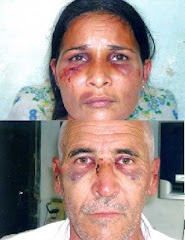
My Case File Disappeared / Angel Santiesteban
Angel Santiesteban, Translator: Regina Anavy
These days I have wandered with my lawyer through the "legal systems" of
Cuba. The Castro brothers, who own the Birán estate that was previously
their father's, later extended the fence to the limit of the
jurisdictional waters and converted the estate into Birania. They seized
the rest of the nation and have "governed" it as if it were their
personal fiefdom, by pure caprice and personal interest.
Back in 1994, they captured me for accompanying my sister to the coast
to say goodbye to her. After 14 months in La Cabaña prison (hell). I
was acquitted and they withdrew the charge of "concealment" because I
heard at trial that among siblings and parents this offense does not
apply. The fact is that I suffered for that year and two months, with
its days, hours, minutes and seconds. I should thank them for making me
do time, because I matured earlier than I would have by my nature,
education and environment. I always say that if God exists he sent me
there because thanks to him I was able to prove myself through poverty,
the suffering of Cuban youth, and the many tears that I saw fall in
those cell blocks. I discovered that my vocation was to be a writer.
I devoted myself to writing in body and soul, and with a literature that
highlights the plight of Cubans through the manipulated image that the
"revolution" has made us suffer. My characters appeared, shaped into
stories and books. These volumes were awarded the most coveted prizes,
in spite of officials who tried to see a way of containing my ascent as
a writer. Of course I suffered in 1992, when they took away from me the
Casa de las Americas prize, according to the testimony of the jurors
themselves. In 1994 something similar happened, and finally to run no
risk, they decided to remove my work from any contests where there were
awards. They also removed my work from portfolios, anthologies and
literary events. That was my punishment, the price I paid for writing a
critical story that was aggressive according to the dogma of the
dictatorship. Honestly I never cared, I was aware it was my duty, and
it's impossible to resist your own nature.
I was visited by several intellectuals who told me to stop.
I don't hide that I always had the need to write my opinion, my point of
view, on the environment, on people I knew, their frustrations, desires,
dilemmas, fears, horizons and all that could happen to human beings. I
dreamed of writing in a newspaper, on a corner of the last page, but I
also knew that was impossible, that with the Cuban system I never could,
since all the newspapers are administered by the government, and any
attempt to create an independent one is punished with the toughest laws.
On a visit to the Book Fair in the Dominican Republic, I learned there
was something called a blog, and it was the closest thing to that little
corner of a newspaper, however unimportant it was. I dreamed about
posting. On returning I opened my blog. Immediately I was visited by
several intellectuals who told me to desist; that was my first warning.
I persisted. So I was removed from the Cubarte email, which was paid
monthly, to prevent my connection with the rest of the world. I resisted.
After two months I was assaulted by members of State Security, who broke
my arm. They thought that this reprisal would be sufficient. They never
were more wrong, because by then, with the cast on my arm, I needed to
double my effort to write more on the blog and to go meet other Cuban
bloggers who offered me support. They staged several repudiation rallies
at my front door. Sometimes I went by and greeted them, thinking they
were CDR (Committee for the Defense of the Revolution) meetings. Then I
found out they were against me, and my neighbors found a way, without
being seen, to tell me they were there but had nothing against me and
supported me, and they always justified themselves by talking about
family, retaliation, etc.
The Prosecutor asked for the laughable sentence of 54 years in prison.
When they realized that blows would not be the way to make me give up,
they brought accusations. The first was when I started the paperwork to
go to the Word Festival in Puerto Rico. They had to avoid my attending
at all costs, and the only way to do this was to bring a civil lawsuit
to hide that I was being punished for my point of view.
They began with detaining me, saying I had knocked down a child with my
car and I would abscond. The child, as I have said several times,
luckily never appeared, nor did the charges. But the time of arrest was
on the record.
Finally they manipulated my ex, from whom I had been separated for over
two years. They accused me, without any evidence or witnesses, of so
many things as if they had happened that perhaps they thought at some
point of torment I might ask for mercy and promise to surrender.
The truth is that adding up all those years in prison, according to the
prosecutor's request, amounted to the laughable sum of 54 years (without
including the other charges that they brought and then dismissed).
The prosecutor, anticipating how ludicrous that would look to
international opinion, decided to "combine" the charges and requested 15
years in prison. For this they invented a "witness" (with acute
neurological problems, who was a career criminal with more than 30
convictions, including theft, fraud, harassment of foreigners, etc..),
and thanks to a hidden camera the truth came out and he showed the
clothing they gave him and other gifts he had been promised, and
invitations to dinners and swimming pools, all in exchange for a
declaration against me.
When they learned about the video, because I gave it to the prosecutor,
they accused me of "attack" because they made him declare that he had
been threatened into making the video. Finally an expert showed that the
man in the video was telling the truth. I suppose the complaint was not
eradicated since I was never summoned to make a statement.
They worked in a feverish manner to make me submit.
Since then I've been waiting for the trial. After three years of being
summoned to the Picota station at 100 and Aldabó, I can understand they
are tired, bored with waiting for my submission, my incorporation into
the fold. There is no shortage of advice; I always warned them that it
wouldn't happen, but they have so little capacity to understand that
they worked feverishly to make me submit. Finally, from my first
statements to what they are today, there are differences, they changed
them, but what they didn't imagine is that the first time they delivered
the file I photographed every page, and you can see the rough work of
falsification they did to incriminate me. Now they settle for keeping me
waiting. My case is in legal limbo.
When I turned up with my lawyer at the Provincial Prosecutor's, which is
in charge of bringing my case, they informed us that my file was sent to
the General Prosecutor of the Republic. We went to this office, which is
located in Miramar. We were told it was sent back to the Provincial
Prosecutor. We left the building and to avoid the trip, as we suspected
the answer, we telephoned and were assured that the file had not been
returned. Fifteen minutes after my attorney returned to the same office
requesting that they get their story straight, there was no choice but
to inform him that my file had been delivered to Officer Ribeiro, at the
Villa Marista (the seat of Cuban State Security).
Visit to Villa Marista.
After the information we headed towards Vibora. We stayed for two hours
in the waiting room. They told us that the file couldn't be found. And
we had no choice but to return and continue to wait. In fact the
"judicial laws" require that notice of any movement of the case file has
to be given to the defense counsel. This step was never fulfilled.
In these three years I had to turn down 27 invitations from
universities, festivals, book presentations and book fairs. Right now
five of my books are being published in different countries. I think
that's the real punishment.
Anyway, I always say, we are the generation of children that nobody
wanted, and if they gave me the opportunity to return to the time I
opened the blog and caused myself so much trouble, without even thinking
about it I would do it again, only with more emphasis.
Ángel Santiesteban-Prats
Translated by Regina Anavy
April 29 2012
http://translatingcuba.com/?p=18253
Saturday, May 12, 2012

Meñique Went out to Travel / Luis Felipe Rojas
Meñique Went out to Travel / Luis Felipe Rojas
Translating Cuba
"Meñique Went out to Travel" — that's the name of a famous children's
song. Those same travels were awarded to me by the combined forces of
State Security (G-2) and the National Revolutionary Police (PNR) on
April 28th. At 7:39 AM, Lieutenant Yasmani Suarez Ramirez showed up at
my house along with FOUR other police agents to detain me. I was taken
to the local police unit and, half an hour later, G2 Major Alberto
Aberetis and Lieutenant Ignacio Wilson Mulet transferred me to the city
of Holguin where I was interrogated in the G2 Operations Unit. The
questions and offenses were the task of Major Jesus Jimenez Ballagas,
who has been in charge of such an undesirable job for 6 years now. It
was yet another interrogation, and yet another threat.
They once again mentioned Law 88 ("The Gag Law"), they mentioned the 25
year sentence they once gave to Prospero Gainza Aguero during the Black
Spring of 2003 and what it means at this moment. Although we know very
well what they are capable of, it's always good to hear from the mouths
of those who sustain the Castro machinery that they do not only lash out
against the 75 of the Black Spring, as they did on that occasion, but
against any others who need to be attacked. They'll put them all in prison.
Considering that they are phrases which the Granma newspaper does not
publish, then it's not bad that we make them public. That's the will
power for change which the ingenious say that the government of
General-President RC practices. Amid those threats against human rights
defenders is that they outline the excellent relationship between the
current government, the Catholic hierarchy, and other elites which prowl
about the corpse. There is no doubt that we are the non-conformists,
those who, every day, disrupt that happy union which has been
established for 52 years.
The Official Letter of Warning handed to me was based on accusations
against me for distributing false news about national and local events,
for sending out information about prisons in Guantanamo, Santiago de
Cuba, and Holguin, for participating in interviews made to me via phone
from the other shores, for writing about the subject of the
"re-structuring of the labor force" (a term which the government uses to
describe layoffs).
I made my arguments clear to Major Ballagas, which were pretty much the
following: Every citizen has the right to give their opinion about any
subject which they desire, it is the leftist dictatorship of the Castro
brothers which has amputated all information channels upon establishing
a single press with sealed lips. Not even if they liberate all Cuban
political prisoners will I stop informing about the Cuban prisons. In
fact, more than 90% of my journalistic reports have to do with prisons
and are stories of beatings, inhumane treatment, poor management of
prisoner-functionary relations, and other violations committed by the
Interior Order Functionaries, along with the re-educators and the Head
of the Penitentiary Establishment Department who also go against the
common prisoners. My denouncements are based on lack of medical
attention in the prisons, the lack of drinkable water, the approval of
the functionaries to allow prisons to become real concentration camps,
and so on, highlighting many cases of self-harm by prisoners.
This time, I did sign the Letter of Warning because, in it, it says what
I expressed: that I will not stop informing about the Cuba I am
interested in. I signed the letter because it says that, although I do
not receive money for what I write, there are organizations and Cubans
in "the exiles" that collaborate with me, making it possible for me to
upload my articles on www.cruzarlasalambradas.com, and even when I give
my reports to Radio Marti and/or Radio Republica, I do not receive pay
for it. And the moral obligation to prepare myself each day to at least
be minimally at the level of the studious commentators and renowned
academics who honor me, and offer me a space which my own country
refuses me as a simple citizen.
The reports which I provide every semester to the Partial Report of the
Human Rights Secretariat of the Eastern Democratic Alliance are directly
proven and confirmed by me, and I am responsible for them, both for the
form in which I obtain the information and by the primary sources in
which I base myself on to make them public. Although it may sound like a
declaration of principles, it is more about being the voice for my
brothers out on the street and in the prisons who risk themselves on a
daily basis so that the world and Cuba know just how much individual and
basic rights are being violated, and with how much impunity.
The same Letter of Warning constitutes a flagrant violation of citizen
rights, so much so that no one is obliged to support it with their mouth
closed, their hands tied back, and the fear eating them up inside.
On Tuesday, April 24th, I provided a lengthy interview to Amnesty
International, in which I describe the vicissitudes of being an
independent communicator, the violation of the phone lines which make
ETECSA and the G2 the owners of our phones, along with the record of my
latest detentions and the attacks which I have suffered at the hands of
the political police during the past few months. And perhaps that was
the real motivation behind this latest arrest, I dare to say. Even so,
on Wednesday May 2nd, the interview with Amnesty will go public. There,
you'll be able to read more of what I said in the Pedernales Unit.
Translated by Raul G.
30 April 2012
http://translatingcuba.com/?p=18223
Cuba, Crying Out Against the Fear / Angel Santiesteban
Cuba, Crying Out Against the Fear / Angel Santiesteban
Angel Santiesteban, Translator: Unstated
Recently various events have stolen our time of creation. On the fifth
anniversary of the blog Generation Y, a pioneer space that shouts to the
world about the rights of Cubans, the gift from the government has been
the imprisonment of the attorney Wilfredo Vallín Almeida, president of
the Cuban Law Association (AJC).
It was Yoani Sanchez herself who alerted me to the tragedy. I was
overcome by rage. It was an attempt to cut off the independent process
of those who are trying to represent the law beyond the fees, limits and
censorship of the administrators of the Law in Cuba and who, according
to the attorney Vallín himself, are the first to violate the provisions
of the laws they themselves have passed.
In more than 50 years of totalitarianism, never has anyone said to the
government officials, Legal Code in hand, that they are all infringing
on the rights of Cuban citizens.
Tranquility and light for the unprotected
I told Yoani we couldn't sit on our hands. She told me we would meet at
his house to make a decision. I assured her I would be there in half an
hour. It was inconceivable to me to imagine Attorney Wilfredo Vallín
detained, being interrogated by the peons without decency, thugs who
follow orders without the intervention of their conscience. My anger was
building, becoming more explosive every second.
Personally, I am very grateful to the Association over which he
presides. The offices are in his own house; they opened to the doors to
me there when I felt myself without legal rights, they would protect me.
When I confirmed that the State was on my back and its henchmen beat me
in the street. Without protection I went to his house charged with a
series of crimes that would total 54 years in prison. Then they brought
me shade, peace, and a light at the end of the tunnel that opened like
heaven itself. They scared away the darkness. And began to prepare me to
break all the lies that they were plotting against me.
When I knocked on the door of the lawyer Vallín, to the delight of all,
it was he who opened the door. He told us what happened and how
outrageous it was that he was arrested and handcuffed in front of his
wife and neighbors. Then at the police station, a young and incompetent
officer assured him tat he was there because of his relationships with
counterrevolutionary people, and he mentioned Yoani Sanchez and
Dagoberto Valdes.
Vallín responded that his home was open to everyone who needed legal
advice, and among those were the wives of officers "like you," he said,
arbitrarily imprisoned, "and the law is for everyone," Vallín assured
him. An example of the constant violations was what they had committed
against he himself, because he was arrested without a warrant to justify
such an actions.
An absurd arrest
The truth was, happily, Vallín was released, and what could have been
the first public protest to demand the release of this Cuban was
avoided, or they might have preyed on us all and we would have joined
Vallín. When we left there were still State Security agents around his
home. I tried to photograph them and two hid, another appeared in the
photo trying to hide himself.
At night we met at Yoani's house to celebrate the anniversary of her
blog. We also spoke about the contribution, days earlier, of Vallín at
the Estado de SATS project, where he explained the flagrant violations
committed during the visit of Pope Benedict XVI, and gave examples,
reading from the Legal Code. For example, the State had imposed a state
of emergency on the country without informing its citizens. We are sure
that his participation in that event was the trigger for the absurd
attempt to frighten him with an arrest.
However, the deep fear instilled in us since birth, living through all
the injustices that the governments of the Castro brothers have sowed in
us, are being overcome with the cry for freedom and justice.
Angel Santiesteban Prats
May 10 2012
http://translatingcuba.com/?p=18243
Friday, May 11, 2012
Adjusting the (socialist) model, part 1
Analysis: Adjusting the (socialist) model, part 1
By José Manuel Pallí, Esq.
jpalli@wwti.net
In 2011, about this same time of the year, the expectation about
impending changes in the way Cuba regulated property rights was in
crescendo. I was invited to participate in a panel at the Association
for the Study of the Cuban Economy (ASCE) conference in early August to
discuss those changes, which, we all assumed, would be "revealed" by the
time the conference took place. They were not, and I ended up writing
(in Spanish, sorry) and discussing the topic of property rights in Cuba
from a historical perspective, since all I could say about the coming
"changes" was little more than speculation.
As it turned out, the "changes" — when they did come in October 2011 —
were lesser than our over-built expectations led us to foretell they
would be. They entailed no more than an adjustment to Cuba's socialist
model, specifically to that part of the model that regulates how Cuba's
citizens' constitutionally guaranteed rights to housing are implemented.
Today, a similar effervescence is noticeable about two "coming" changes.
Maybe this time around we should tone down our expectations, beginning
by calling them "adjustments", for once following Cuba's cue- on two
other legal institutions: The type of business organizations we call
cooperatives (cooperativas) and "superficiary" rights (derechos de
superficie).
Not surprisingly, both these legal concepts, cooperatives and
"superficie" rights, are a wise choice for someone bent on preserving —
even if adjusting — a socio-economic model like the one Cuba has had for
the past 50-some years. But before we greet those "changes," if and when
they happen, with the usual Miamian emotional dismissive reaction ("they
are not changes at all", or "they are not enough", or "they are just
more of the same communist claptrap"), maybe we should try to learn a
little more about them.
A true production cooperative association (cooperativa de producción) is
an entity that gives its workers or members a real input in the
productive process and an ownership interest in the benefits realized
and accumulated by the entity. A cooperative association presumes a
level of independence — from the government, but also from the pressures
of unfair competitors, and it is the government's task to preserve such
fairness in many cases — that many of us may doubt will ever be
available under Cuba's present rulers.
In fact, ownership by the workers/members may not presently be in the
cards for Cuba, where the government may opt for a system whereby
today's state-owned businesses will remain so and be rented out to
cooperatives formed by Cuban workers/members. We simply do not know yet.
But even in this last scenario, this "adjustment" may prove valuable in
the long term, if we can visualize the impact it may have in the Cuba of
the future (can we?).
In a society where the capitalist market model rules, anything a
business does that is not directly or indirectly aimed at maximizing
profits seems illogical, even senseless. A cooperative association
grounded on motives and/or goals aimed at cooperating with others, not
just for the sake of profits but in pursuit of solidarity as well, by
people who see the cooperative as a means to simply improve the
participants quality of life, not to get as rich as they can get, sounds
illogical to us in the United States, but it could make sense to, and be
found attractive by, many among the 11 million Cubans in the island.
Even if most of these Cubans in the island — or all of them, as some of
my neighbors seem to think — may be sick and tired of a Revolution that
has outlived its shelf life, that does not necessarily mean that they
will be ready to swear by the Austrian School of Economics gospel, as
some people Stateside seem to believe they will. Chances are that many
Cubans will look at what "the World according to Hayek" has done to
health services, housing and education, three daily life concerns for us
but which Cubans have, for years now, been able to take for granted —
even if with ups and downs in quality —, and which are becoming
inaccessible for an ever growing number of us citizens of the free
world, whether we live in Spain, in France or in the United States.
For instance, Cubans, faced with the possibility of paying high rental
prices for housing units such as some depicted in a Miami Herald series
(the units look no better than those in Cuba pictured often in the same
newspaper as evidence of the hell-holes Cubans must endure) may simply
say "no way." And I, for one, do not believe the contention that what
Miami renters pay monthly for their hell-holes ($800 and more) is
justified by "the market" will sway Cubans from their natural rejection.
Or take education. I recently asked a very bright young lawyer trained
in Cuba what he had to pay to become a lawyer (zippo), and how it
compares with the level of indebtedness he needs to incur for his
education and accreditation as a lawyer in the United States, something
he is now boldly striving to accomplish.
Another young and accomplished lawyer, this one from Argentina, who
recently obtained an LLM from a law school in Miami, tells me that, if
health care and its costs back home in Buenos Aires were to be handled
the way they are among us in the United States, people would be rioting
in the streets.
An economic system based on diverse types of cooperative associations
may be a viable alternative for Cubans to explore in order to fulfill
those three other daily life concerns we in Miami often amusedly say the
Cuban Revolution lacks an answer for: breakfast, lunch and dinner.
My next entries in this column will try to identify the key elements in
cooperatives and "superficie" rights we may realistically expect to see
in Cuba's coming adjustments to those legal institutions.
José Manuel Pallí is a Cuban-born member of the Florida Bar, originally
trained as a lawyer in Argentina. He is president of Miami-based World
Wide Title
http://www.cubastandard.com/2012/05/10/analysis-adjusting-the-socialist-model-part-1/
The Right to Think and Express Oneself Un-Hypocritically
The Right to Think and Express Oneself Un-Hypocritically
May 11, 2012
by Veronica Vega (Amrit)
HAVANA TIMES — Readers who know me have already been saturated with my
stories about the problems of education in Cuba. I regret having to
bring up that same theme again, and I especially regret this inertia
that we've somehow all helped to create out our own remiss.
This inertia has been produced by generations of people who have been
molded into complying with a rigid canon such that many feel suffocated.
I know that to stand up and protest has a very high price – but it's
worth it.
For those readers who have not followed my trail, I should explain that
this interview is a continuation of the partial victory won against with
the Ministry of Education in a meeting that I referred to in my article
"Cuba's Schools and a Battle Over Hair."
In that post I mention Lourdes Rojas, a friend I met when my son and
hers joined forces in high school around in an unusual cause that
engaged them in a long battle: their right to wear their hair long.
Her son, Sebastian, despite winning an "exemption" to be able to enter
the school with his flowing hair, got only a "1" (poor) in his
evaluation by FEEM (the Federation of Cuban High School Students)
because teachers felt that the length of his hair affected the correct
appearance of his uniform. Arbitrarily, my son didn't get that same rating.
By chance I ran into Lourdes on the street, where she told me that she
had had to go to a second meeting, this time not only with
representatives of the Ministry of Education but also with ones from the
National Assembly of Popular Power (the Cuban parliament).
The cause: A letter she had written to the education ministry, which
having failed to respond within the established statutory period (60
days), sent representatives of that body to meet with her.
In her own words, in that letter she wasn't arguing about her child's
right to have long hair; rather, she was questioning the requirement of
the uniform itself.
The following is a summary of the conversation I had with Lourdes:
HT: What was the outcome of that second meeting?
Lourdes: They told Albert (Sebastian's father) and me that there was
going to be a discussion and they were then going to give "the response."
Not "a" response but "the" response.
HT: A response that wasn't going to be affected by the discussion?
Lourdes: Yes, a response they had already prepared. They pulled out the
resolution according to which the minister of Education is empowered to
issue regulations and resolutions, a right that every minister has. So I
asked them if the minister of Education has the right to make an
exception to the constitution, something that even the People's Assembly
(parliament) can't do.
Constitutional amendments can be made, and that's in the last chapter of
the constitution itself, provided this doesn't affect the first three
articles relating to fundamental rights and duties of citizens, but to
change one of those items requires the calling of a plebiscite.
HT: What was their response?
Lourdes: (She smiled) They again said that they would have to take the
matter higher up to give us the response. Later Alberto and I went to
the prosecutor's office to clarify that particular point. The prosecutor
who attended to us told us this struggle that we were waging was very
interesting and was also something necessary.
He confirmed to us that in legal terms we were right: The minister has
no authority to establish that the right to education is subordinate to
the wearing of a uniform.
HT: You told me that you two had also met with FEEM.
Lourdes: Yes, because we were told that FEEM had approved the school
rules. We had trouble finding their offices since they didn't have a
sign. I told them: "You aren't even in the phone book, I thought FEEM
had ceased to exist."
HT: Were the people who you met with adults?
Lourdes: I thought they would be adults, but — incredibly — we were
first attended to by an 18-year-old boy, and later a girl, both members
of the National Secretariat of FEEM. This same girl had told me over the
phone that they had approved the school rules because it was something
institutionalized, not because they agreed with him.
HT: Does FEEM have the right to contest school rules?
Lourdes: Yes, and I let them know that FEEM, according to the
constitution itself, they have independence with respect to legal
initiatives. As members of that organization, students may file a motion
to eliminate the requirement of school uniforms.
I was a FEEM leader in Los Camilitos, a military school, and if we
wanted to we were able to hold meetings that were closed to the
teachers. Likewise, in a general assembly of FEEM, we students would not
only turn around a teacher from coming into one of our meetings, but an
officier! This was because rank didn't matter there. They had to listen
to the students.
HT: But these guys, how did they react?
Lourdes: They were puzzled. So I said to them: "Look, you approved the
rules, now I want you to tell me: Why is it that females can wear their
hair long and males can't?" The boy replied, "Because long hair has
always been an attribute of women."
I couldn't help laughing, but Lourdes continued very calmly with her
narrative:
Lourdes: So I asked her: "You're saying that my husband and son aren't
man enough? Are you doubting the virility of the long-haired rebels who
came down from the Sierra Maestra Mountains? Do you think our minister
of culture is effeminate?"
He replied, "No, I don't mean that, but it's the custom…"
"But you can't legislate customs," I said.
"We are a civilized country where laws govern, and what the law states
that there is an unrestricted right to education. It doesn't reduce this
right to those who wear their hair in a certain way. Because, as far as
I know, that enters the area of aesthetics, which is an expression of
social consciousness, and even the constitution establishes that
artistic expression is free," I added.
Who sets standards of aesthetics? Who can say that what you like, for
example, is better than what I like?
HT: I don't think they were prepared for questions like that.
Lourdes: No, her only reply was: "School policy has always been this way
and it always will."
I responded, "Well, there, next to the door there's a poster. Give it to
me. I'm going to take it."
She didn't understand and asked why.
I then told her "Because on it is Fidel concept of revolution, which
begins: 'Change everything that needs to be changed,' and that is the
antithesis of 'it always has been and it always will be.' Those are two
contradictory concepts."
"Give me the concept, it's mine. You don't deserve it. I'm fighting for
it and you aren't. You're fighting for the Project of the New American
Century, the Conservatives, the neocons of Ronald Reagan and Bush. Of
course I said that smiling; it wasn't my intention to attack them, just
to make them think and I believe I achieved that."
HT: Usually, young people who hold such positions are not aware of their
responsibilities, they only hope to climb those invisible ladders…
Lourdes: That's what I also told them: "If you don't ask, if you don't
question, you're behaving like social climbers and opportunists. When
you take the lead in this struggle to defend the rights of students,
only then can you gain the respect of the student body, because right
now the student body doesn't believe in you. Are you aware of your
responsibility? You are the future of this nation. You are the leaders
of tomorrow. My generation isn't going to inherit the power – but your
generation will."
HT: What was the conclusion?
Lourdes: They asked me to give them those standards in writing so that
they could discuss them with the people from the ministry. Look, for me
this is a very serious matter. It's not limited to the issue of long
hair, is about how we obtain our rights.
Because what's being trampled here is the Constitution of the Republic
of Cuba, our constitution. This constitution didn't cost only sweat, it
cost blood. Many young people died for that constitution before ever
having loved or having lived.
It makes no sense to stand up in a mass rally and talk about heroes or
recite poetry about them if we remain silent when it comes to defending
their legacy.
The legacy of the dead is this: It is the right of human beings to
develop as individuals, as Marti said, to be free, to think and to speak
un-hypocritically. That's the debt we owe history.
http://www.havanatimes.org/?p=69720
Brain Drain and Naive Youth
Cuba: Brain Drain and Naive Youth
May 10, 2012
Fernando Ravsberg*
HAVANA TIMES — In a recent interview, the Cuban-American writer Uva de
Aragon told me that the emigration of thousands of intelligent young
Cubans does not constitute "brain drain," but their "escape" in search
of better opportunities in other countries.
The concept is controversial, even more so when it comes to a nation
(Cuba) against which enormous economic restrictions are being applied
(by the US) for the express purpose of "causing hunger and desperation"
among its people, while at the same time the world's greatest power
offers residency.
Yet beyond the differences of opinion, the fact is that every year tens
of thousands of young people leave the country by different routes, and
many of them are scientists, doctors, athletes, engineers and architects
– all trained by Cuba.
I know this because I have two "migration-age" children and many of
their friends are already abroad. Most of them came out of the V. I.
Lenin High School, an institution where supposedly some of the best
talent in the country studies.
And this involves more than their academic training, since the youth at
this school are also considered to be especially loyal to the ideology
of the revolution. It was expected that the men and women who would lead
Cuba in the future would be trained there.
It's true that the rate and volume of Cuban emigration is not the
highest in Latin America, as some would have us believe using inflated
figures. However, it does has the characteristic of being composed of
those people who are the best trained – from technicians to university
graduates.
They leave because they are the ones who earn the least, those who have
to live on a salary of $17 USD per month and don't have the opportunity
to do additional work. They are unable to start up a business of their
own or pilfer something from their job and resell it on the street.
But money isn't the only reason. Recently I was interviewed by a Cuban
journalist about the characteristics of the youth of the island,
something that forced me to collect information. I had to seek out young
people and talk to them about what they thought and how they felt.
I discovered that some of them leave the country because they have the
feeling that they're living in a country that isn't their own. They feel
like they're boarders in a strange house where the rules of conduct are
imposed by their grandparents, seniors who for any discrepancy will
remind them about everything they owe them.
Plus they're tired. Gays are weary of waiting for years for parliament
to decide to recognize their rights, just as young scientists doing
their PhD work abroad are confronted with laws that only allow them to
take their spouses and female children abroad if they leave permanently.
There are things as basic as male medical students having to cut their
hair when university authorities consider it too long due to supposed
"health concerns" – though these doesn't apply to women or foreign students.
Surprisingly, this is happening during the government of Raul Castro,
the young guerrilla who came down from the Sierra Maestra Mountains with
shoulder-length hair, something that was not imposed by the rebel forces
even though many of his comrades-in-arms wore their hair much shorter.
I remember when some college students argued for class attendance not to
be mandatory, putting the whole apparatus of the Ministry of Higher
Education up in arms, with them even threatening the journalist who did
a story on the issue.
It's true that in the end the youth organizations are the entities that
make the decisions, but this is only a mirage because often these bodies
— instead of representing their members — are mere tools for imposing
policies, rules and regulations.
Of course young people want to earn wages that allow them to have fun,
dress nicely and think about starting a family and living independently,
but they also aspire to build a nation where everything isn't already
etched in stone and where their opinions count.
A young communist told me that he's sick of his ideas being flung back
in his face with no other argument than a condescending "don't be so
naive," as if all the wisdom of Cuba were in the hands of older people.
Prejudice is neither new nor exclusively Cuban. In the 19th century, the
German poet Friedrich Hebbel recognized that young people often think
the world began with them, but he immediately warned that old people
think even more often that the world ends with them.
"I don't understand what the fear is all about," said one university
student. "We're the same age as our leaders were when they took power.
It's true that we'll make mistakes, but it's our right, just like they
screwed up from time to time."
They are accused of being too naive and immature, but such "defects" can
only be cured with "practice," giving them the power to make decisions
over their own lives and actively participating in the design of a
nation that — after all — will inevitably end up in their hands.
http://www.havanatimes.org/?p=69634
Judge rejects effort to open CIA volume on Cuba
Judge rejects effort to open CIA volume on Cuba
By PETE YOST
Associated Press
WASHINGTON -- A federal judge has ruled that a final volume of the CIA's
three-decade-old history on the failed Bay of Pigs invasion of Cuba can
remain shrouded in secrecy because it is a draft, not a finished product.
The CIA characterized the volume in court papers as "a polemic of
recriminations against CIA officers who later criticized the operation."
U.S. District Judge Gladys Kessler accepted the CIA's arguments that the
fifth volume entitled the "CIA's Internal Investigations of the Bay of
Pigs Operations" did not even pass through the first stage of a
multilayer review process. The volume represented a proposal by a
subordinate member of the history staff that was rejected by the chief
historian as containing significant deficiencies, the CIA argued.
The CIA said the volume is protected from disclosure under the
deliberative process privilege, an exemption in the Freedom of
Information Act.
The National Security Archive, a private group seeking transparency in
government, sued the CIA to declassify the volume.
The CIA had no problem declassifying an earlier volume of the history in
which the author attacked President Kennedy and Attorney General Robert
Kennedy, said Peter Kornbluh, who directs the National Security
Archive's Cuba documentation project.
"Apparently, the CIA sees no problem in the American public reading a
'polemic of recriminations' against the White House," Kornbluh said.
In her decision Thursday, the judge said a draft history would risk
public release of inaccurate historical information.
Kessler also cited the arguments of the CIA chief historian that
disclosure would have a chilling effect on the CIA's current historians.
They would henceforth be inhibited from trying out innovative,
unorthodox or unpopular interpretations in a draft manuscript, the
agency said.
Posted on Fri, May. 11, 2012 06:29 AM
http://www.kansascity.com/2012/05/11/3605867/judge-rejects-effort-to-open-cia.html
Cuba embargo could threaten oil-drilling safety, expert says
Posted on Thursday, 05.10.12
OIL DRILLING
Cuba embargo could threaten oil-drilling safety, expert says
The embargo with Cuba is an obstacle in preventing a possible oil spill
from the recent drilling projects started off the coast of the communist
country.
By Erika Bolstad
ebolstad@mcclatchydc.com
WASHINGTON -- The 50-year-old U.S. embargo of Cuba is getting in the way
of safety when it comes to deepwater drilling in Cuban waters, an expert
on the communist country's offshore drilling activity said Thursday.
Lee Hunt, the former president of the International Association of
Drilling Contractors, warned that Cold War-era economic sanctions
threaten not only Florida's economy and environment but that of Cuba,
too, in the event of a major disaster on the scale of 2010's Deepwater
Horizon oil spill. The worst-case scenario is "state-sponsored chaos at
a disaster site," Hunt said during an event sponsored by the Center for
International Policy, a Washington think tank.
The U.S. Coast Guard has extensive response plans, as does the state of
Florida. But Hunt said he would give prevention efforts an "F" grade. He
likened the work to stocking body bags for a plane crash — but not
training pilots to fly safely or to maintain aircraft properly.
"We're getting ready for what will inevitably happen if we don't take
the right proactive steps," Hunt said.
His warning and that of other experts came as the Spanish oil company
Repsol is about to tap an offshore reservoir beneath 5,600 feet of
seawater and about 14,000 feet of rock. The company, the first of many
set to drill for oil off Cuba's coast, is working just 77 nautical miles
from Key West, Fla.
Workers are about a week from completing their drilling and are
beginning the technically demanding phase of capping the well and
preparing it for possible production, the panelists at the event said.
Former U.S. Environmental Protection Agency chief William Reilly, who
along with former Florida Sen. Bob Graham co-chaired the presidential
commission that examined BP's Deepwater Horizon spill, said that in his
most recent visit to Cuba he was reassured that Repsol was moving slowly
in Cuban waters to avoid any surprises. Dan Whittle of the Environmental
Defense Fund said that in his visits to Cuba, well-thumbed copies of the
commission's report looked as though they were "read even more in Havana
than here."
Reilly also noted that Cuban officials are regular readers of daily
bulletins from U.S. agencies on U.S. oil drilling regulations. He said
he urged them to follow Mexican offshore guidelines — which he said are
based on U.S. rules.
"Nobody is predicting a catastrophe in association with anything that
the Cubans are overseeing," Reilly said. "In every way, the Cuban
approach to this is responsible, careful and attentive to the risks that
they know they're undertaking."
"Nevertheless, should there be a need for a response … the United States
government has not interpreted its sanctions policy in a way that would
clearly make available in advance the kind of technologies that would be
required," Reilly said.
Several of the experts said Thursday they are confident that the
Treasury Department could react quickly in an emergency to allow U.S.
oil response teams to get emergency permits to do business with the
Cuban government.
http://www.miamiherald.com/2012/05/10/2793562/cuba-embargo-could-threaten-oil.html
Thursday, May 10, 2012
The Sword of Damocles over the Weekly Adelante; Libel and Legal Peril / Dora Leonor Mesa
The Sword of Damocles over the Weekly Adelante; Libel and Legal Peril /
Dora Leonor Mesa
Dora Leonor Mesa, Translator: William Fitzhugh
In Cuba, using children for violent political acts has become repeated
and dangerous — the well-known "Acts of Repudiation" — a kind of
propaganda without the permission of the parents, harassing the children
of people who do not sympathize with the government and other violations
that appear in the Penal Code of the Republic of Cuba.
News from the Radio Marti program "Cuba today" and www.martinoticias.com
"They used the son of an opponent in order to judge that opponent's
political ideas"
On the 24th of February, 2012, the official weekly Adelante of Camagey
Province published an article by the journalist Enrique Milanés León
where he uses the child Dainel Gonzalez, seven years of age, from a
family of government opponents, in order to judge his father for his
father's political ideas.
The publication of the local Communist Party titled "Incurable handicap
who conspires against the country that keeps his son alive" takes upon
itself to highlight the illness that Dainel suffers from, the one for
which he receives free medical care and education.
"The father of this child contributes to the manipulation of the Cuban
reality, without keeping in mind the efforts of the Revolution to attend
to the suffering of his son," Milanés León emphasized in one of his
photo captions and in the second part of his work he refers to the
father of this child and independent journalist Joan David González as
"yet another who gets up and goes with difficulty" owing to the fact
that he is missing one leg.
Without the permission of his parents, the press took photos of the
child, meanwhile they came and even asked him to pose as if he were
writing in his workbook.
"The child does confirm that this gentleman appeared before him, asked
him several things even asking him if he would pose for him writing in
his work book and when our son asked him for whom was this for, the
journalist told him that it was for a Pioneers magazine( a children's
political magazine),"affirmed Joan David González.
Victim:Dainel Gonzalez, Seven years of age
Name of Mother:Diana Eliza
Name of Father:Joan David González
Address of the Family:Santa Cruz del Sur
Address of the victim's school:Not available
Accost:to pursue, to pressure, to pester someone with bothersome tasks
or demands.
Libel: Writing that denigrates or defames someone or something.
Presumed guilty: Enrique Milanés León, journalist for the official
weekly Adelanteof Camaguey Province, Cuba
Address of the victim's school:Not available
Analysis of news not taken into account by the weekly Adelante
1. The security of the school where Dainel González studies and that the
boys and girls attend is very vulnerable because access of the press to
the classrooms is prohibited in Cuba without an authorization from the
local or provincial government. Neither is the entry of people outside
the employ of the school permitted.
2. Other students are also at risk. The teacher was told that they were
going to write a profile of the group. If it is true what the teacher
alleges, this situation should be made known to the principal of the
school because similar procedures have to be authorized directly by, at
the very least, the town educational authorities.
3. The absence of the teacher from the classroom must be confirmed. If
it is certain and without justification, then this is abandonment of the
children during school hours. It would be advisable to reprimand if this
conduct is routine and would be an additional factor that works against
the security of the children.
"On that day of the photos, she was not in the classroom because when I
picked up my son, he told me that the teacher wasn't there," continued
Diana Eliza, the mother of the child, in her explanation.
4. There are contradictions in what the teacher describes: a
characterization was going to be done of the group. And the questions of
the journalist to the child: who was the teacher and how was she? The
comments of the teacher raise more doubts than they clarify.
"I'm ashamed that I've been a participant in this. I never imagined that
they were going to do this," said Yaniusdy Betancourt to Diana Eliza.
Then how many people entered the school? Who besides those attached to
the school approached the child in one way or another?
5. The Cuban School of Journalism has a manual of ethics and a code of
conduct. Also, Cuba is a signatory to the Convention of the Rights of
the Child, an international legal tool and a binding agreement. Did the
news article have the approval of an immediate supervisor, a middle
manager, a supervisor of the reporting division or an editor in charge?
Journalists often gather information in a way similar to a police
investigator or a historian when they compile verifications and can
themselves see the necessity of checking the veracity of their notes in
court. If someone attached to the profession wishes to break the rules,
journalists of government media must learn to defend themselves. It's
not necessary to be an opponent of the government in order to go to
jail. There are already people of the media industry in Cuban courts,
some may even be accused in international courts. It wouldn't be the
first time, it even happens in democratic countries.
Translated by William Fitzhugh
http://translatingcuba.com/?p=18205
A Curious Event / Rebeca Monzo
A Curious Event / Rebeca Monzo
Rebeca Monzo, Translator: Unstated
It's been several days since I published on my blog due to, among other
things, a big accumulation of work and personal matters that have
affected me. The last thing I published was related to the first of May
and the impact it had on me.
In these days I have had to dedicate myselfthoroughly to my principal
activity, handicraft, due to the heap of orders.Dividing this time with
my usual routine and having to neglect my blog a little. Also as an
extra, my collaboration was requested for a friend's wedding, which I
did with the greatest pleasure. All that leaving me little space for
other activities.
Sunday arrived and far from being able to rest, I had to dedicate myself
to household chores which were piling up, along with exhaustion, by the
end of the week.
In the worst of the moments there appeared on the lower floor of my
building a casual lookingyoungster who screamed my name even with
spelling errors. I went down to see what he wanted and who sent him. He
told me to look for my identification card because he had to deliver
something to me. I climbed up to search for my identification but I
forgot my glasses.
Look, they're going to send you a package from Miami and I must take
your information to make a delivery, he told me. He took notes on a
long, narrow piece of paper like the Committees for the Defense of the
Revolution (CDR) use to cite you to the police, or the famous ballots.
He speaks firmly here, and as tired as I was and wishing to finish at
once, I signed thatstrip of paper without reading it. Take this CUC
(1.00) to exchange for current pesos and you can pay the amount of the
package when they bring it to you, which shouldn't exceed 25 pesos.
When I climbed the stairs back to my apartment with that bill in my
hands, I reacted, but the boy had already left. At first it made me
laugh, but I immediately panicked. Suddenly I realized the error I had
committed. I even came to think he was a State Security Agent disguised
as bum, like they usually do. I ran tosend a message to the friend who I
presumed had sent the aforementioned package of which I still had no
news. What if I have signed on that little strip of paper that I have
received it?
Maybe I even signed a promise to do CDR guard duty for a whole year?
Finally, in spite of knowing that I shouldn't sign anything before
reading it, I clumsily did so. Even more in our case, of the alternative
blogosphere, in our own country we are constantly being attacked and
defamed. What is done is done, it is only left for me to ask God to
protect me and pray that all this has not been more than a curious
series of coincidences.
May 9 2012
http://translatingcuba.com/?p=18211
Prominent Cuban Dissident Back in Custody
Prominent Cuban Dissident Back in Custody
HAVANA – The opposition Cuban Commission on Human Rights and National
Reconciliation denounced the fact that dissident Jose Daniel Ferrer, who
spent eight years in prison as one of the "Group of 75," was arrested on
Wednesday in Havana.
The spokesman for the commission, Elizardo Sanchez, told Efe that Ferrer
was arrested Wednesday morning in the capital in an operation he called
a "virtual kidnapping."
Sanchez said that the arrest occurred when Ferrer was going to the Czech
Embassy in Havana to "access the Internet" and it was witnessed, from a
distance of about 20 meters (yards), by another dissident who was
accompanying him.
Sanchez said that Ferrer had been in Havana for several days and on
Tuesday he had had a meeting with diplomats representing European Union
countries.
"I took him there and then a diplomat took him back to my house," said
Sanchez, explaining that the dissident had been staying at his home and
during his activities in Havana "he was accompanied by somebody at all
times."
Ferrer, the head of the illegal opposition group Patriotic Union of
Cuba, was held under arrest for 27 days in April in his home province of
Santiago de Cuba and currently is awaiting trial on charges of
disturbing the peace.
In the past few months, the 41-year-old dissident was temporarily
arrested several other times.
The rights commission added that this "arbitrary arrest" of Ferrer may
be added to the arrests of members of the Ladies in White group and
opposition figures in the central province of Villa Clara, all of which
occurred earlier this week.
Henry Perales, a member of the Patriotic Union of Cuba who witnessed
Ferrer's arrest on Wednesday, told Efe that people in plainclothes
"stopped him on the street, asked him for his identity card and loaded
him into a car."
According to Perales' version, someone in another automobile was filming
the arrest of Ferrer, who presented his identification and did not resist.
As one of the Group of 75 members sentenced to lengthy prison terms in
the spring of 2003, Ferrer was freed on parole in March 2011 and was
among the 12 members of the group who refused to travel to Spain as a
condition for being allowed to leave prison. EFE
http://www.laht.com/article.asp?ArticleId=504100&CategoryId=14510
Cubans say reforms under Raúl Castro must speed up
Cubans say reforms under Raúl Castro must speed up
By Catholic Online (NEWS CONSORTIUM)
5/9/2012
Catholic Online (www.catholic.org)
Analysts say changes related to the workforce 'should go slow'
The slow pace of implementation of economic reform under Raúl Castro's
Cuba is far too slow for many. The new policies are a topic of debate
and criticism even among its supporters, who say it must move forward
more rapidly.
LOS ANGELES, CA (Catholic Online) - It has been a full year after the
Raúl Castro government approved a program of changes and measures aimed
at making the Cuban economic model sustainable.
In April 2011, the Sixth Congress of the ruling Communist Party
officially approved the "Economic and Social Policy Guidelines of the
Party and the Revolution," with more than 300 short, medium and
long-term policy goals. Many are still waiting to be put into action.
"The changes should be sped up in some economic sectors," economist
Pável Vidal told IPS. "The best candidates for obtaining immediate
significant results" through the new policies appear to be non-state
forms of organizing small-scale production, he said.
"Unlike large companies, small and medium-sized enterprises, together
with cooperatives and agricultural producers, comprise a group that has
a lot of flexibility and less inertia, no bureaucracy that is resisting
changes, and a large capacity for adapting to a new framework of
incentives," Vidal said.
Cuban authorities are prioritizing cooperatives, although new
legislation announced for that sector is still being studied. "One of
the aspects that apparently is being discussed is the scope or degree of
autonomy that this type of association should have," said a source who
asked to remain anonymous.
University professor Reina Fleitas said that changes related to Cuban
labor "should go slow," to have as little of a negative impact as
possible, especially in the case of women, "who, despite all of the
progress, continue to be the most disadvantaged in terms of employment
and wages."
The government relaxed a planned reorganization of the labor force that
was to involve the eventual elimination of up to one million state jobs.
Some of the workers who were laid off accepted production-related jobs
in the same state enterprise or opted to become self-employed or private
sector workers.
This year, an anticipated 170,000 jobs that are considered superfluous
or unproductive will be cut.
"It is essential to reduce payrolls, to be able to achieve efficiency
and analyze deadweight and capacity to meet the plan and implement the
budget, adjusting to what is available," Salvador Valdés, secretary
general of Cuba's labor federation said.
Self-employed workers, who numbered more than 370,000 as of February,
and about 80 percent of whom are union members, participated as part of
that emerging sector for the first time this year in the parades held on
May 1, International Workers Day. It is anticipated that their numbers
will reach 600,000 this year.
That growth should be favored by a gradual transition this year of state
workers to private enterprise, in trades such as carpenters,
photographers, and repairers of everything from jewelry, mattresses and
other household items to electric and electronic equipment.
http://www.catholic.org/international/international_story.php?id=46129
SA opposition closes ranks on Cuban aid
SA opposition closes ranks on Cuban aid
Opposition parties are united in opposing a R350m economic assistance
package to Cuba
LINDA ENSOR
Published: 2012/05/10 07:20:11 AM
Opposition parties were united yesterday in opposing a R350m economic
assistance package to Cuba which only scraped through the approval
process of a parliamentary committee because the chairwoman used her
casting vote to seal it.
The bilateral agreement — which has to be ratified by Parliament — was
reached when President Jacob Zuma visited Cuba in December 2010 and was
concluded in November last year. It comprises a credit facility of R210m
for buying South African goods, a solidarity grant of R100m and a R40m
grant for seeds.
Equal votes were cast by members of the trade and industry committee for
and against the package, which was only finally approved when chairwoman
Joan Fubbs used her casting vote for the first time to support it.
Department of Trade and Industry deputy-director general of
international trade and economic development Xavier Carim justified the
agreement on the grounds that SA and Cuba had strong political and
diplomatic relations. Furthermore, he said, it would strengthen trade
relations and help Cuba deal with the devastation caused by a hurricane.
He said only R35m of the seed grant would actually leave SA, the rest
being used to pay exporters for local products bought on behalf of Cuba.
African National Congress (ANC) whip Bheki Radebe supported the
agreement, highlighting the critical role Cuba had played in the
liberation of SA and in the fight against colonialism in Africa. Cuban
experts and doctors had also provided assistance to SA after 1994, he said.
The Democratic Alliance (DA) objected on the grounds that the government
was pursuing the ANC's interests, not the nation's.
"The DA maintains that SA should not be bailing Cuba out. Government
should not use public money to maintain the political friendship between
the ANC and the Castro regime in Cuba," DA MP Geordin Hill-Lewis said.
"It is also doubtful that Cuba will repay the loan portion of the
agreement, considering that government had to write off R1,1bn of bad
Cuban debt last year."
The bilateral trade between SA and Cuba was too small to justify using
funds that SA needed.
Freedom Front Plus MP Anton Alberts criticised the agreement for not
including conditions on human rights and democratic transformation in Cuba.
Inkatha Freedom Front MP Mario Oriani -Ambrosini also criticised the
lack of human rights considerations.
ensorl@bdfm.co.za
http://www.businessday.co.za/Articles/Content.aspx?id=171376
South Africa: We Shouldn't Be Bailing Cuba Out
South Africa: We Shouldn't Be Bailing Cuba Out
By Geordin Hill-Lewis, 9 May 2012
Today the Portfolio Committee on Trade and Industry voted to approve the
R350 million economic assistance package to Cuba, including a
"solidarity" grant of R100 million.
The Democratic Alliance (DA) objected to the package and asked for a
vote on the matter. The vote was tied, with five votes for and five
against the package, requiring the Chairperson to use her casting vote
to break the tie in favour of approving the package.
The DA maintains that South Africa should not be bailing Cuba out.
Government should not use public money to maintain the political
friendship between the ANC and the Castro regime in Cuba.
This bailout, which was announced in February, but which must be
ratified by Parliament before it can be implemented, places no
conditions on the Cuban government for the respect of human rights or
democratic governance in that country.
Furthermore, R140 million of the package does not need to be repaid - it
is a gift to Cuba. It is also doubtful that Cuba will repay the loan
portion of the agreement, considering that government had to write off
R1.1 billion of bad Cuban debt last year.
There are several important questions that need to be answered about
this bailout, and I will be submitting parliamentary questions to establish:
• whether the "African Renaissance Fund", the fund from which this
bailout package is being financed, has ever previously been used to
assist a country outside of Africa;
• what the specific benefits to South Africa will be from the bailout
package, considering the comparatively small amount of trade that takes
place between Cuba and South Africa;
• whether this bailout package was requested by the Cuban government, or
initiated by the South African government?
The fact of the matter is that we have pressing concerns here right at
home. We have massive service delivery backlogs and government's
finances have come under ever increasing pressure as the on-going saga
around SANRAL and its e-tolling plans clearly illustrates. We cannot
afford to be throwing away money like this. It will not help to improve
our people's lives and will only help to prop up an anti-democratic and
nepotistic regime in Cuba. It cannot be justified.
Geordin Hill-Lewis, Shadow Deputy Minister of Trade and Industry
http://allafrica.com/stories/201205090984.html
STASI records show Cuba deal included IKEA furniture, antiques, rum and guns
Posted on Wednesday, 05.09.12
STASI records show Cuba deal included IKEA furniture, antiques, rum and guns
Documents of East Germany's STASI security agency provide more details
of the deal between Cuba and IKEA.
By Juan O. Tamayo
jtamayo@ElNuevoHerald.com
The controversial contract to use Cuban prison labor to build IKEA
furniture was part of a broader deal between firms run by the Cuban and
East German security services that also involved Cuban antiques, cigars
and guns, according to a researcher in Berlin.
Documents on the deal, found in the archives of East Germany's notorious
STASI security agency, also refer to Cuban prison labor and indicate
that former Cuban leader Fidel Castro personally approved the overall
deal, said researcher Jorge Luis García.
Garcia told El Nuevo Herald on Wednesday he published an article about
the deal in 2006 that mentioned the Cuban manufacture of furniture "for
export to Sweden," and posted a note about it in his blog, STASI-MININT
Connection, early last year.
But the deal blossomed into scandal last week after a German newspaper
reported that an IKEA subsidiary in Berlin and an East German company
had contracted for Cuban prison labor to build 45,000 tables and 4,000
sofa groupings in 1987.
The Berlin Wall fell two years later and East Germany — officially the
German Democratic Republic — disappeared in 1990 into the Federal
Republic of Germany, also sometimes called West Germany.
It remains unclear how much of the 1987 deal was carried out, said the
Cuban-born García, who was interrogated in the STASI's underground cells
in East Berlin in 1987. He now guides tours of the cells and researches
the agency's archives.
It was also unclear if prison labor was used to make Cuban products that
were not part of the IKEA contract.
One document Garcia found in the archives show the East German firms
involved in the deal were Delta GmbH and Art and Antiquities, known as
KuA, both controlled by the Interior Ministry, in charge of domestic
security. The STASI, which monitored and repressed domestic dissent, was
a much feared part of the ministry.
But the companies were officially branches of the government's foreign
trading agency, Kommerzielle Koordinierung. The agency was led by the
notorious wheeler-dealer Alexander Schalck-Golodkowski, a STASI officer
who defected in 1989.
The document shows that the Havana side of the deal was EMIAT, and
described the company as owned by Cuba's Interior Ministry, or MININT.
Like its East German counterpart, MININT is in charge of domestic
security and runs Cuba's prisons as well as the General Directory of
State Security, which monitors and cracks down on dissidents.
García said the German-language document shows that three officials of
KuA and Delta visited Cuba and met with MININT and EMIAT officials Sept.
17-26 of 1987 to discuss a broad array of deals.
"There were visits to production centers. In part, those centers are in
penitentiary establishments of the MININT," Garcia quoted the document
as saying. "EMIAT wants to increase the use of those installations for
the manufacture of products for export."
The same document reported that Cuban Foreign Commerce Minister Ricardo
Cabrisas had met with the East German visitors and told them "This
cooperation has been authorized by Compañero Fidel Castro."
García added that the document also reported that EMIAT "supplies the
guest houses of the government and the Central Committee" of the Cuban
Communist Party. "It is also a commercial branch of the MININT."
A separate document, in Spanish and dated Sept. 26, 1987, is a
memorandum of understanding that lists all the agreements reached by the
East German visitors and their Cuban hosts, but does not give all the
details of all the deals.
The memo notes that the agreements included a deal on "the production of
furniture for export to Sweden" — the world headquarters of IKEA — with
a total value of 12 million German Marks. But it does not specifically
mention IKEA or prison labor.
It appears from the memo that Delta acted on behalf of the Swedish
furniture and housewares chain.
Also mentioned in the memo are deals on textiles as well as 10,000 tons
of grapefruit juice valued at 4.5 million marks, 200,000 bottles of rum
and 200,000 cigars — all three products highly coveted in East Germany
because of their "tropical" image.
KuA also ordered three containers of "antique furniture," the memo
added. Castro's government seized tens of thousands of valuable
antiques, paintings and sculptures as wealthy families fled abroad in
the early years of the revolution and had to leave their property there.
The Cuban partners also asked for KuA help in exporting to the
non-communist world what the document called "Oldtimers" — the antique
U.S.-made cars and trucks still seen in Cuban streets to this day. "400
Oldtimers are ready for export," the document said.
Also mentioned in the memo were sales to East Germany of Cuban
shellfish, coffee, precious metals and even coffins, García said by
telephone from Berlin. He also provided digital copies of some of the
documents.
But there was no indication of which agreements were turned into legal
contracts, or which contracts were actually carried out.
Cuba's economy went into a tailspin in the late 1980s as Soviet
President Mikhail Gorbachev began cutting subsidies to the island.
Other documents published in Germany last week showed that the initial
batch of IKEA sofas produced in Cuba had quality problems, and that a
group of Delta officials had to travel to the island to fix the issue.
There was no indication of what happened.
The memorandum of understanding was signed by three representatives of
Delta and KuA as well as EMIAT chief Lt. Col. Enrique Sanchez, the first
secretary at the Cuban embassy to East Germany and Gen. Santiago Borges.
García said other STASI documents show Borges ran MININT logistics.
García said another document in the STASI archives, reporting on the
East Germans' trip to Cuba, showed Havana authorities were so happy that
they made KuA president Axel Hilpert an honorary MININT colonel and
upgraded his flight home to first class.
After he returned to East Berlin, Hilpert brokered the sale of 2,200
U.S.-made Colt pistols in Cuban stockpiles — apparently left over from
pre-Castro days — to a Los Angeles weapons dealer, according to the
document quoted by García.
Hilpert, a long-time STASI agent code-named "Monika," became wealthy
after the collapse of East Germany, telling reporters that he had made
profitable contacts with Western business people during his years at
Kommerzielle Koordinierung.
He was investigated in the 1990s in a case involving forged Cuban mail
stamps, and the mishandling of some funds during the final days of East
Germany, and is now jailed while under investigation on other complaints.
But he is still the co-owner of record of the four-star Resort
Schwielowsee in the former East Germany, which hosted a 2007 gathering
of G-8 finance ministers. A single room at the lakeside resort near
Berlin goes for about $160 a night.
http://www.miamiherald.com/2012/05/09/v-fullstory/2791748/stasi-records-show-cuba-deal-included.html
Wednesday, May 9, 2012
They Ignore Us So They Can Discredit Us / Rosa María Rodríguez Torrado
They Ignore Us So They Can Discredit Us / Rosa María Rodríguez Torrado
Rosa María Rodríguez Torrado, Translator: Unstated
I knew about the "Cuban Bloggers" event on the night of April 27th,
briefly, late and on the last Cuban TV newscast of the day, which
provided some information they didn't offer in prime time or that they
rejected to make more time for criticisms of capitalism and praises of
the raised-to-mythical-status Cuban tyranny and that of their Latin
American friends. They probably didn't want to give too much media
attention to the event, but they wanted to stay on the good side of the
forum organizers and attendees.
They referred to the "First National Meeting of Cuban Bloggers in
Revolution," held in Matanzas with representation from all provinces.
Once again the alternative blogosphere, as usually happens with the
independent Cuban society, was ignored by the totalitarian government
and its media officials.
Three days alter the journalistic gloss of the event appeared on page 2
of Juventud Rebelde. It summarized the themes such as the inclusion of
the universities in the official blog horizon, which promotes the image
of Cuba in cyberspace "as diverse" and so on; and went on and on about
the main purposes being to "share experiences, create horizontal
mechanisms of integration, achieve complementarity without falling into
dogmas and preconceived themes, and promoting critical analysis from the
blogs."
We find there Mrs. Mariela Castro — I don't know if she has a blog — who
was, of course, interviewed about the meeting and probably had the
implicit mission of mediated at the highest levels for the facilities
and essential tools for this new militia of letters.
I wonder what they will offer university students — who have to spend
much of their time studying in order to do well academically — in
exchange for creating blogs obedient to the totalitarian model and
facing off against the independents. What diversity are they referring
to? In Cuba, the concept is flawed due to the single-party interests of
the government, which takes forceps to diverse political opinions and
mutilates the aspirations and legitimate rights of Cubans to a
multi-color pluralism.
Will they ever respect the right of everyone to access the Internet or
will they continue to use that tool as a device in exchange for loyalty?
It seems they intend to "lower the profile" of the Cuban independent
blogosphere as they did with the alternative political society.
There is a clear design oriented to this end. I don't expect they that
will use the power of manu militari* to redeem us from the attacks of
fear and double standards that they themselves delineate to divide us
with their a unified and virtual propaganda.
What I do expect and will continue to modestly cultivate, is that we
reach the stage where they don't muzzle those who think differently and
they respect the right to freedom as an attribute inherent to human
nature. This is something very natural for democratic societies which I
hope for, but it for the ancient Caesarian government it is too much.
*By force of arms.
May 8 2012
http://translatingcuba.com/?p=18188
Living Among Lies / Lilianne Ruíz
Living Among Lies / Lilianne Ruíz
Lilianne Ruíz, Translator: AnonyGY
Camilo Cienfuegos seen in an artwork installed in 2009 in the Plaza of
the Revolution. The text says: "You're doing fine, Fidel."
Cuba looks like an anthill, and each one has contributed — as they say —
a grain of sand. Believing that this grain of sand is so little that it
means nothing because "nothing can change". I am reading for the first
time "El poder de los sin poder" (The Power of The Powerless), by Vaclav
Havel, what he defines as autokenesis of the post totalitarian system I
see it as this behavior of ants who sustain the commune that seems to be
Cuba today. The secret life of this Commune, what does not appear, is
not reflected in the official press.
On May 3rd, Press Freedom Day, the announcer of the Nightly News
denounced the murder of Mexican journalists, and mentioned Honduras,
denouncing these two countries as examples of places where repression
against journalists is growing. It was not mentioned in the report,
revised and corrected by the Editorial Board of the News, that Cuba was
the third country on that list. Nor was the Cuban audience made aware
that such a list, where the situation of press freedom is mentioned, was
published by Amnesty International.
In Cuba there is repression against journalists, but the knowledge of
such situation depends much on the media showing that situation from the
moment in Cuba that no one learns about what is happening watching the
News show. Then, in the consequences it has for a citizen conscious of
what is right or wrong to start expressing himself and do journalism,
independent of the interests of the State Dictatorship.
I saw the way in which Ariel Sigler Amaya left prison and it was not on
the News. I never heard of the situation of Oscar Elías Bicet from the
Cuban journalists who work for Cuban television but rather over Radio
Martí. I did not not know well who Laura Pollan was, until I went to her
house. Laura's death occurred under unclear circumstances but it is
impossible to open an investigation and that has not been mentioned in
any News whatsoever.
In the cases of Ariel and Oscar there is clear evidence of psychological
tortures and attempted murder, not to mention Zapata Tamayo who was
slandered in Granma Newspaper and in the News after he was left to die
on a hunger strike rather than recognize the demand Zapata took to an
extreme because of his freedom and that of Cuba as well.
Today I write and also make public in my blog, I live with fear, but I
know the regime has had some kind of defeat after the Black Spring of
2003, carried out by the group of 75 and the Ladies in White. I also
know if I do not express myself, feeling as I do, I would be an accomplice.
It is increasingly promoted in Cuba that youth become part of the huge
and expensive repressive system. The government, historically a
oppressor, one day could not count anymore on "the compartmentalizing"
of information and the obedience of the whole people before the threat,
and it happened when groups of Human Rights defenders appeared, and also
independent journalists.
It did not matter whether one had a degree or not, from the Faculty of
revolutionary journalism; these are people who make an effort to write a
piece of news and above all they really go for it, where the only thing
that matters is to be objective and witness an abuse, an arrest, a
beating, a humiliating social phenomenon, having no other translation
for anyone's conscience, as the so called revolutionary journalism
attempts to make us believe.
Killing isn't done in the streets like in Mexico, but the cost of being
an activist for freedom, a journalist, or a blogger, may be slow death
in one of the regime's jails. Many times, the detentions of activists
are lengthened by the regime with accusations of noncompliance with
police brutality. The Cuban reality is so treacherous that it needs the
real access of journalists without gags.
Then I try to imagine whose brain would be behind all the propaganda
that made poor people during the first years identify their greatest
welfare with the socialist Revolution, which did not start as a
socialist one. And I notice it was not only one brain, but maybe many
people who either believed they were doing the right thing, or
underestimated their small acts from the will to survive without going
against the current. And 53 or 54 years have passed, I never count them
any more.
There will be some, still within the anthill, who know all this is
buried under the lie, and will kill, every time, the hope of rescue for
this nation and therefore for us, the people who live here. Those people
who every day support the lie of the regime on many occasions only
aspire to pretend a little longer until they can leave the country.
The Communist Party uses a language that can not express human
aspirations. It is an inhuman language. Why don't people scream that it
is not exactly what they want, that they have access to? They are
terribly scared, and that generates obedience and immorality, when one
has no faith not even in the innocent fairy tales.
Why did God let such phenomenon happen? But I still trust in Him. To
find Him, still in the darkest valley, makes me fear no evil, as the
psalm says. However, I have the hope He will make a miracle soon. During
the time I have waited for Him, my God has never failed me. The lie will
fall, what I can not foretell is where they will hide from their shame,
those who have sustained it.
Translated by AnonyGy
May 7 2012
http://translatingcuba.com/?p=18176
Cuban Identity: Between Shame and Pride
Cuban Identity: Between Shame and Pride / Jeovany Jimenez Vega
Jeovany J. Vega, Translator: Unstated
In my last post I talked about the emigration/immigration issue, but I
didn't mention there what I consider the worst sequel, which is the lack
of identity of some who leave. Without intending it, as in all human
matters, everyone travels the same path because each person is a
universe, I have seen with sadness how a significant share of those who
emigrate do so denying everything they left here; they confuse the skin
with the sweet potato and mix it all up in a mess of curses and
blasphemies which put in a single sack our patriotic songs, neighborhood
stool pigeons, Matamoros music, the line for bread, the National Anthem,
and our beloved poetry.
Although depending on their personality and culture, too often those who
leave and return within a few months, now bring in their suitcase a
foreign accent more authentic than that of the natives over there, in a
pathetic attempt to show off their new "swing," and often also have the
bad taste to wear thick gold chains — more than a few times rented for
the occasion — putting on a ridiculous display with an array of
artifices that scream of their shame for their past.
All this seems to be the consequence of what in one of my recurring
mental workshops I have named the "psychology of the prison," which is
how I see these things; someone who is imprisoned or confined quickly
comes to two inescapable conclusions. First, they are facing an
immutable power that establishes rigid and threatening rules which
exceed even insurmountable limits, rules that must be abided by no
matter what, it being useless to question them. The second conclusion,
in the face of this reality there is only one recourse, flee.
And it is following this logical thinking that the average citizen in
Cuba, to avoid this harshest of realities of a bad life, almost always
focuses his gaze on the horizon.
To this point, everything seems reasonable, because to try to widen our
horizons and improve our standard of living is a natural thing. It is
precisely this that made man into what he is today. It was this back and
forth of experience and markets, and never the claustrophobia within
limited geographic places, which drove the prosperity of the great
cultures. But from this to drinking the Coca-Cola of oblivion and making
a disposable package of everything that smacks of Cuba, is an enormous
difference.
All great men have had as a rule — there being a few exceptions in the
style of our Lezama — the healthy habit of travel. It is true that
everyone has the right to form their own concept of country and to carry
it with them in their own way wherever they are, but it is nothing more
than the nostalgia for everything beautiful and praiseworthy they left
here, that healthy pride for what is most genuine in Cuba, treasured in
modest silence and the depth of one's heart, which differs substantially
from this Cuban to that; I speak of this Cuba that belongs to all of us,
that will always be where we place our feet, a Cuba that does not like
slogans or political colors other than its flag, for which it lives and
dies, wherever you may be, a good Cuban. It is in essence, discerning
between the caricature and the homeland.
Although I live proud of this, I also agonize when a considerable part
of our youth — some? half? most? — fix their eyes on other latitudes,
feeling that they will not have, here, the least opportunity to build a
future. This heartache is symptomatic of serious evils accumulated over
decades and does not seem, at least when the sun came up today, to have
a solution in the short or medium term.
The fate of tens of thousands of young people who, a few years ago, made
up the army of social workers who ended up conned when they spread out
across the entire country to substitute energy-saving pots and light
bulbs — then fell into the ranks of the PNR (National Revolutionary
Police) or the DTI (State Security) — or the massive suspension of their
careers, after a couple of courses and without much explanation. The
majority of these students who made it to the third year of public
health technologies, are eloquent examples of how poor planning and
miscalculation of the needs of the country have frustrated generations
of young people.
As a consequence we see quite a few Cubans poking their family tree to
resurrect an ancestor from the Canary Islands, but if they don't manage
to get Spanish citizenship, suddenly it's all the same to them if it's
Italian, Irish, Panamanian or Martian, "… Tokyo, Barcelona, or Moscow,
it's all the same … ", anything to change their "cursed" status of Cuban
citizenship — the point is to flee, however they can — because they've
ended up considering a disgrace and a shame to be Cuban, thanks to the
policies pursued by our government to deprive citizens of rights.
I recognize this lack of identity may not be unique, but the same for
everyone, though they live on the Rampa in Havana, if in their heart
they've already reneged on everything that is our. Here we do not
presume to judge, as each has their reasons. I also am among those who
think that homeland is humanity, after all, as the poet sang, we make
the road by walking it, but if I lament and mourn those who leave, I do
it because I believe that this beautiful and suffering homeland has in
all its days past and present glory enough to be honored by all her
children.
All of this, our leaders should consider when implementing the announced
immigration reform. I hope that what has hitherto been a painful stigma,
tomorrow will be a source of prosperity for the country of everyone.
May 7 2012
http://translatingcuba.com/?p=18161
The Fear / Lilianne Ruíz
The Fear / Lilianne Ruíz
Lilianne Ruíz, Translator: Unstated
I would so much like to give us the freedom to speak without fear. To
converse without fear of the State. Without fear of the political power.
My friend Martha was worried for me. Not so much for having a blog from
Cuba because she didn't know what that was, but knowing that I don't
have a job. We were walking down the hill of Kholy Avenue, the
magnificent houses where parked cars were waiting outside with
olive-green plates.
Every so often Martha ordered me to shut up, when I was trying to
explain to her that we must continue to believe in rights, freedom,
truth. To reassure her with some possible version of my life so that she
wouldn't try to give me something from her almost empty wallet, with her
70 and a bit years, worried about how I'm going to get a job; without
understanding that I'm not going to go back to looking for work from the
totalitarian State.
As she is an intelligent woman I expressed my thoughts to her without
upsetting the peace required by her conscience as a grandmother, so that
she would understand the attitude of "what can you do to change that?"
is not valid for me.
It makes me want to cry because in Cuba I don't know if we're all
paranoid that we think there are microphones everywhere recording the
moments when we dare to be true to ourselves, or if we are wrong when we
don't take into account all the evil that could be lurking. I have
finished this matter calming myself, giving it all to God.
Meanwhile, the reality is two women simply walking, talking of their
mutual concerns, not having any apparently great secrets. Or just one
secret, the same one every Cuban has: the powerful desire of our soul to
free itself from fear and oppression. If we didn't continue to keep "the
secret," the human beast made up of millions of souls who live and act
contrary to their own selves, would crumble.
I want to shed all these terrors from above. I know that every time I am
going to involve myself more in the pursuit of our freedom, because to
the extent that I seek God by faith I am shedding the fear.
May 4 2012
http://translatingcuba.com/?p=18174
Cuba conference celebrates sexual diversity
Cuba conference celebrates sexual diversity
AFP
Cuba opened a Conference Against Homophobia Tuesday, featuring events
celebrating sexual diversity, lesbian films and literature, and
transvestite fashion shows and dances in the street.
It is also honoring Virgilio Pinera, a playwright, poet and essayist who
was banned and silenced by the regime in the 1970s because of his
homosexuality.
President Raul Castro's daughter Mariela organized the events as the
head of National Center for Sexual Education, which campaigns against
homophobia in Cuba and for legislation recognizing same-sex unions.
The events include the publication of an anthology on lesbian
literature, a panel on homoeroticism in Cuban film and media, and a
transvestite conga line through Havana.
A reading of "Brokeback Mountain," Annie Proulx's novel about the
forbidden relationship between two cowboys, was to be broadcast on
Cuba's Radio Progresso as part of the festivities.
Cubans, who had never seen public images of two men making love, were
scandalized several years ago when the 2005 movie of the same name,
directed by Ang Lee, was shown here during a previous conference against
homophobia.
Traditionally stigmatized in Cuba, homosexuality was fiercely repressed
for many years by the regime, which interned homosexuals in work camps
in the 1960s and ostracized them in the 1970s.
Among the victims was Pinera, who had contributed to literary magazines
and newspapers after Fidel Castro came to power in 1959. He died in 1979.
http://news.yahoo.com/cuba-conference-celebrates-sexual-diversity-174357116.html;_ylt=Apj7RXuwFK31Y07h_aOIiGL9SpZ4
Speaking of frustrations
Speaking of frustrations
May 8, 2012
Maria Matienzo Puerto
HAVANA TIMES — My mother used to always tell me: "Study Maria. One day
things are going to return to normal, and you'll get back more from
knowledge than what you spent."
I should note that my mother's idea of ??"normalcy" was linked to the
idea of professionals returning to the top of the social and economic
pyramid.
In any case, even though I wasn't a very obedient child, I kept
studying. In the meantime, I didn't stop having boyfriends or quit going
out dancing.
Likewise, I continued wearing the clothes that I could come up with;
they weren't anything that made the fashion statement and they were
often homemade – but I went out to have fun, not to model.
This is the topic of conversation between Liu and me every time we meet.
We recall the old days, when we exchanged clothes so that it would
always seem that we each had something new. We laugh at that. We don't
regret all the crazy things we did together because in the end we were
studying what we wanted.
Then, among all the memories, popped up the name "Julitico."
He wasn't a child of either of us, nor was he an old boyfriend. He
wasn't a dance partner or anyone who we once shared a beach cabin with
on some weekend excursion.
I simply asked Lui: What ever happened to Julitico?
As she hadn't lost touch with him, Lui answered, "He's the same as
always; still hoping to get the right clothes, a good job and a house to
seduce a woman."
I couldn't believe it, though nor did I doubt what Liu was telling me.
She said that throughout the duration of school he always kept saying
that once he graduated, he would start a new life, one that would
include women.
Julitico is a man about six feet tall, thin, a mulatto, nice looking and
someone who knows about everything that's discussed in his presence. If
you talk about sex (at least in theory), he knows it all. If the subject
is astrology, he can share his opinion. If it's about cooking, he'll not
only talk about it but he'll cook up a spectacular meal.
He's an open type who accepts his gay, lesbian and straight friends for
what they are. Everyone seeks him out to confess their troubles and
he'll always give good advice.
His mother also told him that life would change him once he became a man
who was economically self-sustaining. But she didn't let him run the
risk of not surviving the nineties, when you had to block out a lot to
be free of the differences.
Julitico is now a professional (like the two of us) and he doesn't have
anything – no wife or children or house or a decent wage. His
engineering degree has served him only to deepen his frustrations.
We don't have anything either; or rather, we don't have much – because
at least Liu has a home (her husband's) and children.
It's true, Julitico is crazy if he thinks his problem will be solved
when the economy improves, but everyone cements their personality in
what they can or what they want – whether right or wrong.
My mother, Liu's mother and Julitico's mother were right. You had to
study, but not because things in this country would ever return to
normal, but because the only thing that saves us from madness are our
professions.
http://www.havanatimes.org/?p=69501
Cuban Americans in Congress want meeting with IKEA over Cuban prisoners
Posted on Tuesday, 05.08.12
Cuban Americans in Congress want meeting with IKEA over Cuban prisoners
To ask if Cuban prison labor was used to make furniture for the Swedish
giant
By Juan O. Tamayo
jtamayo@ElNuevoHerald.com
The six Cuban-Americans in the U.S. Congress on Tuesday demanded "an
urgent meeting" with the head of IKEA in North America to discuss
whether the company used Cuban prison labor to make some of its
furniture in the 1980s.
"It is the responsibility of every company to ensure that its products
and their respective components are derived from responsible labor
practices," the two Senators and four House members wrote in a letter to
IKEA's Mike Ward.
"They certainly should not derive from the dark prisons of authoritarian
regimes that repress their own populations, including the denial of
basic workers' rights," added the letter to Ward, head of IKEA North
America.
It was signed by Sens. Marco Rubio, a Florida Republican, and Bob
Menendez, a Democrat from New Jersey, as well as South Florida
Republicans Ileana Ros-Lehtinen, Mario Diaz-Balart and David Rivera and
New Jersey Democrat Albio Sires.
"We want to know the exact circumstances that led IKEA to apparently
enter into an accord with the Castro dictatorship to produce some of its
furniture in Cuba," said a statement issued by Ros-Lehtinen's office.
"These are serious allegations and they have caused much consternation
in our communities, and rightly so," it added. "The Castro brothers have
misgoverned Cuba for more than half a century putting in place a
tyrannical regime that harasses, beats, jails, exiles and kills anyone
who stands in their way."
"Multinational corporations have a moral obligation to assure their
businesses are not violating human rights. We look forward to getting
answers from IKEA on our multiple concerns stemming from these
accusations," the statement added.
The four-paragraph letter was sent to Ward at IKEA North America's
headquarters in Conshohocken, Pa. Spokeswoman Mona Liss said a senior
official at IKEA headquarters in Sweden will meet with the Congress
members "very quickly."
The letter said the six members wanted the "urgent" meeting to discuss
"recent reports alleging that IKEA has knowingly benefitted or sought to
benefit from the use of Cuban prison labor to manufacture its products."
The authoritative German newspaper Frankfurter Allgemeine Zeitung
reported last week that the furniture and house wares company had
contracted for Cuban prisoners to build 45,000 tables and 4,000 sofa
groupings in September of 1987.
German reporters found the information while reviewing archives of the
former East Germany because officials of its communist government had
facilitated the deal with Cuba. The Berlin Wall fell in 1989 and East
Germany disappeared the next year.
IKEA already has been investigating reports last fall that some of its
buyers had signed deals to have prisoners in East Germany build
furniture for the company in the 1970s and 1980s.
Liss told El Nuevo Herald in an email last week that IKEA would now
widen that probe to include the Cuba allegations. "We take these
allegations very seriously," she said.
The German newspaper reported that documents found in East German
archives showed that officials of that government had signed a deal with
a Cuban man identified as Lt. Enrique Sánchez, in charge of EMIAT, a
Cuban government enterprise that used prison labor to manufacture furniture.
Liss acknowledged last week that IKEA had agreements of a limited nature
with Cuba but said the firm has not had any long-term business
relationships with any Cuban manufacturer.
"As far as we know, there have only been occasional test purchases of a
limited amount of products from Cuban suppliers in the late '80s, '' she
said.
The German newspaper reported that the first sofas made in Cuba had
quality problems and that East German officials then traveled to the
Caribbean island to try to fix the issues.
It is not known how many of the sofas and tables, if any, were
eventually delivered to IKEA.
http://www.miamiherald.com/2012/05/08/2789850/cuban-americans-in-congress-want.html
Subscribe to:
Posts (Atom)