Lame Thinking or Ideological Lobotomy / Miriam Celaya
Miriam Celaya, Translator: Norma Whiting
Evidently, the dispute between left and right in political affairs is
becoming too narrow to make any progress in resolving global conflicts
today. More than narrow, it is absolutely simplistic. If the statement
is applicable to worldwide levels, we are millions of years behind,
judging by a contradiction that borders on the absurd: the inability of
the so-called left to propose or participate in the politics of a
totalitarian government that has declared itself a "leftist", i.e., that
defines itself from the overall direction of the nation by a single
"communist" party.
And here we are. Any manifestation of thought which does not conform to
the leftist persuasion is immediately disowned, ignored, silenced or
even imprisoned, though it may not be exactly a "rightist" ideology.
But, if the left doesn't unconditionally subject itself to the will of
the elite, then it doesn't have a voice either.
It must be noted that one single thought does not exist inside the
opposition, and that there are many variables within the Island's left
as well, from groups that are wholly subjected to the official thinking,
mere parrots of government directives, to the more advanced sectors,
suggesting bold proposals, not only in terms of economic reforms, but
also with regard to the inclusive social and political transformations
that should accompany changes in Cuba.
Between the two ends of the same rope — and we are talking about just
the left and only about the left — there isn't a very wide range of
intermediate voices. The latter belong to those who want change, but not
too many; they advocate journalism with an opinion, but still
"socialist" and "revolutionary" journalism — let's remember again that
fascist dictate "Within the revolution, everything …" parting the seas
of cultural and intellectual Cuban life since 1961, gagging all freedom
of thought — that constantly appeal to "what Fidel said" or "what
President Raúl stated" as legitimizing and sufficient sources that
replace, all by themselves, the need for arguments. These are the ones
who do not believe the need for any opening; a few cracks are enough,
preferably protected by mesh to prevent any evils that always accompany
freedom from slipping through.
But there are no nuances for the lords of power. People are either from
the left or from the right, and this principle transcends all social
life in the country. After this macro-classification, the rest is a
breeze. Thus, those on the left supposedly have as their common
denominator their adherence to the verses of Das Kapital, the Bible
written by Karl Marx, the practice of hate towards imperialism, and the
recognition of the undisputed guide of the Communist Party to rule the
country, while dissidents, the opposition in general, and independent
journalism in all its variables are part of an alleged block "of the
right", the betraying mercenaries working for the U.S. government so
they get juicy funding from the US Treasury Department, not to mention
advice from the CIA, though no one can figure out how it's possible
that, with such credentials, these individuals are not all in prison.
Seen from such a common view, it would seem that Cuban political thought
is marked by ideological lobotomy: either you are on the left — and
fully assume the roles dictated — or you are of the right, with all the
consequences that entails. If you won't define yourself in this
primitive way, you simply "AREN'T".
That's why my friend, a foreign political scientist with whom I
correspond fairly often, has told me that when he visits Cuba and meets
with representatives of the official academics, he gets the impression
of facing "lame thought." So, while the world seeks new political
solutions to meet the challenges of modern times; while globalization
moves on, leaving behind old concepts of finding regional remedies
against universal ills, and the technology of information and
communication lend human thought and development an urgent pace, the
Cuban political scene weakens at the same pace as the system and the
whole country.
If we continue at this pace, we are eternally doomed to be a miniscule
hamlet lost in the whirlwind of changes revolving around us, but not
touching us. More than a wreck, Cuba threatens to become the ghost ship
of postmodernism: without port, destination, leadership or crew.
Translated by Norma Whiting
May 7 2012
http://translatingcuba.com/?p=18158
Tuesday, May 8, 2012

The New Enemy / Julio Cesar Alvarez
The New Enemy / Julio Cesar Alvarez
Translating Cuba
By Julio Cesar Alvarez
Public enemy number one for the Cuban State is not longer the Ladies in
White, but rather the images captured by the lenses of independent
journalists and common citizens, which can show the dark side of our
society.
They say that a picture is worth a thousand words. In politics this is
doubly true, but for us as independent Cuban journalists, who are
accused by the government of being mercenaries, slanderers and of
following a script written in Washington, the images are a matter of
vital importance.
If we limit ourselves to denouncing the excesses of the government only
with words, well they can reply with more words. But if the lenses of
our cameras or cellphones catch, in flagrante, a cop abusing a citizen,
there are no words that can deny the fact.
The Government knows this reality, and hasn't stood by with folded arms.
Already there is growing hostility, on the part of the supporters of the
regime, against those who take pictures that have the potential to belie
the official discourse, or that can reflect a reality distinct from the
paradise offered by the lenses of the official media.
But most worrying is the notable fear of taking pictures that is
beginning to spread among ordinary people, who now see taking photos or
videos as something forbidden, punishable, or contrary to the security
of the State, even in situations having nothing to do with politics.
Weeks again, in a building located on the Havana street of Porvenir at
the corner of Kessel, a man committed suicide by throwing himself off
the fourth floor. An even apparently without political implications that
can happen anywhere in the world. I happened to be passing by there and
joined the curious to watch the deployment of police, ambulances, fire
engines.
At the very moment when I took out my cellphone to record some images, a
man publicly warned me, "Hey, look out, that's counterrevolutionary."
Seconds later another man said to me, "Hey, be careful with that." And a
lady, seeming very worried for me, warned, "Son, do not get caught filming."
These last two phrases, which were accidentally caught on the audio
recording of the video, are an example of the fear and paranoia with
which our people live, terrorized by someone as harmless and common in
the world today as taking a video or photo of a suicide.
The Revolutionary nonsense and paranoia continue as strong as ever.
Taking a photo or making a video in Cuba has been turned into a
suspicious act, counterrevolutionary; as it was in the '60s and '70s for
a man who had long hair or strange clothes.
The dictatorship knows that images are free, rebellious, not loyal to
any government, not members of any party. From there to the paranoia of
a regime that doesn't know how to exist without the total submission of
its subjects.
Originally published in Spanish in Cubanet.org
7 May 2012
http://translatingcuba.com/?p=18152
Tourism… or? / Anddy Sierra Alvarez
Tourism… or? / Anddy Sierra Alvarez
Anddy Sierra Alvarez, Translator: Unstated
Tourism in Cuba is an organism that because of its importance carries
great economic weight in the country. What is going on with Cuban
tourism? How is it there are no creators in the Cuban architecture, this
being an educational powerhouse?
We don't see architectural projects relevant to the view, that serve as
tourist attractions. They only come on all-expense paid packages,
meaning the tourists don't spend much money in the country and such a
gift is unfavorable to the Cuban economy.
There is a small growth in visits to Cuba, but no related growth in the
economy.
The directors in charge of the tourism agency offer a figure of two
million annual tourist visits as if it were an accomplishment. This
figure compared to the Cuban population of "11 million inhabitants" is
equivalent to 18%, not even a quarter of the population on the Caribbean
island.
When the government allowed Cuban citizens to enjoy the tourist
facilities, the economy of this sector grew in proportion. We Cubans are
contributing more than half of what the tourists bring to the Cuban
economy. Such a situation affects the country, but many who visit
tourist recreation facilities have relatives abroad who send them money,
making the Cuban a target in the island's economic growth.
If Cubans didn't have family abroad, would the government open the doors
of the hotels, the cell phones…"
It's a question that makes my head spin, if tourism isn't given to the
tourist they don't come and many of those who come don't return so Cuban
tourism becomes a tourism with no return.
May 7 2012
http://translatingcuba.com/?p=18150
You’re So Lucky to Live in Cuba
You're So Lucky to Live in Cuba
May 8, 2012
Rosa Martinez
HAVANA TIMES — When he reads this post, my good friend Paul is going to
say — once again — that all we Cubans do is complain. He's from the US.
Likewise, my Italian friend Julian is going to repeat for the umpteenth
time: "But you're soooo lucky to live in Cuba. If you spent any time in
any other country, you'd have a better opinion of your island.
Both of these friends agree that problems exist in Cuba, and in all
corners of the world, but they also believe this to be one of the best
places on the planet.
Personally, I can't say if that last assessment is true or not, I
haven't even been to Cuba's capital, much less some other country –
hell, maybe I never will.
What I do agree with though is that we Cubans do in fact complain too
much. But I'm not saying this exactly for the same reasons that Granma
editor Lazaro Barredo Medina did when he accused ordinary islanders of
being like wide-mouth pichoncitos (dependent nestlings) sitting around
waiting for food from the government.
It's actually the lack of opportunities that has turned us into a nation
of carpers, believing that if we describe our problems enough then
someone will land from Jupiter or Mars to solve what we ourselves
haven't been able to.
That's why I find it increasingly more difficult to write a post related
to the thousand and one shortages I have – as a worker, as a woman and
as a Cuban.
I feel that when I complain I am acting like some of my neighbors
sitting on the corner all day wanting to be the owners of the world —
not working, not studying — just spending all day talking about designer
shoes or the latest reggaeton tune.
But today I'm going to forget about Paul and Julian. Today I'm going to
let them call me a moaner-groaner, or let you readers think that all I
do is wring my hands.
Today I'm writing about the 20th of each month, since for me the 20ths
are the most terrible days of the year.
You know why? It's because that's the day I get paid for the month,
receiving the same amount that never adds up when I do the math of my
expenses.
Once again I'll go into the clerk's office and look at her with disgust,
as if she were to blame for low wages in our country. There I'll sit,
wanting to strangle her with my bare hands, as if she were responsible
for the high prices of pork, tomatoes, shoes and hair bands for my
daughter Tania.
I'll look at the employee and once again reach inside the envelope that
holds that amazing figure of 600 pesos ($25 USD), and once again I
wonder how we're going to get by until the next 20th?
http://www.havanatimes.org/?p=69493
Travel may free up for Cubans
Travel may free up for Cubans
Change only weeks away, official insists
By Paul Haven
Associated Press
Monday, May 7, 2012
HAVANA — After controlling the comings and goings of its people for five
decades, communist Cuba appears on the verge of a decision to lift many
travel restrictions.
One senior official says a "radical and profound" change is only weeks away.
The comment by Parliament Chief Ricardo Alarcon has residents, exiles
and policymakers abuzz with speculation that the much-hated exit visa
could be a thing of the past, even if Raul Castro's government continues
to limit the travel of doctors, scientists, military personnel and
others in sensitive roles to prevent a brain drain.
Other top Cuban officials have cautioned against too much excitement,
leaving islanders and Cuba experts to wonder how far Havana's leaders
are willing to go.
In the past 18 months, Mr. Castro has removed prohibitions on some
private enterprise, legalized real estate and car sales, and allowed
compatriots to hire employees. Those ideas were long anathema to the
government's Marxist underpinnings.
Scrapping travel controls could be an even bigger step, at least
symbolically. It also carries enormous economic, social and political risk.
Even half-measures - such as ending limits on how long Cubans can live
abroad or cutting the staggeringly high fees for the exit visa that
Cubans must obtain just to leave the country - would be significant.
"It would be a big step forward," said Philip Peters, a Cuba expert at
the Virginia-based Lexington Institute.
"If Cuba ends the restrictions on its own citizens' travel, that means
the only travel restrictions that would remain in place would be those
the United States imposes on its citizens."
The move would open the door to increased emigration and make it easier
for Cubans overseas to avoid forfeiting their residency rights, a fate
that has befallen waves of exiles since the 1959 revolution.
It could also bolster the number of Cubans who travel abroad for work,
thus increasing earnings sent home in the short term and, ultimately,
investment by a new moneyed class.
Scrapping exit controls should win Cuba support in Europe, which
improved ties after dozens of political prisoners were freed in 2010.
Mr. Peters and several other analysts said they doubt the new rules
would bring about any immediate shift in U.S. policy toward Cuba, which
includes a ban on American tourism. Those restrictions are entrenched
and have the backing of powerful Cuban-American exiles.
"I don't think it would lead to a drastic change in U.S. policy, but an
accumulation of human rights improvements could lead to an incremental
change," Mr. Peters said.
Cuba-born Rep. Ileana Ros-Lehtinen, Florida Republican, said any
discussion about immigration reform on the island is a peripheral issue.
"The kind of changes I'm interested in are not about immigration," said
Mrs. Ros-Lehtinen, chairwoman of the House Foreign Affairs Committee.
"I'm interested in changes that affect fundamental freedom, democracy
and respect for human rights."
U.S. officials skeptical
U.S. officials said they have been anticipating an announcement for
months, noting there has been such talk as far back as August.
They remain skeptical that the Castro regime is truly committed to such
reform.
State Department spokesman Mark Toner said the United States "would
certainly welcome greater freedom of movement for the Cuban public."
Rumors of the exit visa's imminent demise have circulated for years.
The whispers became open chatter last year after the Communist Party
endorsed migration reform at a crucial gathering. Mr. Castro dashed
those hopes in December, saying the timing wasn't right and the "fate of
the revolution" was at stake.
Mr. Alarcon's comments, made in an interview published in April, revived
hope that a bold move is coming.
"One of the questions that we are currently discussing at the highest
level of the government is the question of emigration," he told a French
journalist.
"We are working toward a radical and profound reform of emigration that
in the months to come will eliminate this kind of restriction."
However, Vice Foreign Minister Dagoberto Rodriguez last week told exiles
not to set their hopes too high, vowing the government would maintain
some travel controls as long as it faced a threat from opponents in
Washington.
Havana residents say they are anxiously waiting to see what the
government does.
"The time has come to get rid of the exit visa," said Vivian Delgado, a
shop worker.
"It's absurd that as a Cuban, I must get permission to leave my country,
and even worse that I need permission to come back."
Domingo Blanco, a 24-year-old state office worker added, "It's as if one
needed to ask to leave one's own house."
Many Cubans are reluctant to talk about their own experience with the
exit visa. One woman named Miru, who has been trying to leave Cuba since
2006, shared her story on the condition her full name not be used for
fear that speaking with a foreign journalist could get her in trouble.
"This has been a very long process," she said of her odyssey, which
began when her husband defected from a medical mission in Africa and
sought asylum in the United States.
First, she had to get a letter releasing her from her job at a
government ministry. That process took five years.
Three months ago, she applied for an exist visa but has yet to receive
an answer. Officials say her case is complicated but will not give a
specific reason for the delay.
"I am very anxious to see my husband again," she said.
Cuba's Berlin Wall
The exit controls are a Cold War legacy of Cuba's alliance with the
Soviet Union.
They were instituted in December 1961 to counteract a brain drain, as
hundreds of thousands of doctors and other professionals fled, many for
new lives in Florida. That was three months before the U.S. embargo
barring most trade with the island went into full effect.
Over the years, it has become much easier for Cubans to obtain
permission to travel, though many are still denied. It is particularly
hard to take children out of the country.
The exit visa's $150 price tag is a small fortune in a country where
salaries average about $20 a month. In addition, the person the traveler
wishes to visit must pay $200 at a Cuban consulate.
Those who leave get only a 30-day pass, and the cost of an extension
varies by country. In the United States, the fee is $130 a month. Those
who stay abroad more than 11 months lose the right to reside in Cuba.
Before 2011, any property would automatically go to the state.
"The Cuban government has monetized every part of the humiliating
process of coming and going," said Ann Louise Bardach, a longtime Cuba
expert and author of "Without Fidel: A Death Foretold in Miami, Havana
and Washington."
"Getting out means running a gantlet, and it is all based on how much
humiliation you can endure, and by the time they end up in Miami, people
are filled with hate and dreams of revenge."
It is unclear how emigration reform will affect dissidents, who are
routinely denied permission to leave and could still find themselves on
some form of no-exit list.
Dissident blogger Yoani Sanchez, writing in the New York Times, called
the exit controls "our own Berlin Wall without the concrete … a wall
made of paperwork and stamps, overseen by the grim stares of soldiers."
She has been denied travel papers at least 19 times by her own count.
http://www.washingtontimes.com/news/2012/may/7/travel-may-free-up-for-cubans/?page=all#pagebreak
Cuba: Letting Others Make the Changes
Cuba: Letting Others Make the Changes
May 7, 2012
Veronica Vega
HAVANA TIMES — In a chance encounter a few days ago, I heard a few words
that shook me to the core. The friend of a friend was talking about his
girlfriend, the daughter of a member of the Ministry of the Interior
(domestic security).
Describing her, he said — almost apologetically — "She doesn't believe
in any of that defending the revolution crap. No one there is living in
a fairytale. Many of those people are disillusioned.
Then he added, "But 'they' can have whatever they want. My girlfriend
sometimes walks around with 200 CUCs (over $200 USD) in her purse. She
goes to school just for the hell of it since she already has a lock on a
job in tourism. What they require is that she be a member of DTI (the
police's Department of Technical Investigations)."
What I expected to follow was some criticism, a protest… but he only
said: "I told her to accept it." Then he completed that sentence with a
shrug.
I couldn't help jumping into the conversation by asking, "But didn't you
just say that she doesn't believe in any of that?
The young man simply made a gesture that meant something like: "Yeah,
but hey, what are you going to do?"
What was most puzzling was that he immediately added, as if he had a
glimmer of hope, "We'll all have to see what happens when everything
changes here."
A response came to me, but I held it in – only out of courtesy.
While my friend was saying goodbye and we separated, my restrained words
kept going around again and again in my mind:
More than ever, we're only helping to complicate things so that others
can wiggle out.
More than ever we're benefiting from lies while hoping others act to
defend the inconvenient truth, which exposes us, which makes us equal.
More than ever we believe the world is changing on its own while we
worsen things with our inaction, while we hang ourselves with all our
weight and try to hide our own little double-dealings (as if that were
possible).
Yoko Ono once said, "We are all connected" in this world.
Those who have 200 CUCs in their purse and those who don't. Those who
watch and those who are watched. Those who are silent, those who lie,
those who express themselves – and those who wait…comfortably.
http://www.havanatimes.org/?p=69355
Cubans Defined by Abbreviations
Cubans Defined by Abbreviations
May 7, 2012
Dariela Aquique
HAVANA TIMES — Our grammatical rules are aided by a few shortcuts, both
in linguistics as well as in writing. One good example of this is the
use of abbreviations. Those in spelling and speech are employed as
work-saving mechanisms to economize on characters.
In the early years of the Cuban Revolution — with the creation of so
many offices, departments, organizations and ministries to implement the
strict and bureaucratic control over individuals — this method was
exploited without end.
Since then, we Cubans have been grouped into these various abbreviations:
CDRs (Committees for the Defense of the Revolution)
FMC (Federation of Cuban Women)
UPC (Young Pioneers of Cuba)
UNEAC (National Union of Writers and Artists of Cuba)
ESBU (Urban Basic Secondary Schools)
IPU (Pre-University High School)
ENA (National School of Art)
ISA (Superior Institute of Arte)
MINCULT (Ministry of Culture)
MINSAP (Ministry of Public Health)
AHS (Hermanos Saiz Association)
Then too, there are infamous abbreviations and euphemisms, such as UMAP
("Military Units to Aid Production"), which in reality was the labor
camp system that existed in Cuba between 1965 and 1968 to isolate
religious believers, gays and dissenters of military-age.
Suddenly everything became limited to nomenclature. But what was curious
was that these didn't remain restricted to naming institutions, boards
or associations. In addition, abbreviations began to emerge as words for
specific offices and divisions, such as those within the Department of
State Security and the Interior Ministry.
For example we have PIO, an onomatopoeia reminiscent of the sound made
by chicks or the name of a Pope. Nevertheless, here it stands for
something else.
P.I.O.'s (Personnel of Operational Interest) are people who are
constantly monitored. They have their phones tapped regularly by the
authorities, who listen to their conversations and discover their
activities and contacts – who? how? when? where?
Grouped under this acronym are dissidents or whatever person who is
merely suspected of having close links with dissidents, bloggers or any
non-governmental activist groups on file.
This information was communicated to me by a friend. He would run into a
former classmate almost every day at the same time on the same street
when he was coming home from work. One day, out of curiosity he asked
the guy if he was romantically pursuing a certain girl in the
neighborhood or something.
His former classmate responded that he wasn't, and explained that he was
following a "PIO," and then he elaborated on the meaning of that
abbreviation.
So throughout our lives we've been UPCers, CDRers, FMCers and now —
perhaps without knowing it, and only for having the courage to defend
our opinions, and as a result of the government's paranoia — we might
find our name on some computer list or filed away in a cabinet somewhere
with yet another acronym to define us.
http://www.havanatimes.org/?p=69432
Goodbye Union and May Things (Not) Go Well
Goodbye Union and May Things (Not) Go Well
May 7, 2012
Daisy Valera
HAVANA TIMES — I'm going to request to resign from the union on May 15,
I wasn't able to on the 1st. In the worker evaluation reports they do on
me every three months, no longer will they be saying I'm interested in
the union's work.
But I swear, I was genuinely interested in exchanging my bad lunch here
at the workplace cafeteria for 15 pesos a day (An option at some
workplaces).
What happened is that I fractured my toe, so I'm not in the mood for
visitors.
You might ask, "Visits from whom?"
From a compañero (comrade) from the union, of course.
Did he come to verify the swelling of my toe or to wish me a speedy
recovery? I really don't know.
I'm not very good at dealing with uncertainties. I prefer to make a
clean cut and say goodbye to my intrepid Workers Union, bye-bye
Confederation of Cuban Workers.
I believe that the compañero who visited me is a retired military
officer and a member of the PCC (Cuban Communist Party). He's seemingly
friendly, but we don't know for sure.
I'm just not in the mood for visits from strangers – it's nothing personal.
Malicious gossip has it that there's nothing that resembles workplace
management more than our own union. It's up to you to believe such
conjecture or not.
For the time being, all I can do is keep wondering what happened to the
dues I paid them every month to belong to that organization.
I need to shake this pessimism; I can assure you that union meetings can
be painful.
-We don't complain because it's not going to solve anything.
-We won't buy a certain piece of equipment because there's no money for it.
-Maybe next year.
There are exceptions, of course.
Note: I haven't forgotten that we are a blockaded country.
But what role have unions played in the face of this sudden growth of
"available" (unemployed) workers?
Persuade me, convince me, that this is good for labor.
I don't feel comfortable when they merely comply with directives –
instead of challenging them.
It irritates me when the barrier between what's work-related and what's
one's private life becomes blurred to the point of converting your home
into an extension of the job.
I feel bad for the lack of protection endured by so many workers here on
this island.
So, I'm bidding my farewell. It's amazing what the threat of a visit can do.
http://www.havanatimes.org/?p=69375
Unions in Cuba: Who Do They Defend?
Unions in Cuba: Who Do They Defend?
May 8, 2012
By Samuel Farber*
HAVANA TIMES — In the 1930s, at the height of Stalinist terror, a
Russian miner called Aleksei Grigorievich Stakhanov, became famous – and
infamous – for supposedly having extracted 102 tons of coal in less than
6 hours, exceeding his quota by a factor of 14.
Under the direction and thrust of the Communist Party of the USSR, and,
of course, with the support of the unions totally controlled by the
government, the Stakhanovite movement spread to all industries forcing
the competition for hyper production among workers.
Stakhanovism left a very bitter memory in the political culture of the
USSR and Eastern Europe, analyzed and pictured in the unforgettable film
The Man of Marble, by the Polish film director Andrzej Wajda.
It was that quasi mythical figure of Stakhanov that came to mind when I
read the May Day speech and interview published in Trabajadores (April
29, 2012) with Salvador Valdés Mesa, general secretary of the
Confederation of Cuban Workers and member of the Political Bureau of the
Cuban Communist Party.
In fact, Valdés Mesa sounded a lot more like the Head of Personnel of
the Cuban state than a union leader particularly when we consider that
the unions exist to defend the interests of the workers, even in a
supposedly socialist state.
Although in his interview Valdés Mesa mentioned, almost in passing, the
improvement of working conditions and consumer goods as a goal of his
Confederation, he did not even mention the subject in his May Day
speech. It is clear that the dominant theme in both pronouncements was
his demand for the Cuban workers to work harder and more productively.
A legitimate workers' leader would at least have asked for a salary
increase to protect the Cuban workers from the uninterrupted rise in the
prices of consumer goods. But Valdés Mesa did nothing of the sort.
Without ifs or buts he declared that there will be no salary increases
"while the country, with the measures that have been adopted, has not
yet reduced payrolls and eliminated undue subsidies and free goods that
conspire against an increase in the productivity of labor."
The union leader did not even demand an improvement in the notoriously
deficient transport system so that the workers could get to work on time
thereby contributing to a rise in productivity.
Neither did he demand that the administrators share in the sacrifices of
the workers and that they also become productive.
To be sure, the union leader defended piecework rates (pay "according to
results") rejecting the well established union principle that opposes
pay by piecework in favor of payment according to time worked.
Valdés Mesa as well as Raul Castro and other Cuban Communist leaders are
invoking the "principle of socialist distribution" to justify piecework.
The "principle of socialist distribution" refers to pay according to
work (in contrast with the communist principle of distribution according
to needs).
But pay according to work does not necessarily imply piecework.
Compensation according to work can easily and perfectly be established
by counting the hours, days, weeks or months that workers have labored.
It is obvious that in contrast with piecework, from the point of view of
the workers, compensation according to time worked constitutes an
elementary defense against super exploitation by the bosses, in this
case the state being the boss.
Besides, pay for time worked is more compatible with the development of
solidarity among workers, while piecework stimulates competition among
them. Can there be any doubt about which of those would be the choice in
a socialist economy and society truly controlled by the workers in
contrast with an employer state like the Cuban?
Valdés Mesa also rejects the right to seniority. Throughout the history
of capitalism, genuine unions have insisted in giving priority to the
workers that have worked longest not only to defend the older workers,
for whom it would obviously be more difficult to find a job, but also to
protect all workers from favoritism and the arbitrary behavior of
supervisors and bosses.
But Valdés Mesa rejects seniority – and ignores any other measures that
would protect black workers and women – on behalf of "suitability,"
precisely the criterion favored by big business in the capitalist
countries when they lay off workers.
Billionaire Michael Bloomberg, the mayor of New York City, where I live,
has undertaken a big campaign to layoff public school teachers without
regard to seniority, supposedly to retain only the "suitable" teachers.
But the real agenda behind this policy is to attack the teachers' union
and weaken the solidarity among its members.
And how is "suitability" to be determined in Cuba? As decided in 2010,
this will be the task of a "Committee of Experts" elected, by a show of
hands, in general workers' assemblies, before which a slate of
candidates jointly elaborated by the enterprise management and the
official union will be submitted.
For anyone aware of the political situation in Cuba, it is obvious that
those elections will be purely cosmetic. It is worth noting that the
government has excluded from the jurisdiction of the Committee of
Experts any decision affecting administrators and political cadres and
leaders.
The work status of those people will be decided by the institutions and
authorities that appointed or elected them.
It is evident that not too many Cuban workers see their official unions
as genuine unions and as a "suitable" instrument for the defense of
their interests, whether inside or outside their workplaces.
Valdés Mesa implicitly recognizes this when he admits, in the interview
published in Trabajadores, that "there are workers who do not believe in
the union."
It is understandable that for this and other reasons the general
secretary of the official central union is worried about the
Confederation having the "capacity to be a protagonist in the updating
of the economic model."
That is why the official workers' confederation has organized the newly
self-employed people; the union leaders already claim that they have
recruited the great majority of these.
Although we do not yet know for sure what the Confederation is planning
to do with the self-employed Cubans (and quite apart from the fact that
only a minority of these are workers and that the great majority are
proprietors, although of small businesses) is there any doubt that the
main impulse behind this is to control the self-employed just as in the
case of the state workers?
It is very clear that the official workers' confederation and its
affiliate unions are not authentic unions but representatives and allies
of the employer state.
It is also clear that never before has an independent union movement
been as necessary as in the present transition towards a new
exploitation model that will likely lead to numerous protests by workers
and peasants as has happened in China.
What will the nascent independent left in Cuba do in regard to such an
important matter?
—–
(*) Samuel Farber was born and grew up in Cuba and is the author of
numerous articles and books about that country including his most recent
Cuba Since the Revolution of 1959. A Critical Assessment (Haymarket
Books, 2011.)
http://www.havanatimes.org/?p=69480
Cuban casas particulares turn home into a business
Posted on Monday, 05.07.12
Cuban casas particulares turn home into a business
Booking a room at a "casa particular," a Cuban bed and breakfast, is a
way to see the island through the eyes of the people
By Mimi Whitefield
mwhitefield@MiamiHerald.com
SANTIAGO, Cuba -- Norma Arias Puente has been learning the hospitality
business for more than a decade from a perch overlooking this city's
Parque Céspedes and the Cathedral of Nuestra Señora de la Asunción with
its statue of a trumpeting archangel.
That would be her apartment in a wedding cake of a building where she
operates a casa particular — Cuba's version of a bed and breakfast — and
rents out two spacious rooms.
One thing she has learned since opening for business in 1997 when the
government first allowed Cubans to rent out rooms in their homes —
although they had been doing it under the table for years before that —
is give the customers what they want.
At her bed-and-breakfast, you can get breakfast, of course. But for an
extra charge, guests can order lunch or dinner, use her kitchen to cook
their own meals or have their laundry done. She's also available to help
with lost cell phones and other dilemmas.
Casa Havana, an Old Havana homerun by retired dentist Emilio Nodarse,
even has a rooftop terrace bar complete with a full-time barman. Other
casas provide guests with cold Bucanero and Cristal beers from the
fridge or cigars — for an extra fee.
Most of the casas charge $20 to $35 a night, payable in convertible
pesos (CUCs) — the currency used by foreigners. Some provide breakfast
for free; others charge around $3.
In the 1990s, Cubans who wanted to earn some extra money would offer
clean but generally Spartan rooms.
But when the law changed in 1997, allowing casas particulares to
register as businesses, it really unleashed the entrepreneurial spirit
for people like Arias.
"When the law came out, I said, 'Wow, this is for me,''' said Arias, a
retired educator who has lived in her colonial style apartment for the
past 41 years. "I have learned this business by doing it ever since.''
In the past year, there have been other changes that allow the casas to
rent out more than two rooms, hire employees that aren't family members
to help with cooking and housekeeping, and that lower the monthly
per-room taxes from 200 pesos per room to 150 pesos. During slow
periods, proprietors also can close down for the month and aren't
responsible for taxes.
Now guests can travel from one end of the island to the other, renting
rooms from Cubans all the way. Some of the casas are featured in guide
books such as Lonely Planet; others show up on online booking services.
But for advance bookings, most still rely on the telephone or e-mail
exchanges, often relayed by third parties.
Matthew Sellar, a London-based research assistant, decided to take the
concept one step further. At his Cubacasa site (www.cubacasa.co.uk), you
can click on the desired casa and check a calendar to see which dates
are available and book the accommodation on the spot.
The Edinburgh-based website was an outgrowth of Sellar's own travels in
Cuba. "I didn't want to stay at a resort. If you really want to see what
Cuba is like, you should stay in a casa,'' he said. "But I found it was
relatively difficult to book a casa from abroad.''
Cubacasa charges a 10 percent booking fee and then guests pay the
proprietor of the casa directly when they arrive in Cuba. Sellar uses
Moneybookers, a British-based online payments company rather than
PayPal, to make sure neither the company nor any potential guests run
afoul of the U.S. embargo against Cuba or any Cuban or U.K. laws.
Since the website went live last July, it has handled more than 150
bookings and works with about 90 casas.
Sellar said it's been challenging to try to professionalize the casa
business.
Often casa owners jump on the largest booking they can get, even if it
means cancelling a previous registration. They want to ensure they'll be
able to pay their monthly tax to the government. But Sellar said such
bookings have "traditionally been very flimsy and do not materialize.''
Now, he said, casa owners know the customers he books will actually show
up and he's started to concentrate on marketing and building ties with
travel agents and guide books.
Among other booking sites are MyCasaParticular.com, which recently had
254 accommodations listed across the island, and cubaparticular.com,
which offers a "Welcome Service'' to greet visitors at the airport.
But some casas' marketing efforts are more rudimentary.
In Trinidad, a picturesque colonial city, people with signs advertising
their casas are in the parking area when the tour buses pull in about 5
p.m. But some visitors find their way to a casa simply by walking down
the street and looking for small signs with a blue symbol representing a
roof line that indicates the casa is registered with the government.
Rebecca Mohr and Jan Kuhn, a German couple, began a recent three-week
trip to Cuba on the western end of the island in Pinar del Rio and ended
it in Baracoa on the eastern tip of the island, staying at casas
particulares all the way.
"It really put you in touch with the Cuban people. It's a great
experience,'' said Mohr, a lawyer.
The casas also appeal to some travelers concerned that their tourism
spending goes into government coffers.
MyCasaParticular.com, which is run by Basel, Switzerland-based ABUC
Media Network, says it "is convinced of the social and economic
importance that each visit of a tourist to a casa particular has for a
Cuban family.''
Mohr and Kuhn liked the variety they found. The couple stayed at casas
ranging from a home dating to 1850 in Trinidad to a very modest place in
Viñales, with roosters pecking in the yard, dogs barking in the night,
and a cupboard that served as part of the bedroom divider.
"We really were living with this woman for two days,'' said Mohr. "She
was a simple country woman but she knew her casa was in Lonely Planet.
At Arias' Casa Catedral, they found more stately quarters — a spacious
air-conditioned bedroom, a sitting room with a refrigerator, a balcony
with views of the cathedral and a huge azure-tiled private bathroom with
the original porcelain tub.
"These tiles are from France — 1929, the year this house was built,''
said Arias who runs the business with her husband Manuel Rondon.
Some of the casas have unexpected treasures — period architectural
flourishes amid makeshift repairs, wooden rocking chairs on a sunny
terrace or, in the case of Casa Colonial, a second-floor bedroom where
the doors to the balcony can be flung open at night to catch the breeze
and allow the aroma of freshly-brewed coffee to waft in at dawn.
Because they are family homes, the casas all have their own
characteristics. Some offer guests more privacy and are more commercial;
but others come complete with children playfully crawling under the
dinner table and meals shared with the family.
"We are your family now'' is the way Nivia Melendez greets guests at
Casa Colonial, her Santiago home that has two rooms for rent. She lives
there with her husband Roberto, her daughter and son-in-law and two
grandchildren.
Although both her daughter and son-in-law are scientists and have
full-time jobs, everyone pitches in with running the casa — keeping
records, cleaning up after dinner or slicing fruit for breakfast.
The family has been renting rooms for about a decade. It was Melendez's
daughter Beatriz's idea. "She said, 'Let's exploit the house,'"
explained Melendez.
The rambling colonial-style dwelling has been in the family since 1919,
and it is expensive to keep up. A 1950s-era Westinghouse refrigerator
still keeps beer cold for guests, but a termite-ridden staircase leading
up to the second-floor rental had to be replaced with sturdy metal stairs.
Operating a casa particular "really helps out'' in making ends meet,
said Melendez.
She charges 30 CUCs a night. Breakfast is 4 CUCs and the family offers
dinner for 10 CUCs. (The official exchange rate is 1 CUC to $1 U.S., but
Cuban exchange houses impose a 20 percent fee on dollar exchanges.)
On a recent night the evening meal at Casa Colonial included vegetable
soup, rice, French fries, chicken fricassee; a cucumber, tomato and
cabbage salad dressed with homemade banana-peel vinegar, a fruit salad
and coffee.
Arias said running a casa can be a lot of work but it suits her. She's
had visitors from Macedonia, Japan, China, England, Scotland, and the
United States. "Really the entire world,'' she said.
"It's very interesting work; there's always something going on," she
said as she sat in a rocking chair in the apartment's front room, "and I
like to talk, to converse with the guests.''
http://www.miamiherald.com/2012/05/07/v-fullstory/2788095/cuban-casas-particulares-turn.html
Cuba warns of rising rail danger, faster trains
Posted on Monday, 05.07.12
Cuba warns of rising rail danger, faster trains
By PETER ORSI
Associated Press
HAVANA -- A railroad upgrade project in Cuba has trains traveling faster
and that means more danger for careless motorists and pedestrians,
authorities said Monday, reporting 33 collisions involving cars and 47
pedestrians hit last year.
An article in labor union newspaper Trabajadores did not say how many of
the vehicular crashes were fatal, but 30 of the people hit by trains
died. That alone was about 50 percent more than the 19 deaths from all
train-related accidents reported the previous year.
The trend appears to be worsening, with 27 pedestrian accidents in just
the first three months of 2012, including 10 fatalities.
This Caribbean island's state-run media are mercifully free of grisly
stories about crashes and violent crime that are common in newspapers
elsewhere, and accidents generally go unreported until officials give a
yearly tally.
But Trabajadores carried accounts of impatient and inattentive drivers
being mowed down, including a motorcyclist who tried to race across the
tracks and an animal cart that failed to stop for a passenger train.
Many crossings here lack descending barriers, and not all drivers come
to a full stop and look both ways as they are supposed to.
Ronald Bofil, director of rail safety and inspection for the Ministry of
Transportation, said a national campaign to overhaul Cuban railroads
means the trains themselves are operating more safely, but efforts to
improve signaling have not resulted in motorists reforming their own bad
habits.
"On the tracks today, the (safety) measures must be extreme. With the
current revitalization of the railways, the trains are gradually
reaching greater velocities," Bofil told Trabajadores. "Nevertheless,
many drivers and pedestrians ignore the danger inherent in crossing
train tracks even when they see the locomotive approaching."
Bofil also said collisions with free-ranging cattle is a significant
problem that joint efforts with the Agriculture Ministry has yet to solve.
He did not give numbers on incidents involving livestock.
http://www.miamiherald.com/2012/05/07/2787819/cuba-warns-of-rising-rail-danger.html
Monday, May 7, 2012
Cubans in Seoul
Cubans in Seoul
05-07-2012 17:01
Visit to serve as catalyst for improved ties
A rare economic delegation arrived in Seoul Monday. The mission consists
of officials and businessmen from Cuba, one of the four countries with
which Korea has no diplomatic relations.
The Ministry of Foreign Affairs and Trade said the delegation will stay
here until Friday to seek ways to increase bilateral trade and
investment. So far, only Cuban state company officials have visited
Seoul and this is the first time for a high-level official to visit the
country.
The delegates will meet with Korean government officials and visit the
Korea Trade-Investment Promotion Agency (KOTRA), Hyundai Motor, Hyundai
Mobis and Hyundai Engineering & Construction.
So far, Cuba has been an unknown country to South Koreans except for
some sports games. The Caribbean island country recognized South Korea
in 1949 and provided the poverty-stricken South with $2.79 million
during the 1950-53 Korean War. But their relations were severed in 1959
when Cuba was communized.
Instead, Cuba has built up close relationships with North Korea.
Following the establishment of diplomatic ties in 1960, Cuba's longtime
leader Fidel Castro visited Pyongyang in 1986 to meet with then North
Korean leader Kim Il-sung. Cuba signed a free trade agreement with the
North in 1997.
Cubans' contacts with South Koreans have been rare despite former
President Roh Tae-woo's ``Northern Policy'' declared in 1991. In 2001,
then National Assembly Speaker Lee Man-sup visited Cuba to attend a
meeting of the Inter-Parliamentary Union (IPU) and met with Castro. In
the same year, a Cuban culture ministry official attended a World
Tourism Organization (WTO) conference in Seoul.
History shows that relations with Cuba began with Korean immigrants in
the early 1900s, when the Korean Peninsula was under Japan's colonial
rule. Of more than 2,000 immigrants who were sent to Mexico, nearly 300
travelled to Cuba in 1921 to work on collective farms. At present, 300
Korean Cubans from 80 households reportedly live in the communist country.
The delegation's visit allegedly resulted from Cuba's growing interest
in Korean businesses, especially automobile and electronics companies,
which have been raising their profiles in the Cuban market.
Currently, Korean exports to Cuba remain at about $200-$300 million a
year but the prospect for export growth is bright. In fact, there has
been intermittent talk about secret contacts with Cuba but little
progress was reported owing to the country's passivity.
Foreign ministry officials say it may be different this time, noting
that the Seoul visit was realized at the request of Cubans. It's too
early to foster premature expectations for an epoch-making deal but the
visit could serve as a catalyst for the enhancement of mutual
cooperation in diverse fields.
We feel it necessary for the government to make more active diplomatic
efforts toward Cuba in consideration of looming threats from North Korea
and expect that the two countries will set up official ties in the
not-so-distant future.
http://www.koreatimes.co.kr/www/news/opinon/2012/05/202_110478.html
University of Michigan groups visit Cuba after Obama eases travel restrictions
University of Michigan groups visit Cuba after Obama eases travel
restrictions
Posted: Sun, May 6, 2012 : 1:11 p.m.
Jacqueline Haber grew up hearing stories of Cuba, the communist island
her father, once a member of the Cuban military, fled nearly half a
century ago.
In April, 45-year-old Haber, a nurse for the University of Michigan
Health System, stepped foot on Cuban soil for the first time.
[ University Students, Faculty and Staff Receive 5% off purchases of $25
or more. ]
She and 34 U-M alumni became a few of the first Americans to visit Cuba
since U.S. President Barack Obama eased travel restrictions in 2011. The
group was the first of three U-M contingents to tour Cuba as part of U-M
Alumni Association-backed travel expeditions. The last group, which
includes Lisa Rudgers, U-M vice president of global communications, is
touring the country now.
"It was a bag of mixed emotions," Haber says of her trip to Cuba. "My
father always wanted to take his family back to Cuba, to the country he
left behind to go to the States for freedom."
In many ways, the Cuba Haber experienced during her visit was similar to
the one her father left for America. There's been little construction in
the 50 or so years since the U.S. closed doors to Cuba. People drive
bike taxis and pre-revolutionary cars and pay to use public restrooms,
where toilet paper is rationed by the square and toilets don't have lids.
"Havana is a city frozen in time, with buildings that are just
crumbling. The infsatructure is just a mess over there," Haber said.
In other veins, however, the city has changed vitally.
"Almost all of these very large, old estates and homes that were built
by the very rich in the (1940s and 50s) have all been turned over to
renters," said U-M Alumnus David Morrison, a retired foreign service
worker who traveled to Cuba with Haber beginning March 19. "There are
huge numbers of families crowded in each of these places."
Morrison and his wife, along with other travelers, paid $3,845 each for
the eight-day trip to Cuba, during which they visited with Cuban
artists, ballet performers, economists and students and toured several
cities, including Havana, the island's capitol.
U-M Alumni Association travel coordinator Carrie Fediuk originally
planned for just one departure but response was "so overwhelming" she
decided to tack on two extra trips. Fediuk applied for an educational
travel visa to Cuba in June 2011 and received the go-ahead in November.
Travel to Cuba has been heavily restricted since the 1960s and in 2003
George W. Bush fully eliminated licenses to travel there. Obama in 2011
eased restrictions, allowing educational trips to Cuba, and the first
group of U.S. citizens landed in August. Other elite universities, such
as the University of California at Los Angeles and Harvard University,
have since led similar trips to Cuba.
"It was a very labor intensive process. The U.S. government wanted to
know everything about our program, our history, what our intentions were
to travel there," Fediuk recalled, adding that officials circled back
with her twice requesting additional information. Fediuk, who regularly
arranges trips to countries like Egypt, Machu Picchu, the Galapagos
Islands and Turkey, said she can't recall a more detailed vetting process.
The difficulty, she said, was well worth the eventual reward.
"It was uncharted territory," Fediuk said. "Cuba is a place we knew our
travelers would want to go. They're curious and they wanted to see a
place that's been closed off to U.S. travelers for many, many years."
That's not to say the expedition didn't stir up a little controversy.
"Cuba is a communist regime that not necessarily everybody approves of.
We know people have lost their lives trying to flee the country and
that's bothersome. So when we opened the trip up I knew there would be
some people who didn't agree with our decision to go," Fediuk said.
"They were concerned about our traveling there and supporting their
economy. Based on the fact that it is a dictatorship and not a free
economy."
It was the effects of the restricted economy that shocked Morrison the most.
"The irony is that you have doctors and university professors who stand
on street corners and offer guided tours to earn a decent living, which
they can't get from either being a professor or a doctor," he recalled.
For Haber, the short trip was "an eye-opener."
"Now I totally understand why my family is the way they are," she said.
"Cubans are definitely survivors. They do the most they can with the
little they have."
Fediuk says she is planning additional trips for 2013.
http://www.annarbor.com/news/university-of-michigan-group-among-first-to-visit-cuba-after-five-decades-of-restriction/
Sunday, May 6, 2012
Castro’s desperate warning
Posted on Sunday, 05.06.12
CUBA/VENEZUELA/U.S.
Castro's desperate warning
BY ROGER F.NORIEGA
rfn@visionamericas.com
When an imperious bully like Fidel Castro starts to fear, his instinct
is to try to sow fear among his enemies. Today, with his student and
benefactor, Venezuelan leader Hugo Chávez, dying of cancer, what the
Cuban dictator fears most is that his bankrupt regime in Havana is about
to lose billions in critical aid and oil.
So, in an April 27 essay entitled, What Obama Knows, Castro conjures a
"river of blood" in Venezuela if the Chavista movement is forced from
power by the "oligarchy" or "overthrown" by the United States.
It would come as a surprise to President Obama that he is advocating the
overthrow of the Chávez government. The passive policy of the U.S.
government is to maintain commercial relations with that country and to
wish the Venezuelan people well. What has Castro so alarmed is the
intensified effort of U.S. law enforcement — primarily the Drug
Enforcement Administration and Department of the Treasury — to hold
officials of the Chávez regime accountable for their complicity with
drug trafficking and terrorism.
It is extraordinary, to say the least, that targeting drug kingpins in
Venezuela is perceived as aggression against the government in Caracas.
But that is an indictment of the senior leadership of the Chavista
regime, hardly the fault of U.S. policy.
Castro's desperate warning comes in the wake of news that a former
Chavista supreme court justice, Eladio Aponte Aponte, has sought refuge
in the United States and is cooperating with the DEA. Indeed, the
Chavista leadership is in a panic because they know that Aponte Aponte
is just the first of many defectors who will help U.S. prosecutors
expose an international criminal conspiracy implicating Chávez and his
most trusted operatives.
For example, potential U.S. indictments will likely torpedo a succession
led by military loyalists Diosdado Cabello, Gen. Henry Rangel Silva and
Gen. Cliver Alcala, whom Chávez had named to crucial posts in the
National Assembly, ruling party and military, in spite of their
notorious ties to drug trafficking.
For obvious reasons, a man as corrupt and paranoid as Fidel Castro is
something of an expert on the U.S. judicial system. So, he knows that an
indictment of Hugo Chávez is out of the question, because of his status
as a head of state. Moreover, any federal prosecutor considering the
indictment of a senior official of the Venezuelan government must obtain
the prior approval of the Justice Department in Washington, DC. Castro,
who 60 years ago was known for a wicked curveball, is throwing at
Obama's head: Call off your prosecutors, or deal with a bloody mess in
the streets of Caracas.
No doubt, the wily dictator is hoping for an abundance of caution from
President Obama in an election year. However, the idea that the White
House would ask beleaguered Attorney General Eric Holder to intervene to
save drug traffickers in Caracas is Castro-crazy.
My guess is that such U.S. indictments will come. So will the defectors.
So will the preemptive squelching of witnesses. And so will the
gangland-style assassinations, as the criminals who are running
Venezuela today try to cover their tracks and evade justice.
Castro's second warning is directed at the "oligarchs" of the opposition
who intend to challenge Chavismo at the polls in October, when Chávez's
successor is supposed to be chosen. Chávez's Cuban godfather is sending
a not-so-subtle warning that democratic opponents will be branded as
collaborators, as the U.S. justice system begins to chip away at the
corrupt foundations of the regime. If that is the case, then Chavista
civilians — like Foreign Minister Nicolas Maduro, Vice President Elias
Jaua, Governor Adan Chávez, former Minister of Defense José Vicente
Rangel — are similarly complicit in the crimes of the narco-generals who
finance and defend their political movement. As the crimes of the
military leadership are exposed, the civilian Chavistas will have no
more credibility than the piano player in a bordello.
Perhaps Chávez's henchmen are counting on the thousands of Cuban
triggermen and Venezuelan militia members, who are armed to the teeth
with Russian weapons. So, if there is bloodshed in Venezuela, let there
be no mistake who is doing the shooting.
However, if such wanton violence is to be contained, it will require an
unusual bit of resourcefulness by the civilian opposition and an
unprecedented measure of courage by the majority of Venezuelan soldiers
who would prefer to honor their constitution than murder innocents at
the behest of criminals.
Only someone of Fidel Castro's ilk would consider bloody repression in
the service of drug traffickers a noble undertaking. His demented hope
is that such a terrible threat will prevent Latin American leaders, whom
he knows so well, and President Obama, whom he knows so little, from
doing the right thing as a narco-state is unmasked in Caracas.
Roger F. Noriega was ambassador to the Organization of American States
from 2001-03 and assistant secretary of state from 2003-05.
http://www.miamiherald.com/2012/05/06/2783953/castros-desperate-warning.html
Cuba oil drilling shifts west
Cuba oil drilling shifts west
that could raise risk for South Florida
May 03, 2012|By William E. Gibson, Washington Bureau
WASHINGTON -- A giant floating rig hunting for oil north of Cuba is
about to move farther west to dig an exploratory well even closer to the
Gulf Stream that rushes along the South Florida coast.
The exact location of the new site is a closely guarded secret, but
sources familiar with drilling operations say it will be off the
northwest coast of Cuba a little more than 100 miles from Key West.
That's farther from Florida than the current drilling site north of
Havana but closer to the Gulf Stream, which would carry a potential oil
slick toward the Keys and South Florida's beachfront.
Oil drilling this close to Florida, just two years after the Deepwater
Horizon disaster in the Gulf of Mexico, has raised alarms about a
potential threat to Florida's delicate environment and $60-billion
tourism industry.
Repsol, the Spanish energy company that is leasing the rig for $500,000
a day, has yet to strike oil after more than three months of trying. But
it will keep on digging before turning the rig over to a Malaysian
company, Petronas, in late May or June.
Federal scientists have developed computer models – using scenarios
based on currents and wind patterns -- to predict where a potential
slick would go. The most likely path would run close to shore along the
southeast tip of the Florida peninsula, perhaps as far north as Cape
Canaveral, before heading into open seas toward the Carolinas.
"If you move the drilling site farther west, there seems to be a
slightly higher risk to the Florida Keys and the area south of Miami,"
said Brad Benggio, a scientist for the National Oceanic and Atmospheric
Administration.
Oil could come ashore anywhere along the southeast Florida coast, he
said, if it is blown by winds from the east or pushed by eddies, which
are smaller cross-currents.
Coast Guard officials have prepared an elaborate response plan, which
says "trajectory modeling suggests that the oil could reach U.S. waters
within two to three days and have potential shoreline impacts within
five to seven days."
Officials hope prevailing currents would push any slick rapidly past
South Florida without it touching shore. But marine scientists and local
officials in South Florida say a giant slick almost certainly would foul
parts of the coastline.
http://articles.sun-sentinel.com/2012-05-03/news/fl-cuba-oil-drilling-turns-west-20120503_1_oil-drilling-deepwater-horizon-south-florida
U.S. government’s Radio and TV Marti call Cuban Cardinal Jaime Ortega a lackey
U.S. government's Radio and TV Marti call Cuban Cardinal Jaime Ortega a
lackey
By William Booth, Sunday, May 6, 4:01 AM
MEXICO CITY — Criticism of the leader of the Catholic Church in Cuba,
who has been negotiating with the communist government to expand
religious and political freedom, intensified last week when the head of
Radio and TV Marti called the archbishop of Havana a lackey who is
colluding with an oppressive regime.
The stinging editorial against Cardinal Jaime Ortega — signed by Radio
and TV Marti's director, Carlos Garcia-Perez — is significant because
Marti is a U.S. government agency, with its board of directors appointed
by the White House and its policies coordinated with the State
Department to direct messages to Cubans.
Some analysts said the editorial could undermine Ortega's position in
Cuba and they wondered whether it signaled a lack of support for the
Church's delicate position on the communist-run island.
Marti broadcasts, according to spokeswoman Lynne Weil, "are editorially
independent, although supported by U.S. taxpayer dollars. Their
editorials, unless otherwise stated, represent the views of the
broadcasters only and not necessarily those of the U.S. government."
Weil said she did not know when the State Department saw the editorial
or whether there was any discussion of its content.
"I would suggest that this is equivalent to a U.S. government statement
and that people may conclude, rightly or wrongly, that this is a U.S.
government position," said Phil Peters, a Cuba analyst at the Lexington
Institute.
The cardinal has been hailed by some for his role in the freeing of
political prisoners and for creating a small but relatively safe space
for citizens to complain about the Cuban government, including its tight
immigration and economic policies. Cuba's Catholic magazines contain
some of the most lively, as well as pointed, criticism of the government.
But Ortega has been hammered in the Cuban exile community and by members
of the South Florida congressional delegation, who say he is an appeaser
who enables the Castro brothers and prolongs their rule.
Many activists voiced disappointment that Ortega did not publicly push
for human rights or defend dissidents during the recent visit to Cuba by
Pope Benedict XVI.
Ortega also came under fire for statements he made at an April 24
Harvard University panel, where he described the 13 dissidents who
sought to occupy a Havana church a few days before the pope arrived as
"criminals" and "people of low culture."
The dissidents, who included a mentally ill person, had said they hoped
to push the church to engage the pope on human rights issues. Ortega had
state security officers remove them.
Guillermo I. Martinez, a columnist with the Sun Sentinel in Fort
Lauderdale, recently called Ortega a bootlicker. The popular Cuban
American blog Babalu called Ortega "a truly despicable man."
Ortega has said that he gets attacked from all sides.
"Perhaps this takes time and is a sort of martyrdom all Christians,
including myself as pastor, must undergo," the cardinal said at Harvard.
"That is what it means to give your life for the sheep."
In his editorial, aired on Radio and TV Marti and published on the
broadcaster's Web site, Garcia-Perez, a Cuban-American lawyer from
Puerto Rico, accused Ortega of speaking with "scorn and arrogance" of
the 13 dissidents.
"This attitude of Ortega just goes to show his political collusion with
the government and his willingness to follow the official line," he
wrote. "This lackey attitude demonstrates a profound lack of
understanding and compassion toward the human reality of these children
of God."
El Nuevo Herald in Miami contacted several of the 13 dissidents, who
denied they had criminal records.
"I can only say that the 13 are a perfect reflection of Cuban society,
in which there is everything," Havana human rights activist Elizardo
Sanchez told the newspaper.
Jorge Dominguez, the Harvard professor who invited the archbishop to
speak, said: "Cardinal Ortega is a good man. Calling him a lackey is
beyond belief."
Dominguez added, "It is amazing that this comes from a U.S. government
broadcaster."
The professor noted that as a young priest, Ortega was sent to a
reeducation camp and forced to do manual labor, as the church struggled
in a state that had declared itself officially atheist.
"Who freed the political prisoners in Cuba? Not the European Union. Not
the U.S. government. And not Radio and TV Marti. It was Ortega who
convinced Raul Castro to let them out," Dominguez said.
He added, however, that Ortega's condemnation of the dissidents was
unfair. "A lot of people have criminal records in Cuba, but you have no
way of knowing if they have records simply because the state has
targeted them for their political activities," he said.
http://www.washingtonpost.com/world/us-broadcaster-calls-cuban-cardinal-a-castro-lackey/2012/05/05/gIQA0PtX4T_story.html
In dissidents' arrest following Pope’s Cuba visit, a Cardinal neglects his flock
In dissidents' arrest following Pope's Cuba visit, a Cardinal neglects
his flock
May 4, 2012
Achy Obejas
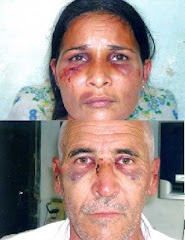
Cuban authorities arrested dissidents Vladimir Calderón and Julio
Beltrán on April 28. Their crime? The two men were accused of passing
out anti-government flyers and organizing an anti-government march on
May 1. Both men were publicly beaten as they were arrested.
(AP/Franklin Reyes)
Pope Benedict XVI walks with Cuba's Cardinal Jaime Ortega, right, as he
waves upon his arrival in Havana in late March.
If anyone should be held responsible should something happen to Calderón
and Beltrán while in custody, I point a finger squarely at Havana
Cardinal Jaime Ortega.
The crux of this story lies in Pope Benedict XVI's recent visit to the
island. Dissident groups saw an opportunity to have this self-proclaimed
man of peace intercede with the government for them, or at the very
least acknowledge them. Many Cuban dissident groups are Catholic,
including the country's best known opposition group, The Ladies in White.
Calderon and Beltrán's group, the Republican Party of Cuba, is small and
mostly unknown. They meet and pray together on the 13th of every month
at the Church of the Virgin of Charity in central Havana, a crumbling
neighborhood of tremendous poverty and crime just outside the city's
tourist belt.
When they learned of the Pope's impending visit, they prepared a list of
demands they hoped the pontiff would discuss with President Raul Castro.
The demands included freedom for political prisoners, a stop to the
repression of dissidents, freedom to travel, freedom of association,
economic freedom, access to private property, internet access, wage
increases, more food for children and a dialogue between the government
and its opposition. Pretty standard stuff, at least for those of us
living under the Constitution and the Bill of Rights.
Their idea was to deliver the list to the Pope via the Church of the
Virgin of Charity. But when presented with the document, the parish
priest refused to accept it, thus setting off a complicated back and
forth between the dissidents and the archbishop's office. The
dissidents, fearing they'd be victims of a government rapid-response mob
outside the church, refused to leave until a church official came to
talk to them.
And what did Cardinal Ortega do? He requested that members of the
national police force enter the church and forcibly remove the group of
13 men, women and children, sanctuary be damned.
The Pope came and went from Cuba, salsa dancing with the excommunicated
Fidel (in 1962), saying not a word about, nor once acknowledging, never
mind meeting with, any of the dissidents.
And then the Cardinal went to Harvard.
Ortega said the entire incident, which he described as the "occupation"
of the Church of the Virgin of Charity, had been a plot planned by Miami
exiles against the government.
And the dissidents? "They were a group that – this pains me a lot – all
of them were former delinquents," said the Cardinal. "There was a former
Cuban prisoner who had been returned to Cuba, he had been in prison for
six years and was one of the excludable people who were sent to Cuba […]
among them were people without any cultural level, some with
psychological disturbances."
The Miami Herald broke down the background of group's members. They are
mostly working class people (one survives by fixing lighters), but
several have a college education and professional careers, including
Calderón.
The extraordinary thing, to me, in the Cardinal's declaration, though,
is his use of the word "delinquent": a government favorite to discredit
its critics.
And, of course, the Cardinal's cruel dismissal of the very people that
Jesus would have called us to protect: the voiceless and oppressed, the
poor and powerless.
http://www.wbez.org/blogs/achy-obejas/2012-05/dissidents-arrest-following-pope%E2%80%99s-cuba-visit-cardinal-neglects-his-flock
The death of a Cuban spymaster
Posted on Saturday, 05.05.12
The death of a Cuban spymaster
By Brian Latell
Fidel Castro's young intelligence officers were skilled and relentless —
even when they were turned against their own bosses. In the last of
three excerpts from his new book 'Castro's Secrets: The CIA and Cuba's
Intelligence Machine,' retired CIA analyst Brian Latell discloses the
lethal secret behind the apparently natural death of one of Castro's
senior advisers.
When Florentino Aspillaga defected from Cuba's General Directorate of
Intelligence — the DGI, Fidel Castro's elite force of spies — it was a
double blow for Havana. Not only was he a highly decorated intelligence
officer, he was a veteran, a member of one of the first classes to go
through the DGI's intelligence school. He enrolled in November 1962, a
few weeks after the resolution of the Cuban missile crisis and several
months shy of his 16th birthday. "It was my destiny,'' Aspillaga told me
when we first met, 20 years after his 1987 defection, "to work in
intelligence.''
All of his 50 classmates were precocious too, most also teenagers, 16 to
19 years old. The eldest was 23, and there was another boy who was even
younger than he. They were malleable and learned quickly, enthusiastic
acolytes in a fledgling intelligence service led by revolutionary
stalwarts most of whom were only a few years older.
Ramiro Valdés, the interior minister at the top of their chain of
command, was 30 that year. Manuel Piñeiro — Barbaroja, the
American-educated "Redbeard'' — who led the DGI from its inception, was
28. Fidel was 36; Raúl, 31, Che Guevara, 34. Most of the other top-tier
figures were also still in their 20s or early 30s, as were the most
important DGI operatives abroad. Armando Lopez Orta — the suave
"Arquimides'' — was typical. A friend of Piñeiro, he was 30 when
assigned to run the DGI's large Center in Paris. All were in the
vanguard of a generational upheaval that was convulsing Cuban society.
Not surprisingly, Piñeiro's tough young charges attracted considerable
attention. Former Mexican foreign minister and author Jorge Castañeda,
who knew Redbeard well, wrote about how they were initially easy to
spot. The DGI chief's " muchachos were generally young, lower
middle-class, or quite poor, uncouth but bright.'' Castañeda also quoted
a Colombian who knew some of them: "Piñeiro taught these boys how to
dress and use knives and forks at the table.''
There were no manicured playing fields in their backgrounds, no tennis
whites or prom night formals. Most, including Aspillaga, had scarcely
any schooling at all. Too easily dismissed, as some in the CIA did,
those Cuban teenagers were rugged true believers in Fidel and his
revolution. Thoroughly trained and ready for almost anything, they
should not have been underestimated.
Canny and street smart, they had been toughened during the years spent
as guerrilla fighters and conspirators in the revolution's urban
underground. Some survived the brutalizing ordeals of Batista's
political prisons. Quite a few were adoring acolytes of Fidel or Raúl,
or of Piñeiro or another top lieutenant who treated them like adopted
sons. Castañeda wrote that Piñeiro's boys were "adoring and totally
devoted to him."
A CIA officer in Santiago, Cuba's second city at the eastern end of the
island also admired Redbeard when they met on several occasions in 1958.
He told me he had a high opinion of Piñeiro. "I thought he was a real
nice guy. He was not a communist when I knew him."
This experienced Agency officer had also been deceived. Piñeiro had
studied at Columbia University in New York earlier in the 1950s, where
he courted and married a Tennessee-born ballerina. He spoke colloquial
English and was adept at charming Americans. But later, when he threw in
his lot with the Castro brothers, he was a hardcore revolutionary. He
shared their antipathy toward the United States and their desire to sow
revolution throughout Latin America. Fidel and Raúl had no doubt that he
was the perfect choice to get their nascent intelligence service up and
running.
Under Redbeard's tough leadership, it did not take the DGI long to
achieve something close to world-class excellence. Five KGB instructors
played a crucial role in that. Future CIA director Richard Helms
recalled that they did "a rather astonishing job."
The Soviets taught the full range of illicit tradecraft. The chief
tutor, a short, gray-haired Russian nicknamed "the Frenchman" by the
Cubans, spoke good Spanish. With his Soviet bodyguard or aide, he was
often seen at Piñeiro's side. Cuban instructors in the intelligence
school learned quickly from these KGB veterans, and Redbeard innovated
and improvised. The best students completing a course in some
operational specialty often jumped to the front of the classroom, where
they then taught novices what they had just mastered. The pattern
followed class after class.
But Cuba's intelligence professionals could never be sure they would
remain in the regime's good graces. During his decades in power, Fidel
authorized the executions of a long list of offenders, including two
intelligence chieftains who died under mysterious circumstances,
probably on his orders.
Redbeard Piñeiro was one of them. A well-connected former Cuban
government official who worked closely with the spymaster for many years
claimed that Piñeiro was murdered in 1998 on the orders of either Fidel
or Raúl Castro.
Like so many others in the brothers' entourages over the decades,
Piñeiro had strayed from their rigid orthodoxies and had been shunted
aside. But "he was impossible to retire,'' my source told me. He knew
too much; he was writing a book, and he made the mistake of telling
others about it. His whole career — more than 40 years — had been in
intelligence and intrigue. Everything he had done was as Fidel or Raúl's
proxy in covert operations in dozens of countries on several continents.
What else could he have been writing about?
The day after his death, security personnel searched his home in Havana,
"as if he were a dissident'' or a conspirator, and "kept all kinds of
papers,'' according to the former Cuban official who now resides in
Florida. He also told me that Piñeiro's home "was surely bugged'' and
that he had been talking too freely.
Redbeard's bodyguard, who doubled as his driver, was also certain his
boss had been murdered. Piñeiro was said to have fainted at the wheel of
his car, resulting in a single-vehicle accident on the streets of
Havana. He survived with minor injuries and was taken to a government
executive hospital for observation — only to die in his hospital bed of
a heart attack, the regime said. A day before the accident, the
transportation ministry had instructed his driver to take some time off:
Piñeiro would drive himself. My source told me the distraught driver
lamented openly: "They knew. They knew."
http://www.miamiherald.com/2012/05/05/v-fullstory/2785481/the-death-of-a-cuban-spymaster.html
Saturday, May 5, 2012
Cars, Costs and Benefits / Eliécer Ávila
Cars, Costs and Benefits / Eliécer Ávila
Eliécer Ávila, Translator: Unstated
In Cuba, there are many things we take for granted and count on for
ourselves and for the world as settled matters, normal in how they work,
but in reality they are obsolete things, of poor quality and even
dangerous or extremely harmful to our health.
Most people don't realize it because our level of development is so low,
so in terms of appreciating the quality of the things around us, almost
anything available for subsistence satisfies us. There could be
thousands of examples, perhaps millions, because every Cuban could offer
several related to his or her own environment and experience.
This time I will address an issue that illustrates some of this
insidious reality: cars.
The equipment that is considered ordinary cars in Cuba could not
circulate on the streets of any country at a certain level in the world,
unless it were for an antique show. Much less if the country is proud of
being a tooth-and-nail defender of the environment. The same goes for
almost all the motorcycles, most of which are two-stroke (banned for
years by international protocols).
An American vehicle of the '40s and '50s circulating on our streets
leaves a trail of black smoke in its wake that contaminates more than
100 modern cars would, worse than the ones the Chinese make, and what's
more, since they are practically the only ones in the country in private
hands, their sale prices are enough to make you die of sadness.
An American "almendrón" (the old cars used in private shared taxi
services), reasonably maintained for its year, with an adapted gas
engine, can easily cost 25,000 to 35,000 CUC and more, a figure that is
even higher in dollars. A Soviet made motorcycle with original parts no
longer exists, but would have been almost completely reinvented thanks
to Cuban ingenuity, and could be worth between 2,000 to 7,000 CUC,
depending on the make.
But a simple search on the Internet will show you how many cars —
modern, economical, ecological, safe, and above all "cheap" — can be
purchased in international markets. There are even places where you can
buy a used car manufactured after 2000 for $300, which would be a dream
for any doctor, engineer or teacher in Cuba. And it's the same thing
with motorcycles.
Recently I saw an ad for a 2011 Italian Lambretta, a top flight bike of
world-renowned quality and durability, for not more than 800 Euros,
which is less that a Karpaty would cost in Cuba which, along with the
Berjovina, is the worst motorcycle made on the face of the earth, though
every day they carry thousands of Cubans all over the place, at cost of
spending all your money on it, constantly "babying it along," living
covered in grease and permanently pissed off because anything can break
on it anywhere, such that people have nicknamed it "prison sentence";
and still it's a privilege to have one at a price which very few people
can afford (800-1,700 CUC).
But the issue also involves the subject of fuel, which in spite of all
the treaties and the "integration" with countries like Venezuela where,
according to Cuban doctors themselves — who are serving on overseas
Missions there — "water is more expensive than gasoline"; the fact is
that in Cuba fuel prices are rising and according to some Europeans with
whom I've talked it is more expensive than in their countries.
It's crystal clear that the greatest institutional fraud is the fact
that as Cubans we have to pay much more for almost everything, it being
more expensive here than anywhere in the world, while, paradoxically, we
earn the least money for a month's work.
This is a topic that the "people's representatives" never seriously
addressed at any conference of the Party or the National Assembly. It is
very clear that those who don't sleep thinking of our welfare and our
development will not face these problems because with the money that is
left over after paying an entire people, they are able to buy very nice
and comfortable cars, as well as the fuel to go from meeting to meeting
in their very clean clothes, not squeezed in with people of all kinds,
without sweating their lives away, without losing their health breathing
the carbon coming from the bowels of one of those priceless
truck-tractors (being operated as public transport) that are imposed on
ordinary Cubans. Then there is the TV spot that speaks of the danger of
exposing yourself to secondhand smoke…
The truth is that since the year 1959 no Cuban can go to an agency and
buy a car normally. The State is the only one who has this privilege and
it takes advantage of it to "work" more efficiently, for example, the
thousands of men the government has to better monitor — from their
modern and comfortable transport — each sheep in the flock who is
traveling on foot.
Our people have a right to demand that companies around the world come
and sell their equipment directly here. And also that this happens
because they pay us according to the standards of the international
economy in which a worker (and more if they are professionals which a
great number of Cubans are) can have a decent vehicle to get to work and
take care of the problems and necessities of life.
The word "safe" is very important in this issue; we all know that
accidents have become one of the leading causes of death in our country.
But how are they not going to kill people traveling on top of each other
crammed into pure iron crates without the slightest guarantee of
safety! That, coupled with the deplorable state of the roads and the age
of the aircraft fitted with homemade inventions "to keep them flying" is
a perfect combination to kill yourself. But the Cuban government seems
to only see the responsibility of drivers.
The saddest part is that the propaganda and all the mechanisms of
government do not allow people to realize that this one-party system is
the permanent barrier that will not let us develop and access the vast
store of progress and benefits we could achieve with an open,
participatory and democratic society.
It is a mortal sin and suicidal for us and for future generations not to
see that everything, absolutely everything, happens because of politics.
If we don't change the way we do politics in Cuba, we cannot change
anything, we cannot have development, progress, the public good,
respect, tolerance, peace or happiness. We will always be backward and
hungry and in the end in hell, where we have already lost a good part of
our lives and are threatened with losing them completely.
Eliécer Avila
Puerto Padre, Las Tunas, Cuba
This text was published in Spanish in the blog Penultimos Dias, courtesy
of La Cubanada social network which will bring weekly chronicles from
this author.
4 May 2012
http://translatingcuba.com/?p=18097
Spread Your Little Legs
Spread Your Little Legs
May 4, 2012
Irina Echarry
HAVANA TIMES, May 4 — It was 7:00 a.m. at the Maternidad Obrera
Maternity Hospital, where my fear was making me sweat. The abortion
wing was full of impatient women: some nervous, others extremely sure
of things, but all of them hoping this would be over quickly.
The women were of different ages, each getting by on wages that
weren't enough to take care of themself – let alone another child.
Because of a mistake made by the woman in admissions, I had to go back
down stairs to request my records, which has caused me to lose my
place in line. Before I left I heard — for the third time — the nurse
announcing, "We can't have men in here, those who don't have a woman
accompanying them can't get a curettage."
The young guy at whom the message was being directed looked at his
partner, gave her a kiss and then left, while she repeated that she
didn't have anyone else to be with her – only him, her husband.
I went downstairs and after a few minutes returned with my medical
records in hand. They had already assigned the ten beds that were
there, so I had to wait even though the biopsy I needed had priority.
Still, the wait allowed me to interact with people, listening to their
stories and making my comments (though only a few).
They would cart in the anesthetized women on gurneys. The orderly
doing this seemed to have taken a course in how to be a stevedore
based on how he would plop his load on the bed like a sack of cement.
I tried to help him with one woman but he wouldn't let me.
The nurse realized that I shouldn't have had to wait so long and gave
me the second bed that was unoccupied. I spoke to her softly asking
for a place with a little more privacy, but she only explained to me
that such a change didn't make any sense since when I came out of the
operating room I was going to be asleep.
Everything was quick: you change your clothes, see the
anesthesiologist (who only asks if you're allergic to any
medications), go to the waiting area, see yourself rolled onto a
gurney that comes in when it's your turn, and then you put on some
make-do cloth hospital slippers and a green cloth cap when you get to
being third in line to go in.
Meanwhile, I watched some of the women come out asleep and listened to
the stories of others.
I calculated that they were going to do between 20 and 25 abortions
that day. That means that from Tuesday to Friday they must do around a
hundred or so each week, making me think that this is a country
without a future.
A young woman who was about 20 kept repeating that she wasn't nervous
about any of the commotion because "all the women in my family have
been through this." Still, the cries of another woman flooded the room
– she has just lost her baby and was being "cleaned up" without
anesthesia.
Behind me was another woman who already had an eight-month-old baby
and was in no condition to give birth to another one now. But what was
most striking were those who were in front of me.
One of them was a 35-year-old mother who has been pregnant for a short
time; she has three grown children, two boys and a girl who's 15 – and
who was also in line for an abortion.
The girl entered the room crying.
The doctor talked to the mother saying, "This is voluntary, so we're
going to wait a little while. If she still says "no" when she gets
back in, then we're going to take her out of here. We can't do
anything against her will."
The mother asks, "So who's going to raise it, me?"
Other relatives of the girl came up to her saying: "What's wrong with
you? I thought we had agreed on everything last night. Quit crying and
go on in there. You're too young to ruin your life like this."
Even a hospital assistant offered a few words to the girl: "You can't
be like that. Why are you crying? You better dry those tears. You have
to study, because we blacks have to study so that the white people
can't come along and kick us to the curb. So you go in there now,
don't be crying. You're going to spread those little legs like you did
when you got in this mess. You just breathe deeply and you won't feel
anything."
Convinced, she went back into the room.
The mother then announced: "Tomorrow I'm going to give you a good
beating. All you are is a big headache.
"Poor thing," I then said to her. "She's just going through a bad
time." But I stopped immediately when I saw the mother's pain in her
eyes. Then she said, "I went through a bad time too. I've spent my
working life. I've given everything and look at how they pay me."
I entered the room and the doctor plunged his fingers inside of me:
"How far along are you?" he asked jarringly. When I explained that I
was there for a biopsy his demeanor changed, he became kinder, less
anxious.
He gave me a shot, and then I didn't feel anything.
http://www.havanatimes.org/?p=69148
Subscribe to:
Posts (Atom)