Saturday, February 12, 2011

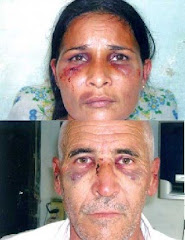
Cuba frees husband of rights group leader

Cuba frees husband of rights group leader
AFP
Cuba

HAVANA (AFP) – Cuba on Saturday released from prison Hector Maseda, the
husband of the main leader of the Ladies in White rights group, a
prominent political dissident told AFP.

Maseda, a 68-year-old journalist and founder of the outlawed Liberal
Party, was released at noon and will remain in Cuba, said Elizardo
Sanchez, the head of an illegal but tolerated rights group.

Maseda was one of 52 dissidents the government of President Raul Castro
had promised to release from prison last July in a deal brokered by the
Catholic Church. Of those, 11 rejected offers of exile in Spain.

Five security agents took Maseda to the home he shares with his wife,
Laura Pollan, in a working-class neighborhood of Havana, Sanchez said.

Maseda initially did not want to leave prison until he had a pardon or
was granted unconditional freedom, Sanchez said. He also wanted the sick
dissidents to be released first.

Instead his sentence was merely suspended, not revoked.

"The government, the officers, told him that he had to leave now,"
Sanchez told AFP.

Maseda, an electrical engineer by training, has collaborated in the past
for the group Reporters Without Borders, and written for newspapers such
as France's Le Monde and The New York Times.

Three of the 11 who had rejected exile to Spain have now been freed, all
this month.

Cuba released Eduardo Diaz, 59, on Friday and Guido Sigler, 57, on
February 4. Sigler said he is considering emigrating to the United States.

The three had been arrested in a 2003 crackdown that swept 75 dissidents
into prisons and saw them sentenced to terms of between six and 28 years.

Maseda's release surprised Pollan, who on Saturday was visiting Diaz and
his family in the town of Consolacion del Sur, in Pinar del Rio
province, some 130 kilometers (80 miles) west of Havana.

The remaining jailed dissidents are considered prisoners of conscience
by the rights group Amnesty International.

The female relatives of political dissidents are the core members of the
Ladies in White, a group that won the European Parliament's 2005
Sakharov Prize for Freedom of Thought.

The group have held marches and vigils seeking the release of their
loved ones, often facing verbal and sometimes physical abuse from
supporters of the island's communist regime.

Dissident sources say around 100 political prisoners remain jailed in
Cuba. The government rejects the claim, arguing that the dissidents are
"mercenaries" in Washington's pay."

http://news.yahoo.com/s/afp/20110212/wl_afp/cubarightsdissident_20110212194649

U.S.- Cuban Relations Ease Another Notch

U.S.- Cuban Relations Ease Another Notch
How Black Flags and a News Ticker Caused a Diplomatic Dust-up
By MARC FRANK
HAVANA Feb. 11, 2011

Cuba has stopped flying black flags in front of the
U.S. diplomatic mission in Havana, the latest step
towards dismantling an in-your-face confrontation
that arose around the building during the George W.
Bush administration and brought always contentious
relations between the two countries to the breaking
point.

Former Cuban President Fidel Castro ordered the
parking lot in front of the U.S. Interests Section dug
up and the 100-foot-high flags installed in 2006.

The action came after the United States turned on a
five-foot-high news ticker that ran across 25
windows on the outside of the fifth floor of the
mission on Havana's busy seaside Malecon Drive.

The Times Square-style ticker streamed news,
political statements and messages in crimson letters
blaming Cuba's problems on the country's communist
system and socialist economy.

The dozens of huge black flags, which Cuba said
represented more than 3,000 of its citizens killed
over the years by U.S. inspired violence, effectively
blocked it from view.

The bizarre scene, as the two old nemeses
symbolically squared off in Havana, became a tourist
attraction and barometer of the rising level of hostility
between them.

The two countries do not have full diplomatic
relations, but maintain lower level interests sections
in each other's capitals.

"They stopped flying the flags completely at least two
weeks ago," a U.S. diplomat said, adding he had no
idea if the measure was permanent.

The Cuban government hasn't commented on the
flags disappearance. The huge -- and now barren --
field of flag poles remains standing and at the ready
where cars once parked just yards from the building's
front door.

Soon after the Obama administration took over in
Washington, anti-Bush billboards around the
building, depicting the former U.S. president as
Dracula, Hitler and a terrorist, were taken down.

The news ticker went dark in June 2009 and the
government of Raul Castro, who replaced his brother
in 2008, responded by reducing the size and number
of flags, but still kept some flying.

Cuba Removes One Obstacle to U.S.

Diplomatic contact with Havana, which was
suspended when the ticker lighted up, has resumed
and has been civil, according to U.S. diplomats.

"Maybe removing the flags, and previous steps, are
signs both governments want to move away from
symbols to the substance of U.S.-Cuban relations,"
said Julia Sweig, a senior fellow at the Council on
Foreign Relations and author of a number of books
on Cuba.

The Obama administration has recommenced regular
meetings with the Cuban government on such issues
as immigration, mail service and other matters which
were suspended by Bush, and has lifted restrictions
on Cuban Americans visiting home and supporting
their families.

Obama also lifted restrictions imposed by Bush on
academic, religious and some other professional
travel and in other ways has modified decades-old
sanctions to promote "people-to-people" contact with
the Communist-run island, while maintaining a
general ban on Americans visiting the country.

Relations remain strained, however, with Cuba
charging the Obama administration has strengthened
some aspects of the 50-year-old U.S. trade embargo
and stepped up efforts to undermine the Cuban
government.

But all is not sanguine between the two countries.

Cuba is preparing to bring to trial U.S. contractor
Alan Gross, detained in late 2009 for accused of
setting up illegal satellite communications as part of a
U.S. program to promote civil society and democracy.

Cuba considers such activities as subversive and is
seeking a 20 year sentence based on the charge that
Gross was acting "against the independence or
territorial integrity" of the country.

U.S. officials have said his conviction would
seriously dampen prospects for any further
improvement in relations.

http://abcnews.go.com/International/us-cuban-relations-ease-island-nation-lowers-black/story?id=12886940

Mubarak and Castro: The Self-Deception of Dictators

Yoani Sanchez - Award-Winning Cuban Blogger
Posted: February 12, 2011 01:26 PM

Mubarak and Castro: The Self-Deception of Dictators

My guest post today is from Angel Santiesteban, a Cuban writer whose
work has been published in more than 15 countries. His blog from Cuba is
titled, The Children Nobody Wanted.

The Reflection in the Mirror: Castro and Mubarak
by Angel Santiesteban

The newspaper Granma, official organ of the Communist Party of Cuba,
which also controls the rest of the official media as is common in
totalitarian regimes, announces that demonstrations against Egyptian
President Hosni Mubarak are a response to his thirty years in power.

The news seems to mock Cubans. The Castro government is already
threatening to reach double that figure at the helm of the country,
leading to ever growing poverty and scarcity.

Common sense, however, seems to fail authorities because a certain logic
dictates that they shouldn't publish this image of Mubarak--their
reflection in the mirror. Thirty years in power in the Egyptian nation
is bad, but fifty-three years for the Cuban dictatorship is good?

Mubarak declared, according to an interview on the American network ABC,
that his departure from power would lead the country into chaos. "I hate
to see Egyptians fighting among themselves." It's hard to know whether
all dictators are the same by nature or if they studied the same manual.

What's laughable--if such a thing were possible--is that they mock
themselves, they defy the most basic common sense. Mubarak and Fidel
Castro imagine themselves to be gods, chosen ones, capable of guiding
their people if not to prosperity, at least to "dignity." They have no
bread to offer but they try to swindle us with populist ideology. The
tragedy is that the price of their love of power is paid by their people.

Also, recently, we have the "bread intifada" in Tunisia, a rebellion
against a government that, as the official Cuban press describes it, has
been "entrenched in power for 23 years." In Yemen something similar is
happening. In the Ivory Coast the population demands respect for the
outcome of its elections. Sudan votes in a referendum of
self-determination. Peoples, risking their destiny, tired of being
deceived, launch themselves like cannon fodder to impose their will.

Just a few hours ago, national television claimed that representatives
from the Mubarak government were holding talks with the opposition. The
key question is when will the Castros' government accept democracy,
admit the opposition, and stop ignoring plans that could heal the
present national crisis.

Mohammed Bouazizi, the Tunisian whose death sparked the wave of riots
that are shaking the Arab world today, died like Orlando Zapata Tamayo.
Neither of them had any other alternative."

http://www.huffingtonpost.com/yoani-sanchez/mabarak-and-castro-the-se_b_822386.html

Cuba's Medics Still Take Flight

Cuba's Medics Still Take Flight
Jan. 15 2011 - 11:12 am
By TIM FERGUSON

The Wall Street Journal today features a front-page report on one
fallout of Communist Cuba's worldwide medical missionary program–the
defection of many of the doctors to freedom. Cuba uses the program to
gain favored access to commodities and to gain diplomatic points. The
program is most advanced in Africa and Latin America but also reaches a
poor Asian spot like East Timor.

Much of what is described in today's Journal story was laid out in
Forbes more than five years ago, in a piece by Susan Kitchens that I
edited. (The text but unfortunately not the accompanying photos can be
found here.)

The thing about Castroite Cuba is that, just as with the old cars and
building facades in Havana, you can revisit the scene years later and
even in this dynamic world, things are pretty much the same.

http://blogs.forbes.com/timferguson/2011/01/15/cubas-medics-still-take-flight/

Cuban defector wins debut in two rounds

Posted on Saturday, 02.12.11

Boxing
Cuban defector wins debut in two rounds
By Santos A. Perez
sperez@MiamiHerald.com

Like a cheerful schoolboy who just gained another hour of recess, Leduan
Barthelemy let out a huge grin as he reflected on the outcome of his
first professional fight.

"I cannot fully describe my emotions right now," Barthelemy said. "I
just feel very happy."

Barthelemy had reason for his joy. Two years since defecting from his
native Cuba, Barthelemy made a successful debut with a second-round
technical knockout over Shane Tenney in an undercard bout of Friday
night's show at Magic City Casino.

Using his 6-1 frame, Barthelemy kept Tenney at a distance in the first
round with a lead right jab.

Late in the round, Barthelemy pressed Tenney (3-1) to the ropes and
scored with combinations to the head.

Barthelemy quickly realized the potency of his shots in the second
round, sending Tenney to the canvas with a right to the head. Tenney
struggled to reach his feet before the 10-count, forcing referee Sam
Burgos to stop the super-bantamweight bout at 2:23 of the round.

"After the first round, I knew he wasn't stronger than me," Barthelemy
said. "I wanted to win by knockout so I went after him."

Barthelemy, 21, said sparring with middleweight Eromeseme Albert helped
him prepare for the bout.

Albert fought in the card's main event late Friday, defending his
regional middleweight title against Lester Gonzalez.

Another of the card's late Friday bouts featured Barthelemy's older
brother, Rances, against Anthony Woods.

In another bout, Miami resident Chris Velez won a hard-fought and
entertaining majority decision against Cutler Bay's Jessy Cruz.

Returning to the sport after a two-year absence, Cruz hurt Hernandez
(5-0) late in the first round with a left to the head.

But Hernandez fought back in the following rounds with effective
combinations the head from short range. Cruz (3-3) also landed short
combinations to the head as both fighters maintained a busy pace
throughout the bantamweight bout's four-round distance.

Judges Jack Woodburn and Ralph Vidal had Hernandez winning, 40-36 and
39-37, and judge Ric Bays scored it 38-38.

"Jessy is a hell of a fighter and a good friend; we have sparred
together," Hernandez said. "But in the ring you can't think about
friendships. I had a job to do."

In other bouts: heavyweight Glendy Hernandez won by unanimous decision
over Jerry Butler; light-heavyweight Yuniesky Gonzalez knocked out Chris
Kahn at 2:30 of the second round; junior-welterweight Puro Pairol won by
unanimous decision over Jean Petit-Homme; and welterweight Chris Velez
scored a TKO over Alejandro Artola at 1:54 of the second round.

http://www.miamiherald.com/2011/02/11/2063117/cuban-defector-wins-debut-in-two.html

Travelers to Cuba beware

Posted on Saturday, 02.12.11

U.S. POLICY
Travelers to Cuba beware
By Mauricio Claver-Carone
www.capitolhillcubans.com

On Jan.14, the Obama administration announced the further easing of
"purposeful" travel to Cuba. The stated intent of this policy is to:
"increase people-to-people contact; support civil society in Cuba;
enhance the free flow of information to, from, and among the Cuban
people; and help promote their independence from Cuban authorities."

On Feb. 4, the Castro regime announced that it would seek a 20-year
prison sentence against an American development worker, Alan Gross, for
"Acts Against the Integrity and Independence of Cuba" – a catch-all
"law" against anything the regime perceives as a threat.

Indeed, this "law" is so arbitrary that anyone traveling to Cuba under
the administration's new measures would be ipso facto in breach of it.
After all, the expressed intent of the new policy, as noted above, is to
weaken the control of the Cuban dictatorship over its people –
presumably a mortal threat to any dictatorial regime.

So, according to the administration's rationale, Americans traveling to
Cuba on "purposeful" academic and religious travel will (hopefully) take
with them copies of the U.N. Declaration of Human Rights, iPads loaded
with uncensored literature and subscriptions to foreign press, smart
phones for Cubans to connect with the free world and engage in
conversations with dissidents (or discuss current events with regular
Cubans on the street).

Faced with this presumed threat, the Castro regime will surely seek to
blunt the intended effect of the new policy and make fresh examples of
any would-be Alan Gross who gets in its way.

Bottom line: Without legal guarantees and respect for basic human
rights, any American traveling to Cuba under the administration's new
policy can be whimsically arrested for an indefinite period. Indeed,
recent Iranian actions against three U.S. hikers show how the arrest of
American travelers can become a favorite past time for cruel dictatorships.

Therefore, the State Department should issue a clear travel warning to
Cuba. Or better yet, the administration should revert its new policy
until Cuban laws are transparent and, hopefully, more humane. Otherwise,
the administration's new policy amounts to nothing more than a tourist
measure, which would not only be in contravention of congressional
intent, but of U.S. law.

Mauricio Claver-Carone wrote this view in his blog
capitolhillcubans.com. He is the executive director of Cuba Democracy
Advocates in Washington, D.C., a non-partisan organization that promotes
a transition in Cuba toward human rights, democracy and the rule of law.
He serves on the board of U.S. Cuba Democracy PAC.

http://www.miamiherald.com/2011/02/12/2062482/travelers-to-cuba-beware.html

Friday, February 11, 2011

Cuba Is Half a Century Behind in Technology

Yoani Sanchez - Award-Winning Cuban Blogger
Posted: February 11, 2011 04:40 PM

Cuba Is Half a Century Behind in Technology

Currently on display at Pabexpo, the exhibition center located in the
wealthiest part of the city, are computer-related products created
within and outside our country. Guests from all over are brought
together there, including a large group of foreigners who I imagine are
more interested in taking a trip on our Paleolithic technology than
doing business with local firms. The Kaspersky Group, for example, is
showing a version of its well-known anti-virus program, developed in
conjunction with the national company Segurmatica. Everything has been
made to look like an exhibition of this type anywhere in the world, were
it not for one detail: This is the Island of the Disconnected.

Already well into the year 2011, inhabitants of the "Cuban archipelago"
cannot buy a bus, train or airline ticket on the web, we don't know the
sensation of managing our bank accounts online, and purchasing a product
through the computer screen is something we have seen only in foreign
films. Still, today, my compatriots have never handled bureaucratic
paperwork via email, not even the simplest of requests for one's own
birth certificate. Don't even talk about reserving some vacation on the
flashy webpages of the travel agencies Cubatur or Islazul. Among my
hundreds of friends, none have managed -- from here -- to recharge their
own mobile phones on those portals that offer the service, without
having to stand in the long lines at the ETECSA office. We are a people
who have no opportunity to pay our bills through cyberspace and who live
as software pirates faced with the impossibility of purchasing licensed
versions.

Here we live at a stage that is more characteristic of the first half of
the twentieth century than it is of the twenty-first. Thus, the Computer
Science Fair appears as a glimpse into the future, a shop window that
displays to others what we haven't even tasted. After the visitors
return home, they will praise the skill sets of the Cuban computer
scientists and remember the tasty mojito they were given at the farewell
party. Meanwhile, we remain in the twilight of the disconnected, turning
on autistic computers unable to connect to others. We dream -- it's true
-- of one day filling out a form on the Internet where a phrase will
confirm for us: "Thank you for your purchase, your ticket to Guantanamo
has been reserved. Have a nice trip!"

http://www.huffingtonpost.com/yoani-sanchez/cuba-is-half-a-century-be_b_821759.html

Cuba gets cable link to Venezuela

Cuba gets cable link to Venezuela

The cable is expected to be operational in July

The cable will transform communications in Cuba, which has among the
slowest internet speeds in the world.

The new connection will make download speeds 3,000 times faster - at
least for the small minority of Cubans who have internet access.

It should also make international phone calls much cheaper.

The 1,600km (1,000 mile) cable from Venezuela was financed by the
Bolivarian Alliance for the Peoples of Our America (Alba) - a left-wing
regional grouping founded by Venezuelan President Hugo Chavez.

Cuban Information and Communications Minister Medardo Diaz said it
"reinforced Cuba's sovereignty" and "opened a breach" in the US economic
blockade.

The cable would "be at the service of our people, as a tool to reinforce
its development, integration and sovereignty" when it became operational
in July, he added.

Until now, Cuba has relied on internet and international telephone
connections via satellite, which is expensive and slow.

Cuba's communist government has always blamed its poor communications
links with the outside world on the decades-old US trade embargo, which
has prevented the installation of a fibre optic cable to Florida, just
144km away.

Broader access?

The arrival of the fibre-optic cable has raised enormous expectations in
Cuba, says the BBC's Fernando Ravsberg in Havana.

According to official Cuban statistics, only 3% of the population have
access to the web - the lowest figure in the western hemisphere.

Access is restricted and available only with government permission -
although since 2009 Cubans have been able to use internet cafes, mostly
in hotels, and there is a strong black market for internet connections.

Last November the official Communist Party newspaper, Granma, sought to
lower expectations.

"The underwater cable will provide higher quality communications, but
not necessarily mean a broader extension of the same," it said.

The Cuban government says there is no "political obstacle" to the
internet in Cuba.

But opposition groups - including the prominent dissident blogger Yoani
Sanchez - say the authorities have always sought to control sources of
information and free expression.

http://www.bbc.co.uk/caribbean/news/story/2011/02/110210_cuba_venezuela.shtml

Coast Guard interdicts refugees

Posted on Thursday, 02.10.11

Coast Guard interdicts refugees

The U.S. Coast Guard repatriated 30 Cuban migrants this week, including
five men spotted on a raft on Sunday by the Disney Magic cruise ship.
The men were found about 21 miles southeast of Key West. A small Coast
Guard crew boat picked up the refugees to transport them to a larger
cutter for repatriation. The other Cuban refugees were picked up in
separate incidents in groups of seven, 15, two and one. All the Cubans
were returned to Bahias de Cabañas.

In addition, five Haitian migrants were returned to Haiti.

"The U.S. Coast Guard policy is to deter and respond to dangerous,
disorderly and illegal maritime migration by intercepting vessels that
pursue perilous and illegal voyages,'' said Capt. Steven Banks, Seventh
Coast Guard District chief of enforcement, in a prepared statement. "We
continue to maintain a robust presence of cutters and aircraft
throughout the Caribbean to respond to illegal migration and migrant
smuggling activities."

Once aboard a Coast Guard cutter, migrants are provided food, water,
shelter and basic medical care.

http://www.miamiherald.com/2011/02/10/2061152/coast-guard-interdicts-refugees.html

US intel report highlights Cuba, Venezuela woes

US intel report highlights Cuba, Venezuela woes
(AFP)

WASHINGTON — President Hugo Chavez will face increasing protests as the
Venezuelan economy deteriorates and the opposition strengthens, while
political instability is also possible in Cuba, a US intelligence report
said Thursday.

The dire news for the two leftist Latin American regimes came in the
annual Worldwide Threat Assessment, a report issued by the office of
Director of National Intelligence James Clapper.

"Facing an energized opposition in the coming year, Chavez may have to
deal with more popular protests over his continued push to implement
21st Century Socialism," read the report.

Venezuela "currently suffers from nearly 30 percent inflation and
negative growth," and Chavez will "struggle to improve his country's
poor economic performance."

Chavez's hold on power however "remains secure, despite his party's
lackluster performance" in September 2010 legislation elections.

As for Cuba, "the economic situation is dire," the report said.

Foreign revenue coming from nickel exports and tourism have decreased,
resulting in a foreign currency reserve drop that has "forced dramatic
cuts to imports, especially food imports, and we have seen increases in
the price of oil, food, and electricity.

"As a result, Havana has become even more dependent on subsidized oil
shipments from Venezuela and earnings from over 40,000 health workers,
teachers and advisers in that country," read the report.

"We doubt that the Cuban economy can quickly absorb all the dismissed
state workers given the many bureaucratic and structural hurdles to
increased private sector employment."

Cuban President Raul Castro has announced sweeping reforms that include
slashing half a million government jobs and making it easier for private
entrepreneurs to work.

The report noted that there is "little organized opposition to the Cuban
government, and Cuba's security forces are capable of suppressing
localized public protests."

However it warned that "a heavy-handed Cuban put-down of protests could
spark wider discontent and increased violence which could lead to a
level of political instability."

http://www.google.com/hostednews/afp/article/ALeqM5iuXBSWUp3lN8rC968zX97sV-e-VQ?docId=CNG.6b096ac0cdcfce7a0f599fbbb1c85c27.b21

Cuba presents Linux-based operating system

Cuba presents Linux-based operating system

The state informatics university launched an updated, Cuban-designed
operating system based on the open-access
Linux software.

The commercial arm of the Universidad de Ciencias Informáticas presented
version 3.0 of Nova Linux at the Informática 2011 fair in Havana, saying
it will speed up Cuba's conversion to open-access software.

Cuba is planning to convert most of its IT operations to the new system
this year. Beginning this year, all personal computers assembled by a
Chinese-Cuban joint venture will be loaded with both Windows and Nova
Linux. The use of Microsoft Corp.'s ubiquitous Windows system has been
hampered by U.S. sanctions.

Emulating Microsoft Office, the UCI also developed a package of
applications called Nova Escritorio. Other UCI products include Nova
Servidores for servers, and Nova Ligero for mini laptops and small
notebooks.

http://www.cubastandard.com/2011/02/10/cuba-presents-linux-based-operating-system/

Protests in Egypt Spark Fears in Cuba Over Growing Internet Opposition Movements

Protests in Egypt Spark Fears in Cuba Over Growing Internet Opposition
Movements
By Serafin Gomez
Published February 11, 2011
FoxNews.com

Peering at the upheaval thousands of miles away in Egypt, the Cuban
government is increasingly concerned about a burgeoning opposition
movement growing through the Internet.

As a result, the Castro regime has intensified its crackdown on
dissident groups in an attempt to ensure that what is happening in Cairo
will not happen in Havana, according to some observers.

"We do see instances of repression starting since the Egyptian upheaval.
There have been brutal beatings on dissidents," said Susel Perez, of the
Cuba Transition Project, at the University of Miami. " It is a direct
sign from the Cuban government that this is something that will not be
tolerated on the island."

In a 53-minute video leaked last week, a Cuban counter-intelligence
staffer warned an audience of Castro government officials that
pro-Democracy organizers in Cuba and the United States were using social
media, like Facebook and Twitter, to foment a political uprising in the
island nation.

"The technology in itself is not a threat, but the threat is what the
people who use the technology can do with it," the lecturer said in the
video, identified by the Miami Herald as 38-year-old Eduardo
Fontes-Suarez. "The Internet is a battlefield."

The video lecture was purportedly shot over the summer, months before
the situation exploded in Egypt. The impetus behind the unrest was a
Facebook page created to honor a young Egyptian man allegedly murdered
by corrupt police.

During the lecture, Fontes-Suarez directly blamed the U.S. government
for coordinating the new Internet push and says Cuban bloggers like
Yoani Sanchez -- creator of "Generacion Y," a blog critical of the Cuban
regime -- are part of a U.S. campaign to overthrow the Castro government.

"A network of mercenaries is being organized that are not like the
traditional counter revolution," Fontes-Suarez said. "We are talking
about young people. Young people who hang out with our children."

But the Cuban government has taken steps that seemingly contradict the
premise that they fear the Internet. On Tuesday, Cuban authorities
recently unblocked Sanchez' blog, allowing it to be accessed and read
within the island for the first time.

The reason may be that the authoritarian regime has such tight control
of Cuba's Internet and those who access it -- much firmer than Egypt's
Mubarak government-- that they believe they could clamp down on any
uprising.

"It is always hard to predict what ends up bringing down a
dictatorship," said Dr. Susan Kaufman Purcell, a Latin American expert
at the University of Miami. " The Cuban government is fearful, and they
have always been fearful of the impact of social media, that is why they
control it so much."

The overwhelming majority of Cubans do not have Internet access.
According to recent statistics, there are only about 1.5 million
Internet users out of 11 million in Cuba – just 14 percent.

According to the CIA's world fact book, private citizens in Cuba are
prohibited from buying computers or accessing the Internet without
special authorization. Some Cubans buy illegal passwords on the black
market or take advantage of public outlets to access limited e-mail and
the government-controlled intranet.

"The problem is access. In Egypt, there is much broader access to the
Internet. You had numbers that go into the street that could make it
difficult," Purcell says. "Cuba is a much more closed society than Egypt
and many other Middle East countries."

In the few audience shots of the leaked video, Cuban officials in
military uniforms intently watch as Fontes-Suarez brings up the case of
American Alan Gross, who is facing 20 years in a Cuban jail for
allegedly supplying satellite phones to Cuban-Jewish communities, as an
example of the United States helping dissidents expand Internet access.

"Social media sites are the basis of all the actions being taken against
Cuba, " Fontes-Suarez says. "But being a blogger is not a bad thing.
They have their bloggers and we will have ours. We are going to fight
and see which of them will be stronger."

On Wednesday, a Cuban official announced a major achievement in
increasing the weak Internet strength on the island nation that sits
just 90 miles away from Florida beaches: an underwater fiber-optic
cable, across 1,000 miles, which links Cuba to Venezuela and promises
faster Internet and telephone service to Cuba.

Sanchez questioned whether the move would do more to increase
communication options for Cubans or increase opportunities for the
government to monopolize communication, but it probably will do both.

"This international connection looks like it's more destined to control
us rather than to interconnect us," Sanchez wrote, according to The Wall
Street Journal. But Chavez also predicted that hours of Internet access
would end up being sold on Cuba's infamous black market.

"With authorization or without it, the hours of connectivity will end up
on sale, in a country where the diversion of resources is a daily
occurrence, and a strategy for survival," she wrote.

http://latino.foxnews.com/latino/news/2011/02/11/protests-egypt-spark-fears-cuba-growing-internet-opposition-movements/

Church: Cuba to free 4 more prisoners into exile

Posted on Friday, 02.11.11

Church: Cuba to free 4 more prisoners into exile
The Associated Press

HAVANA -- The Roman Catholic Church has announced that Cuba is releasing
four more opposition prisoners and sending them and their families into
exile in Spain.

The men have been identified as Felipe Ramon Pino, Osmel Aguilera, Juan
Junior Padron, and Rafael Jorrin.

They are not among a group of 10 nonviolent dissidents remaining in
Cuban jails from a 2003 crackdown on dissent. The release was announced
Friday by church spokesman Orlando Marquez.

Little is known about Pino. Aguilera was serving a 30-year sentence for
sabotage, and Jorrin and Padron were in jail for hijacking and other
charges. Cuba is clearing its jails of many opposition figures.

http://www.miamiherald.com/2011/02/11/2061941/church-cuba-to-free-4-more-prisoners.html

Thursday, February 10, 2011

Undersea Fiber-Optic Cable from Venezuela Reaches Cuba

Undersea Fiber-Optic Cable from Venezuela Reaches Cuba

Cuban Computer Science and Communications Minister Medardo Diaz said the
undersea cable that arrived on Cuba's eastern coast on Tuesday after a
19-day voyage from Venezuela, "opens a breach in the (economic)
blockade" that the United States has imposed on the island and bolsters
"national sovereignty" in telecommunications

HAVANA – Cuba held a ceremony Wednesday to mark the arrival of an
undersea fiber-optic cable from Venezuela – a link expected to provide a
big boost to Internet speed and capacity on the Communist-ruled island.

Official media said among those on hand for the ceremony in the eastern
city of Santiago de Cuba were Vice President Ramiro Valdes, the
secretary-general of the International Telecommunication Union, Hamadou
Toure, and a representative of the Venezuelan government.

Toure had traveled to Cuba for a computer science fair in Havana.

The ship that brought the cable ashore, the Ile de Batz, arrived on
Cuba's eastern coast Tuesday after a 19-day voyage from Venezuela,
Cuba's closest ally.

Cuban Computer Science and Communications Minister Medardo Diaz said the
undersea cable "opens a breach in the (economic) blockade" that the
United States has imposed on the island and bolsters "national
sovereignty" in telecommunications.

Wilfredo Morales, president of Telecomunicaciones Gran Caribe S.A., the
Cuban-Venezuelan joint venture that owns the line, said the project has
gone according to schedule and the cable should be operational in July.

The cable – which began to be laid on Jan. 22 in northern Venezuela –
will give Cuba an alternative to its current, painfully slow satellite link.

Acquired in China and France at an estimated cost of $70 million, the
cable spans 1,630 kilometers (1,012 miles) from a spot near Venezuela's
La Guaira port to the eastern Cuban town of Siboney. A second segment
will run 230 kilometers (143 miles) from Cuba to Ocho Rios, Jamaica.

The cable, which has a 640-gigabyte capacity and a lifespan of 25 years,
is expected to provide a 3,000-fold increase in Cuba's voice, data and
video transmission speeds, experts say.

But Cuban officials say that even after the link has been established
more investment in infrastructure and networks will be needed to improve
Internet and telephone service on the island.

Cuba says its priority will be to continue to build public telecenters
and improve Internet access at schools, hospitals and scientific
institutions.

Presently, only a small number of academics, journalists and other
professionals in Cuba have access to the Internet from their homes.

The island has relied on a slow and expensive satellite link since 1996,
and the government has pointed to the capacity limitations of that
connection in justifying restrictions on individual access to the Web.

The Cuban government says the U.S. embargo is the primary reason why
Internet service is generally unavailable to most Cubans.

The arrival of the undersea cable coincides with an apparent move by the
Cuban government to unblock access – for the moment, at least – to
Internet blogs critical of the government, including Yoani Sanchez's
"Generacion Y."

http://www.laht.com/article.asp?ArticleId=386513&CategoryId=10718

Generation Y 'sighted from inside Cuba'

Generation Y 'sighted from inside Cuba'

p2pnet view P2P | Freedom:- A little while back, "What if Generation Y
is a government sponsored initiative (that will really have no impact to
change things) just so that the government [of Cuba] can give the
illusion of freedom of speech to the smarter part of the population …
false hope basically?" – asked Another Perspective in a Reader's Write
to a p2pnet re-post of Yoani Sánchez (right) then current Generation Y blog

"If the regime was so ruthless why is she still blogging?" – asked the
comment.

Here's a new Generation Y post >>>

Seated in the armchair of a hotel with my laptop open, I note the slow
blinking of the WiFi transmitter and watch the stern faces of the
custodians. This could be one more day trying to enter my own blog with
an anonymous proxy, jumping over the censorship with a few tricks that
let me look at the forbidden. On the bottom of the screen a banner
announces that I'm navigating at 41 kilobytes a second.

Joking with a friend I warn her we'd better hold onto our hair so it
won't get messed up from "speeding." But the narrow band doesn't matter
much this February afternoon. I'm here to cheer myself up, not to get
depressed all over again by the damned situation of an Internet
undermined by filters. I have come to see if the long night of
censorship no longer hangs over Generation Y. With just a click I manage
to enter the site that, since March of 2008, has not been visible from a
public place.

I'm so surprised I shout and the camera watching from the ceiling
records the fillings in my teeth as I laugh uncontrollably.

After three years, my virtual space is again sighted from inside Cuba.

I don't know the reasons for the end to this blockade, although I can
speculate that the celebration of the 2011 Havana International Computer
Science Fair has brought many foreign guests and it is better to show
them an image of tolerance, of supposed openings in the realm of citizen
expression.

It is also possible that after having proved that blocking a website
only makes it more attractive to internauts, the cyberpolice have chosen
to exhibit the forbidden fruit they so demonized in recent months.

If it's because of a technical glitch that will soon be corrected, once
again throwing shadows over my virtual diary, then there will be plenty
of time to loudly denounce it. But for the moment, I make plans for the
platforms www.vocescubanas.com and www.desdecuba.com to enjoy a long
stay with us.

"This is a citizen victory over the demons of control", says Yoanni on
Generation Y, adding:

"We have taken back what belongs to us. These virtual places are ours,
and they will have to learn to live with what they can no longer deny."

http://www.p2pnet.net/story/48657

Cuba represents missed wheat marketing opportunity

Cuba represents missed wheat marketing opportunity
By Tyler Jameson, U.S. Wheat Associates
Feb. 10, 2011 7:20am

• With a population of 11 million people and wheat imports averaging
over 800,000 metric tons (MT), Cuba is the largest wheat importer in the
Caribbean.

• While the United States could supply the majority of these imports,
the longstanding embargo and other barriers inhibit trade between the
two countries.

Advertisement
Penton Media - Southeast Farm press, Click Here!
With close proximity to U.S. ports, the Caribbean region is a natural
destination for U.S. wheat exports.

Shipments from the Gulf of Mexico can reach destinations within a
fraction of the time and cost it takes other wheat exporters to deliver
their products to this region. As a result, the United States maintains
a wheat market share of at least 80 percent in the Caribbean due not
only to close proximity, but also high quality product and proven
reliability as a supplier.

Unfortunately, American wheat farmers are missing out on a critical
Caribbean market — Cuba.

With a population of 11 million people and wheat imports averaging over
800,000 metric tons (MT), Cuba is the largest wheat importer in the
Caribbean. While the United States could supply the majority of these
imports, the longstanding embargo and other barriers inhibit trade
between the two countries.

American wheat farmers are missing out on at least $150 million in
potential sales based on current export levels and prices. U.S. wheat
sales to Cuba have fallen from a high of 500,000 MT in 2007 to 119,000
MT in 2009/10. Sales to date for 2010/11 to Cuba are only 32,500 MT,
while U.S. wheat exports to the entire Mexico, Central America and
Caribbean region are up 32 percent.

U.S. Wheat Associates has long supported elimination of sales barriers
to Cuba and, with the entire U.S. wheat industry, has actively promoted
open access to the Cuban market for more than 12 years. In early 1998,
USW and state wheat commissions organized and funded charitable
donations of wheat flour to humanitarian groups working in Cuba.

Industry representatives then traveled to Cuba over the next two years
to expose their bakers to U.S. wheat flour, before the United States
permitted sales of food and medicine. The Trade Sanctions Reform and
Export Enhancement Act in 2000 finally allowed agricultural sales to
Cuba. After a devastating hurricane in late 2001, Cuba made its first
wheat purchase of 40,000 MT of hard red winter wheat and 10,000 MT of
wheat flour in 2001.

U.S. wheat exports began to flow and exports increased every year until
a change in the rules made agricultural sales more burdensome and
expensive. As a result of tightened U.S. restrictions and the lack of
credit for U.S. purchases, Cuba began sourcing more wheat from
competitors such as the EU, Canada and Argentina.

Recently, the Obama administration announced it will take steps to allow
more Americans to travel to Cuba for religious, educational and family
purposes. While these changes are welcome, more steps are needed to
ensure a steady supply of safe and high quality food produced by U.S.
wheat farmers to the people of Cuba.

http://southeastfarmpress.com/grains/cuba-represents-missed-wheat-marketing-opportunity

Does Cuba Fear A Facebook-Powered Revolution?

Does Cuba Fear A Facebook-Powered Revolution?
Posted by Jorge Cino on February 10th, 2011 1:41 PM

Now circulating virally: "The Cyber Police in Cuba" a filmed lecture
that appears to be directed at Cuban officials, asking them to be
extremely wary of social media. We've embedded a copy at the bottom of
this post, and have translated some key quotes as well.

(Remember that last month Facebook had reinstated Cubadebate's page on
the social network after the government complained about censorship.)

Sure, the spin given in the 53-minute video –- led by a 38-year-old
counterintelligence official–- is that it's the U.S. government that has
been purposefully trying to upset the Cuban revolution since 2008. Yes,
the video makes the Obama administration as responsible for this "plan"
as the Bush administration. "Social media is the base of all the actions
that are being taken against Cuba," says the man.

Although the lecture begins with a lucid statement, "It's not the tools
that are evil, but the people who can use them for evil purposes," it
quickly becomes focused on the U.S. government's supposed strategy for
provoking dissent among Cuban citizens through Facebook and Twitter.

It is also strangely fascinating to watch this man, whose aim is to
explain how social media poses a threat to Cuban society, go into great
detail about the connecting power of Facebook. "It is based on the way
we create real-life, physical connections," he explains. "You write that
you studied somewhere and that you graduated in whatever year, and in
ten minutes [Facebook] suggests all the people you may know."

"In Cuba, Facebook is the number one social networking site, and the
fourth most visited site overall," he explains… in order to make the
point that Cuban people have the same "psychology of the Internet" as
their peers in "China, Brazil, or Venezuela."

Might they be worried that what has been happening in the Middle East
may spread to other areas of the world? That would make sense if Cubans
were using the Internet to the extent that people in other parts of the
world.

In 2008, Cuba became one of the last countries on earth to legalize
mobile phones. Internet access continues to be mostly blocked unless it
is officially granted through the government. According to the Cuban
government, only 1 in 14 residents have access to the Internet at
all—costly, unstable, just-local access.

Readers, what do you think about the idea that a Cuban revolution might
result from postings by U.S. Facebook users?

Note: All translations from the video are the writer's. Apparently the
video's title came from Coral Negro, who uploaded the footage. The
actual title of the conference depicted is "Political and Dissident
Confrontative Campaigns Against Anti-Revolution Groups."

http://www.allfacebook.com/does-cuba-fear-a-possible-facebook-powered-revolution-2011-02

Press Cuba to keep promise to free journalists

Press Cuba to keep promise to free journalists

February 9, 2011

José Luis Rodríguez Zapatero
President of the Government of Spain
Palacio de La Moncloa
Madrid, Spain

Via facsímile: 34-913- 900-217

Dear President Rodríguez Zapatero:

The Committee to Protect Journalists is alarmed that the Cuban
government has yet to fulfill its promise to free all journalists
imprisoned during the 2003 crackdown on dissent. We urge your
government, which was a key party to the agreement to release the
prisoners by November 2010, to hold President Raúl Castro to his word.

We are further concerned by reports last week that imprisoned
journalists Pedro Argüelles Morán and Albert Santiago Du Bouchet
Hernández have initiated a hunger strike to call attention to their
continued incarceration and that of other political prisoners.
Argüelles, 63, who has been in prison since 2003, is in poor health.

After negotiations between the Cuban government and the Catholic Church,
President Castro's administration agreed on July 7, 2010, to release
"within three to four months," all 52 prisoners who were still jailed
from the 2003 crackdown, the church said in a statement issued that day.
Your government played an important role in facilitating those talks.
Spanish Minister for Foreign Affairs Miguel Ángel Moratinos announced
the same month that "the agreement with the Cuban authorities is that
all political prisoners will be released from prison."

CPJ welcomed the subsequent release of 17 journalists, and wishes to
thank you and your government for your sustained efforts in securing the
freedom of the journalists and in offering them safe harbor in Spain
with their families.

However, with nine of the 52 political prisoners still behind bars three
months after the deadline for their release, the Cuban government has so
far failed to fulfill its commitment.

These detainees have expressed a desire to stay in Cuba upon release and
have refused immediate deportation to Spain, the reporters' families
told CPJ. Exile from the island was not stated as a condition of the
Cuban government's agreement to release political prisoners; however,
CPJ research indicates that all of 17 freed journalists were immediately
flown to Spain with their families. (At least three have since
relocated, one to Chile and two to the United States.)

In July, Moratinos announced in the Spanish parliament that Spain would
receive "free people who freely choose to come to Spain," but noted that
"the commitment we have from Raúl Castro is that [former prisoners]
would be able to return to the island." On Friday, a dissident
imprisoned during the 2003 crackdown, Guido Sigler, was permitted to
remain in Cuba upon his release, the BBC reported. While CPJ considers
this a positive development, President Castro should respect his
commitment to release all political prisoners without exile as a condition.

Those still jailed from the 2003 crackdown include three journalists:
Héctor Maseda Gutiérrez, Iván Hernández Carrillo, and Pedro Argüelles
Morán, all of whom suffer chronic health problems. CPJ has also called
for the release of Albert Santiago Du Bouchet Hernández, who was jailed
in 2009 on charges of "disrespect" and distribution of enemy propaganda.
Du Bouchet Hernández, who is serving a three-year sentence, has been
subjected to beatings in prison. (Detailed capsule reports on each
detained journalist are available on CPJ's website.)

Three months have passed since the November deadline for Cuban
authorities to free the remaining dissidents. Without signs of an
imminent release, the journalists in prison are putting their health in
jeopardy to draw attention to their plight. The extended delay in their
release not only undermines Cuba's credibility; it erodes Spain's
grounds for calling on the European Union states to normalize relations
with Cuba. CPJ urges you to press President Castro to release all jailed
journalists without further delay.

Thank you for your attention on this urgent matter.

Sincerely,

Joel Simon
Executive Director

http://cpj.org/2011/02/press-cuba-to-keep-promise-to-free-journalists.php

Wednesday, February 9, 2011

Bread running short at bakeries

Cuba: Bread running short at bakeries
Entrepreneurs may be buying up flour on the black market, causing bread
shortages.
By Nick Miroff
Published: February 9, 2011 08:33 ET in The Americas

HAVANA, Cuba — Like air and water, or free health care and education,
state-subsidized bread is regarded as a natural right in socialist Cuba.
Neighborhood bakeries across the island churn it out in blanched, spongy
loaves and two-foot torpedoes so rigid they could practically whack a
baseball.

Every Cuban is entitled to at least one bun-sized piece per day as part
of the island's ration system, and bread is such a staple of the Cuban
diet that long lines form outside government outlets for those wanting
to buy more.

But with tens of thousands of new Cuban entrepreneurs opening up private
snack bars, cafeterias and pizza stands as part of President Raul
Castro's economic reforms, the island's state-run bakeries have been
coming up short lately. Suspicions have fallen on the new small
businesses, which may be buying up more and more flour on the black market.

At several locations around the capital, Cubans grumbled about
diminished bread availability at state stores, though workers said they
were still meeting the minimum output required for the ration system.

"We're making about 60 percent as much as we used to," said one employee
at a government bakery in Havana's Playa neighborhood, where customers
who queued up on a recent morning were turned away. "We don't have the
flour," he said.

The shortage at the state shops points to an emerging problem with the
Castro government's plan to shed hundreds of thousands of government
employees and create a new class of private entrepreneurs. In the
absence of a formal wholesale market to supply the upstart businesses,
pilfering employees with access to state supplies and stockrooms become
the island's de facto wholesalers.

While global wheat prices have risen sharply lately, workers at several
bakeries said they were receiving the same amount of flour, and denied
that supplies were being stolen. Instead, they said that the new
entrepreneurs were simply buying up more bread, for use in making
sandwiches.

"It's all these new snack bars," said a clerk at a bakery in the city's
Vedado neighborhood, who, like other state employees asked about the
shortages, did not give her name. Attempts to reach the Ministry of Food
Production, which oversees the state bakeries, were unsuccessful, as the
phones at its main offices went unanswered.

Government planners have said they will set up a supply system for the
new small businesses, with $130 million set aside toward the effort this
year, including $36 million for foodstuffs. But they caution it could
take years to implement. Since most of the wholesale supplies will have
to be imported, it is not clear if the government will sell items at or
around cost, as most other goods shipped from abroad and sold in hard
currency stores at a hefty markup.

With the government pledging to lay off or reassign 500,000 state
workers in the coming months, and possibly hundreds of thousands more
after that, it is looking to cut costs by shrinking the size of the
state and allowing more private sector and non-state activity. Since
October, officials have issued some 80,000 new self-employment licenses,
of which roughly 30 percent are for food or food-service related activities.

While the new licenses have created a sense of optimism among some
enterprising Cubans at a time when other government subsidies are being
cut back, the licenses are limited to a list of 178 occupations. The
government has yet to authorize others, citing the lack of a wholesale
market for raw materials, such as auto-body repairman, upholsterer and
welder — jobs that are now widely performed on the black market anyway.

Late last year, as the reforms were being announced, the communist party
newspaper Granma urged patience with the creation of the wholesale
system, explaining that officials couldn't set up such a network
overnight. "To think that the State is allowing new small businesses
without creating a market for their supplies would be irresponsible,
especially since solid planning has been one of the basic principles of
these updates to our economic model," the article said.

"But we can't rest on our laurels, nor expect the materials to appear
from one day to the next," it continued. "The new economic landscape
requires us to increase our levels of production, direct our efforts to
the most urgent tasks, and better allocate our resources. These small
business can't subtract from what is available for the people — they
must do the opposite."

But until such a wholesale supply system exists, the island's budding
entrepreneurs — food vendors, mechanics, plumbers — will likely do just
that, relying on black-market suppliers for their businesses, even
though inspectors can confiscate items that aren't matched to a receipt.
And while some government stores sell imported baking flour and other
materials in hard currency, under-the-table providers at state bakeries
can offer a more reliable and cheaper supply.

Wheat does not grow in Cuba's tropical climate, so the country's entire
supply is imported, along with about 70 percent of the rest of the
Cuba's food, a cost of more than $2 billion a year.

The Castro government wants to reduce that heavy dependence on imports,
granting no-cost leases of state-owned land to Cubans who want to farm.
But so far the effort has brought only modest productivity increases.

http://www.globalpost.com/dispatch/cuba/110208/bread-rations-flour-prices-food

Compounding an Injustice in Cuba

Compounding an Injustice in Cuba

Fourteen months after he was arrested by Cuban authorities while working
to bring greater Internet access to civil society groups on the island,
the other shoe has dropped on American contractor Alan Gross.

02-09-2011

Fourteen months after he was arrested by Cuban authorities while working
to bring greater Internet access to civil society groups on the island,
the other shoe has dropped on American contractor Alan Gross.

Government prosecutors said they will finally file criminal charges
against the ailing 61-year old aid worker, accusing him of "acts against
the integrity and independence" of their country. If convicted, he could
face up to 20 more years in prison.

Mr. Gross works for an American company that was implementing a program
in Cuba for the U.S. Agency for International Development. Hardly
subversive, its aim is to strengthen civil society organizations and
improve the flow of information to and from the island. Mr. Gross was
particularly engaged with helping members of the island's Jewish
communities seeking to communicate with other members of their faith
around the world. Even Cuban President Raul Castro has recognized the
need for the Cuban people to become more connected through technology,
when in 2008 he took steps to liberalize government policies on goods
and services, allowing the private ownership of cell phones and personal
computers.

Mr. Gross' long imprisonment without charge was contrary to all
international human rights obligations and commitments regarding justice
and due process. The severe charges now being considered compound a
serious injustice against a man already unfairly detained and deprived
of his liberty.

The United States is deeply concerned about Mr. Gross's welfare and
urges again that he be freed without conditions and allowed to return to
his family in the United States. His continued detention is a major
impediment to advancing the dialogue between our two nations.

http://www.voanews.com/policy/editorials/Compounding-an-Injustice-in-Cuba-115666389.html

Cuba unblocks access to controversial blog

Cuba unblocks access to controversial blog
HAVANA | Tue Feb 8, 2011 4:23pm EST

HAVANA (Reuters) - Dissident blogger Yoani Sanchez said on Tuesday the
Cuban government apparently has unblocked access to her blog, which had
been off limits on the island's Internet since 2008.

In a posting on Twitter, she wondered how long Cuban Internet users
would be able to view her Generation Y blog,
(www.desdecuba.com/generaciony/), but exulted in the opening, however brief.

"In the long night of censorship, a small hole has opened. My blog
Generation Y returns to the insular light," the 35-year-old blogger said.

Her blog, which criticizes the Cuban system and the difficulties of
daily life on the communist-led island, is little known in Cuba, where
Internet access is limited, but she has an international audience.

Sanchez has become the new face of political opposition in Cuba,
replacing an old guard less conversant in new technologies, and she has
earned the enmity of the Cuban government, which frequently criticizes
her on its websites.

She was mentioned prominently last week in a leaked videotape of a
government meeting about the Internet as the new battlefield in Cuba's
ongoing ideological conflict with the United States.

Sanchez has won a number of international prizes and was named one of
the 100 most influential people in the world by Time Magazine in 2008.

Her blog is translated into 15 languages and she has more than 100,000
followers on Twitter.

A Cuban government official did not respond to questions about why
Sanchez's blog has been unblocked, but it came as Cuba hosted an
international computer science conference.

(Reporting by Nelson Acosta and Esteban Israel; Editing by Jeff Franks
and Paul Simao)

http://www.reuters.com/article/2011/02/08/us-cuba-blogger-idUSTRE7175YG20110208

My Blog Is Once Again Visible In Cuba

Yoani Sanchez - Award-Winning Cuban Blogger
Posted: February 9, 2011 04:00 PM

My Blog Is Once Again Visible In Cuba

Seated in the armchair of a hotel with my laptop open, I note the slow
blinking of the WiFi transmitter and watch the stern faces of the
custodians. This could be one more day trying to enter my own blog with
an anonymous proxy, jumping over the censorship with a few tricks that
let me look at the forbidden. On the bottom of the screen a banner
announces that I'm navigating at 41 kilobytes a second. Joking with a
friend I warn her we'd better hold onto our hair so it won't get messed
up from "speeding." But the narrow band doesn't matter much this
February afternoon. I'm here to cheer myself up, not to get depressed
all over again by the damned situation of an Internet undermined by
filters. I have come to see if the long night of censorship no longer
hangs over Generation Y. With just a click I manage to enter the site
that, since March of 2008, has not been visible from a public place. I'm
so surprised I shout and the camera watching from the ceiling records
the fillings in my teeth as I laugh uncontrollably.

After three years, my virtual space is again sighted from inside Cuba.

I don't know the reasons for the end to this blockade, although I can
speculate that the celebration of the 2011 Havana International Computer
Science Fair has brought many foreign guests and it is better to show
them an image of tolerance, of supposed openings in the realm of citizen
expression. It is also possible that after having proved that blocking a
website only makes it more attractive to internauts, the cyberpolice
have chosen to exhibit the forbidden fruit they so demonized in recent
months. If it's because of a technical glitch that will soon be
corrected, once again throwing shadows over my virtual diary, then there
will be plenty of time to loudly denounce it. But for the moment, I make
plans for the platforms www.vocescubanas.com and www.desdecuba.com to
enjoy a long stay with us.

This is a citizen victory over the demons of control. We have taken back
what belongs to us. These virtual places are ours, and they will have to
learn to live with what they can no longer deny.

http://www.huffingtonpost.com/yoani-sanchez/my-blog-is-once-again-vis_b_820917.html

Fiber-optic communications cable arrives in Cuba

"Posted on Wednesday, 02.09.11

Fiber-optic communications cable arrives in Cuba
By ANDREA RODRIGUEZ
Associated Press

HAVANA -- A long-awaited undersea fiber-optic cable linking Cuba with
the outside world arrived on the island on Wednesday, promising a
bandwidth bonanza for a country saddled with exorbitant telephone rates
and among the slowest Internet connection speeds on the planet.

The cable connecting Cuba with key ally Venezuela was brought ashore in
the eastern resort of Siboney in a ceremony attended by dignitaries from
the two countries, the state-run Prensa Latina news agency reported.

The cable is not expected to be operational until the summer, but its
arrival is a landmark for an island that often feels cut off from the
outside world, 52 years after Fidel Castro's revolution turned it from
decadent American playground to crumbling Soviet satellite.

When finished, the cable is expected to increase Internet speed
3,000-fold and be capable of handling about 80 million simultaneous
phone calls.

That's good news in a country where Web pages open at the speed of
molasses oozing out of a jar. A recent report by Akamai Technologies
Inc. said Cuba has the second slowest Internet speed in the world,
besting only the tiny Indian Ocean-island chain of Mayotte.

And that's for those lucky enough to have online access.

A report last year by Cuba's National Statistics Office said only 2.9
percent of the population had used the Internet over a 12-month period,
most through work or school - the lowest level of Internet penetration
in the Western Hemisphere.

Deputy Information Minister Jorge Luis Perdomo told reporters at a
technology conference this week that, for now at least, Cubans would
continue to be able to connect solely through their jobs or through school.

He said the limitations were not the result of any political concern
over what increased connectivity will mean, but rather a product of the
sorry infrastructure on the island and the time it will take to improve it.

Still, widespread Internet activity is sure to be a wild card on an
island with a state-controlled media, a closed political system and
where opposition groups are often marginalized or worse.

Last week a video began circulating on blogs - including one maintained
by well-known activist Yoani Sanchez - that appears to show an Interior
Ministry official warning a group of government employees that Cuba's
enemies hope to use the Internet to attack the island.

"We are not 'fighting' new technology," the official says. "But we must
understand it, use it in our interest, and know what our enemy means to
do with it."

The official repeatedly brings up the case of Alan Gross, a 61-year-old
American subcontractor detained in Cuba since December 2009 on suspicion
of spying. Washington has said he was distributing communication
equipment to the Jewish community. Cuban prosecutors are seeking a
20-year jail term.

The man in the video, who was not identified, said Gross was carrying
satellite phones and technology that would have created unauthorized
Internet networks.

"Technology in itself is not a threat," the man says. "The threat is
what is done, or what can be done, using technology."

Cuba has had no reaction to the video, nor has it confirmed its
authenticity.

The fiber-optic cable project is being carried out by Alcatel-Lucent SA
of Paris for the state telecommunications companies of Cuba and
Venezuela. Cuban officials have said it is expected to cost about $70
million, and be functional in June or July. A second segment will extend
from Cuba to nearby Jamaica.

Cuba relies on slow, expensive satellite links because the U.S.
government's 48-year embargo has prevented most trade between the island
and the United States and has made companies in other countries shy away
from doing business with Cuba.

Cubans have high hopes for the cable, despite warnings that things will
not change quickly.

"I think it is fantastic," said Lazaro More, a musician who twice a week
goes to a Havana "cybercafe" that allows access to a limited number of
internal Web sites and e-mail options. He spends $3 for two hours of
service, a fortune for many since Cubans earn an average of just $20 a
month.

"I am sure this will make it a lot easier for Cubans to communicate with
the rest of the world," he said.

Associated Press writer Paul Haven contributed to this report.

http://www.miamiherald.com/2011/02/09/2058223/fiber-optic-communications-cable.html

Wikileaks: Cuba expected to survive recession

Posted on Wednesday, 02.09.11

Wikileaks: Cuba expected to survive recession

U.S. diplomats in Havana reported in Wikileaks cables that Cuba would
suffer but survive a deep economic crisis in 2009.
By JUAN TAMAYO
jtamayo@elnuevoherald.com

As an economic crisis began gripping Cuba in early 2009, U.S. diplomats
in Havana reported the island was better equipped to withstand the blow
than when its Soviet subsidies collapsed in 1989.

Havana had diversified its foreign trade and built up its tourism
industry in the intervening two decades, they reported. Cuba also was
receiving billions in remittances and the government was planning to
slash public spending.

The judgements that the communist system would struggle but change and
survive were contained in four cables filed by the U.S. diplomatic
mission in Havana in 2009 and made public by the whistleblower site
Wikileaks.

One dispatch that June noted that the crisis had begun to bite in Cuba.
The world economy had gone into a tailspin, drying up new loans that
Cuba desperately needed.

Income from tourism, remittances and nickel exports were down and the
island was still trying to recover from the three hurricanes that
devastated it the previous year.

The problems already had sparked rumors that the island was headed for
another "special period,'' noted the dispatch, referring to Cuba's
economic implosion triggered

by the end of Soviet subsidies in the early 1990s.

But "the reality is that Cuba and Cubans are not as vulnerable as they
were ... before the end of Soviet subsidies'' because by 2009 they also
were getting income from tourism and remittances, the dispatch added.

While the former Soviet Union represented 80 percent of Cuba's total
trade in 1989, the island's top five trade partners in 2007 --
Venezuela, China, Canada, Spain and the United States -- represented
only 60 percent, the cable noted.

The dispatch also noted Castro had good diagnoses of Cuba's economic
ills -- low productivity, high public spending and corruption -- and
reported his famous jab at the island's version of communism: "In the
conditions of our imperfect socialism, because of our own shortcomings,
two plus two often produces three.''

But "what he has failed to identify (or admit) are the root causes
endemic to a system where the government tries to control every aspect
of the economy, and of life in general,'' the cable added.

Another dispatch dated Oct. 19 detailed some of the tough cost-cutting
measures that the government of Cuba, known as the GOC, was then rumored
to be contemplating to overcome the burgeoning crisis.

They included closing free workplace cafeterias, removing or reducing
the food ration system, distributing idle state lands to private
farmers, starting a merit-based pay

system and encouraging municipalities to resolve local problems.

"The next question is how far the GOC is willing to expand the private
sector in order to fill the gap,'' noted the cable, titled The end of
the Papa' state in Cuba? and published last week by Spain's El País
newspaper.

The Castro government indeed announced last year that it would allow a
broad expansion of private economic activity, hoping to provide new jobs
for about half the 500,000 state workers to be laid off in order to cut
public spending.

So far, only about 80,000 Cubans have applied for the permits required
for the new jobs, which range from carpenters to animal groomers to
umbrella repairmen.

One cable in March of 2009, one year after Castro had officially assumed
power from his ailing brother Fidel, noted that a string of changes in
senior jobs meant Cuba's new

leadership was made up "entirely of individuals known for their loyalty
to Raúl Castro and/or their experience as military officers.''

"The result is a much older governing group, but one which is likely to
respond well to (Castro) when he demands greater discipline and
efficiency within the government and society alike,'' the dispatch added.

Written the month after President Barack Obama was sworn in, the cable
reported that Havana "appears to be taking a wait and see attitude'' on
relations with the new U.S. administration.

But while Cuba may even "hope for some adjustments in U.S. policy toward
Cuba that will make its life easier ... it should not be expected to
initiate any positive steps in that direction,'' the dispatch cautioned.

http://www.miamiherald.com/2011/02/09/2058145/wikileaks-cuba-expected-to-survive.html

Tuesday, February 8, 2011

Amnesty International Calls on Cuba to Release All Imprisoned Activists

Amnesty International Press Release
Monday, February 7, 2011

Amnesty International Calls on Cuba to Release All Imprisoned Activists

Contact: Wende Gozan Brown at 212-633-4247, wgozan@aiusa.org.

(London) -- Amnesty International today urged the Cuban authorities to
release immediately and unconditionally all prisoners of conscience,
following the release of a human rights activist who refused to go to
exile in Spain.

Guido Sigler Amaya was freed on Friday. He had been held since 2003 and
was among 52 prisoners of conscience the authorities agreed to release
last July as a result of talks between the Roman Catholic Church and
Cuban President Raul Castro.

Since the releases were announced in July, 40 prisoners of conscience
have been freed and gone into exile in Spain. Only Arnaldo Ramos
Lauzerique, released in November 2010, has been allowed to stay in Cuba.
Ten prisoners of conscience remain in detention.

"The release of Guido Sigler is great news. The Cuban authorities must
now ensure that the ten remaining prisoners of conscience, arrested for
the peaceful exercise of their right to freedom of expression and
assembly, are released immediately," said Javier Zuñiga, special adviser
at Amnesty International. "Once they are free, these activists should be
allowed to carry out their legitimate work without fear of reprisals."

Guido Sigler was among 75 people arrested in March 2003 as part of a
mass government crackdown on opposition figures and activists. Most were
subjected to hasty and unfair trials in early April and quickly
sentenced to long prison terms.

Guido Sigler was sentenced to 20 years in prison for "counter
revolutionary activities", which included demanding the release of
political prisoners. Guido Sigler is a member of the opposition group
the Alternative Option Movement (Movimiento Opción Alternativa) in
Matanzas Province, north-west Cuba. He was arrested along with his
brothers Ariel and Miguel. They were released in June 2010 and January
2005 respectively.

The ten remaining activists in prison are: Pedro Arguelles Moran; Oscar
Elias Biscet Gonzalez; Eduardo Diaz Fleitas; Jose Daniel Ferrer Garcia;
Diosdado Gonzalez Marrero; Ivan Hernandez Carrillo; Librado Ricardo
Linares Garcia; Hector Fernando Maseda Gutierrez; Angel Moya Acosta and
Felix Navarro Rodriguez.

Amnesty International is a Nobel Peace Prize-winning grassroots activist
organization with more than 3 million supporters, activists and
volunteers in more than 150 countries campaigning for human rights
worldwide. The organization investigates and exposes abuses, educates
and mobilizes the public, and works to protect people wherever justice,
freedom, truth and dignity are denied.

http://www.amnestyusa.org/document.php?id=ENGUSA20110207002&lang=e&rss=recentnews